








FRICTION
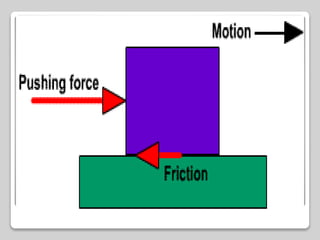
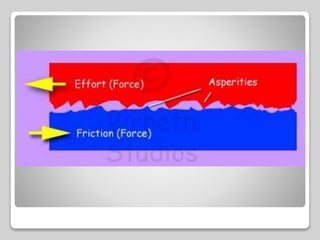
 An opposing force to an outside force that tries 
to move a body surface past another body 
surface. 
 The direction of the frictional force is opposite 
the direction of motion. 
Friction
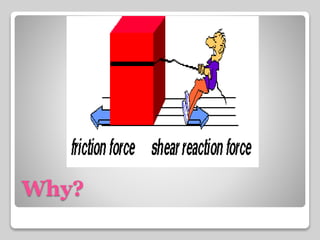
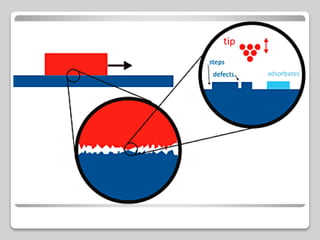
Why?
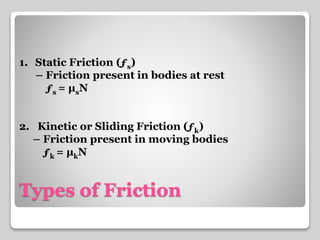
1. Static Friction (ƒs) 
– Friction present in bodies at rest 
ƒs = μsN 
2. Kinetic or Sliding Friction (ƒk) 
– Friction present in moving bodies 
ƒk = μkN 
Types of Friction
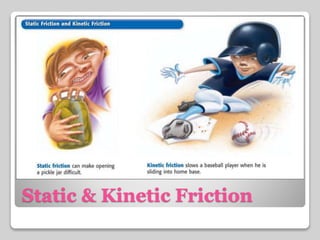
Static & Kinetic Friction
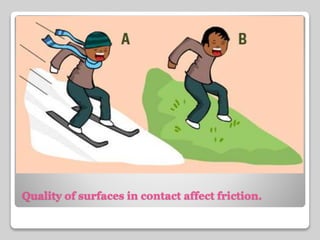
1. Quality or Nature of the Surfaces in Contact 
Rough surfaces mean greater friction, smooth 
surfaces mean lesser friction 
Basis of the value of coefficients of static and 
kinetic friction 
Independent of the magnitude of the area in 
contact 
Factors Affecting Friction (1)
Quality of surfaces in contact affect friction.
MATERIALS STATIC 
FRICTION 
KINETIC 
FRICTION 
Rubber on dry ice 1.0 0.7 
Rubber on wet concrete 0.7 0.5 
Wood on wood 0.5 0.3 
Waxed wood on wet snow 0.14 0.1 
Metal on wood 0.5 0.3 
Steel on steel (dry) 0.6 0.3 
Steel on steel (oiled) 0.05 0.03 
Teflon on steel 0.04 0.04 
Bone lubricated with synovial fluid 0.016 0.015 
Shoes on wood 0.9 0.7 
Shoes on ice 0.1 0.05 
Ice on ice 0.1 0.03 
Steel on ice 0.4 0.02 
*Values are approximate. 
Source: Physics With Health Science Applications by Paul Peter Urone 
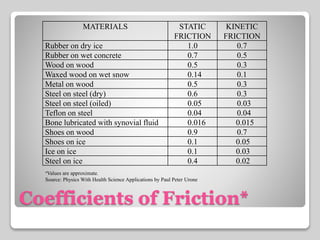
Coefficients of Friction*
2. Load or Normal Force 
 Force with which the two surfaces are pressed 
together 
 Acts perpendicular to the surfaces in contact 
Factors Affecting Friction (2)
F 
θ θ 
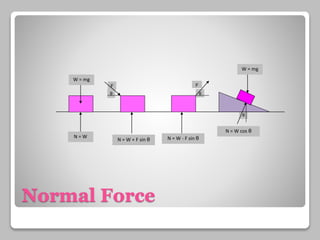
Normal Force 
θ 
W = mg 
F 
W = mg 
N = W 
N = W + F sin θ N = W - F sin θ 
N = W cos θ
 Friction is proportional to the normal force. 
 Static friction acts to keep the object from 
moving. 
 The force of kinetic friction acts when 
the object is in motion. 
 The force of static friction is generally 
greater than the force of kinetic friction. 
More about Friction
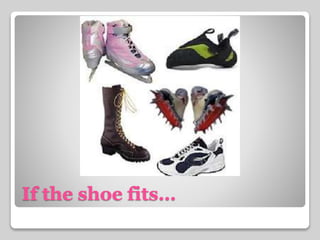
If the shoe fits…
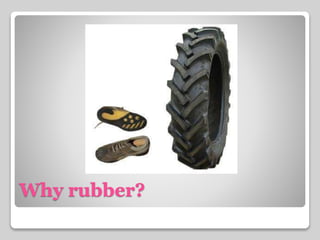
Why rubber?
Push back or threaded?
. 1. A) Find the normal force on a block of wood of 
mass 1 kg placed on a horizontal wooden surface. 
Determine friction. 
B) If the block of wood is pressed against a 
vertical wooden wall with a force of 5 N, 
what is the normal force? 
Problem 1
. 
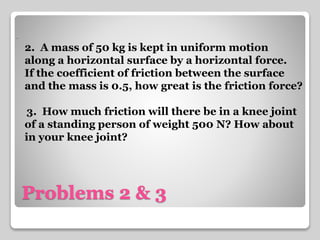
2. A mass of 50 kg is kept in uniform motion 
along a horizontal surface by a horizontal force. 
If the coefficient of friction between the surface 
and the mass is 0.5, how great is the friction force? 
3. How much friction will there be in a knee joint 
of a standing person of weight 500 N? How about 
in your knee joint? 
Problems 2 & 3
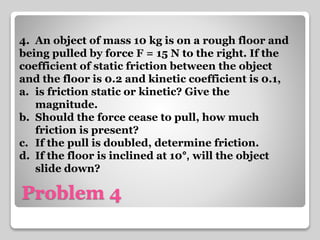
4. An object of mass 10 kg is on a rough floor and 
being pulled by force F = 15 N to the right. If the 
coefficient of static friction between the object 
and the floor is 0.2 and kinetic coefficient is 0.1, 
a. is friction static or kinetic? Give the 
magnitude. 
b. Should the force cease to pull, how much 
friction is present? 
c. If the pull is doubled, determine friction. 
d. If the floor is inclined at 10°, will the object 
slide down? 
Problem 4
A gem cannot be 
polished without friction, 
nor man perfected 
without trials. 
Lucius Annaeus Seneca

Friction

  • 7.
  • 8.
     An opposingforce to an outside force that tries to move a body surface past another body surface.  The direction of the frictional force is opposite the direction of motion. Friction
  • 10.
  • 13.
    1. Static Friction(ƒs) – Friction present in bodies at rest ƒs = μsN 2. Kinetic or Sliding Friction (ƒk) – Friction present in moving bodies ƒk = μkN Types of Friction
  • 14.
  • 15.
    1. Quality orNature of the Surfaces in Contact Rough surfaces mean greater friction, smooth surfaces mean lesser friction Basis of the value of coefficients of static and kinetic friction Independent of the magnitude of the area in contact Factors Affecting Friction (1)
  • 16.
    Quality of surfacesin contact affect friction.
  • 17.
    MATERIALS STATIC FRICTION KINETIC FRICTION Rubber on dry ice 1.0 0.7 Rubber on wet concrete 0.7 0.5 Wood on wood 0.5 0.3 Waxed wood on wet snow 0.14 0.1 Metal on wood 0.5 0.3 Steel on steel (dry) 0.6 0.3 Steel on steel (oiled) 0.05 0.03 Teflon on steel 0.04 0.04 Bone lubricated with synovial fluid 0.016 0.015 Shoes on wood 0.9 0.7 Shoes on ice 0.1 0.05 Ice on ice 0.1 0.03 Steel on ice 0.4 0.02 *Values are approximate. Source: Physics With Health Science Applications by Paul Peter Urone Coefficients of Friction*
  • 18.
    2. Load orNormal Force  Force with which the two surfaces are pressed together  Acts perpendicular to the surfaces in contact Factors Affecting Friction (2)
  • 19.
    F θ θ Normal Force θ W = mg F W = mg N = W N = W + F sin θ N = W - F sin θ N = W cos θ
  • 20.
     Friction isproportional to the normal force.  Static friction acts to keep the object from moving.  The force of kinetic friction acts when the object is in motion.  The force of static friction is generally greater than the force of kinetic friction. More about Friction
  • 21.
    If the shoefits…
  • 22.
  • 23.
    Push back orthreaded?
  • 24.
    . 1. A)Find the normal force on a block of wood of mass 1 kg placed on a horizontal wooden surface. Determine friction. B) If the block of wood is pressed against a vertical wooden wall with a force of 5 N, what is the normal force? Problem 1
  • 25.
    . 2. Amass of 50 kg is kept in uniform motion along a horizontal surface by a horizontal force. If the coefficient of friction between the surface and the mass is 0.5, how great is the friction force? 3. How much friction will there be in a knee joint of a standing person of weight 500 N? How about in your knee joint? Problems 2 & 3
  • 26.
    4. An objectof mass 10 kg is on a rough floor and being pulled by force F = 15 N to the right. If the coefficient of static friction between the object and the floor is 0.2 and kinetic coefficient is 0.1, a. is friction static or kinetic? Give the magnitude. b. Should the force cease to pull, how much friction is present? c. If the pull is doubled, determine friction. d. If the floor is inclined at 10°, will the object slide down? Problem 4
  • 27.
    A gem cannotbe polished without friction, nor man perfected without trials. Lucius Annaeus Seneca