Name:_______________________________________ Period: _____ Date: _______
Unit 1: Energy                        Kinetic versus Potential Energy Practice

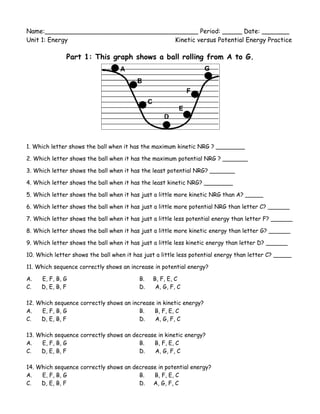
               Part 1: This graph shows a ball rolling from A to G.


1. Which letter shows the ball when it has the maximum kinetic NRG ? ________

2. Which letter shows the ball when it has the maximum potential NRG ? _______

3. Which letter shows the ball when it has the least potential NRG? _______

4. Which letter shows the ball when it has the least kinetic NRG? ________

5. Which letter shows the ball when it has just a little more kinetic NRG than A? _____

6. Which letter shows the ball when it has just a little more potential NRG than letter C? ______

7. Which letter shows the ball when it has just a little less potential energy than letter F? ______

8. Which letter shows the ball when it has just a little more kinetic energy than letter G? ______

9. Which letter shows the ball when it has just a little less kinetic energy than letter D? ______

10. Which letter shows the ball when it has just a little less potential energy than letter C? _____

11. Which sequence correctly shows an increase in potential energy?

A.   E, F, B, G                           B.   B, F, E, C
C.   D, E, B, F                           D.    A, G, F, C

12. Which sequence correctly shows an increase in kinetic energy?
A.   E, F, B, G                          B.   B, F, E, C
C.   D, E, B, F                          D.   A, G, F, C

13. Which sequence correctly shows an decrease in kinetic energy?
A.   E, F, B, G                         B.   B, F, E, C
C.   D, E, B, F                         D.    A, G, F, C

14. Which sequence correctly shows an decrease in potential energy?
A.   E, F, B, G                         B.   B, F, E, C
C.   D, E, B, F                         D. A, G, F, C
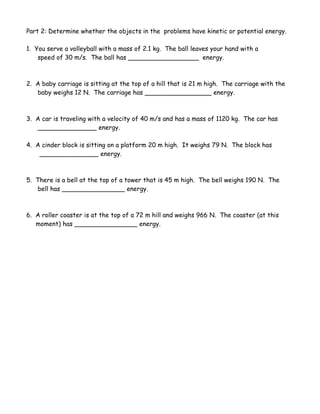
Part 2: Determine whether the objects in the problems have kinetic or potential energy.

1. You serve a volleyball with a mass of 2.1 kg. The ball leaves your hand with a
    speed of 30 m/s. The ball has __________________ energy.


2. A baby carriage is sitting at the top of a hill that is 21 m high. The carriage with the
   baby weighs 12 N. The carriage has _________________ energy.


3. A car is traveling with a velocity of 40 m/s and has a mass of 1120 kg. The car has
   _______________ energy.

4. A cinder block is sitting on a platform 20 m high. It weighs 79 N. The block has
    _______________ energy.


5. There is a bell at the top of a tower that is 45 m high. The bell weighs 190 N. The
   bell has ________________ energy.


6. A roller coaster is at the top of a 72 m hill and weighs 966 N. The coaster (at this
   moment) has ________________ energy.

Kinetic vs. potential energy worksheet

  • 1.
    Name:_______________________________________ Period: _____Date: _______ Unit 1: Energy Kinetic versus Potential Energy Practice Part 1: This graph shows a ball rolling from A to G. 1. Which letter shows the ball when it has the maximum kinetic NRG ? ________ 2. Which letter shows the ball when it has the maximum potential NRG ? _______ 3. Which letter shows the ball when it has the least potential NRG? _______ 4. Which letter shows the ball when it has the least kinetic NRG? ________ 5. Which letter shows the ball when it has just a little more kinetic NRG than A? _____ 6. Which letter shows the ball when it has just a little more potential NRG than letter C? ______ 7. Which letter shows the ball when it has just a little less potential energy than letter F? ______ 8. Which letter shows the ball when it has just a little more kinetic energy than letter G? ______ 9. Which letter shows the ball when it has just a little less kinetic energy than letter D? ______ 10. Which letter shows the ball when it has just a little less potential energy than letter C? _____ 11. Which sequence correctly shows an increase in potential energy? A. E, F, B, G B. B, F, E, C C. D, E, B, F D. A, G, F, C 12. Which sequence correctly shows an increase in kinetic energy? A. E, F, B, G B. B, F, E, C C. D, E, B, F D. A, G, F, C 13. Which sequence correctly shows an decrease in kinetic energy? A. E, F, B, G B. B, F, E, C C. D, E, B, F D. A, G, F, C 14. Which sequence correctly shows an decrease in potential energy? A. E, F, B, G B. B, F, E, C C. D, E, B, F D. A, G, F, C
  • 2.
    Part 2: Determinewhether the objects in the problems have kinetic or potential energy. 1. You serve a volleyball with a mass of 2.1 kg. The ball leaves your hand with a speed of 30 m/s. The ball has __________________ energy. 2. A baby carriage is sitting at the top of a hill that is 21 m high. The carriage with the baby weighs 12 N. The carriage has _________________ energy. 3. A car is traveling with a velocity of 40 m/s and has a mass of 1120 kg. The car has _______________ energy. 4. A cinder block is sitting on a platform 20 m high. It weighs 79 N. The block has _______________ energy. 5. There is a bell at the top of a tower that is 45 m high. The bell weighs 190 N. The bell has ________________ energy. 6. A roller coaster is at the top of a 72 m hill and weighs 966 N. The coaster (at this moment) has ________________ energy.