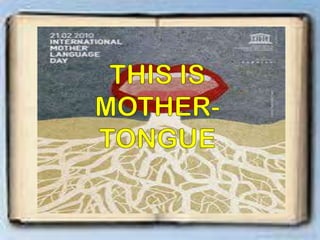
 The that a person
has grown up speaking from
childhood.
 Native language
DepEd issued Order No. 74 series of
2009, entitled “Institutionalizing Mother
Tongue-Based Multilingual Education
(MLE).”
That is, the use of more than two languages
for literacy and instruction—as a
fundamental policy and program in the
whole stretch of formal education, including
preschool.
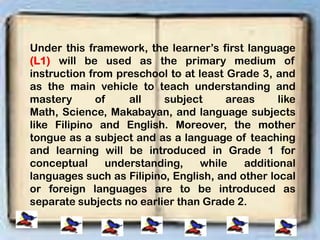
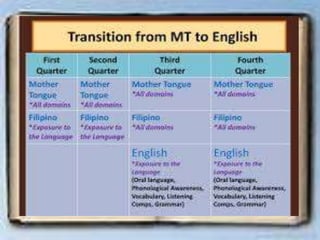
Under this framework, the learner’s first language
(L1) will be used as the primary medium of
instruction from preschool to at least Grade 3, and
as the main vehicle to teach understanding and
mastery of all subject areas like
Math, Science, Makabayan, and language subjects
like Filipino and English. Moreover, the mother
tongue as a subject and as a language of teaching
and learning will be introduced in Grade 1 for
conceptual understanding, while additional
languages such as Filipino, English, and other local
or foreign languages are to be introduced as
separate subjects no earlier than Grade 2.
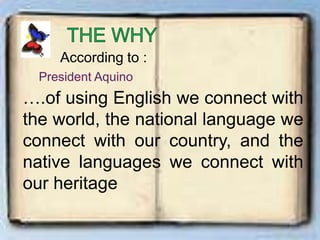
According to :
….of using English we connect with
the world, the national language we
connect with our country, and the
native languages we connect with
our heritage
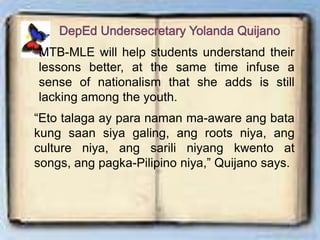
MTB-MLE will help students understand their
lessons better, at the same time infuse a
sense of nationalism that she adds is still
lacking among the youth.
“Eto talaga ay para naman ma-aware ang bata
kung saan siya galing, ang roots niya, ang
culture niya, ang sarili niyang kwento at
songs, ang pagka-Pilipino niya,” Quijano says.
The child's language will serve as
the fundamental language for
literacy and learning.
The Philippines has 181 languages but only
177 are currently being used.
Out of the 181, 153 languages are considered
"healthy," 14 are "in trouble," 10 are "dying," and
four are already "extinct."
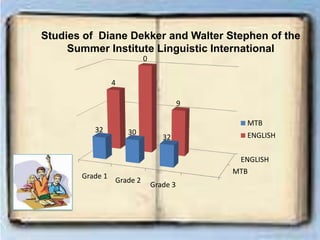
Studies of Diane Dekker and Walter Stephen of the
Summer Institute Linguistic International
MTB
ENGLISH
Grade 1
Grade 2
Grade 3
32 30
32
4
0
9
MTB
ENGLISH
LUBUAGAN STUDY
OTHER EXPERIMENTS
to develop appropriate cognitive and
reasoning skills enabling children to
operate equally in different
languages – starting in the mother
tongue with transition to Filipino and
then English
According to a 2000
United Nations report, the
dropout rate in the
Philippines at the public
school elementary level
has remained high in a
span of five decades
since the 1960s – 28 to
34 percent of that student
population fail to reach
Grade 6 level.
Based on the 2008 data
from the Commission on
Higher Education, out of
every 100 Grade 1
students, 66 finish Grade
6, 58 reach first year high
school, and only 43 finish
high school. Of these high
school graduates, only 23
enroll in college, while 14
manage to even finish their
degrees
The first language of a child is part of their
personal, social and cultural identity.
Children begin their education in a language they
understand, their mother tongue, and develop a strong
foundation in their mother language
As a SUBJECT
As a Medium of
Instruction
ORAL LANGUAGE
- Use culturally appropriate expressions in giving
opinion, ideas, views, etc. in a given
situations/issues/news/events
WORD RECOGNITION
-Read stories, legends, essays, news
articles, blogs, etc. containing high frequency
words and words studied
FLUENCY
- Read grade one level text with an accuracy
rate of 95-100%
-Read grade one level text in four to five-word-
phrases with appropriate
intonation, expression, and punctuation cues
SPELLING
- Correctly spell previously learned words
-Correctly spell descriptive words as they are
used in the sentences
HANDWRITING
- Observe proper spacing between
words, punctuation marks, and capitalization in
essay and story writing
COMPOSING
- Write essays and stories observing correct
punctuation
marks, capitalization, indention, and format.
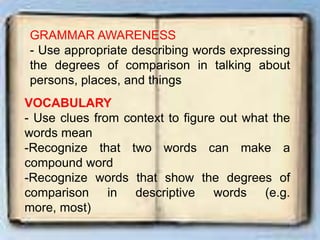
GRAMMAR AWARENESS
- Use appropriate describing words expressing
the degrees of comparison in talking about
persons, places, and things
VOCABULARY
- Use clues from context to figure out what the
words mean
-Recognize that two words can make a
compound word
-Recognize words that show the degrees of
comparison in descriptive words (e.g.
more, most)
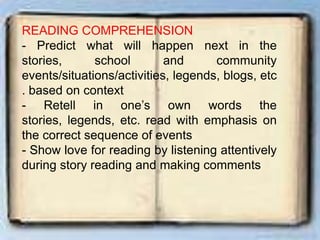
READING COMPREHENSION
- Predict what will happen next in the
stories, school and community
events/situations/activities, legends, blogs, etc
. based on context
- Retell in one’s own words the
stories, legends, etc. read with emphasis on
the correct sequence of events
- Show love for reading by listening attentively
during story reading and making comments
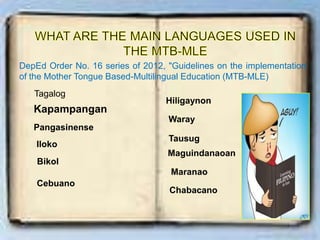
DepEd Order No. 16 series of 2012, "Guidelines on the implementation
of the Mother Tongue Based-Multilingual Education (MTB-MLE)
Tagalog
Kapampangan
Pangasinense
Iloko
Bikol
Cebuano
Hiligaynon
Waray
Tausug
Maguindanaoan
Maranao
Chabacano
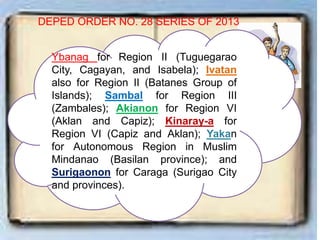
DEPED ORDER NO. 28 SERIES OF 2013
Ybanag for Region II (Tuguegarao
City, Cagayan, and Isabela); Ivatan
also for Region II (Batanes Group of
Islands); Sambal for Region III
(Zambales); Akianon for Region VI
(Aklan and Capiz); Kinaray-a for
Region VI (Capiz and Aklan); Yakan
for Autonomous Region in Muslim
Mindanao (Basilan province); and
Surigaonon for Caraga (Surigao City
and provinces).
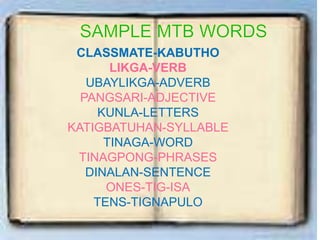
CLASSMATE-KABUTHO
LIKGA-VERB
UBAYLIKGA-ADVERB
PANGSARI-ADJECTIVE
KUNLA-LETTERS
KATIGBATUHAN-SYLLABLE
TINAGA-WORD
TINAGPONG-PHRASES
DINALAN-SENTENCE
ONES-TIG-ISA
TENS-TIGNAPULO
When our children go to school, they
go to an alien place. They leave their
parents, they leave their gardens, they
leave everything that is their way of
life. They sit in a classroom and they
learn things that have nothing to do
with their own place. Later, because
they have learned only other
things, they reject their own.
They don’t want to dig sweet
potatoes, they say it’s dirty; they don’t
want to help their mother fetch water.
They look down on those things. There
are big changes in the children now.
They don’t obey their parents; they
become rascals. And this is because
they have gone to school and left the
things that are ours.
Now my child is in Tok Ples school.
He is not leaving his place. He is
learning in school about his
customs, his way of life. Now he can
write anything he wants to in Tok
Ples. Not just the things he can
see, but things he thinks about, too.
And he writes about his place. He
writes about helping his mother carry
water, about digging kaukau, about
going to the garden.
When he writes these things they become
important to him. He is not only reading and
writing about things outside, but learning
through reading and writing to be proud of
our way of life. When he is big, he will not
reject us. It is important to teach our children
to read and write, but it is more important to
teach them to be proud of themselves, and
of us.
Parent, Laitrao Vil age Tok Ples
School, Buin, North Solomons Province,
in Delpit and Kemelfield, 1985, p. 29-30)
what is mother-tongue based teaching?

what is mother-tongue based teaching?

  • 2.
     The thata person has grown up speaking from childhood.  Native language
  • 4.
    DepEd issued OrderNo. 74 series of 2009, entitled “Institutionalizing Mother Tongue-Based Multilingual Education (MLE).” That is, the use of more than two languages for literacy and instruction—as a fundamental policy and program in the whole stretch of formal education, including preschool.
  • 5.
    Under this framework,the learner’s first language (L1) will be used as the primary medium of instruction from preschool to at least Grade 3, and as the main vehicle to teach understanding and mastery of all subject areas like Math, Science, Makabayan, and language subjects like Filipino and English. Moreover, the mother tongue as a subject and as a language of teaching and learning will be introduced in Grade 1 for conceptual understanding, while additional languages such as Filipino, English, and other local or foreign languages are to be introduced as separate subjects no earlier than Grade 2.
  • 7.
    According to : ….ofusing English we connect with the world, the national language we connect with our country, and the native languages we connect with our heritage
  • 8.
    MTB-MLE will helpstudents understand their lessons better, at the same time infuse a sense of nationalism that she adds is still lacking among the youth. “Eto talaga ay para naman ma-aware ang bata kung saan siya galing, ang roots niya, ang culture niya, ang sarili niyang kwento at songs, ang pagka-Pilipino niya,” Quijano says.
  • 9.
    The child's languagewill serve as the fundamental language for literacy and learning.
  • 10.
    The Philippines has181 languages but only 177 are currently being used. Out of the 181, 153 languages are considered "healthy," 14 are "in trouble," 10 are "dying," and four are already "extinct."
  • 11.
    Studies of DianeDekker and Walter Stephen of the Summer Institute Linguistic International MTB ENGLISH Grade 1 Grade 2 Grade 3 32 30 32 4 0 9 MTB ENGLISH
  • 12.
  • 13.
    to develop appropriatecognitive and reasoning skills enabling children to operate equally in different languages – starting in the mother tongue with transition to Filipino and then English
  • 14.
    According to a2000 United Nations report, the dropout rate in the Philippines at the public school elementary level has remained high in a span of five decades since the 1960s – 28 to 34 percent of that student population fail to reach Grade 6 level. Based on the 2008 data from the Commission on Higher Education, out of every 100 Grade 1 students, 66 finish Grade 6, 58 reach first year high school, and only 43 finish high school. Of these high school graduates, only 23 enroll in college, while 14 manage to even finish their degrees
  • 15.
    The first languageof a child is part of their personal, social and cultural identity. Children begin their education in a language they understand, their mother tongue, and develop a strong foundation in their mother language
  • 17.
    As a SUBJECT Asa Medium of Instruction
  • 18.
    ORAL LANGUAGE - Useculturally appropriate expressions in giving opinion, ideas, views, etc. in a given situations/issues/news/events WORD RECOGNITION -Read stories, legends, essays, news articles, blogs, etc. containing high frequency words and words studied
  • 19.
    FLUENCY - Read gradeone level text with an accuracy rate of 95-100% -Read grade one level text in four to five-word- phrases with appropriate intonation, expression, and punctuation cues SPELLING - Correctly spell previously learned words -Correctly spell descriptive words as they are used in the sentences
  • 20.
    HANDWRITING - Observe properspacing between words, punctuation marks, and capitalization in essay and story writing COMPOSING - Write essays and stories observing correct punctuation marks, capitalization, indention, and format.
  • 21.
    GRAMMAR AWARENESS - Useappropriate describing words expressing the degrees of comparison in talking about persons, places, and things VOCABULARY - Use clues from context to figure out what the words mean -Recognize that two words can make a compound word -Recognize words that show the degrees of comparison in descriptive words (e.g. more, most)
  • 22.
    READING COMPREHENSION - Predictwhat will happen next in the stories, school and community events/situations/activities, legends, blogs, etc . based on context - Retell in one’s own words the stories, legends, etc. read with emphasis on the correct sequence of events - Show love for reading by listening attentively during story reading and making comments
  • 23.
    DepEd Order No.16 series of 2012, "Guidelines on the implementation of the Mother Tongue Based-Multilingual Education (MTB-MLE) Tagalog Kapampangan Pangasinense Iloko Bikol Cebuano Hiligaynon Waray Tausug Maguindanaoan Maranao Chabacano
  • 24.
    DEPED ORDER NO.28 SERIES OF 2013 Ybanag for Region II (Tuguegarao City, Cagayan, and Isabela); Ivatan also for Region II (Batanes Group of Islands); Sambal for Region III (Zambales); Akianon for Region VI (Aklan and Capiz); Kinaray-a for Region VI (Capiz and Aklan); Yakan for Autonomous Region in Muslim Mindanao (Basilan province); and Surigaonon for Caraga (Surigao City and provinces).
  • 25.
  • 26.
    When our childrengo to school, they go to an alien place. They leave their parents, they leave their gardens, they leave everything that is their way of life. They sit in a classroom and they learn things that have nothing to do with their own place. Later, because they have learned only other things, they reject their own.
  • 27.
    They don’t wantto dig sweet potatoes, they say it’s dirty; they don’t want to help their mother fetch water. They look down on those things. There are big changes in the children now. They don’t obey their parents; they become rascals. And this is because they have gone to school and left the things that are ours.
  • 28.
    Now my childis in Tok Ples school. He is not leaving his place. He is learning in school about his customs, his way of life. Now he can write anything he wants to in Tok Ples. Not just the things he can see, but things he thinks about, too. And he writes about his place. He writes about helping his mother carry water, about digging kaukau, about going to the garden.
  • 29.
    When he writesthese things they become important to him. He is not only reading and writing about things outside, but learning through reading and writing to be proud of our way of life. When he is big, he will not reject us. It is important to teach our children to read and write, but it is more important to teach them to be proud of themselves, and of us. Parent, Laitrao Vil age Tok Ples School, Buin, North Solomons Province, in Delpit and Kemelfield, 1985, p. 29-30)