

STABILITY
Stability 
The property of a body that causes it 
to return to its original position or state of 
motion as a result of the action of 
restoring forces once its equilibrium has 
been disturbed.
Factors Affecting Stability 
1. Base of Support 
2. Location of The Center of Gravity 
3. Mass 
4. Line of Gravity
Base of Support 
• The area in contact with the 
supporting surface plus the intervening 
area 
• Wider base of support means greater 
stability
Location of Center of Gravity 
• The point where the weight of the 
body is concentrated; the point where a 
body may be hung without rotating. 
• Center of gravity must be as low as 
possible for greater stability.
Mass 
• The amount of matter in a body. 
• Greater mass means greater inertia. 
• Body must be heavy for greater 
stability.
Line of Gravity 
• The vertical line passing through the 
center of gravity. 
• Line of gravity must pass within the 
base of support for greater stability.
Types of Mechanical Equilibrium 
(States of Equilibrium ) 
Any object that is not accelerating may be 
in one of three states of equilibrium: 
• Stable 
• Unstable 
• Neutral
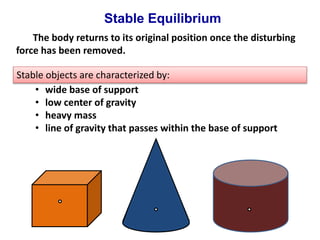
Stable Equilibrium 
The body returns to its original position once the disturbing 
force has been removed. 
Stable objects are characterized by: 
• wide base of support 
• low center of gravity 
• heavy mass 
• line of gravity that passes within the base of support
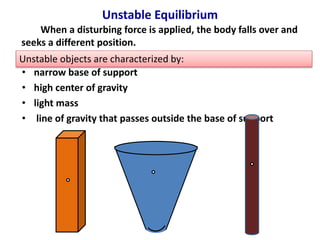
Unstable Equilibrium 
When a disturbing force is applied, the body falls over and 
seeks a different position. 
Unstable objects are characterized by: 
• narrow base of support 
• high center of gravity 
• light mass 
• line of gravity that passes outside the base of support
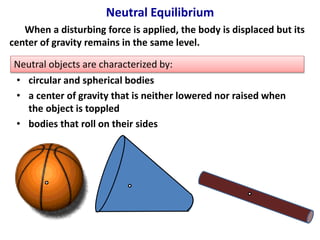
Neutral Equilibrium 
When a disturbing force is applied, the body is displaced but its 
center of gravity remains in the same level. 
Neutral objects are characterized by: 
• circular and spherical bodies 
• a center of gravity that is neither lowered nor raised when 
the object is toppled 
• bodies that roll on their sides
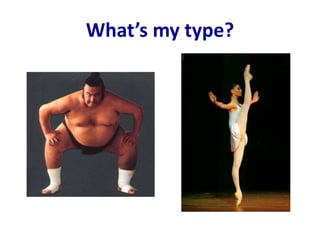
What’s my type?
Stable, unstable, neutral?

Stability

  • 1.
  • 2.
    Stability The propertyof a body that causes it to return to its original position or state of motion as a result of the action of restoring forces once its equilibrium has been disturbed.
  • 3.
    Factors Affecting Stability 1. Base of Support 2. Location of The Center of Gravity 3. Mass 4. Line of Gravity
  • 4.
    Base of Support • The area in contact with the supporting surface plus the intervening area • Wider base of support means greater stability
  • 5.
    Location of Centerof Gravity • The point where the weight of the body is concentrated; the point where a body may be hung without rotating. • Center of gravity must be as low as possible for greater stability.
  • 6.
    Mass • Theamount of matter in a body. • Greater mass means greater inertia. • Body must be heavy for greater stability.
  • 7.
    Line of Gravity • The vertical line passing through the center of gravity. • Line of gravity must pass within the base of support for greater stability.
  • 8.
    Types of MechanicalEquilibrium (States of Equilibrium ) Any object that is not accelerating may be in one of three states of equilibrium: • Stable • Unstable • Neutral
  • 9.
    Stable Equilibrium Thebody returns to its original position once the disturbing force has been removed. Stable objects are characterized by: • wide base of support • low center of gravity • heavy mass • line of gravity that passes within the base of support
  • 10.
    Unstable Equilibrium Whena disturbing force is applied, the body falls over and seeks a different position. Unstable objects are characterized by: • narrow base of support • high center of gravity • light mass • line of gravity that passes outside the base of support
  • 11.
    Neutral Equilibrium Whena disturbing force is applied, the body is displaced but its center of gravity remains in the same level. Neutral objects are characterized by: • circular and spherical bodies • a center of gravity that is neither lowered nor raised when the object is toppled • bodies that roll on their sides
  • 12.
  • 13.