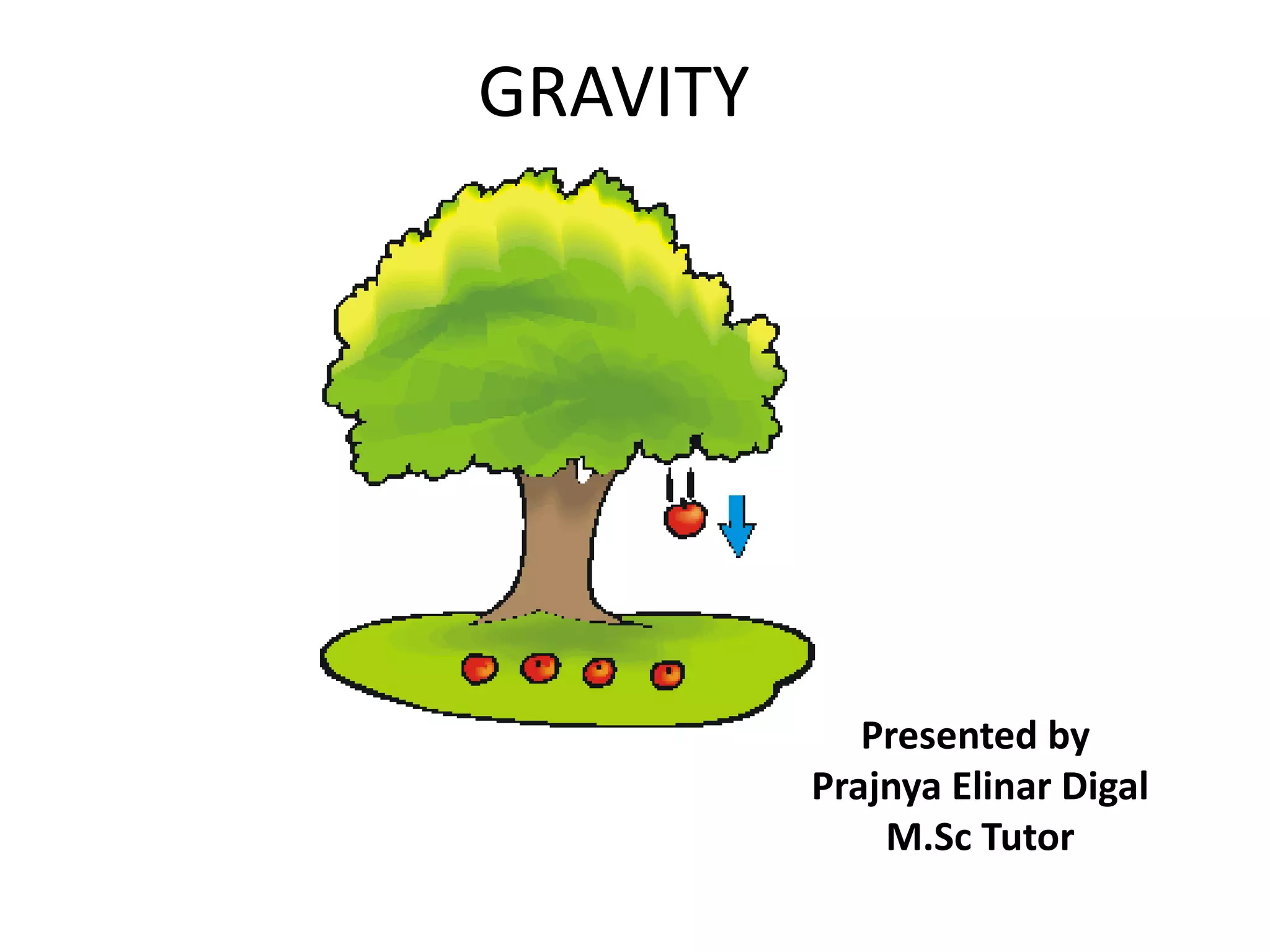
GRAVITY
Presented by
Prajnya Elinar Digal
M.Sc Tutor
Introduction
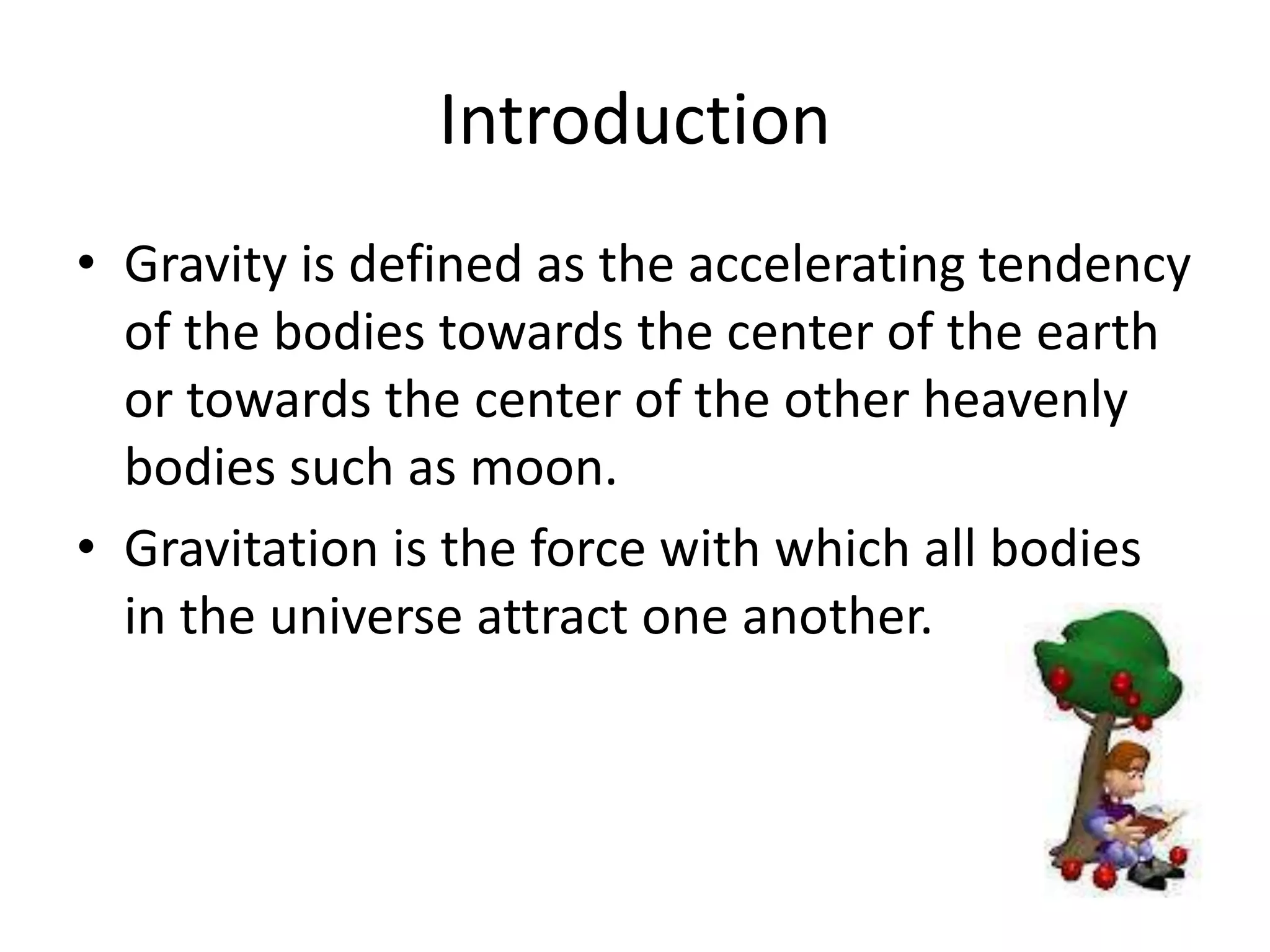
• Gravity is defined as the accelerating tendency
of the bodies towards the center of the earth
or towards the center of the other heavenly
bodies such as moon.
• Gravitation is the force with which all bodies
in the universe attract one another.
Earth’s gravity acts downward toward
the center of the Earth.
Newton’s Law of Gravitation
Every particle of matter attracts every other
particle with a force which is directly proportional to the
product of their masses and inversely proportional to the
square of the distance between them.
Where,
F = gravitational force
M and m = any two masses in the universe
d = distance between two masses
G = gravitational constant 1
DENSITY
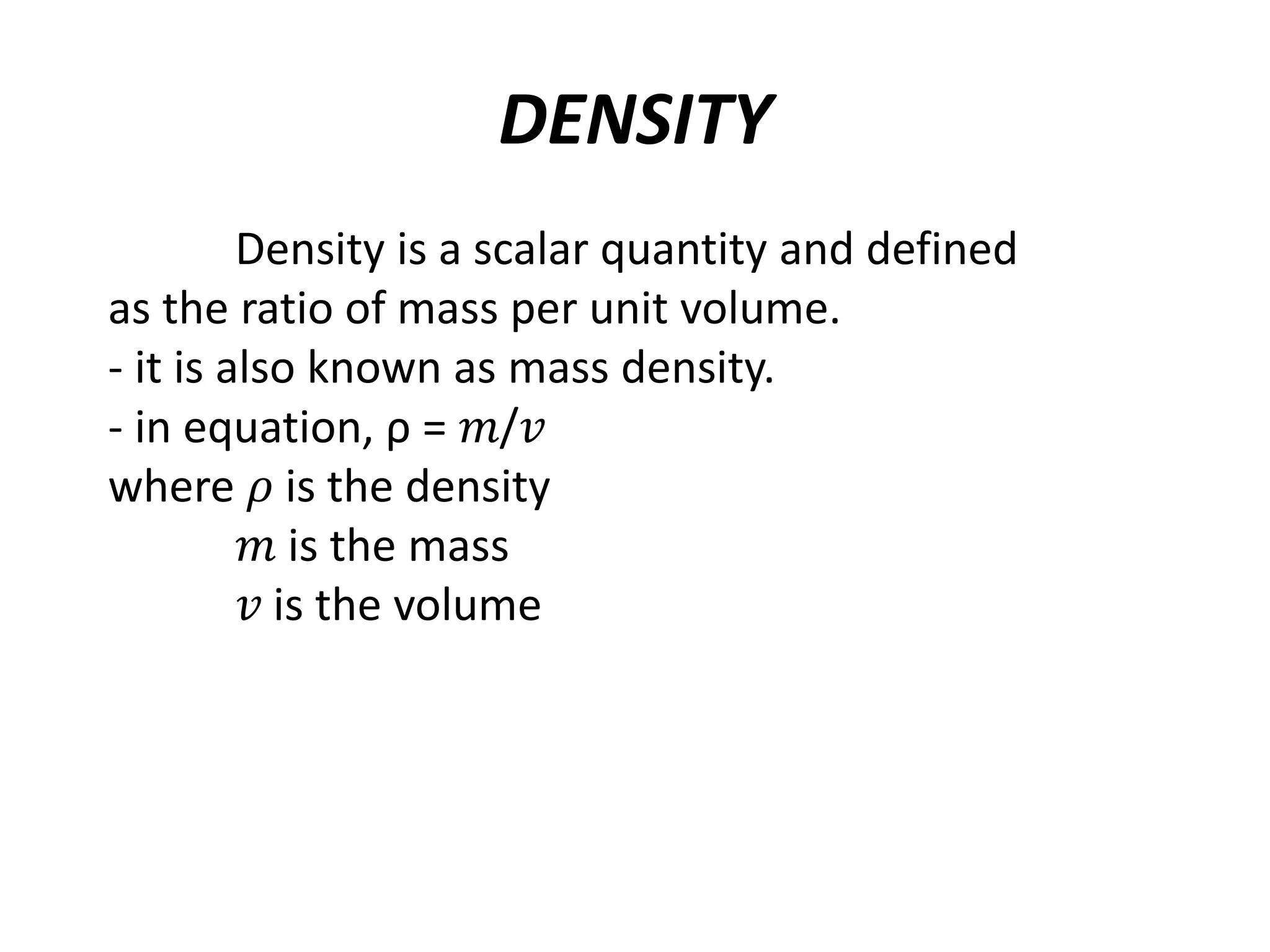
Density is a scalar quantity and defined
as the ratio of mass per unit volume.
- it is also known as mass density.
- in equation, ρ = 𝑚/𝑣
where 𝜌 is the density
𝑚 is the mass
𝑣 is the volume
SPECIFIC GRAVITY
- also known as “relative density”.
- is the ratio of the density of the
substance to that of water (1000 𝑘𝑔/𝑚3)
- can be expressed by the equation
𝑆 = 𝜌𝑠𝑢𝑏𝑠𝑡𝑎𝑛𝑐𝑒/𝜌𝑤𝑎𝑡𝑒𝑟
• Water has a density of 1gm/cm at 4 C
temperature, specific gravity of a substance is
expressed numerically by the values of its density
in grams per cubic centimeter (gm/cm ), but with
the unit omitted.
• For eg:- the specific gravity of a substance ‘A’
with a density of 5 gm/cm will be 5. It means the
substance is five times heavier than water under
same circumstances.
3 0
3
3
Center of gravity
• In general the center of gravity or center of
mass of a body is the point at which all the
mass is considered to be centered.
Principles of Gravity
• The most important
principle of gravity is
Archimede’s preniciple.
• Archimedes, a greek
mathematician gave an
Archimedes’ principle.
Pressure in a Fluid
Objects in a fluid experience an Upward
buoyant force which can make them float.
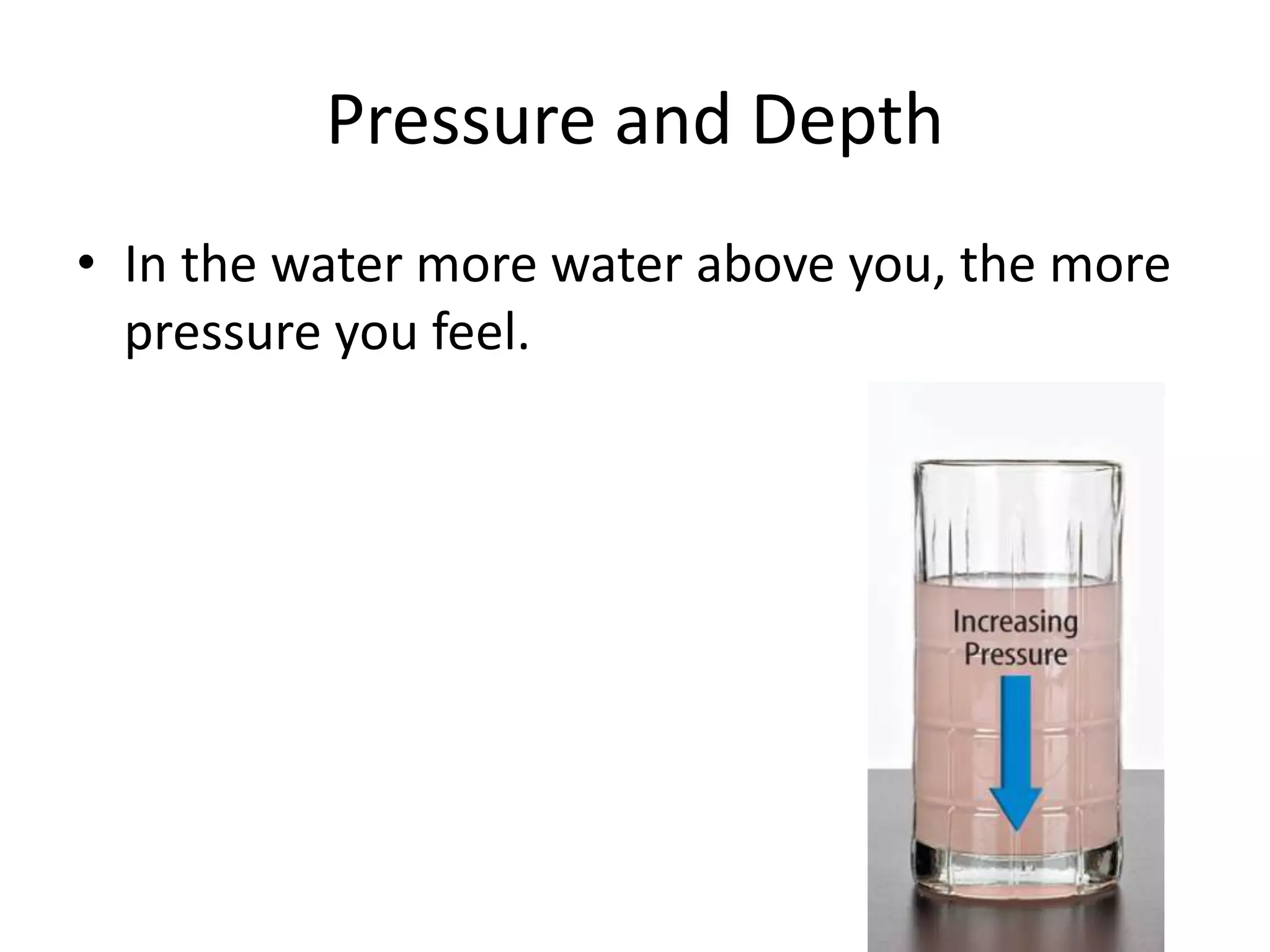
Pressure and Depth
• In the water more water above you, the more
pressure you feel.
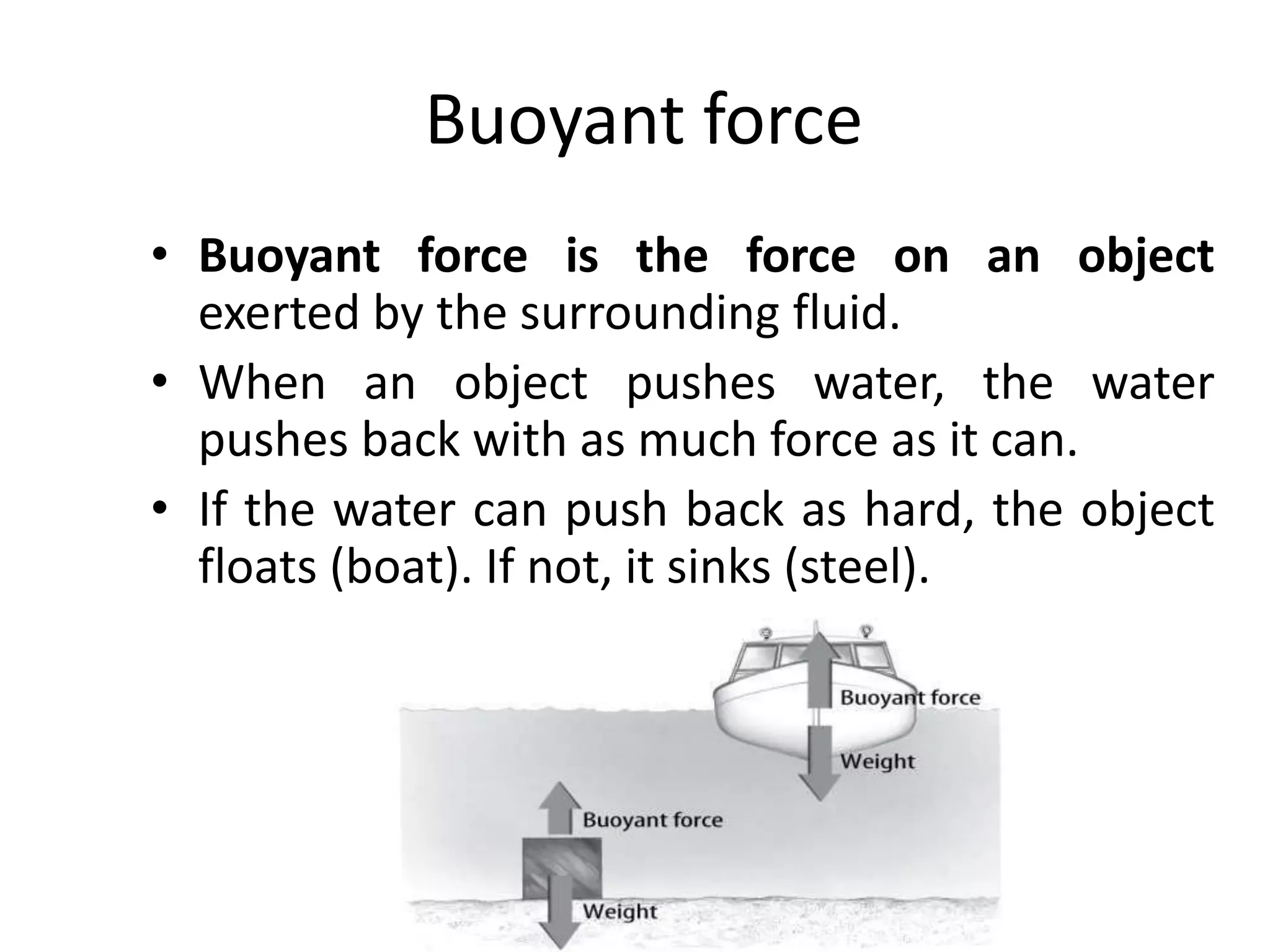
Buoyant force
• Buoyant force is the force on an object
exerted by the surrounding fluid.
• When an object pushes water, the water
pushes back with as much force as it can.
• If the water can push back as hard, the object
floats (boat). If not, it sinks (steel).
Archimedes’ Principle
• states that the buoyant force is equal to the
weight of the fluid the object displaces.
How to measure the buoyant force
• Weight of object in air - weight of object in
water = upward buoyant force.
• The buoyant force is equal to the weight of
the displaced water
Application of Archimede’s principle in
Nursing
• Hydrometer
• Urinometer
• Underwater exercise
Application of principles of gravity in
Nursing
• Standing with balance
• IV Fluid infusion or blood transfusion
• Blood circulation in the body
• Brain surgery
• Rib resection
• ESR
• Postural drainage
• Oscillating beds
• Post-radical mastectomy

Gravity biophysics

  • 1.
  • 2.
    Introduction • Gravity isdefined as the accelerating tendency of the bodies towards the center of the earth or towards the center of the other heavenly bodies such as moon. • Gravitation is the force with which all bodies in the universe attract one another.
  • 3.
    Earth’s gravity actsdownward toward the center of the Earth.
  • 4.
    Newton’s Law ofGravitation Every particle of matter attracts every other particle with a force which is directly proportional to the product of their masses and inversely proportional to the square of the distance between them. Where, F = gravitational force M and m = any two masses in the universe d = distance between two masses G = gravitational constant 1
  • 5.
    DENSITY Density is ascalar quantity and defined as the ratio of mass per unit volume. - it is also known as mass density. - in equation, ρ = 𝑚/𝑣 where 𝜌 is the density 𝑚 is the mass 𝑣 is the volume
  • 6.
    SPECIFIC GRAVITY - alsoknown as “relative density”. - is the ratio of the density of the substance to that of water (1000 𝑘𝑔/𝑚3) - can be expressed by the equation 𝑆 = 𝜌𝑠𝑢𝑏𝑠𝑡𝑎𝑛𝑐𝑒/𝜌𝑤𝑎𝑡𝑒𝑟
  • 7.
    • Water hasa density of 1gm/cm at 4 C temperature, specific gravity of a substance is expressed numerically by the values of its density in grams per cubic centimeter (gm/cm ), but with the unit omitted. • For eg:- the specific gravity of a substance ‘A’ with a density of 5 gm/cm will be 5. It means the substance is five times heavier than water under same circumstances. 3 0 3 3
  • 8.
    Center of gravity •In general the center of gravity or center of mass of a body is the point at which all the mass is considered to be centered.
  • 9.
    Principles of Gravity •The most important principle of gravity is Archimede’s preniciple. • Archimedes, a greek mathematician gave an Archimedes’ principle.
  • 10.
    Pressure in aFluid Objects in a fluid experience an Upward buoyant force which can make them float.
  • 11.
    Pressure and Depth •In the water more water above you, the more pressure you feel.
  • 12.
    Buoyant force • Buoyantforce is the force on an object exerted by the surrounding fluid. • When an object pushes water, the water pushes back with as much force as it can. • If the water can push back as hard, the object floats (boat). If not, it sinks (steel).
  • 13.
    Archimedes’ Principle • statesthat the buoyant force is equal to the weight of the fluid the object displaces.
  • 14.
    How to measurethe buoyant force • Weight of object in air - weight of object in water = upward buoyant force. • The buoyant force is equal to the weight of the displaced water
  • 15.
    Application of Archimede’sprinciple in Nursing • Hydrometer • Urinometer • Underwater exercise
  • 16.
    Application of principlesof gravity in Nursing • Standing with balance • IV Fluid infusion or blood transfusion • Blood circulation in the body • Brain surgery • Rib resection • ESR • Postural drainage • Oscillating beds • Post-radical mastectomy