MTB- MLE
(Mot her Tongue-Based
Mult i Lingual
Educat ion)
ACTIVITY
HALI! MAG
TIGMO
TIGMO
TA!
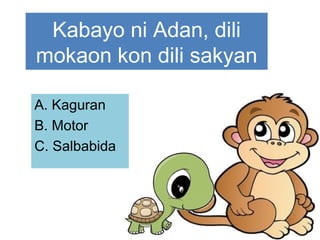
Kabayo ni Adan, dili
mokaon kon dili sakyan
A. Kaguran
B. Motor
C. Salbabida
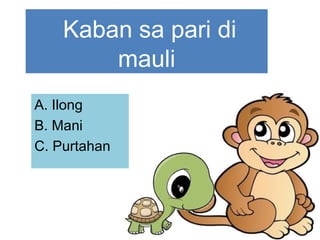
 Kaban sa pari di
mauli
A. Ilong
B. Mani
C. Purtahan
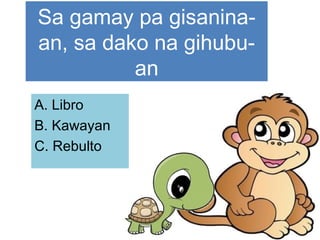
Sa gamay pa gisanina-
an, sa dako na gihubu-
an
A. Libro
B. Kawayan
C. Rebulto
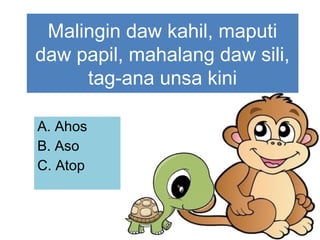
A. Ahos
B. Aso
C. Atop
Malingin daw kahil, maputi
daw papil, mahalang daw sili,
tag-ana unsa kini
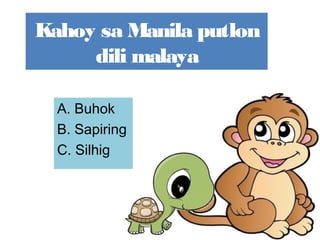
Kahoy sa Manila putlon
dili malaya
A. Buhok
B. Sapiring
C. Silhig
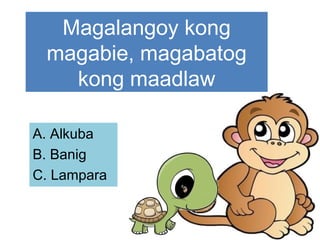
Magalangoy kong
magabie, magabatog
kong maadlaw
A. Alkuba
B. Banig
C. Lampara
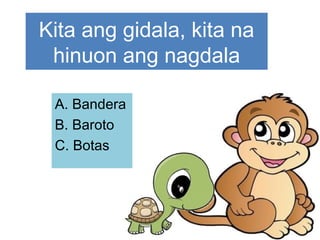
Kita ang gidala, kita na
hinuon ang nagdala
A. Bandera
B. Baroto
C. Botas
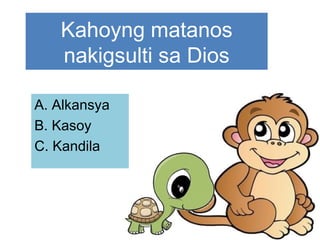
Kahoyng matanos
nakigsulti sa Dios
A. Alkansya
B. Kasoy
C. Kandila
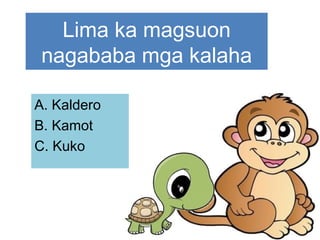
Lima ka magsuon
nagababa mga kalaha
A. Kaldero
B. Kamot
C. Kuko
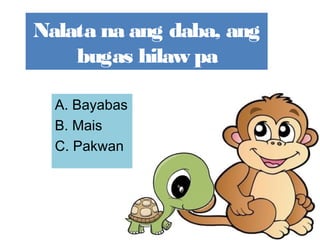
Nalata na ang daba, ang
bugas hilaw pa
A. Bayabas
B. Mais
C. Pakwan
PROCESSING
• How do you feel about the activity? Was it
easy or difficult? Why?
• What do you think is the situation of the
usage of Mother tongue language here in our
country, the Philippines?
• What is the challenge of the teachers
nowadays in the implementation of MTB-MLE
program?
MTB- MLE
(Mot her Tongue-Based
Mult i Lingual
Educat ion)
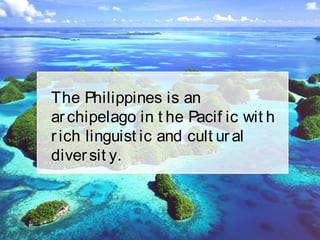
The Philippines is an
archipelago in t he Pacif ic wit h
rich linguist ic and cult ural
diversit y.
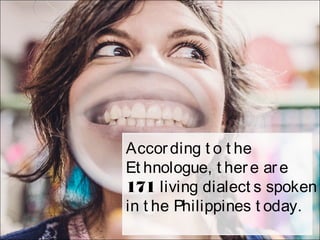
According t o t he
Et hnologue, t here are
171 living dialect s spoken
in t he Philippines t oday.
Making English and Filipino t he of f icial
languages of t he Philippines is a
pract ical move, seeing as t here needs
t o be language t hat can be used t o do
business and t rade as well as t o
communicat e on bot h nat ional and
int ernat ional levels.
The linguist ic
discriminat ion is
present in t he
educat ional syst em in
part icular.
bot h
psychologically and
culturally
damaging
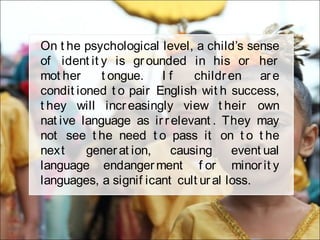
On t he psychological level, a child’s sense
of ident it y is grounded in his or her
mot her t ongue. I f children ar e
condit ioned t o pair English wit h success,
t hey will increasingly view t heir own
nat ive language as ir relevant . They may
not see t he need t o pass it on t o t he
next generat ion, causing event ual
language endanger ment f or minorit y
languages, a signif icant cult ur al loss.
There are t wo maj or
component s of t he bill t hat
dramat ically change t he f ormat
of Philippine schools, st art ing in
2012.
1
ext ension of
secondar y school (K-
12)
The Philippines adopt ed a K-12 cycle
t o ensure t hat st udent s are prepared
t o go t o universit y by t he t ime of
graduat ion f rom grade 12.
addresses t he linguist ic
discriminat ion t hat occurs in
emphasizing English educat ion,
by implement ing Mot her Tongue
Based, Mult ilingual Educat ion
(MTB-MLE)
2
This model promot es language of
inst ruct ion in t he mot her t ongue
of t he school dist rict , rat her t han
Filipino or English.
However, t hese ot her languages
will be t aught and incorporat ed
int o t he curriculum gradually.
Advocat es of t his approach point t o
pilot programs in t he Philippines t hat
have been successf ul in helping
st udent s gain f ull prof iciency in t he
mot her t ongue, t he nat ional language
Filipino, and t he global language,
English.
Mot her Tongue –Based Mult ilingual
Educat ion (MTB-MLE) is t he
government ’s banner program f or
educat ion as a salient part of t he
implement at ion of t he K t o 12 Basic
Educat ion Program. I t s signif icance is
underscored by t he passing of Republic
Act 10533, ot herwise known as t he
“Enhanced Basic Educat ion Act of 2013.”
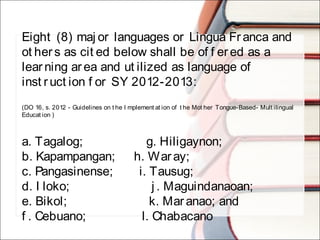
Eight (8) maj or languages or Lingua Fr anca and
ot her s as cit ed below shall be of f ered as a
lear ning ar ea and ut ilized as language of
inst r uct ion f or SY 2012-2013:
(DO 16, s. 2012 - Guidelines on t he I mplement at ion of t he Mot her Tongue-Based- Mult ilingual
Educat ion )
a. Tagalog;                 g. Hiligaynon;
b. Kapampangan;     h. Waray;
c. Pangasinense;       i. Tausug;
d. I loko;                      j . Maguindanaoan;
e. Bikol;                     k. Maranao; and
f . Cebuano;               l. Chabacano
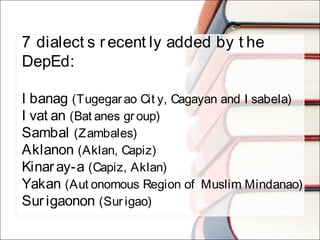
7 dialect s recent ly added by t he
DepEd:
I banag (Tugegarao Cit y, Cagayan and I sabela)
I vat an (Bat anes gr oup)
Sambal (Zambales)
Aklanon (Aklan, Capiz)
Kinaray-a (Capiz, Aklan)
Yakan (Aut onomous Region of Muslim Mindanao)
Surigaonon (Sur igao)
MTB-MLE is educat ion, f ormal or
non -f ormal, in which t he learner’s
mot her t ongue and addit ional
languages are used in t he classroom.
This bridge enables t he learners t o
use bot h or all t heir languages f or
success in school and f or lif elong
learning.
Wit h t he end goal of
making Filipino
children lif elong
learners in t heir L1
(MT), L2 (Filipino, t he
nat ional language), and
L3 (English, t he global
language) t he learners
are more t hat
prepared t o develop
t he compet encies in
t he dif f erent learning
areas.
MTB-MLE provides:
Lit eracy
.Prior
knowledge.
Cognit ive development and HOTS.
St rong Bridge.
Scaf f olding.
Teaching f or meaning and accuracy
Conf idence building and prof iciency development
LITERACY
PRIOR
KNOWLEDGE
Cognitive development
and higher order
thinking skills
Strong Bridge
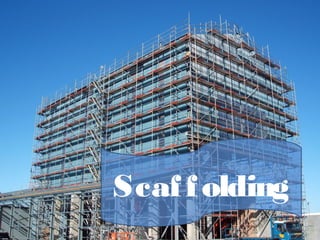
Scaffolding
Teaching for
meaning and
accuracy
Confidence building
and proficiency
development
“Weshouldbecometri-lingualasacountry. LearnEnglishwelland
connecttotheWorld. LearnFilipinowellandconnecttoourcountry.
Retainyourdialectandconnecttoyourheritage.”
-Benigno Aquino I I I

Knowing About MTB-MLE

  • 1.
    MTB- MLE (Mot herTongue-Based Mult i Lingual Educat ion)
  • 2.
  • 3.
    Kabayo ni Adan,dili mokaon kon dili sakyan A. Kaguran B. Motor C. Salbabida
  • 4.
     Kaban sa paridi mauli A. Ilong B. Mani C. Purtahan
  • 5.
    Sa gamay pagisanina- an, sa dako na gihubu- an A. Libro B. Kawayan C. Rebulto
  • 6.
    A. Ahos B. Aso C.Atop Malingin daw kahil, maputi daw papil, mahalang daw sili, tag-ana unsa kini
  • 7.
    Kahoy sa Manilaputlon dili malaya A. Buhok B. Sapiring C. Silhig
  • 8.
    Magalangoy kong magabie, magabatog kongmaadlaw A. Alkuba B. Banig C. Lampara
  • 9.
    Kita ang gidala,kita na hinuon ang nagdala A. Bandera B. Baroto C. Botas
  • 10.
    Kahoyng matanos nakigsulti saDios A. Alkansya B. Kasoy C. Kandila
  • 11.
    Lima ka magsuon nagababamga kalaha A. Kaldero B. Kamot C. Kuko
  • 12.
    Nalata na angdaba, ang bugas hilaw pa A. Bayabas B. Mais C. Pakwan
  • 13.
    PROCESSING • How doyou feel about the activity? Was it easy or difficult? Why? • What do you think is the situation of the usage of Mother tongue language here in our country, the Philippines? • What is the challenge of the teachers nowadays in the implementation of MTB-MLE program?
  • 14.
    MTB- MLE (Mot herTongue-Based Mult i Lingual Educat ion)
  • 15.
    The Philippines isan archipelago in t he Pacif ic wit h rich linguist ic and cult ural diversit y.
  • 16.
    According t ot he Et hnologue, t here are 171 living dialect s spoken in t he Philippines t oday.
  • 17.
    Making English andFilipino t he of f icial languages of t he Philippines is a pract ical move, seeing as t here needs t o be language t hat can be used t o do business and t rade as well as t o communicat e on bot h nat ional and int ernat ional levels.
  • 18.
    The linguist ic discrimination is present in t he educat ional syst em in part icular.
  • 19.
  • 20.
    On t hepsychological level, a child’s sense of ident it y is grounded in his or her mot her t ongue. I f children ar e condit ioned t o pair English wit h success, t hey will increasingly view t heir own nat ive language as ir relevant . They may not see t he need t o pass it on t o t he next generat ion, causing event ual language endanger ment f or minorit y languages, a signif icant cult ur al loss.
  • 21.
    There are two maj or component s of t he bill t hat dramat ically change t he f ormat of Philippine schools, st art ing in 2012.
  • 22.
    1 ext ension of secondary school (K- 12)
  • 23.
    The Philippines adopted a K-12 cycle t o ensure t hat st udent s are prepared t o go t o universit y by t he t ime of graduat ion f rom grade 12.
  • 24.
    addresses t helinguist ic discriminat ion t hat occurs in emphasizing English educat ion, by implement ing Mot her Tongue Based, Mult ilingual Educat ion (MTB-MLE) 2
  • 25.
    This model promotes language of inst ruct ion in t he mot her t ongue of t he school dist rict , rat her t han Filipino or English.
  • 26.
    However, t heseot her languages will be t aught and incorporat ed int o t he curriculum gradually.
  • 27.
    Advocat es oft his approach point t o pilot programs in t he Philippines t hat have been successf ul in helping st udent s gain f ull prof iciency in t he mot her t ongue, t he nat ional language Filipino, and t he global language, English.
  • 28.
    Mot her Tongue–Based Mult ilingual Educat ion (MTB-MLE) is t he government ’s banner program f or educat ion as a salient part of t he implement at ion of t he K t o 12 Basic Educat ion Program. I t s signif icance is underscored by t he passing of Republic Act 10533, ot herwise known as t he “Enhanced Basic Educat ion Act of 2013.”
  • 29.
    Eight (8) major languages or Lingua Fr anca and ot her s as cit ed below shall be of f ered as a lear ning ar ea and ut ilized as language of inst r uct ion f or SY 2012-2013: (DO 16, s. 2012 - Guidelines on t he I mplement at ion of t he Mot her Tongue-Based- Mult ilingual Educat ion ) a. Tagalog;                 g. Hiligaynon; b. Kapampangan;     h. Waray; c. Pangasinense;       i. Tausug; d. I loko;                      j . Maguindanaoan; e. Bikol;                     k. Maranao; and f . Cebuano;               l. Chabacano
  • 30.
    7 dialect srecent ly added by t he DepEd: I banag (Tugegarao Cit y, Cagayan and I sabela) I vat an (Bat anes gr oup) Sambal (Zambales) Aklanon (Aklan, Capiz) Kinaray-a (Capiz, Aklan) Yakan (Aut onomous Region of Muslim Mindanao) Surigaonon (Sur igao)
  • 31.
    MTB-MLE is education, f ormal or non -f ormal, in which t he learner’s mot her t ongue and addit ional languages are used in t he classroom.
  • 32.
    This bridge enablest he learners t o use bot h or all t heir languages f or success in school and f or lif elong learning.
  • 33.
    Wit h the end goal of making Filipino children lif elong learners in t heir L1 (MT), L2 (Filipino, t he nat ional language), and L3 (English, t he global language) t he learners are more t hat prepared t o develop t he compet encies in t he dif f erent learning areas.
  • 34.
    MTB-MLE provides: Lit eracy .Prior knowledge. Cognitive development and HOTS. St rong Bridge. Scaf f olding. Teaching f or meaning and accuracy Conf idence building and prof iciency development
  • 35.
  • 36.
  • 37.
    Cognitive development and higherorder thinking skills
  • 38.
  • 39.
  • 40.
  • 41.
  • 42.