Filter Sterilization
Air and Liquid media
Filter Sterilisation
Filtration is used for the removal of
microbes from solutions that cannot
easily be treated in other fashions.
Typically heat-sensitive compounds
such as antibiotics and vitamins are
filtered before addition to sterile cool
media. In the food industry, filtration
finds utility in beer making to remove
yeast before final bottling.
Filter Sterilisation
Filtration physically removes microbes
because it employs membranes whose
precisely defined pores are too small to
allow their passage. It is obviously only useful
for liquids and gases. Filtration does not
effectively remove viruses from solution
because they are typically too small. A filter
system with sufficiently small pores to
remove viruses would have an extremely
slow flow rate due to the viscosity of water.
Because viruses are not removed, filtration
cannot technically be considered a form of
sterilization, although it is common to refer to
the process as “filter sterilization.”
Types of Filters
There are three major types of filters.
Depth filters, are the oldest type and
consist of overlapping layers of fibrous
sheets of paper, asbestos or glass
fibers. The random nature of the fibers
laying on one top of another creates
torturous paths through the filter that
trap many particles.
Depth Filters
Due to their nature they do not trap all
particles of a given size, but they find
utility as pre-filters before final filtration.
That is, their ability to remove the vast
majority of things means that this
removed material does not plug up
the more efficient filters noted below.
They are also useful for the filter
sterilization of gases. Glass and
asbestos depth filters can tolerate high
heat and can be conveniently
sterilized with steam.
Membrane Filters
The membrane filter is the most
common type of filtration system used
in modern microbiology laboratories.
These are made from high tensile
strength polymers of cellulose acetate,
cellulose nitrate, polycarbonate,
polyester, polypropylene or
polysulfone.
Membrane Filters
At high magnification the
polymers appear as a thick mesh
of interconnected strands with
rather precisely defined spaces
between the polymer. By adjusting
polymerization conditions, the size
of the spaces or pores can be
controlled to create membranes
with various maximal sizes.
Nucleopore membranes
Nucleopore Membranes are created
by exposing a very thin polycarbonate
film (10 µm) to nuclear radiation, which
creates areas of weakness in the
polymer. The membrane is then
treated with an etching solution that
degrades the weak areas creating
pores in the membrane.
Nucleopore Membranes
Changing the strength of the etching
solution or the time of exposure of the
membrane controls the size of the
pores created and results in
remarkably precise pore sizes.
Nucleopore membranes are
particularly useful for trapping bacteria
on the surface of a membrane for
subsequent microscopic examination.
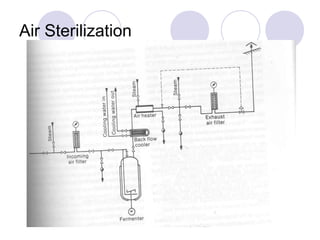
Sterilization of Air
An aerobic process requires large amount
of air ( of the order .1-1 volume of air per
volume of liquid media). Since the cost
incurred for sterilizing such huge amount
of air would be enormous air filters are
used to reduce costs. These filters are
periodically changed when blocked dirty.
Air Sterilization
Filters come in many shapes and sizes
from small (13 mm) filters that are used for
the filtration of a few milliliters of liquid to
industrial filters with surface areas of
several square meters that can process
hundreds of liters a minute. The figure
below illustrates several different types of
filters and filtration apparatus.
Some Filter Types
Diagram of Air Filter ( membrane Type)
Critical oxygen concentration
Critical oxygen concentration is the
term used to indicate the value of
specific oxygen absorption rate which
permits the respiration without
hindrance
Dissolved Oxygen Concentration
QO2
Ccritical
Effect of dissolved O2 concentration on the
QO2 of a microorganism
Specific O2 uptake increases with increase in
dissolved O2 levels to a certain point Ccrit.
Critical dissolved oxygen levels for a range
of microorganisms
Organism Temperature Critical dissolved
o
C Oxygen concentration
(mmoles dm -3
)
Azotobacter sp. 30 0.018
E. coli 37 0.008
Saccharomyces sp. 30 0.004
Penicillium chrysogenum 24 0.022
Critical dissolved oxygen levels
To maximise biomass production you must satisfy the
organisms specific oxygen demand by maintaining the
dissolved O2 levels above Ccrit
Cells become metabolically disturbed if the level drops
below Ccrit
High dissolved O2 levels also promote product
formation
Amino acid biosynthesis by Brevibacterium flavum
FACTORS AFFECTING OXYGEN DEMAND
• Rate of cell respiration
• Type of respiration (aerobic vs anaerobic)
• Type of substrate (glucose vs methane)
• Type of environment (e.g pH, temp etc.)
• Surface area/ volume ratio
large vs small cells (bacteria v mammalian cells)
hyphae, clumps, flocs, pellets etc.
• Nature of surface area ( shape)
Size of sparger
gas bubble
Gas composition, volume &
velocity
Design of Impeller
size, no. of blades
rotational speed Baffles
width, number
FACTORS INFLUENCING OXYGEN SUPPLY
Foam/antifoam
Temperature
Type of liquid
Height/width ratio
‘’Hold up’’
Process factors

Filter sterilization

  • 1.
  • 2.
    Filter Sterilisation Filtration isused for the removal of microbes from solutions that cannot easily be treated in other fashions. Typically heat-sensitive compounds such as antibiotics and vitamins are filtered before addition to sterile cool media. In the food industry, filtration finds utility in beer making to remove yeast before final bottling.
  • 3.
    Filter Sterilisation Filtration physicallyremoves microbes because it employs membranes whose precisely defined pores are too small to allow their passage. It is obviously only useful for liquids and gases. Filtration does not effectively remove viruses from solution because they are typically too small. A filter system with sufficiently small pores to remove viruses would have an extremely slow flow rate due to the viscosity of water. Because viruses are not removed, filtration cannot technically be considered a form of sterilization, although it is common to refer to the process as “filter sterilization.”
  • 4.
    Types of Filters Thereare three major types of filters. Depth filters, are the oldest type and consist of overlapping layers of fibrous sheets of paper, asbestos or glass fibers. The random nature of the fibers laying on one top of another creates torturous paths through the filter that trap many particles.
  • 5.
    Depth Filters Due totheir nature they do not trap all particles of a given size, but they find utility as pre-filters before final filtration. That is, their ability to remove the vast majority of things means that this removed material does not plug up the more efficient filters noted below. They are also useful for the filter sterilization of gases. Glass and asbestos depth filters can tolerate high heat and can be conveniently sterilized with steam.
  • 6.
    Membrane Filters The membranefilter is the most common type of filtration system used in modern microbiology laboratories. These are made from high tensile strength polymers of cellulose acetate, cellulose nitrate, polycarbonate, polyester, polypropylene or polysulfone.
  • 7.
    Membrane Filters At highmagnification the polymers appear as a thick mesh of interconnected strands with rather precisely defined spaces between the polymer. By adjusting polymerization conditions, the size of the spaces or pores can be controlled to create membranes with various maximal sizes.
  • 8.
    Nucleopore membranes Nucleopore Membranesare created by exposing a very thin polycarbonate film (10 µm) to nuclear radiation, which creates areas of weakness in the polymer. The membrane is then treated with an etching solution that degrades the weak areas creating pores in the membrane.
  • 9.
    Nucleopore Membranes Changing thestrength of the etching solution or the time of exposure of the membrane controls the size of the pores created and results in remarkably precise pore sizes. Nucleopore membranes are particularly useful for trapping bacteria on the surface of a membrane for subsequent microscopic examination.
  • 10.
    Sterilization of Air Anaerobic process requires large amount of air ( of the order .1-1 volume of air per volume of liquid media). Since the cost incurred for sterilizing such huge amount of air would be enormous air filters are used to reduce costs. These filters are periodically changed when blocked dirty.
  • 11.
  • 12.
    Filters come inmany shapes and sizes from small (13 mm) filters that are used for the filtration of a few milliliters of liquid to industrial filters with surface areas of several square meters that can process hundreds of liters a minute. The figure below illustrates several different types of filters and filtration apparatus.
  • 13.
  • 14.
    Diagram of AirFilter ( membrane Type)
  • 15.
    Critical oxygen concentration Criticaloxygen concentration is the term used to indicate the value of specific oxygen absorption rate which permits the respiration without hindrance
  • 16.
    Dissolved Oxygen Concentration QO2 Ccritical Effectof dissolved O2 concentration on the QO2 of a microorganism Specific O2 uptake increases with increase in dissolved O2 levels to a certain point Ccrit.
  • 17.
    Critical dissolved oxygenlevels for a range of microorganisms Organism Temperature Critical dissolved o C Oxygen concentration (mmoles dm -3 ) Azotobacter sp. 30 0.018 E. coli 37 0.008 Saccharomyces sp. 30 0.004 Penicillium chrysogenum 24 0.022
  • 18.
    Critical dissolved oxygenlevels To maximise biomass production you must satisfy the organisms specific oxygen demand by maintaining the dissolved O2 levels above Ccrit Cells become metabolically disturbed if the level drops below Ccrit High dissolved O2 levels also promote product formation Amino acid biosynthesis by Brevibacterium flavum
  • 19.
    FACTORS AFFECTING OXYGENDEMAND • Rate of cell respiration • Type of respiration (aerobic vs anaerobic) • Type of substrate (glucose vs methane) • Type of environment (e.g pH, temp etc.) • Surface area/ volume ratio large vs small cells (bacteria v mammalian cells) hyphae, clumps, flocs, pellets etc. • Nature of surface area ( shape)
  • 20.
    Size of sparger gasbubble Gas composition, volume & velocity Design of Impeller size, no. of blades rotational speed Baffles width, number FACTORS INFLUENCING OXYGEN SUPPLY Foam/antifoam Temperature Type of liquid Height/width ratio ‘’Hold up’’ Process factors