Ancient
Astronomy
ANCIENT
ASTRONOMY
ANCIENT
ASTRONOMY
ANCIENT
ASTRONOMY
ANCIENT
ASTRONOMY
ANCIENT
ASTRONOMY
ANCIENT
ASTRONOMY
ANCIENT
ASTRONOMY
ANCIENT
ASTRONOMY
ANCIENT
ASTRONOMY
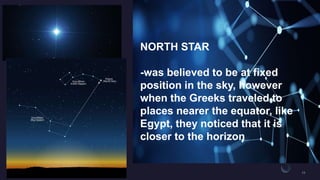
NORTH STAR
-was believed to be at fixed
position in the sky, however
when the Greeks traveled to
places nearer the equator, like
Egypt, they noticed that it is
closer to the horizon
ANCIENT
ASTRONOMY
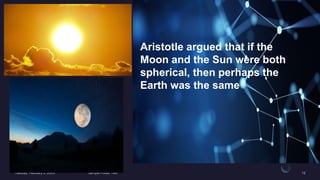
Aristotle argued that if the
Moon and the Sun were both
spherical, then perhaps the
Earth was the same
ANCIENT
ASTRONOMY
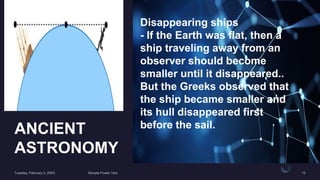
Disappearing ships
- If the Earth was flat, then a
ship traveling away from an
observer should become
smaller until it disappeared..
But the Greeks observed that
the ship became smaller and
its hull disappeared first
before the sail.
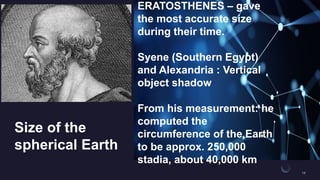
Size of the
spherical Earth
ERATOSTHENES – gave
the most accurate size
during their time.
Syene (Southern Egypt)
and Alexandria : Vertical
object shadow
From his measurement: he
computed the
circumference of the Earth
to be approx. 250,000
stadia, about 40,000 km
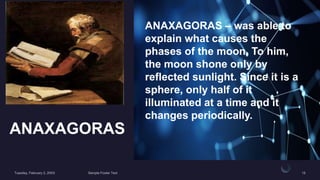
ANAXAGORAS
ANAXAGORAS – was able to
explain what causes the
phases of the moon. To him,
the moon shone only by
reflected sunlight. Since it is a
sphere, only half of it
illuminated at a time and it
changes periodically.
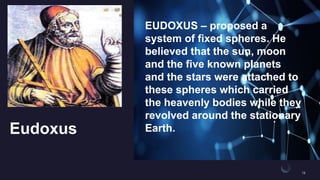
Eudoxus
EUDOXUS – proposed a
system of fixed spheres. He
believed that the sun, moon
and the five known planets
and the stars were attached to
these spheres which carried
the heavenly bodies while they
revolved around the stationary
Earth.
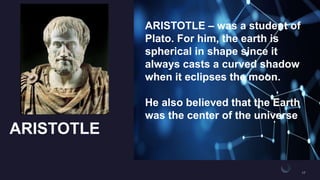
ARISTOTLE
ARISTOTLE – was a student of
Plato. For him, the earth is
spherical in shape since it
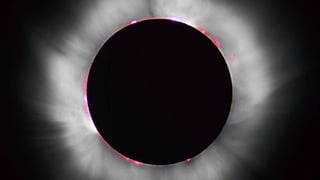
always casts a curved shadow
when it eclipses the moon.
He also believed that the Earth
was the center of the universe
ARISTARCHUS
ARISTARCHUS – very first
Greek to profess the
heliocentric views
“helio” – sun
“centric”- centered
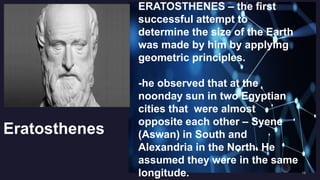
Eratosthenes
ERATOSTHENES – the first
successful attempt to
determine the size of the Earth
was made by him by applying
geometric principles.
-he observed that at the
noonday sun in two Egyptian
cities that were almost
opposite each other – Syene
(Aswan) in South and
Alexandria in the North. He
assumed they were in the same
longitude.
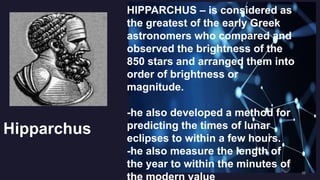
Hipparchus
HIPPARCHUS – is considered as
the greatest of the early Greek
astronomers who compared and
observed the brightness of the
850 stars and arranged them into
order of brightness or
magnitude.
-he also developed a method for
predicting the times of lunar
eclipses to within a few hours.
-he also measure the length of
the year to within the minutes of
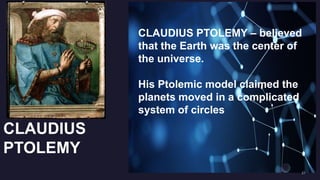
CLAUDIUS
PTOLEMY
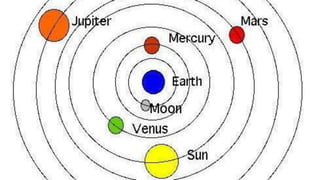
CLAUDIUS PTOLEMY – believed
that the Earth was the center of
the universe.
His Ptolemic model claimed the
planets moved in a complicated
system of circles
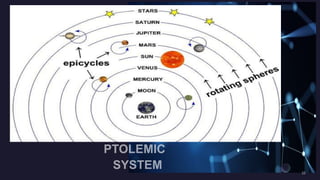
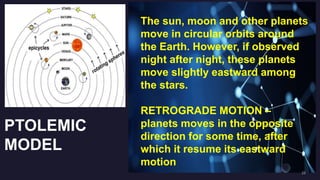
PTOLEMIC
MODEL
The sun, moon and other planets
move in circular orbits around
the Earth. However, if observed
night after night, these planets
move slightly eastward among
the stars.
RETROGRADE MOTION –
planets moves in the opposite
direction for some time, after
which it resume its eastward
motion
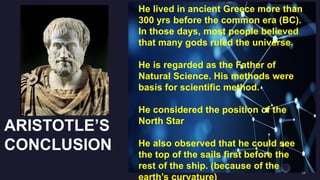
ARISTOTLE’S
CONCLUSION
He lived in ancient Greece more than
300 yrs before the common era (BC).
In those days, most people believed
that many gods ruled the universe.
He is regarded as the Father of
Natural Science. His methods were
basis for scientific method.
He considered the position of the
North Star
He also observed that he could see
the top of the sails first before the
rest of the ship. (because of the
Thank You
Ancient Astronomy.pptx

Ancient Astronomy.pptx

  • 1.
  • 2.
  • 3.
  • 4.
  • 5.
  • 6.
  • 7.
  • 8.
  • 9.
  • 11.
    ANCIENT ASTRONOMY NORTH STAR -was believedto be at fixed position in the sky, however when the Greeks traveled to places nearer the equator, like Egypt, they noticed that it is closer to the horizon
  • 12.
    ANCIENT ASTRONOMY Aristotle argued thatif the Moon and the Sun were both spherical, then perhaps the Earth was the same
  • 13.
    ANCIENT ASTRONOMY Disappearing ships - Ifthe Earth was flat, then a ship traveling away from an observer should become smaller until it disappeared.. But the Greeks observed that the ship became smaller and its hull disappeared first before the sail.
  • 14.
    Size of the sphericalEarth ERATOSTHENES – gave the most accurate size during their time. Syene (Southern Egypt) and Alexandria : Vertical object shadow From his measurement: he computed the circumference of the Earth to be approx. 250,000 stadia, about 40,000 km
  • 15.
    ANAXAGORAS ANAXAGORAS – wasable to explain what causes the phases of the moon. To him, the moon shone only by reflected sunlight. Since it is a sphere, only half of it illuminated at a time and it changes periodically.
  • 16.
    Eudoxus EUDOXUS – proposeda system of fixed spheres. He believed that the sun, moon and the five known planets and the stars were attached to these spheres which carried the heavenly bodies while they revolved around the stationary Earth.
  • 17.
    ARISTOTLE ARISTOTLE – wasa student of Plato. For him, the earth is spherical in shape since it always casts a curved shadow when it eclipses the moon. He also believed that the Earth was the center of the universe
  • 18.
    ARISTARCHUS ARISTARCHUS – veryfirst Greek to profess the heliocentric views “helio” – sun “centric”- centered
  • 19.
    Eratosthenes ERATOSTHENES – thefirst successful attempt to determine the size of the Earth was made by him by applying geometric principles. -he observed that at the noonday sun in two Egyptian cities that were almost opposite each other – Syene (Aswan) in South and Alexandria in the North. He assumed they were in the same longitude.
  • 20.
    Hipparchus HIPPARCHUS – isconsidered as the greatest of the early Greek astronomers who compared and observed the brightness of the 850 stars and arranged them into order of brightness or magnitude. -he also developed a method for predicting the times of lunar eclipses to within a few hours. -he also measure the length of the year to within the minutes of
  • 21.
    CLAUDIUS PTOLEMY CLAUDIUS PTOLEMY –believed that the Earth was the center of the universe. His Ptolemic model claimed the planets moved in a complicated system of circles
  • 23.
    PTOLEMIC MODEL The sun, moonand other planets move in circular orbits around the Earth. However, if observed night after night, these planets move slightly eastward among the stars. RETROGRADE MOTION – planets moves in the opposite direction for some time, after which it resume its eastward motion
  • 24.
    ARISTOTLE’S CONCLUSION He lived inancient Greece more than 300 yrs before the common era (BC). In those days, most people believed that many gods ruled the universe. He is regarded as the Father of Natural Science. His methods were basis for scientific method. He considered the position of the North Star He also observed that he could see the top of the sails first before the rest of the ship. (because of the
  • 25.