Classroom Rules:
1. Respectthe Teacher in front.
2. Do not do unnecessary things during class
hours.
3. Using cellphones during class hours is
prohibited. A teacher’s permission is needed
for certain activities.
4. If you have a question, just raise your hand.
WHAT WERE THECOMPETING MODELS
OF THE UNIVERSE?
• Over time, the Greeks developed models of the universe
based on their output with their naked eye, with the use
of instruments, and with the implications of the data
they gathered
24.
WHAT WERE THECOMPETING MODELS
OF THE UNIVERSE?
• Over time, the Greeks developed models of the
universe based on their output with their naked eye,
with the use of instruments, and with the implications
of the data they gathered.
• There were two competing models of the universe: the
GEOCENTRIC MODEL, and the HELIOCENTRIC MODEL.
• Eudoxus’, Aristotelian, and Ptolemaic models
supported the geocentric, while Aristarchus’ and
Copernican models supported the heliocentric
25.
EUDOXUS’S MODEL
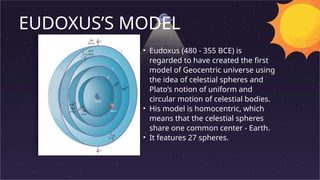
• Eudoxus(480 - 355 BCE) is
regarded to have created the first
model of Geocentric universe using
the idea of celestial spheres and
Plato’s notion of uniform and
circular motion of celestial bodies.
• His model is homocentric, which
means that the celestial spheres
share one common center - Earth.
• It features 27 spheres.
26.
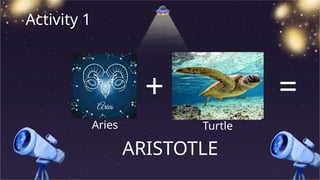
ARISTOTELIAN
MODEL • Aristotleconsidered Eudoxus’s
model but was not totally
convinced.
• The Aristotelian model has 56
spheres that guide the motion of
the sun, the moon, and the five
well-known planets
• He also proposed the concept of
Prime mover, which drives the
motion of the planets
• Aristotle also proposed the ideas
about both terrestrial and celestial
motion.
27.
ARISTOTLE’S TYPES OFMOTION
• Aristotle, a Greek philosopher and scientist, categorized
TERRESTRIAL MOTION into three- natural, violent, and alteration.
• Natural motion is determined by the
nature of an object’s composition.
Every object which may be composed
of any of the four terrestrial elements
(earth, water, fire, and air), tends to go
back to its natural place.
28.
ARISTOTLE’S TYPES OFMOTION
• Violent motion happens when an
object is acted upon by any external
force. The Greek believed that once
arrow is no longer in physical contact
with the bow, a turbulent motion of
air is created and pushes the arrow
forward. Air resistance opposes this
turbulent motion of air, slowing down
the arrow until it stops.
29.
ARISTOTLE’S TYPES OFMOTION
• Alteration refers to a type of
motion that describes
qualitative change. As an
example, liquid water can be
turned into ice by “”removing””
heat from the liquid water (its
cause). Liquid water can also
be changed into steam by
application of fire
30.
ARISTOTLE’S TYPES OFMOTION
While for the CELESTIAL MOTION, Aristotle categorized
it into which includes diurnal and annual motion
Diurnal motion refers to the daily
rising and setting of the sun. It
specifically pertains to the apparent
westward motion of celestial bodies
because of Earth’s eastward rotation
on its axis It was not until after
many centuries that astronomers
found out the correct explanation
for this motion.
31.
ARISTOTLE’S TYPES OFMOTION
Annual motion refers to the apparent shift in
location of the stars. The Greeks noticed that the
stars moved in an annual cycle, slightly shifting
toward the west after each day, and returning to
their positions after a year. Today annual motion is
attributed to a single full revolution of Earth around
the sun
32.
BONUS ACTIVITY!
Earth takes365.25 days to completely revolve
around the Sun. Convert the full revolution of
Earth around the Sun into hours.
33.
BONUS ACTIVITY!
Earth takes365.25 days to completely revolve
around the Sun. Convert the full revolution of
Earth around the Sun into hours.
ANSWER: 365.25 days x 24hours = 8,766
hours
1 day
34.
• Around 140CE, Claudius Ptolemy proposed a refinement of the
geocentric model of the universe.
• He provided an accurate explanation for the motion of heavenly
bodies and explained the epicycle and deferent of the planetary
spheres.
• The deferent refers to a circular path in which the planet moves
around Earth, while the epicycle pertains to a smaller circle
along which a planet moves
PTOLEMAIC
MODEL
35.
• Ptolemaic modelsummarized the theory
of planetary motion
• He adopted the concept of uniform
circular motion.
• His ideas on the apparent speeding up or
slowing down of planets were based on
three concepts:
1. epicycle
2.eccentric - putting the observers out of
the center
3.equant - the point with the same
distance as that of Earth to the center.
PTOLEMAIC
MODEL
36.
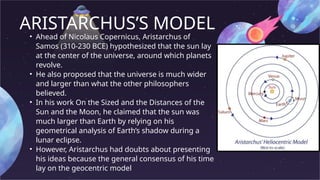
ARISTARCHUS’S MODEL
• Aheadof Nicolaus Copernicus, Aristarchus of
Samos (310-230 BCE) hypothesized that the sun lay
at the center of the universe, around which planets
revolve.
• He also proposed that the universe is much wider
and larger than what the other philosophers
believed.
• In his work On the Sized and the Distances of the
Sun and the Moon, he claimed that the sun was
much larger than Earth by relying on his
geometrical analysis of Earth’s shadow during a
lunar eclipse.
• However, Aristarchus had doubts about presenting
his ideas because the general consensus of his time
lay on the geocentric model
37.
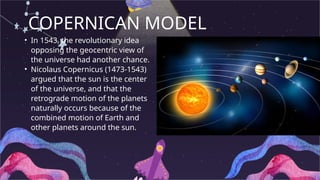
COPERNICAN MODEL
• In1543, the revolutionary idea
opposing the geocentric view of
the universe had another chance.
• Nicolaus Copernicus (1473-1543)
argued that the sun is the center
of the universe, and that the
retrograde motion of the planets
naturally occurs because of the
combined motion of Earth and
other planets around the sun.
38.
COPERNICAN MODEL
THE COPERNICANMODEL SUGGESTED THE FOLLOWING
• Celestial motions are uniform, infinite, and circular, or
a compound of numerous circles (epicycles)
• The planets, including the fixed stars, revolve around
the sun, which is considered the center of the
universe and the nearest star to the Earth
• Earth’s motion explains the retrograde motion of
other planets.
• Earth spins on a tilted axis, which accounts for the
seasons.
EARTH IS SPHERICAL
•In Mesopotamian mythology, Earth was believed to be
a flat disk floating on the ocean and bounded by a
spherical sky.
• The Greeks sought to prove the sphericity of Earth. Two
Greek philosophers, Plato (428/427-348/347 BCE) and
Aristotle provided physical and observational evidence
supporting this hypothesis.
For Anaximander, theEarth is
cylindrical circled by air and
then fire “’like a bark of a tree’’
which separated off at an
early stage. We still see
echoes of the early
cosmologies, but an attempt
is made to explain the scheme
in purely physical
EARTH IS SPHERICAL
• Anaximenes ofMiletus
refined the flat-earth idea,
suggesting that all things
are produced thru a
process of gradual
condensation and
‘’rarification’’
• He theorized that the
earth and heavenly bodies
are flat and loft on infinite
air like a leaf.
EARTH IS SPHERICAL
1. If youwere one of the individuals who lived during
the time of those Ancient Greek Philosophers, whose
theory of the Earth’s model would make you believe?
And which theory would make you oppose the most?
2. How did their ideas influence future scientific
discoveries?
3. Do you think that the inaccuracy of their models for
today’s concept about the Earth have makes no
contribution? Why?
1. Which ofthe following motion refers to a ball
falling down because it seeks to its natural
place-the ground?
a. Natural Motion
b. Violent Motion
c. Alteration
d. Celestial Motion
50.
2. What isthe key idea behind Eudoxus' homocentric model?
a. The planets move in elliptical orbits around the Sun
b. The Earth is the center of the universe.
c. The stars and planets move in straight lines through space.
d. The Sun is at the center, and planets revolve around it.
51.
3. Which ancientGreek philosopher refined the
Geocentric model of the universe?
a. Eudoxus
b. Aristotle
c. Ptolemy
d. Aristarchus
52.
4. He wasthe ancient Greek philosopher who first
hypothesized the Heliocentric model of the
universe.
a. Eudoxus
b. Aristotle
c. Copernicus
d. Aristarchus
53.
5. What isthe importance of the Copernican model to our daily lives today?
a. It helped develop modern technology like GPS and satellite systems by
improving our understanding of planetary motion.
b. It had no real impact on daily life and is only important for historians
and astronomers.
c. It proved that the Earth is the center of the universe, reinforcing
traditional beliefs.
d. It was an interesting idea but has been completely replaced by
modern scientific theories.
54.
Advanced study aboutBrahe's innovations and Kepler's
discovery of his laws of planetary motion.
1. How did Tycho Brahe’s astronomical innovations contribute
to Kepler’s discovery of the laws of planetary motion?
2.What was the key difference between Brahe’s geocentric-
heliocentric model and Kepler’s heliocentric model?
3.How did Kepler use Brahe’s precise observational data to
formulate his three laws of planetary motion?
55.
THANK YOU!
Thank youfor joining this journey into the world of
astronomical observations! The universe is vast, and there’s
so much more to discover. Keep looking up at the sky—you
never know what amazing things you’ll find next!
Editor's Notes
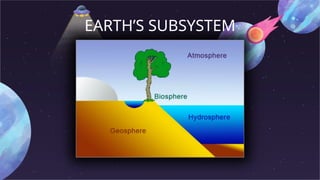
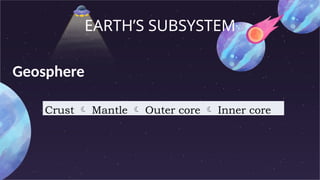
#3 Each group must pick an envelope that corresponds to a set of pictures relating to the components of a specific Earth’s subsystem. Each group must arrange these set of images in proper sequence and put them on the board.
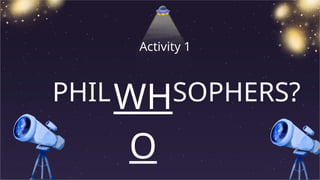
#20 Are you familiar with these Greek philosophers?
In what field have you encountered these Philosophers?
#25 27 spheres : One for the background or fixed stars, three for the sun, three for the moon, and four for each of the five then-known planets- Mecury, Mars, Venus, Jupiter, and Saturn.
#27 For instance, a ball thrown up falls down because it seeks to its natural place which- the ground.
#28 For example, the force applied in shooting an arrow set it in motion.
#30 "Diurnal motion refers to the daily rising and setting of the sun." means that the sun appears to move across the sky from east to west each day due to the Earth's rotation. This apparent motion happens regularly over a 24-hour period and is part of the natural cycle of day and night.
#31 "Annual" refers to something that happens once a year or every year.
#34 Refinement" means the process of improving something to make it more polished, elegant, or effective.
#44 "rarefaction", which refers to the process of becoming less dense or more spread out.
#46 If you were one of the individuals who lived during the time of those Ancient Greek Philosophers, whose theory of the Earth’s model would make you believe? And which theory would make you oppose the most?
How did their ideas influence future scientific discoveries?
Do you think that the inaccuracy of their models for today’s concept about the Earth have makes no contribution? Why?
Add further valuable insights and explanation that would make students realize and appreciate Greek Philosopher’s philosophical contributions.