Models of the Universe
Their contributions in order to come up
with the more accurate model of the
universe
Persons that proposed their views of the early universe
Two classification of how the universe might look like according to
the
early Greeks
According to the early Greeks
 The early humans relied on the skies as their principal means of telling the time,
of navigation, and knowing when to start planting rice.
 3,000 years ago, the Egyptians established a 365- day calendar based on the track of the stars Sirius.
The track also coincide with the annual flooding of the Nile river.
 The Babylonians and the Assyrian also invented similar calendars to aid them in determining when to sow
and reap crops.
 Humans have come up with several models in an effort to understand the universe. Before the invention
of the telescope, they had to rely on their senses for a picture of the Universe with much philosophical
and religious symbolism.
 Thales of Miletus proposed that the Earth is a disk floating on water.
 Anixamander, also from Miletus, suggested that Earth is a cylinder and that its surface is curved.
Introduction:
Classification of the models:
 As civilization flourished, several models were proposed. These models can be grouped under two
categories:
 The geocentric model considers
Earth as the center of the
Universe.
 The heliocentric model assumes the
sun to be the center of the Universe.
Heliocentric
Model
Geocentric Model
 Pythagoras
 Plato
 Eudoxus
 Aristotle
 Apollonius
 Ptolemy
 Aristarchus
 Copernicus
 Galileo
 Kepler
Pyrocentric Model – suggests that a “fire” is the center of the universe
- suggested by Philolaus.
Tychonic Model – a compromise between heliocentric and geocentric model.
- it was proposed by Tyco Brahe.
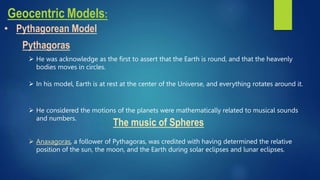
Geocentric Models:
• Pythagorean Model
Pythagoras
 He was acknowledge as the first to assert that the Earth is round, and that the heavenly
bodies moves in circles.
 In his model, Earth is at rest at the center of the Universe, and everything rotates around it.
 He considered the motions of the planets were mathematically related to musical sounds
and numbers.
The music of Spheres
 Anaxagoras, a follower of Pythagoras, was credited with having determined the relative
position of the sun, the moon, and the Earth during solar eclipses and lunar eclipses.
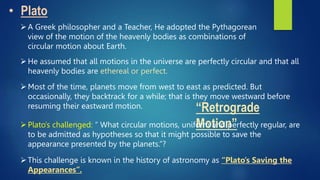
A Greek philosopher and a Teacher, He adopted the Pythagorean
view of the motion of the heavenly bodies as combinations of
circular motion about Earth.
• Plato
He assumed that all motions in the universe are perfectly circular and that all
heavenly bodies are ethereal or perfect.
Most of the time, planets move from west to east as predicted. But
occasionally, they backtrack for a while; that is they move westward before
resuming their eastward motion. “Retrograde
Motion”
Plato’s challenged: “ What circular motions, uniform and perfectly regular, are
to be admitted as hypotheses so that it might possible to save the
appearance presented by the planets.”?
This challenge is known in the history of astronomy as “Plato’s Saving the
Appearances”.
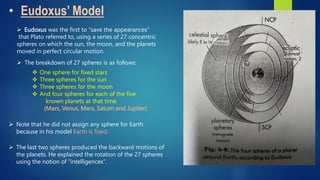
 Eudoxus was the first to “save the appearances”
that Plato referred to, using a series of 27 concentric
spheres on which the sun, the moon, and the planets
moved in perfect circular motion.
• Eudoxus’ Model
 The breakdown of 27 spheres is as follows:
 One sphere for fixed stars
 Three spheres for the sun
 Three spheres for the moon
 And four spheres for each of the five
known planets at that time.
(Mars, Venus, Mars, Saturn and Jupiter)
 Note that he did not assign any sphere for Earth
because in his model Earth is fixed.
 The last two spheres produced the backward motions of
the planets. He explained the rotation of the 27 spheres
using the notion of “intelligences”.
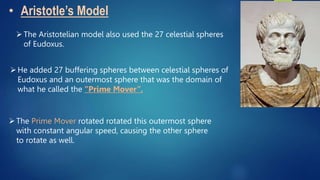
• Aristotle’s Model
The Aristotelian model also used the 27 celestial spheres
of Eudoxus.
He added 27 buffering spheres between celestial spheres of
Eudoxus and an outermost sphere that was the domain of
what he called the “Prime Mover”.
The Prime Mover rotated rotated this outermost sphere
with constant angular speed, causing the other sphere
to rotate as well.
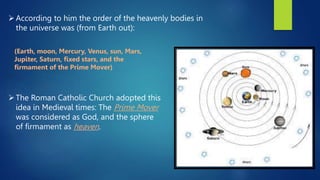
According to him the order of the heavenly bodies in
the universe was (from Earth out):
(Earth, moon, Mercury, Venus, sun, Mars,
Jupiter, Saturn, fixed stars, and the
firmament of the Prime Mover)
The Roman Catholic Church adopted this
idea in Medieval times: The Prime Mover
was considered as God, and the sphere
of firmament as heaven.
• Aristotle’s Model
Aristotle divided the universe into two realms; terrestrial and celestial.
with the orbit of the moon as the boundary. Below the moon’s orbit was the terrestrial
realm.
Terrestrial objects was composed of four primordial elements in this sequence ;
earth, water, air, and fire.
Celestial objects was consist of the fifth element called aether or ether.
He considered terrestrial matter to be ephemeral and undergoing decay, while
ether was unchanging and perpetual.
This realm was composed of four primordial elements in this sequence ; earth,
water, air, and fire.
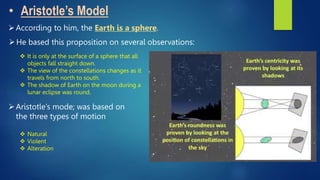
According to him, the Earth is a sphere.
• Aristotle’s Model
He based this proposition on several observations:
 It is only at the surface of a sphere that all
objects fall straight down.
 The view of the constellations changes as it
travels from north to south.
 The shadow of Earth on the moon during a
lunar eclipse was round.
Aristotle’s mode; was based on
the three types of motion
 Natural
 Violent
 Alteration
• Ptolemy’s Model
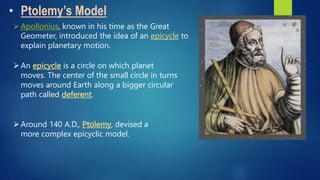
Apollonius, known in his time as the Great
Geometer, introduced the idea of an epicycle to
explain planetary motion.
An epicycle is a circle on which planet
moves. The center of the small circle in turns
moves around Earth along a bigger circular
path called deferent.
Around 140 A.D., Ptolemy, devised a
more complex epicyclic model.
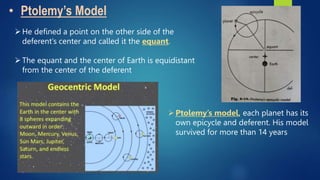
He defined a point on the other side of the
deferent’s center and called it the equant.
The equant and the center of Earth is equidistant
from the center of the deferent
Ptolemy’s model, each planet has its
own epicycle and deferent. His model
survived for more than 14 years
• Ptolemy’s Model
Heliocentric Models:
Before heliocentric model came about, a Greek astronomer
Philolaus, proposed a pyrocentric model of the universe.
According to him, neither Earth nor the

3rd Universe Model .pptx

  • 1.
    Models of theUniverse Their contributions in order to come up with the more accurate model of the universe Persons that proposed their views of the early universe Two classification of how the universe might look like according to the early Greeks According to the early Greeks
  • 3.
     The earlyhumans relied on the skies as their principal means of telling the time, of navigation, and knowing when to start planting rice.  3,000 years ago, the Egyptians established a 365- day calendar based on the track of the stars Sirius. The track also coincide with the annual flooding of the Nile river.  The Babylonians and the Assyrian also invented similar calendars to aid them in determining when to sow and reap crops.  Humans have come up with several models in an effort to understand the universe. Before the invention of the telescope, they had to rely on their senses for a picture of the Universe with much philosophical and religious symbolism.  Thales of Miletus proposed that the Earth is a disk floating on water.  Anixamander, also from Miletus, suggested that Earth is a cylinder and that its surface is curved. Introduction:
  • 4.
    Classification of themodels:  As civilization flourished, several models were proposed. These models can be grouped under two categories:  The geocentric model considers Earth as the center of the Universe.  The heliocentric model assumes the sun to be the center of the Universe. Heliocentric Model Geocentric Model  Pythagoras  Plato  Eudoxus  Aristotle  Apollonius  Ptolemy  Aristarchus  Copernicus  Galileo  Kepler Pyrocentric Model – suggests that a “fire” is the center of the universe - suggested by Philolaus. Tychonic Model – a compromise between heliocentric and geocentric model. - it was proposed by Tyco Brahe.
  • 5.
    Geocentric Models: • PythagoreanModel Pythagoras  He was acknowledge as the first to assert that the Earth is round, and that the heavenly bodies moves in circles.  In his model, Earth is at rest at the center of the Universe, and everything rotates around it.  He considered the motions of the planets were mathematically related to musical sounds and numbers. The music of Spheres  Anaxagoras, a follower of Pythagoras, was credited with having determined the relative position of the sun, the moon, and the Earth during solar eclipses and lunar eclipses.
  • 6.
    A Greek philosopherand a Teacher, He adopted the Pythagorean view of the motion of the heavenly bodies as combinations of circular motion about Earth. • Plato He assumed that all motions in the universe are perfectly circular and that all heavenly bodies are ethereal or perfect. Most of the time, planets move from west to east as predicted. But occasionally, they backtrack for a while; that is they move westward before resuming their eastward motion. “Retrograde Motion” Plato’s challenged: “ What circular motions, uniform and perfectly regular, are to be admitted as hypotheses so that it might possible to save the appearance presented by the planets.”? This challenge is known in the history of astronomy as “Plato’s Saving the Appearances”.
  • 7.
     Eudoxus wasthe first to “save the appearances” that Plato referred to, using a series of 27 concentric spheres on which the sun, the moon, and the planets moved in perfect circular motion. • Eudoxus’ Model  The breakdown of 27 spheres is as follows:  One sphere for fixed stars  Three spheres for the sun  Three spheres for the moon  And four spheres for each of the five known planets at that time. (Mars, Venus, Mars, Saturn and Jupiter)  Note that he did not assign any sphere for Earth because in his model Earth is fixed.  The last two spheres produced the backward motions of the planets. He explained the rotation of the 27 spheres using the notion of “intelligences”.
  • 8.
    • Aristotle’s Model TheAristotelian model also used the 27 celestial spheres of Eudoxus. He added 27 buffering spheres between celestial spheres of Eudoxus and an outermost sphere that was the domain of what he called the “Prime Mover”. The Prime Mover rotated rotated this outermost sphere with constant angular speed, causing the other sphere to rotate as well.
  • 9.
    According to himthe order of the heavenly bodies in the universe was (from Earth out): (Earth, moon, Mercury, Venus, sun, Mars, Jupiter, Saturn, fixed stars, and the firmament of the Prime Mover) The Roman Catholic Church adopted this idea in Medieval times: The Prime Mover was considered as God, and the sphere of firmament as heaven.
  • 10.
    • Aristotle’s Model Aristotledivided the universe into two realms; terrestrial and celestial. with the orbit of the moon as the boundary. Below the moon’s orbit was the terrestrial realm. Terrestrial objects was composed of four primordial elements in this sequence ; earth, water, air, and fire. Celestial objects was consist of the fifth element called aether or ether. He considered terrestrial matter to be ephemeral and undergoing decay, while ether was unchanging and perpetual. This realm was composed of four primordial elements in this sequence ; earth, water, air, and fire.
  • 11.
    According to him,the Earth is a sphere. • Aristotle’s Model He based this proposition on several observations:  It is only at the surface of a sphere that all objects fall straight down.  The view of the constellations changes as it travels from north to south.  The shadow of Earth on the moon during a lunar eclipse was round. Aristotle’s mode; was based on the three types of motion  Natural  Violent  Alteration
  • 12.
    • Ptolemy’s Model Apollonius,known in his time as the Great Geometer, introduced the idea of an epicycle to explain planetary motion. An epicycle is a circle on which planet moves. The center of the small circle in turns moves around Earth along a bigger circular path called deferent. Around 140 A.D., Ptolemy, devised a more complex epicyclic model.
  • 13.
    He defined apoint on the other side of the deferent’s center and called it the equant. The equant and the center of Earth is equidistant from the center of the deferent Ptolemy’s model, each planet has its own epicycle and deferent. His model survived for more than 14 years • Ptolemy’s Model
  • 14.
    Heliocentric Models: Before heliocentricmodel came about, a Greek astronomer Philolaus, proposed a pyrocentric model of the universe. According to him, neither Earth nor the