G
I
N
G
E
R
VAISHNAVI
2019-11-172
Introduction
• Zingiber officinale
• Zingiberaceae family
• 2n =
• Aromatic herb with an
underground rhizome
• The family Zingiberaceae consists of 47 genera and
about 1400 species. Among these, 22 genera and 178
species are endemic to India.
• Apart from cultivated ginger, the other important
economic species of the genus are Z. zerumbet,
Z.odoriferum, Z. spectabile, Z. squarrosum and
Z.casumunnar, which are used as medicine and
aromatic purposes.
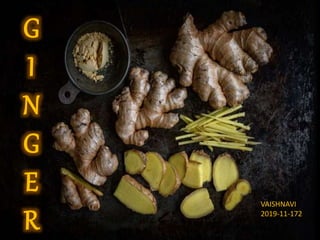
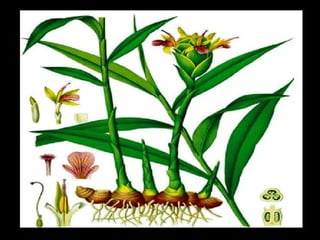
• Ginger (Zingiber officinale) is a flowering
plant whose rhizome , ginger root or ginger, is
widely used as a spice and a folk medicine . It is
a herbaceous perennial which grows annual
pseudostems (false stems made of the rolled bases of
leaves) about one meter tall bearing narrow leaf
blades.
• The inflorescences bear flowers having pale yellow
petals with purple edges, and arise directly from the
rhizome on separate shoots.
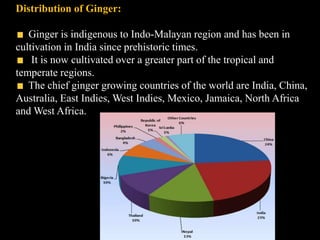
Distribution of Ginger:
Ginger is indigenous to Indo-Malayan region and has been in
cultivation in India since prehistoric times.
It is now cultivated over a greater part of the tropical and
temperate regions.
The chief ginger growing countries of the world are India, China,
Australia, East Indies, West Indies, Mexico, Jamaica, North Africa
and West Africa.
ORIGIN
• Ginger originated in Island Southeast Asia and was
likely domesticated first by the Austronesia peoples.
• It was transported with them throughout the Indo-
Pacific during the Austronesian
expansion(c. 5,000 BP), reaching as far as Hawaii.
• Ginger is one of the first spices to have been exported
from Asia, arriving in Europe with the spice trade,
and was used by ancient Greeks and Romans.
Nutritional value per 100 g (3.5 oz)
Energy 333 kJ (80 kcal)
Carbohydrates 17.77 g
Sugars 1.7 g
Dietary fiber 2 g
Fat 0.75 g
Protein 1.82 g
Water 79 g
BOTANY
• Erect, herbaceous perennial
• Grown for its edible rhizome (underground stem) which is
widely used as a spice.
• Rhizome - brown, with a corky outer layer and pale-yellow
scented center.
• .
• The above ground shoot is erect and reed-like with linear
leaves that are arranged alternately on the stem.
• The shoots originate from a multiple bases and wrap around
one another.
• Flowering heads are borne on shorter stems and the plant
produces cone shaped, pale yellow flowers .
• Grown as an annual plant
• Rhizome: The rhizome (underground stem) is brown, with a corky(
light brown substance) outer layer and pale-yellow
scented(distinctive, pleasant smell) center.
• Shoot: The above ground shoot is erect with linear leaves that are
arranged alternately on the stem. The shoots originate from a
multiple bases and wrap around one another.
• Leaves: Narrow green. The leaves can reach 7 cm in length and 1.9
cm broad.
• Flowers: Flowering heads are produced on shorter stems and the
plant produces cone shaped, pale yellow flowers.
• Plant Height: The ginger plant can reach 2-4 ft in height.
• Part Used: The fresh and dried rhizomes are used and an essential
oil is also extracted.
Floral biology
• Ginger flowers are produced in peducled spikes arising directly
from the rhizomes.
• conical spike consists of overlapping bracts, from the axils of which
flowers arise, each bract producing a single flower.
• The flowers are fragile, short-lived, and surrounded by a scariose,
glabrous bracteole.
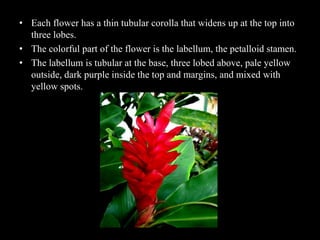
• Each flower has a thin tubular corolla that widens up at the top into
three lobes.
• The colorful part of the flower is the labellum, the petalloid stamen.
• The labellum is tubular at the base, three lobed above, pale yellow
outside, dark purple inside the top and margins, and mixed with
yellow spots.
From left: Bract, bracteole, mature capsule (dehisced) and seeds
enclosed in arils.
• The single fertile anther is ellipsoid, two celled, cream colored, and
dehisces by longitudinal slits.
• The inferior ovary is globose, the style is long and filiform, and the
stigma is hairy.
• Flowering is not common, and is probably influenced by climatic
factors and photoperiod.
. A. Flower (front view). B. Flower (semi-side view). C. Flower dissection (from left to
right: bract, bracteole, single flower in side view, dorsal corolla lobe, two lateral corolla
lobes, labellum with lateral staminodes partially basally connate, stamen with upper part
of style in the groove between two anther thecae
Anthesis
• Ginger is shown to be a quantitative short-day plant (Adaniya et al.,
1989).
• Jayachandran et al. (1979) reported that the flower bud development
took 20 to 25 days from the bud initiation to full bloom and 23 to 28
days to complete flower opening in an inflorescence.
• Flower opening takes place in an acropetal succession. Anthesis is
between 1.30 and 3.30 p.m. under the west coast conditions of
Kerala.
• Anther dehiscence almost coincides with the flower opening.
• The flower fades and falls on the next day morning.
• There is no fruit setting.
BREEDING OBJECTIVES
 High yield
A high yielding introduction Rio-de-Janeiro has become very
popular among the growers. Its yield potential is 25 to 35
tonnes per ha. The fiber content is 5.19 % and
dry ginger recovery is 16-18 %. Maran, a cultivar of Assam
which was introduced into cultivation in Kerala and
Karnataka, is becoming popular owing to its high yields and
high percentage of dry ginger
 Higher driage
The drying rate increases with the increase
in drying air temperature and blanching also
increases the drying rate. The drying rate
depends on shape and size of
the ginger rhizomes. The highest drying rate
was found for sliced samples
of ginger rhizome followed by splitted and
whole root samples.
 Wide adaptability
• Ginger grows well in warm and humid climate and is
cultivated from sea level to an altitude of 1500 m above sea
level.
• IISR Varada Adaptable to various agroclimatic conditions
High quality (high oil, high oleoresin, low
fibre etc.)
• Maran -The size of rhizome is medium,colour of
skin is buff, pungent, high flavour and less fibrous
• IISR Varada- good quality , high yielding variety
with plumpy rhizomes having flattened fingers and
medium sized reddish brown scales and less fiber
content.
• IISR Rejatha -is rich in essential oil
 Resistance to fungal and bacterial pathogens
(bacterial wilt and rhizome rot).
• IISR Mahima- resistant to M. incognita and M.
javanica pathotype 1(rootknot nematode)
• Himgiri - less susceptible to rhizome rot disease
BREEDING METHODS
• Introduction and Selection
Both indigenous and introduced cultivars were screened
under various geographic situations and selections made
for yield, quality and resistance attributes.
• Mutation breeding
• Because of existence of sterility, alternative to induce
variability is through physical and chemical mutagens. Being a
vegetatively propagated crop, induced variability can be fixed
immediately and true to type can be propagated.
• Induction of variability through mutations were tried by many
workers and desirable mutants identified. Ginger buds are
sensitive to irradiation and LD50 was reported below 2Krad.
• Suralibi variety is an induced mutant (V1K1-3) from the
Rudrapur local, released during 1991.
• Polyploidy breeding
• Because of chromosomal sterility, polyploidy
breeding offers scope to explore possibilities of
inducing variability in ginger
In vitro propagation
• Among the spices, ginger (Zingiber officinale Rosc.) contributes
greatly towards human health and is regarded as a food medicine for
several ailments.
• The major limitation in increasing production and productivity of
ginger is lack of adequate disease.-free planting materials of high
yielding varieties.
• As the major diseases are spread through contaminated seed-
rhizomes, the possibility of producing pathogen-free planting
materials using tissue culture is attractive.
Biotechnology of ginger
• Biotechnological tools have played a pivotal role in the
improvement of plant species.
• There are many techniques specially the micropropagation
techniques, production of enhanced secondary metabolite
production using cell suspension cultures .
• In vitro production of haploids, somatic embryogenesis, somatic
hybridization , germplasm conservation and storage, recombinant
DNA technology and transgenic .
• Many of these have been used in the recent times for the
improvement of ginger mainly because of the vegetative mode of
propagation and those techniques have been discussed below.
• Micropropagation of ginger
• Ginger is one of the important spice crops in India under the
family Zingiberaceae.
• This plant is a highly important horticultural crop and plays a
very important role in pharmaceuticals, food and beverage
industries.
• In a vegetatively propagated plant like ginger, risk of systemic
Infections by root knot nematodes, bacterial wilt from the
propagules is very high.
• Heavy losses in ginger productions is due to diseases caused by
bacterial wilt (P-50), soft rot (Pythium) and rhizome rot (E-Oxy).
• Therefore, the diseases are mainly transmitted by rhizome
propagules; production of disease free clones is necessary.
• Micropropagation using tissue culture technique can be the
alternative method.
• In vitro culture technique provides an alternative means of plant
propagation and a tool for crop improvement .
• Clonal multiplication of ginger through shoot multiplication also
has been reported.
• Clonal propagation is achieved through direct organogenesis or
indirect organogenesis .
• Establishment of the explants plays a very important role in
micropropagation.
• The explants usually used are the rhizome buds. Leaf explants,
internodes and roots.
• However, the adventitious buds have been widely used.
• The buds have the preformed primordia for the direct
organogenesis. Nutrients are provided for the development of the
shoots from these buds.
• In indirect organogenesis the explants is subjected to enter the
callus phase and then dedifferentiate into plantlets.
• Callus culture is proposed for rapid proliferation of plant cells .
• However, contamination plays a very important role in the
establishment.
• In order to achieve contamination free cultures the buds
thoroughly washed with running water and with the detergents
namely Tween 20 under running water.
• These dust free/soil free buds are later subjected with surface
sterilants such as mercuric chloride and ethanol, Followed by
washing with distilled water and inoculated.
The following are the established cultures seen in the author’s lab:
Figure .
Stages of micropropagation through callus
• These shoots are subjected to multiple shoot formation steps
which needs the specific media for multiplication.
• This requires the lower concentration of auxins and cytokinins
with 2 mg/l NAA and 0.1 mg/l BAP was used for the
multiplication .
Following are the established cultures
Figure .
Fully grown ginger explants via micropropagation
• After multiplication is the elongation step where the gibberllic
acid is added.
• However since this step was not required the shoots are
transferred to rooting media
Figure .
Stages in hardening of ginger explants
• Multiple shoots transferred for rooting with MS medium
supplemented with 2 mg/l NAA and 0.1 mg/l BAP.
• Many other researchers have tried different concentrations
growth enhancers.
• After rooting the shoots have been primarily acclimatized by
transferring to the netted pots filled with sterilized peat mixture
and kept in the growth chamber by maintaining a humidity of
80% and the light period 16 ± 8 hrs.
• After 2 weeks transferred to green house for secondary
acclimatization of the plants in netted pots .
Enhanced secondary metabolite production
• There are various studies conducted in ginger to compare the
secondary metabolite production both in vitro and in vivo.
• The In vitro culture did not enhance the production of the
gingerols and gingiberene.
• However, the in vivo produced the same amount of secondary
metabolites .
• In another study the influence of mevalonic acid (MVA)
increased the production of 6-gingerol in in vitro grown callus
cultures compared to other precursors and biotic elicitors.
• Other active substances did not influence the production of 6-
shogaol, 8-gingerol and 10-gingerol.
• 30 μg/100 mg callus FW was recorded with 1 mg/l MVA .
• Many elicitation studies need to be conducted for different
varieties of ginger.
VARIETIES
• Several cultivars of ginger are grown in different ginger growing
areas in India and they are generally named after the localities where
they are grown.
• Dry ginger: Maran, Wayanad, Manantoddy, Himachal, Valluvanad,
Kuruppampady, IISR-Varada, IISR-Rejatha and IISR-Mahima
• Green ginger: Rio-De-Janeiro, China, Wayanad Local and
Tafengiya
• Rio-De-Janeiro is preferable for extraction of oleoresin. the local
cultivars Ernad and Kuruppumpadi are also suitable
for oleoresin extraction.
• The variety IISR Varada is suited for fresh ginger, dry ginger and
making candy while, IISR Rejatha is rich in essential oil.
• The variety IISR Varada is suited for fresh ginger, dry
ginger and making candy while, IISR Rejatha is rich in
essential oil.
Indian Institute of Spices Research, Kozhikode
• IISR Varada
• IISR Mahima
• IISR Rajatha
High Altitude Research Station, Orissa University of
Agriculture and Technology, Pottangi
• Suprabha
• Suruchi
• Suravi
• Subhada
• Y.S. Parmar University of Horticulture and Forestry,
Nauni, Solan, Himachal Pradesh
• Himagiri
• Kerala Agricultural University, Thrissur
• Athira
• Aswathy
• Karthika
Exotic species
Exotic ginger cultivars have been introduced in India
• Rio-de-Janeiro (Brazil) – bold rhizome, fair skin,
pungency, flavour and less fibrous
• China (China) – extra bold rhizome, yellowish white skin,
good pungency, flavour and fibrous
• Jamaica (Jamaica) – bold rhizome, white skin, moderately
pungent, high flavour and less fibrous.
• Sierra- Leone (Sierra- Leone) – slender rhizome, buff
skin, pungent, moderately flavoured and fibrous
• Taffingiva (Nigeria) – a moderately high yielder, which is
under commercial cultivation in the ginger growing tracts
of Nigeria.
Uses
• used for the manufacture of ginger oil, oleoresin,
essence, tinctures etc.
• in the manufacture of a number of food products like
ginger bread, confectionery, gingerale, curry powders,
certain curried meats, table souces, in the pickling and in
the manufacture of certain soft drinks like cordials, ginger
cocktail, carbonated drinks, bitters, etc.
• The pharmaceutical uses are carminative rubefacient,
stimulant in alcoholic gastritis, dyspepsia, flatulent colic,
etc. Veterinary uses of ginger are stimulant and
carminative in indigestion of horses and cattle, in
spasmodic colic of horses and prevent the griping by
purgatives.
THANK YOU

Ginger

  • 1.
  • 2.
    Introduction • Zingiber officinale •Zingiberaceae family • 2n = • Aromatic herb with an underground rhizome
  • 3.
    • The familyZingiberaceae consists of 47 genera and about 1400 species. Among these, 22 genera and 178 species are endemic to India. • Apart from cultivated ginger, the other important economic species of the genus are Z. zerumbet, Z.odoriferum, Z. spectabile, Z. squarrosum and Z.casumunnar, which are used as medicine and aromatic purposes.
  • 4.
    • Ginger (Zingiberofficinale) is a flowering plant whose rhizome , ginger root or ginger, is widely used as a spice and a folk medicine . It is a herbaceous perennial which grows annual pseudostems (false stems made of the rolled bases of leaves) about one meter tall bearing narrow leaf blades. • The inflorescences bear flowers having pale yellow petals with purple edges, and arise directly from the rhizome on separate shoots.
  • 5.
    Distribution of Ginger: Gingeris indigenous to Indo-Malayan region and has been in cultivation in India since prehistoric times. It is now cultivated over a greater part of the tropical and temperate regions. The chief ginger growing countries of the world are India, China, Australia, East Indies, West Indies, Mexico, Jamaica, North Africa and West Africa.
  • 6.
    ORIGIN • Ginger originatedin Island Southeast Asia and was likely domesticated first by the Austronesia peoples. • It was transported with them throughout the Indo- Pacific during the Austronesian expansion(c. 5,000 BP), reaching as far as Hawaii. • Ginger is one of the first spices to have been exported from Asia, arriving in Europe with the spice trade, and was used by ancient Greeks and Romans.
  • 7.
    Nutritional value per100 g (3.5 oz) Energy 333 kJ (80 kcal) Carbohydrates 17.77 g Sugars 1.7 g Dietary fiber 2 g Fat 0.75 g Protein 1.82 g Water 79 g
  • 8.
    BOTANY • Erect, herbaceousperennial • Grown for its edible rhizome (underground stem) which is widely used as a spice. • Rhizome - brown, with a corky outer layer and pale-yellow scented center. • .
  • 9.
    • The aboveground shoot is erect and reed-like with linear leaves that are arranged alternately on the stem. • The shoots originate from a multiple bases and wrap around one another. • Flowering heads are borne on shorter stems and the plant produces cone shaped, pale yellow flowers . • Grown as an annual plant
  • 10.
    • Rhizome: Therhizome (underground stem) is brown, with a corky( light brown substance) outer layer and pale-yellow scented(distinctive, pleasant smell) center. • Shoot: The above ground shoot is erect with linear leaves that are arranged alternately on the stem. The shoots originate from a multiple bases and wrap around one another. • Leaves: Narrow green. The leaves can reach 7 cm in length and 1.9 cm broad. • Flowers: Flowering heads are produced on shorter stems and the plant produces cone shaped, pale yellow flowers. • Plant Height: The ginger plant can reach 2-4 ft in height. • Part Used: The fresh and dried rhizomes are used and an essential oil is also extracted.
  • 11.
    Floral biology • Gingerflowers are produced in peducled spikes arising directly from the rhizomes. • conical spike consists of overlapping bracts, from the axils of which flowers arise, each bract producing a single flower. • The flowers are fragile, short-lived, and surrounded by a scariose, glabrous bracteole.
  • 13.
    • Each flowerhas a thin tubular corolla that widens up at the top into three lobes. • The colorful part of the flower is the labellum, the petalloid stamen. • The labellum is tubular at the base, three lobed above, pale yellow outside, dark purple inside the top and margins, and mixed with yellow spots.
  • 14.
    From left: Bract,bracteole, mature capsule (dehisced) and seeds enclosed in arils.
  • 15.
    • The singlefertile anther is ellipsoid, two celled, cream colored, and dehisces by longitudinal slits. • The inferior ovary is globose, the style is long and filiform, and the stigma is hairy. • Flowering is not common, and is probably influenced by climatic factors and photoperiod.
  • 16.
    . A. Flower(front view). B. Flower (semi-side view). C. Flower dissection (from left to right: bract, bracteole, single flower in side view, dorsal corolla lobe, two lateral corolla lobes, labellum with lateral staminodes partially basally connate, stamen with upper part of style in the groove between two anther thecae
  • 17.
    Anthesis • Ginger isshown to be a quantitative short-day plant (Adaniya et al., 1989). • Jayachandran et al. (1979) reported that the flower bud development took 20 to 25 days from the bud initiation to full bloom and 23 to 28 days to complete flower opening in an inflorescence. • Flower opening takes place in an acropetal succession. Anthesis is between 1.30 and 3.30 p.m. under the west coast conditions of Kerala. • Anther dehiscence almost coincides with the flower opening. • The flower fades and falls on the next day morning. • There is no fruit setting.
  • 18.
    BREEDING OBJECTIVES  Highyield A high yielding introduction Rio-de-Janeiro has become very popular among the growers. Its yield potential is 25 to 35 tonnes per ha. The fiber content is 5.19 % and dry ginger recovery is 16-18 %. Maran, a cultivar of Assam which was introduced into cultivation in Kerala and Karnataka, is becoming popular owing to its high yields and high percentage of dry ginger
  • 19.
     Higher driage Thedrying rate increases with the increase in drying air temperature and blanching also increases the drying rate. The drying rate depends on shape and size of the ginger rhizomes. The highest drying rate was found for sliced samples of ginger rhizome followed by splitted and whole root samples.
  • 20.
     Wide adaptability •Ginger grows well in warm and humid climate and is cultivated from sea level to an altitude of 1500 m above sea level. • IISR Varada Adaptable to various agroclimatic conditions
  • 21.
    High quality (highoil, high oleoresin, low fibre etc.) • Maran -The size of rhizome is medium,colour of skin is buff, pungent, high flavour and less fibrous • IISR Varada- good quality , high yielding variety with plumpy rhizomes having flattened fingers and medium sized reddish brown scales and less fiber content. • IISR Rejatha -is rich in essential oil
  • 22.
     Resistance tofungal and bacterial pathogens (bacterial wilt and rhizome rot). • IISR Mahima- resistant to M. incognita and M. javanica pathotype 1(rootknot nematode) • Himgiri - less susceptible to rhizome rot disease
  • 23.
    BREEDING METHODS • Introductionand Selection Both indigenous and introduced cultivars were screened under various geographic situations and selections made for yield, quality and resistance attributes.
  • 26.
    • Mutation breeding •Because of existence of sterility, alternative to induce variability is through physical and chemical mutagens. Being a vegetatively propagated crop, induced variability can be fixed immediately and true to type can be propagated. • Induction of variability through mutations were tried by many workers and desirable mutants identified. Ginger buds are sensitive to irradiation and LD50 was reported below 2Krad. • Suralibi variety is an induced mutant (V1K1-3) from the Rudrapur local, released during 1991.
  • 27.
    • Polyploidy breeding •Because of chromosomal sterility, polyploidy breeding offers scope to explore possibilities of inducing variability in ginger
  • 28.
    In vitro propagation •Among the spices, ginger (Zingiber officinale Rosc.) contributes greatly towards human health and is regarded as a food medicine for several ailments. • The major limitation in increasing production and productivity of ginger is lack of adequate disease.-free planting materials of high yielding varieties. • As the major diseases are spread through contaminated seed- rhizomes, the possibility of producing pathogen-free planting materials using tissue culture is attractive.
  • 29.
    Biotechnology of ginger •Biotechnological tools have played a pivotal role in the improvement of plant species. • There are many techniques specially the micropropagation techniques, production of enhanced secondary metabolite production using cell suspension cultures . • In vitro production of haploids, somatic embryogenesis, somatic hybridization , germplasm conservation and storage, recombinant DNA technology and transgenic . • Many of these have been used in the recent times for the improvement of ginger mainly because of the vegetative mode of propagation and those techniques have been discussed below.
  • 30.
    • Micropropagation ofginger • Ginger is one of the important spice crops in India under the family Zingiberaceae. • This plant is a highly important horticultural crop and plays a very important role in pharmaceuticals, food and beverage industries. • In a vegetatively propagated plant like ginger, risk of systemic Infections by root knot nematodes, bacterial wilt from the propagules is very high. • Heavy losses in ginger productions is due to diseases caused by bacterial wilt (P-50), soft rot (Pythium) and rhizome rot (E-Oxy). • Therefore, the diseases are mainly transmitted by rhizome propagules; production of disease free clones is necessary.
  • 31.
    • Micropropagation usingtissue culture technique can be the alternative method. • In vitro culture technique provides an alternative means of plant propagation and a tool for crop improvement . • Clonal multiplication of ginger through shoot multiplication also has been reported. • Clonal propagation is achieved through direct organogenesis or indirect organogenesis . • Establishment of the explants plays a very important role in micropropagation. • The explants usually used are the rhizome buds. Leaf explants, internodes and roots. • However, the adventitious buds have been widely used. • The buds have the preformed primordia for the direct organogenesis. Nutrients are provided for the development of the shoots from these buds.
  • 32.
    • In indirectorganogenesis the explants is subjected to enter the callus phase and then dedifferentiate into plantlets. • Callus culture is proposed for rapid proliferation of plant cells . • However, contamination plays a very important role in the establishment. • In order to achieve contamination free cultures the buds thoroughly washed with running water and with the detergents namely Tween 20 under running water. • These dust free/soil free buds are later subjected with surface sterilants such as mercuric chloride and ethanol, Followed by washing with distilled water and inoculated.
  • 33.
    The following arethe established cultures seen in the author’s lab: Figure . Stages of micropropagation through callus
  • 34.
    • These shootsare subjected to multiple shoot formation steps which needs the specific media for multiplication. • This requires the lower concentration of auxins and cytokinins with 2 mg/l NAA and 0.1 mg/l BAP was used for the multiplication .
  • 35.
    Following are theestablished cultures Figure . Fully grown ginger explants via micropropagation
  • 36.
    • After multiplicationis the elongation step where the gibberllic acid is added. • However since this step was not required the shoots are transferred to rooting media Figure . Stages in hardening of ginger explants
  • 37.
    • Multiple shootstransferred for rooting with MS medium supplemented with 2 mg/l NAA and 0.1 mg/l BAP. • Many other researchers have tried different concentrations growth enhancers. • After rooting the shoots have been primarily acclimatized by transferring to the netted pots filled with sterilized peat mixture and kept in the growth chamber by maintaining a humidity of 80% and the light period 16 ± 8 hrs. • After 2 weeks transferred to green house for secondary acclimatization of the plants in netted pots .
  • 38.
    Enhanced secondary metaboliteproduction • There are various studies conducted in ginger to compare the secondary metabolite production both in vitro and in vivo. • The In vitro culture did not enhance the production of the gingerols and gingiberene. • However, the in vivo produced the same amount of secondary metabolites . • In another study the influence of mevalonic acid (MVA) increased the production of 6-gingerol in in vitro grown callus cultures compared to other precursors and biotic elicitors. • Other active substances did not influence the production of 6- shogaol, 8-gingerol and 10-gingerol. • 30 μg/100 mg callus FW was recorded with 1 mg/l MVA . • Many elicitation studies need to be conducted for different varieties of ginger.
  • 39.
    VARIETIES • Several cultivarsof ginger are grown in different ginger growing areas in India and they are generally named after the localities where they are grown. • Dry ginger: Maran, Wayanad, Manantoddy, Himachal, Valluvanad, Kuruppampady, IISR-Varada, IISR-Rejatha and IISR-Mahima • Green ginger: Rio-De-Janeiro, China, Wayanad Local and Tafengiya • Rio-De-Janeiro is preferable for extraction of oleoresin. the local cultivars Ernad and Kuruppumpadi are also suitable for oleoresin extraction. • The variety IISR Varada is suited for fresh ginger, dry ginger and making candy while, IISR Rejatha is rich in essential oil.
  • 40.
    • The varietyIISR Varada is suited for fresh ginger, dry ginger and making candy while, IISR Rejatha is rich in essential oil.
  • 41.
    Indian Institute ofSpices Research, Kozhikode • IISR Varada • IISR Mahima • IISR Rajatha High Altitude Research Station, Orissa University of Agriculture and Technology, Pottangi • Suprabha • Suruchi • Suravi • Subhada
  • 42.
    • Y.S. ParmarUniversity of Horticulture and Forestry, Nauni, Solan, Himachal Pradesh • Himagiri • Kerala Agricultural University, Thrissur • Athira • Aswathy • Karthika
  • 43.
    Exotic species Exotic gingercultivars have been introduced in India • Rio-de-Janeiro (Brazil) – bold rhizome, fair skin, pungency, flavour and less fibrous • China (China) – extra bold rhizome, yellowish white skin, good pungency, flavour and fibrous • Jamaica (Jamaica) – bold rhizome, white skin, moderately pungent, high flavour and less fibrous. • Sierra- Leone (Sierra- Leone) – slender rhizome, buff skin, pungent, moderately flavoured and fibrous • Taffingiva (Nigeria) – a moderately high yielder, which is under commercial cultivation in the ginger growing tracts of Nigeria.
  • 44.
    Uses • used forthe manufacture of ginger oil, oleoresin, essence, tinctures etc. • in the manufacture of a number of food products like ginger bread, confectionery, gingerale, curry powders, certain curried meats, table souces, in the pickling and in the manufacture of certain soft drinks like cordials, ginger cocktail, carbonated drinks, bitters, etc. • The pharmaceutical uses are carminative rubefacient, stimulant in alcoholic gastritis, dyspepsia, flatulent colic, etc. Veterinary uses of ginger are stimulant and carminative in indigestion of horses and cattle, in spasmodic colic of horses and prevent the griping by purgatives.
  • 45.