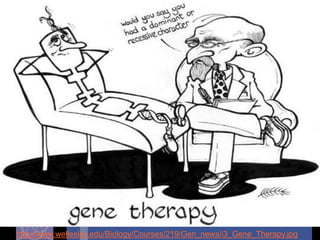
GENE THERAPY
 Gene
 Gene Therapy
 Approaches for gene therapy
 History
 How gene therapy is carried out?
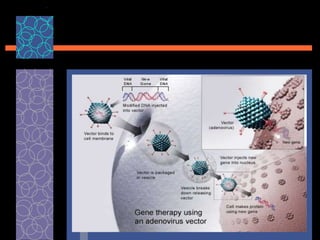
 How it works?
 Delivery systems
 Different types of viruses used in gene therapy
vectors
 Non-viral Options
 Disadvantages of gene therapy
 Disease targets for Gene Therapy
oImmunodeficiency disorder
oVascular proliferative disorders
oLung Diseases
oLiver diseases
oSkeletal muscle
oHemoglobinopathies
oCancer
oOthers
oRare Disease Treated Using Gene
Therapy
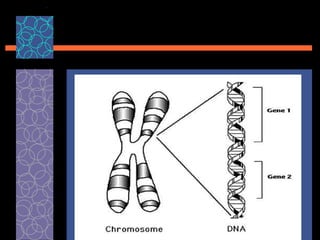
GENES
Carried on chromosome
Basic unit of hereditary
Encode how to make protein
DNA>RNA>Protein
When gene altered cause
dysfunction of a protein
GENE THERAPY
 It is technique for correcting defective
genes that are responsible for disease
development
 Introduction of normal gene into cells
that contain defective gene to
reconstitute a missing protein product
 Is used to correct a definitive
phenotype so that sufficient amount of
a normal gene product are synthesized
Approaches for Gene Therapy
 A normal gene inserted to compensate
for a nonfunctional gene
 An abnormal gene traded for a normal
gene
 An abnormal gene repaired through
selective reverse mutation
 Change the regulation of gene pairs
HISTORY
 In 1980’s scientists began to look
into gene therapy
Insert human gene to bacterial cell
Bacterial cell would transcribe and
translate the information into protein
Then they would introduce the protein
into human cells
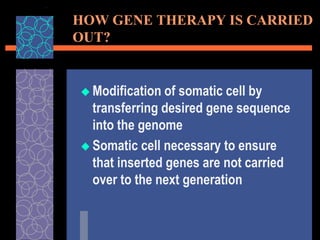
HOW GENE THERAPY IS CARRIED
OUT?
 Modification of somatic cell by
transferring desired gene sequence
into the genome
 Somatic cell necessary to ensure
that inserted genes are not carried
over to the next generation
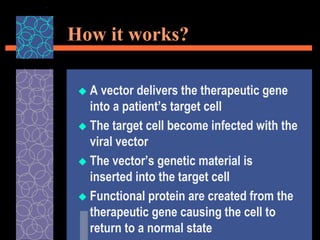
How it works?
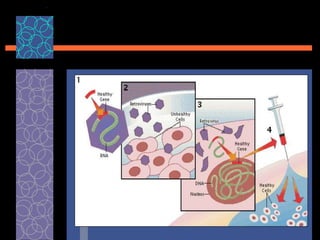
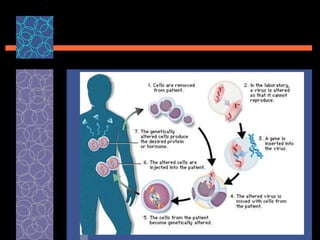
 A vector delivers the therapeutic gene
into a patient’s target cell
 The target cell become infected with the
viral vector
 The vector’s genetic material is
inserted into the target cell
 Functional protein are created from the
therapeutic gene causing the cell to
return to a normal state
Delivery systems
 In vivo:-
o Delivery of gene takes place in
the body
 In vitro:-
o Delivery takes place out of the
body and then cell are placed
back into the body
 In vivo technique use viral vector:-
– Virus = carrier of desired gene
– Virus is usually “crippled” to disable its
ability to cause disease
– Viral methods have proved to be the
most efficient to date
– Many viral vectors can stable integrate
the desired gene into the target cell’s
genome
 In vitro technique usually use
manipulation technique:-
– Electroporation
– Liposome
– Calcium phosphate
– Gold bullets (fired within helium pressurized
gun)
– Retrotransposons (jumping genes – early
days)
– Human artificial chromosomes
Different types of viruses used in
gene therapy vectors
 Retroviruses:-
A class of viruses that can
create double standard DNA
copies of their RNA genome
Copy of its genome can be
integrated into the chromosome
of host cell
HIV virus is retrovirus
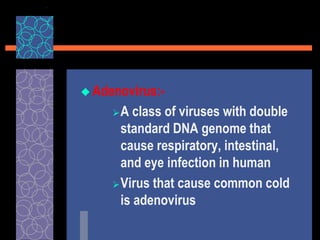
 Adenovirus:-
A class of viruses with double
standard DNA genome that
cause respiratory, intestinal,
and eye infection in human
Virus that cause common cold
is adenovirus
 Adeno- associated virus:-
A class of small, single,
standard DNA viruses that can
insert their genetic material at a
specific site on chromosome 19
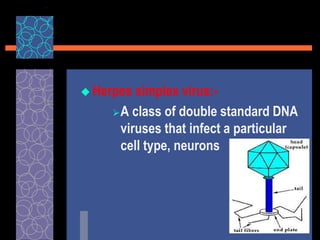
 Herpes simplex virus:-
A class of double standard DNA
viruses that infect a particular
cell type, neurons
Non-viral Options
 Direct introduction of therapeutic
DNA into target cells
 The creation of an artificial lipid
sphere with an aqueous core
 Chemically linking the DNA to a
molecule that will bind to special cell
receptors (less effective  )
Advantage of gene therapy
 Provide better treatment options for
cancer, AIDS and some hereditary
disease
Disadvantages of gene therapy
 Short-lived nature of gene therapy
 Immune response
 Problems with viral vectors
 Multigene disorders
 Ethical and legal problems
 Religious concerns
Disease targets for Gene Therapy
 Immunodeficiency disorder :-
For the treatment of congenital
immunodeficiency disorder
illustrate the use of ex vivo gene
transfer into hematopoietic stem cell
The three important
immunodeficiency syndrome that
use gene therapy are:-
 Adenosine deaminase deficiency:-
o First genetic diseases clinically treated
with gene therapy
o In children with this disorder leads to
the accumulation of deoxyadenosine
triphosphate that is toxic to lymphocyte
o It develop infections due to the
defective cell mediated and humoral
immune responses
Standard therapy is bone marrow
transplantation with periodic infusion of
PEG-ADA enzyme
 X- linked severe combined
immunodeficiency:-
Gene therapy for treating children with
X-SCID (sever combined
immunodeficiency) or the "bubble boy“
 Child is born with a very weal immune
system
Through this therapy, ADA is inserted
and then the genetically corrected cells
are transplanted back into the child
Vascular proliferative
disorders
 Atherosclerosis, restenosis after
angioplasty, and bypass-graft failure,
are leading causes of morbidity and
mortality
 Leads to up-regulated expression of
growth factors, cytokines, and
adhesion molecules by the vascular
smooth-muscle cells
Lung Diseases
 Several gene delivery vectors have
been applied to treating inherited
lung diseases
Cystic fibrosis:-
 Adeno-associated viral vector for
delivering CFTR are now in clinical
trials
 Alpha-1 Antitrypsin deficiency:-
It cause individual to pulmonary
emphysema and hepatic chirriosis
Recombinant alpha-1 antitrypsin
protein is commercially available for
human use
Liver diseases
 The liver can be afflicted with variety
of metabolic, infectious, and
neoplastic diseases for which
specific molecular intervention can
be envisioned
Skeletal muscle
 A variety of inherited disorder of
muscle including Duchenne
muscular dystrophy and the limb
girdle muscular dystrophies are
prime targets for the development of
gene based therapies
 Adeno- associated virus has been
demonstrated to be capable of
efficient and stable transduction of
adult skeletal muscle
Hemoglobinopathies
 Sickle cell disease and the
thalassemias are common single
gene disorders associated with
substantial morbidity and mortality
 These disorder should be amenable
to ex vivo gene transfer into
hematopoietic stem cells which then
would be used to reconstitute a
patient’s bone marrow
Cancer
 Multiple strategies have been
experimented with to treat different
kinds of cancer.
 These strategies include:-
 Oncolytic virotherapy
Suicide gene therapy
Therapeutic gene vaccines
Anti-angiogenesis
 Nanotechnology + gene therapy
yields treatment to torpedo cancer.
 A combination of two tumor
suppressing genes delivered in
lipid-based nanoparticles
drastically reduces the number
and size of human lung cancer
tumors
Others
 Chronic Granulomatus Disorder
(CGD),in which the process of ADA-
SCID is followed to help the patients
 In Hemophilia, the therapeutic gene
is introduced in the patient’s body to
cure it.
 Gene therapy is effectively used to
treat two adult patients for a disease
affecting no lymphocytic white blood
cells called myeloid cells
 Gene Therapy cures deafness in
guinea pigs. Thus gene therapy cure
deafness
 Neurodegenerative Diseases:-
Treatment of neurodegenerative
diseases such as Parkinson’s disease
and Huntington’s disease
Rare Disease Treated Using
Gene Therapy
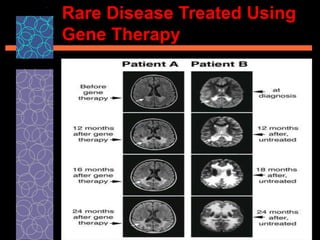
 Brain scans of two boys with X-
linked adrenoleukodystrophy (ALD):-
The scans on the left (A) are from
a patient who received gene
therapy
 the one on the right (B) did not
The white areas represent the
brain damage caused by the
disease
The arrow on the left points to an
area that showed some damage,
but receded over the course of the
therapy
When gene therapy started, there
were a lot of predictions that this
was going to revolutionize
medicine. It's been a long time to
actually get it to work in humans"
 If the treatment for ALD holds up, it
might be the start of that revolution
http://www.wellesley.edu/Biology/Courses/219/Gen_news/i3_Gene_Therapy.jpg
Dr. BIKASH BHANDARI

Genes.ppt2003

  • 1.
  • 2.
     Gene  GeneTherapy  Approaches for gene therapy  History  How gene therapy is carried out?  How it works?  Delivery systems  Different types of viruses used in gene therapy vectors
  • 3.
     Non-viral Options Disadvantages of gene therapy  Disease targets for Gene Therapy oImmunodeficiency disorder oVascular proliferative disorders oLung Diseases oLiver diseases oSkeletal muscle oHemoglobinopathies oCancer oOthers oRare Disease Treated Using Gene Therapy
  • 4.
    GENES Carried on chromosome Basicunit of hereditary Encode how to make protein DNA>RNA>Protein When gene altered cause dysfunction of a protein
  • 6.
    GENE THERAPY  Itis technique for correcting defective genes that are responsible for disease development  Introduction of normal gene into cells that contain defective gene to reconstitute a missing protein product  Is used to correct a definitive phenotype so that sufficient amount of a normal gene product are synthesized
  • 7.
    Approaches for GeneTherapy  A normal gene inserted to compensate for a nonfunctional gene  An abnormal gene traded for a normal gene  An abnormal gene repaired through selective reverse mutation  Change the regulation of gene pairs
  • 8.
    HISTORY  In 1980’sscientists began to look into gene therapy Insert human gene to bacterial cell Bacterial cell would transcribe and translate the information into protein Then they would introduce the protein into human cells
  • 9.
    HOW GENE THERAPYIS CARRIED OUT?  Modification of somatic cell by transferring desired gene sequence into the genome  Somatic cell necessary to ensure that inserted genes are not carried over to the next generation
  • 10.
    How it works? A vector delivers the therapeutic gene into a patient’s target cell  The target cell become infected with the viral vector  The vector’s genetic material is inserted into the target cell  Functional protein are created from the therapeutic gene causing the cell to return to a normal state
  • 13.
    Delivery systems  Invivo:- o Delivery of gene takes place in the body  In vitro:- o Delivery takes place out of the body and then cell are placed back into the body
  • 14.
     In vivotechnique use viral vector:- – Virus = carrier of desired gene – Virus is usually “crippled” to disable its ability to cause disease – Viral methods have proved to be the most efficient to date – Many viral vectors can stable integrate the desired gene into the target cell’s genome
  • 15.
     In vitrotechnique usually use manipulation technique:- – Electroporation – Liposome – Calcium phosphate – Gold bullets (fired within helium pressurized gun) – Retrotransposons (jumping genes – early days) – Human artificial chromosomes
  • 16.
    Different types ofviruses used in gene therapy vectors  Retroviruses:- A class of viruses that can create double standard DNA copies of their RNA genome Copy of its genome can be integrated into the chromosome of host cell HIV virus is retrovirus
  • 18.
     Adenovirus:- A classof viruses with double standard DNA genome that cause respiratory, intestinal, and eye infection in human Virus that cause common cold is adenovirus
  • 19.
     Adeno- associatedvirus:- A class of small, single, standard DNA viruses that can insert their genetic material at a specific site on chromosome 19
  • 20.
     Herpes simplexvirus:- A class of double standard DNA viruses that infect a particular cell type, neurons
  • 21.
    Non-viral Options  Directintroduction of therapeutic DNA into target cells  The creation of an artificial lipid sphere with an aqueous core  Chemically linking the DNA to a molecule that will bind to special cell receptors (less effective  )
  • 22.
    Advantage of genetherapy  Provide better treatment options for cancer, AIDS and some hereditary disease
  • 23.
    Disadvantages of genetherapy  Short-lived nature of gene therapy  Immune response  Problems with viral vectors  Multigene disorders  Ethical and legal problems  Religious concerns
  • 24.
    Disease targets forGene Therapy  Immunodeficiency disorder :- For the treatment of congenital immunodeficiency disorder illustrate the use of ex vivo gene transfer into hematopoietic stem cell The three important immunodeficiency syndrome that use gene therapy are:-
  • 25.
     Adenosine deaminasedeficiency:- o First genetic diseases clinically treated with gene therapy o In children with this disorder leads to the accumulation of deoxyadenosine triphosphate that is toxic to lymphocyte o It develop infections due to the defective cell mediated and humoral immune responses
  • 26.
    Standard therapy isbone marrow transplantation with periodic infusion of PEG-ADA enzyme
  • 27.
     X- linkedsevere combined immunodeficiency:- Gene therapy for treating children with X-SCID (sever combined immunodeficiency) or the "bubble boy“  Child is born with a very weal immune system Through this therapy, ADA is inserted and then the genetically corrected cells are transplanted back into the child
  • 28.
    Vascular proliferative disorders  Atherosclerosis,restenosis after angioplasty, and bypass-graft failure, are leading causes of morbidity and mortality  Leads to up-regulated expression of growth factors, cytokines, and adhesion molecules by the vascular smooth-muscle cells
  • 30.
    Lung Diseases  Severalgene delivery vectors have been applied to treating inherited lung diseases Cystic fibrosis:-  Adeno-associated viral vector for delivering CFTR are now in clinical trials
  • 31.
     Alpha-1 Antitrypsindeficiency:- It cause individual to pulmonary emphysema and hepatic chirriosis Recombinant alpha-1 antitrypsin protein is commercially available for human use
  • 32.
    Liver diseases  Theliver can be afflicted with variety of metabolic, infectious, and neoplastic diseases for which specific molecular intervention can be envisioned
  • 33.
    Skeletal muscle  Avariety of inherited disorder of muscle including Duchenne muscular dystrophy and the limb girdle muscular dystrophies are prime targets for the development of gene based therapies  Adeno- associated virus has been demonstrated to be capable of efficient and stable transduction of adult skeletal muscle
  • 34.
    Hemoglobinopathies  Sickle celldisease and the thalassemias are common single gene disorders associated with substantial morbidity and mortality  These disorder should be amenable to ex vivo gene transfer into hematopoietic stem cells which then would be used to reconstitute a patient’s bone marrow
  • 35.
    Cancer  Multiple strategieshave been experimented with to treat different kinds of cancer.  These strategies include:-  Oncolytic virotherapy Suicide gene therapy Therapeutic gene vaccines Anti-angiogenesis
  • 36.
     Nanotechnology +gene therapy yields treatment to torpedo cancer.  A combination of two tumor suppressing genes delivered in lipid-based nanoparticles drastically reduces the number and size of human lung cancer tumors
  • 37.
    Others  Chronic GranulomatusDisorder (CGD),in which the process of ADA- SCID is followed to help the patients  In Hemophilia, the therapeutic gene is introduced in the patient’s body to cure it.
  • 38.
     Gene therapyis effectively used to treat two adult patients for a disease affecting no lymphocytic white blood cells called myeloid cells  Gene Therapy cures deafness in guinea pigs. Thus gene therapy cure deafness
  • 39.
     Neurodegenerative Diseases:- Treatmentof neurodegenerative diseases such as Parkinson’s disease and Huntington’s disease
  • 40.
    Rare Disease TreatedUsing Gene Therapy
  • 41.
     Brain scansof two boys with X- linked adrenoleukodystrophy (ALD):- The scans on the left (A) are from a patient who received gene therapy  the one on the right (B) did not The white areas represent the brain damage caused by the disease
  • 42.
    The arrow onthe left points to an area that showed some damage, but receded over the course of the therapy When gene therapy started, there were a lot of predictions that this was going to revolutionize medicine. It's been a long time to actually get it to work in humans"
  • 43.
     If thetreatment for ALD holds up, it might be the start of that revolution
  • 44.
  • 47.