MANISHA BHAURYAL
(B.PHARM 5 Sem.)
2018
manishabhauryal@gmil.com
DEPARTMENT OF PHARMACEUTICAL SCIENCES,
BHIMTAL CAMPUS
KUMAUN UNIVERSITY,
NAINITAL (UTTARAKHAND)
INTRODUCTION
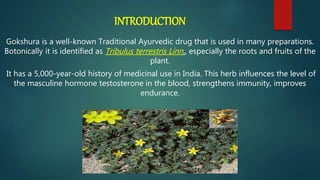
Gokshura is a well-known Traditional Ayurvedic drug that is used in many preparations.
Botonically it is identified as Tribulus terrestris Linn., especially the roots and fruits of the
plant.
It has a 5,000-year-old history of medicinal use in India. This herb influences the level of
the masculine hormone testosterone in the blood, strengthens immunity, improves
endurance.
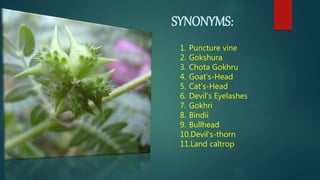
1. Puncture vine
2. Gokshura
3. Chota Gokhru
4. Goat’s-Head
5. Cat’s-Head
6. Devil’s Eyelashes
7. Gokhri
8. Bindii
9. Bullhead
10.Devil’s-thorn
11.Land caltrop
SYNONYMS:
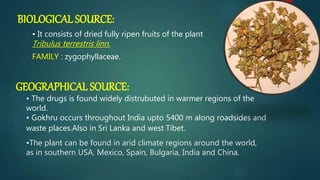
BIOLOGICAL SOURCE:
• It consists of dried fully ripen fruits of the plant
Tribulus terrestris linn.
FAMILY : zygophyllaceae.
GEOGRAPHICAL SOURCE:
• The drugs is found widely distrubuted in warmer regions of the
world.
• Gokhru occurs throughout India upto 5400 m along roadsides and
waste places.Also in Sri Lanka and west Tibet.
•The plant can be found in arid climate regions around the world,
as in southern USA, Mexico, Spain, Bulgaria, India and China.
 Tribulus terrestris is annual or biennial plant. The plant is growing
about 0.6m (2ft) at the fast rate. It is hermaphrodite species and seeds
are used as planting material.
 It is a frost tender annual and we experimenting with its hardiness.
 It is suitable for light(sandy), medium(loamy), high(clay) soils and
prefers well drained dry to moist soil. Water-logged and highly alkaline
soil is unsuitable for cultivation.
 A network of fine rootlets arise from the taproot to take advantage of
soil moisture by which the plant can survive in very arid conditions. But
it can’t grow in the shade.
 It requires low rainfall and it flowers in rainy season from April to
August. The seeds ripen in October when the crop is uprooted. Seeds
and roots are separated and dried then ollected in October to
November.
CULTIVATION AND COLLECTIONS:
MACROSCOPY:
 COLOUR
 ODOUR
 SIZE
 SHAPE
 TEXTURE
 TASTE
- Fruits are greenish to gray.
- Odourless
- 1.0 to 1.5cm in diameter,
8.5mm thick.
- Fruits are globose, consisting of
5 to 10 woody cocci, each with
two pairs of hard and sharp
divergent spines.
- Hard.
- Slightly bitter and Astringent.
MICROSCOPY:
 TRICROME – Straight, unicellular, with bulbous base. Some are very short
and narrow usually bent at the base.
 EPICARP – Rectangular to polygonal in surface view and transeversed by
anisocytic stomata.
 MESOCARP – Stone cells with lumen of variable thickness.
 ENDOCARP – Cells are parenchymatous and striated.
 CRYSTALS – Clusters of calcium oxalate crystals
 ENDOSPERM – Cells filled with starch grains, fixed oil globules and aleuren
grains.
 VESSELS – Spiral thickening.
 TESTA and CALYX present but not characteristic.
DIGRAMETRIC T.S. OF RIPEN FRUIT:
CHEMICAL CONSTITUENTS:
 The drug contains traces of alkaloids and harman
.
 They contain saponins Teresterosin A,
Teresterosin E, Tribulosin, which on hydrolysis
yield, steroidal sapogenins like Diosgenin,
Gitogenin, Chlorogenin and Ruscogenin. The
roots and leaves also contain saponin.
 Flavonoids, kaemferol, tribuloside and its
derivatives have also been isolated from the
leaves and fruits. Fixed oil (3.5%), resin.
 It contains not less than 0.5 % Diosgenin on
dried basis.
PHYTOCHEMICAL TEST:
Sno. PARAMETERS RANGE
1 Foreign organic matter Not less than 2%
2 Ash values – Total ash Not less than 9%
3 Ash values – acid insoluble Not less than 3%
4 Extractive values alcohol soluble Not less than 6%
5 Extractive values water soluble Not less than 16%
ADULTRANT & SUBSTITUTE:
• Instead the fruits of another plant Pedalium murex Linn. (B) are commonly used and the
drug is frequently substituted.But both the species (B,D) are proved for
Nephroprotective, Lithotriptic, Diuretic and Hepatoprotective activities.
Tribulus terrestris
(Zygophyllaceae)
Pedalium murex
(Pedaliaceae)
USES:
• Fruits are used as Diuretic, Tonic, Emmenagogue and also
in the treatment of Calculous affections and painful
micturition. They are also used as Aphrodisiac, emollient,
expectorant, anodyne, anti-inflammatory, cardiotonic,
styptic and linthontriptic properties .
• They are useful in gonorrhoea, gout, gleet, ultitis,
inflammation, menorrhagia, strangury, leprosy, skin
diseases, verminosis and general weaknss.
• The seeds are astringent, strengthening and are useful
in epistaxis, haemorrhages and ulcerative stomatitis.
• The ash of whole plant is good for external application in rheumarthritisals.
• The Ayurvedic system of medicine Gokhru is indicated for use for regulation
of heart function, reduction of inflammation, indigestion, chronic cough,
asthma, internal inflammation and anaemia also.
• Gokhru is a common ingredient of ayurvedic preparations, Dashmoolarishta
and Chyavanprash.
VARIETIES:
THANKING YOU

Gokhru

  • 1.
    MANISHA BHAURYAL (B.PHARM 5Sem.) 2018 manishabhauryal@gmil.com DEPARTMENT OF PHARMACEUTICAL SCIENCES, BHIMTAL CAMPUS KUMAUN UNIVERSITY, NAINITAL (UTTARAKHAND)
  • 3.
    INTRODUCTION Gokshura is awell-known Traditional Ayurvedic drug that is used in many preparations. Botonically it is identified as Tribulus terrestris Linn., especially the roots and fruits of the plant. It has a 5,000-year-old history of medicinal use in India. This herb influences the level of the masculine hormone testosterone in the blood, strengthens immunity, improves endurance.
  • 4.
    1. Puncture vine 2.Gokshura 3. Chota Gokhru 4. Goat’s-Head 5. Cat’s-Head 6. Devil’s Eyelashes 7. Gokhri 8. Bindii 9. Bullhead 10.Devil’s-thorn 11.Land caltrop SYNONYMS:
  • 5.
    BIOLOGICAL SOURCE: • Itconsists of dried fully ripen fruits of the plant Tribulus terrestris linn. FAMILY : zygophyllaceae. GEOGRAPHICAL SOURCE: • The drugs is found widely distrubuted in warmer regions of the world. • Gokhru occurs throughout India upto 5400 m along roadsides and waste places.Also in Sri Lanka and west Tibet. •The plant can be found in arid climate regions around the world, as in southern USA, Mexico, Spain, Bulgaria, India and China.
  • 6.
     Tribulus terrestrisis annual or biennial plant. The plant is growing about 0.6m (2ft) at the fast rate. It is hermaphrodite species and seeds are used as planting material.  It is a frost tender annual and we experimenting with its hardiness.  It is suitable for light(sandy), medium(loamy), high(clay) soils and prefers well drained dry to moist soil. Water-logged and highly alkaline soil is unsuitable for cultivation.  A network of fine rootlets arise from the taproot to take advantage of soil moisture by which the plant can survive in very arid conditions. But it can’t grow in the shade.  It requires low rainfall and it flowers in rainy season from April to August. The seeds ripen in October when the crop is uprooted. Seeds and roots are separated and dried then ollected in October to November. CULTIVATION AND COLLECTIONS:
  • 7.
    MACROSCOPY:  COLOUR  ODOUR SIZE  SHAPE  TEXTURE  TASTE - Fruits are greenish to gray. - Odourless - 1.0 to 1.5cm in diameter, 8.5mm thick. - Fruits are globose, consisting of 5 to 10 woody cocci, each with two pairs of hard and sharp divergent spines. - Hard. - Slightly bitter and Astringent.
  • 8.
    MICROSCOPY:  TRICROME –Straight, unicellular, with bulbous base. Some are very short and narrow usually bent at the base.  EPICARP – Rectangular to polygonal in surface view and transeversed by anisocytic stomata.  MESOCARP – Stone cells with lumen of variable thickness.  ENDOCARP – Cells are parenchymatous and striated.  CRYSTALS – Clusters of calcium oxalate crystals  ENDOSPERM – Cells filled with starch grains, fixed oil globules and aleuren grains.  VESSELS – Spiral thickening.  TESTA and CALYX present but not characteristic.
  • 9.
    DIGRAMETRIC T.S. OFRIPEN FRUIT:
  • 10.
    CHEMICAL CONSTITUENTS:  Thedrug contains traces of alkaloids and harman .  They contain saponins Teresterosin A, Teresterosin E, Tribulosin, which on hydrolysis yield, steroidal sapogenins like Diosgenin, Gitogenin, Chlorogenin and Ruscogenin. The roots and leaves also contain saponin.  Flavonoids, kaemferol, tribuloside and its derivatives have also been isolated from the leaves and fruits. Fixed oil (3.5%), resin.  It contains not less than 0.5 % Diosgenin on dried basis.
  • 11.
    PHYTOCHEMICAL TEST: Sno. PARAMETERSRANGE 1 Foreign organic matter Not less than 2% 2 Ash values – Total ash Not less than 9% 3 Ash values – acid insoluble Not less than 3% 4 Extractive values alcohol soluble Not less than 6% 5 Extractive values water soluble Not less than 16%
  • 12.
    ADULTRANT & SUBSTITUTE: •Instead the fruits of another plant Pedalium murex Linn. (B) are commonly used and the drug is frequently substituted.But both the species (B,D) are proved for Nephroprotective, Lithotriptic, Diuretic and Hepatoprotective activities. Tribulus terrestris (Zygophyllaceae) Pedalium murex (Pedaliaceae)
  • 13.
    USES: • Fruits areused as Diuretic, Tonic, Emmenagogue and also in the treatment of Calculous affections and painful micturition. They are also used as Aphrodisiac, emollient, expectorant, anodyne, anti-inflammatory, cardiotonic, styptic and linthontriptic properties . • They are useful in gonorrhoea, gout, gleet, ultitis, inflammation, menorrhagia, strangury, leprosy, skin diseases, verminosis and general weaknss. • The seeds are astringent, strengthening and are useful in epistaxis, haemorrhages and ulcerative stomatitis.
  • 14.
    • The ashof whole plant is good for external application in rheumarthritisals. • The Ayurvedic system of medicine Gokhru is indicated for use for regulation of heart function, reduction of inflammation, indigestion, chronic cough, asthma, internal inflammation and anaemia also. • Gokhru is a common ingredient of ayurvedic preparations, Dashmoolarishta and Chyavanprash. VARIETIES:
  • 15.