Pokhara University
School of Health and Allied Sciences
A Randomized, Controlled Trial to Test
the Effectiveness of a Glaucoma Patient
Navigator to Improve Appointment
Adherence
Presented By : Deepa kumari karn
Seminar 3nd , M Pharm (C.P), 1st Sem
Pokhara University
School of Health and Allied Sciences
Table of Content
• Introduction
• Research Question
• Literature Review
• Objective
– General Objective
– Specific Objective
• Rational of Study
Pokhara University
School of Health and Allied Sciences
• Methods
– Study design
– Sample size
• Results
Pokhara University
School of Health and Allied Sciences
• Methods
– Study design
– Participants
– Sample size
• Results
– Efficacy assessment
– Statistical Analysis
• Discussion
• Conclusion
• References
5/29/2017 4
Pokhara University
School of Health and Allied Sciences
Introduction
• Glaucoma is a progressive neurodegenerative
disorder that affects the optic nerve and the inner
layers of the retina
• Appropriate treatment and follow-up eye care are
crucial in preventing vision loss due to glaucoma
• Various research suggested that there are various
factors that is associated with the poor follow up
adherence among those people diagnosed with
glaucoma who were prescribed intraocular pressure-
lowering eye drops
Pokhara University
School of Health and Allied Sciences
• A patient navigator is a member of a health-care
team who helps patients “navigate” the health-care
system and get timely care
• To determine the impact of a patient navigator on
glaucoma eye care follow-up adherence, the
researcher initiated a 1-year prospective,
randomized, controlled trial in an urban community
setting versus office-based setting
Pokhara University
School of Health and Allied Sciences
Research Question
• What is the impact of a patient navigator on
glaucoma eye care follow-up adherence, in 1-year
prospective, randomized, controlled trial?
Pokhara University
School of Health and Allied Sciences
Literature Review
• The patient navigator concept was first introduced in
the 1990s by Dr Harold Freeman to help females
obtain breast cancer screening
• Patient navigation programs have been shown in
several randomized, controlled trials to improve
appointment adherence, initiation of treatment, and
patient’s quality of life
Pokhara University
School of Health and Allied Sciences
• Patient navigators have been utilized in a variety of
medical fields with the navigators serving to help
patients schedule doctor’s appointments, determine
insurance requirements, arrange transportation,
make appointment reminder calls, and accompany
patients to their appointments
• There was limited data on the use of a patient
navigator in an ophthalmic patient population and its
efficacy in improving follow-up adherence and
preventing vision loss, particularly among patients
diagnosed with glaucomatous diseases
Pokhara University
School of Health and Allied Sciences
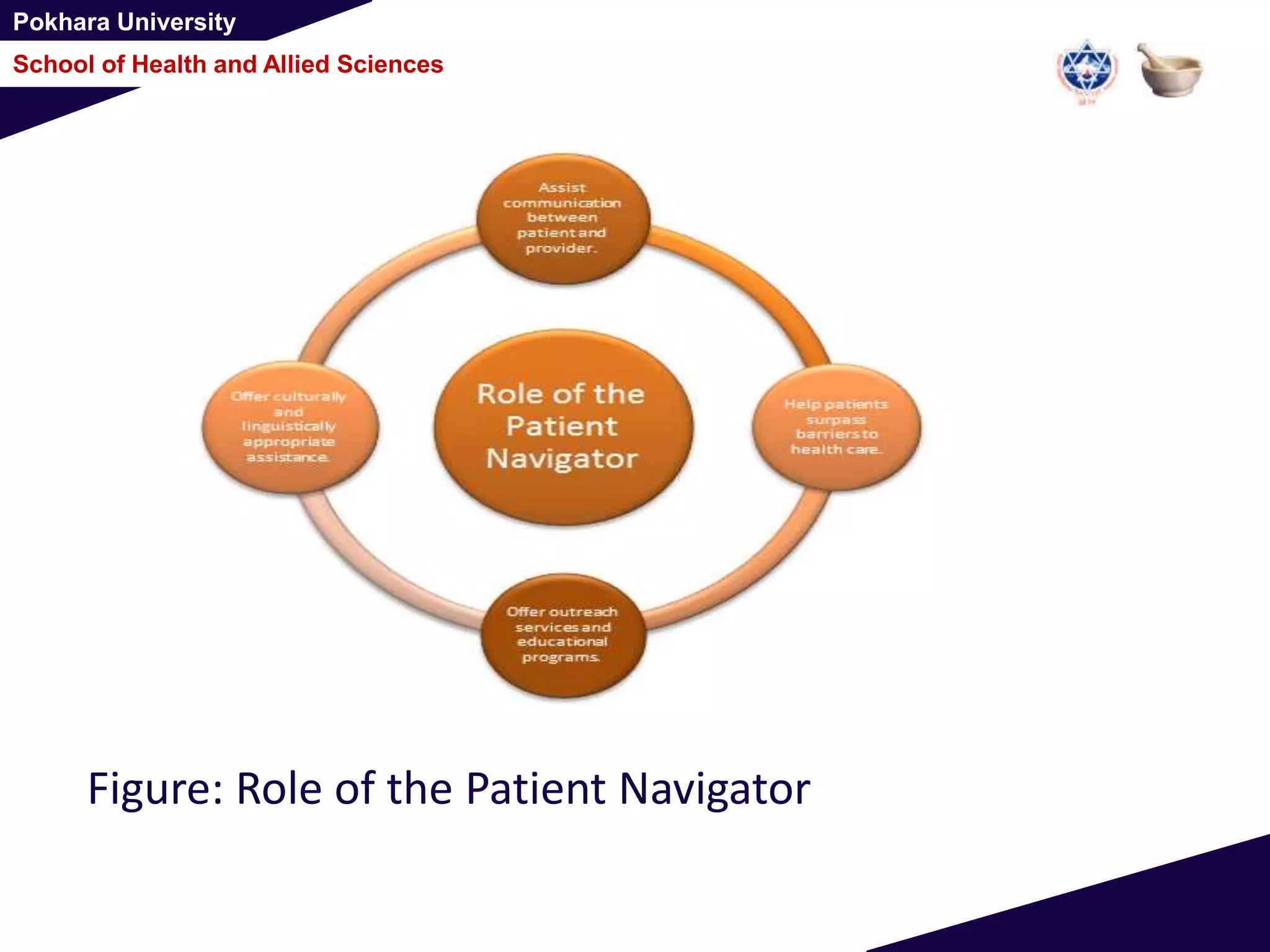
Figure: Role of the Patient Navigator
Pokhara University
School of Health and Allied Sciences
Objective
• General Objective
– To determine the impact of a patient navigator on
glaucoma eye care follow-up adherence in an urban
community setting versus office-based setting
• Specific Objective
– Assessment of the patient for the eligibility for the
inclusion for the research
– To evaluate how community- and office-based
interventions affected disease progression by assessing
changes in clinical diagnoses
Pokhara University
School of Health and Allied Sciences
– Collection of the patient’s demographic and clinical
characteristics
– Assessment of medication adherence, and a complete eye
examination
Pokhara University
School of Health and Allied Sciences
Rational of Study
• There was limited data on the use of a patient
navigator in an ophthalmic patient population and its
efficacy in improving follow-up adherence and
preventing vision loss, particularly among patients
diagnosed with glaucomatous diseases
Pokhara University
School of Health and Allied Sciences
Methods
• Study Design:-
– This study was a randomized, controlled trial where
subjects were equally randomized into one of three groups
for a 1-year period
– Approved by the Institutional Review Board of Wills Eye
Hospital and conducted in accordance to the Declaration
of Helsinki
– Subjects were equally randomized into one of three groups
for a 1-year period
Pokhara University
School of Health and Allied Sciences
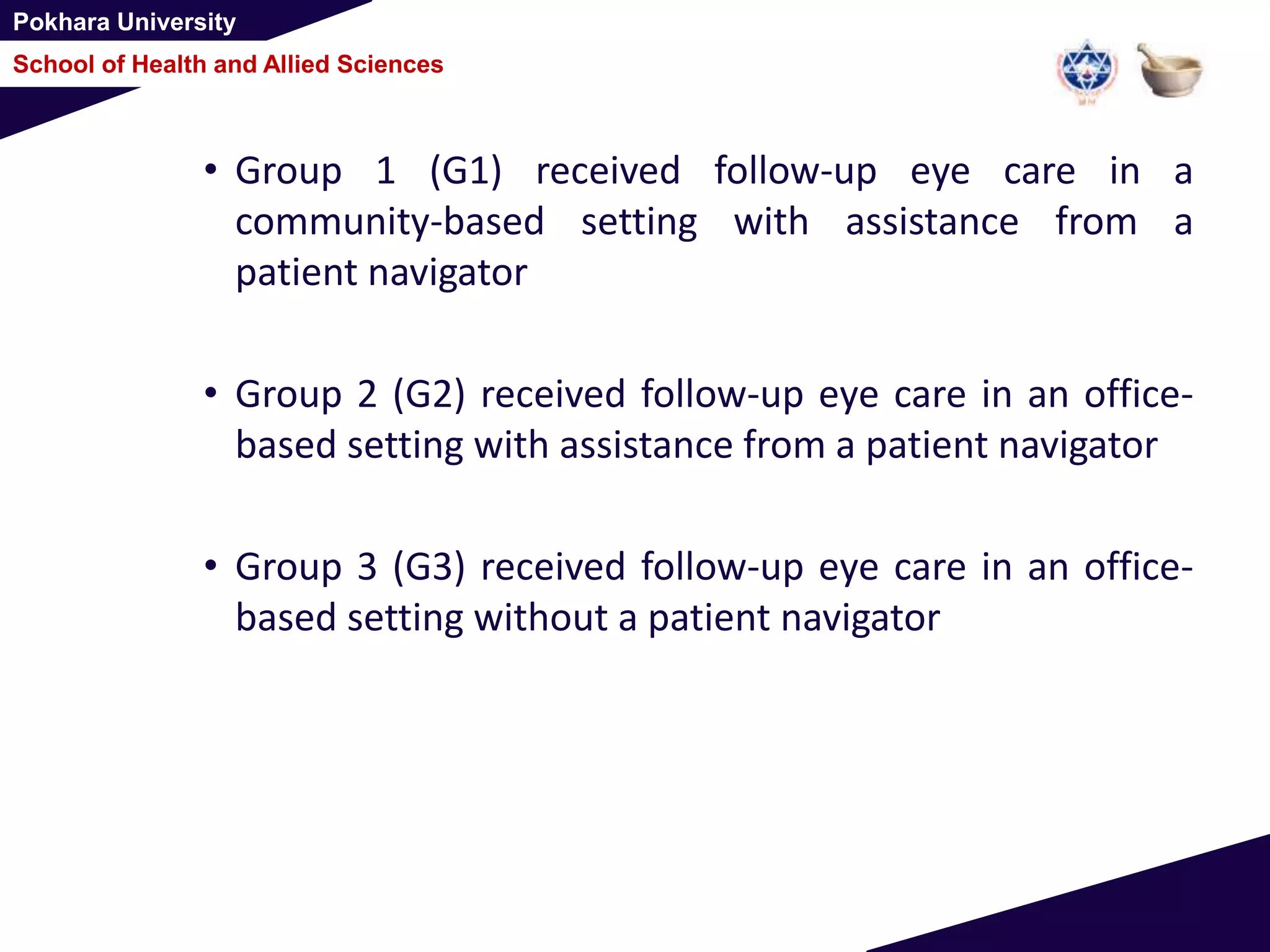
• Group 1 (G1) received follow-up eye care in a
community-based setting with assistance from a
patient navigator
• Group 2 (G2) received follow-up eye care in an office-
based setting with assistance from a patient navigator
• Group 3 (G3) received follow-up eye care in an office-
based setting without a patient navigator
Pokhara University
School of Health and Allied Sciences
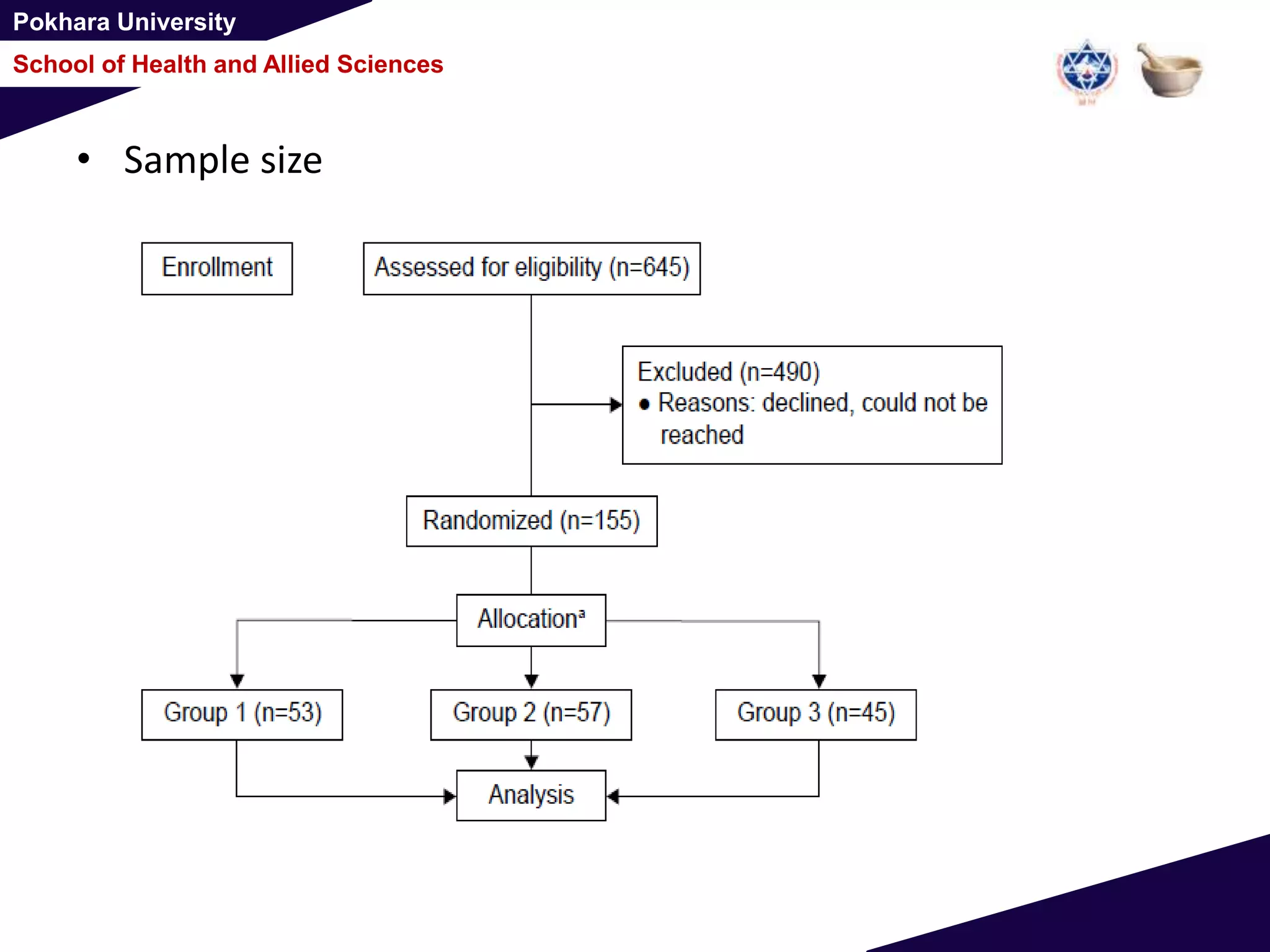
• Sample size
Pokhara University
School of Health and Allied Sciences
Results
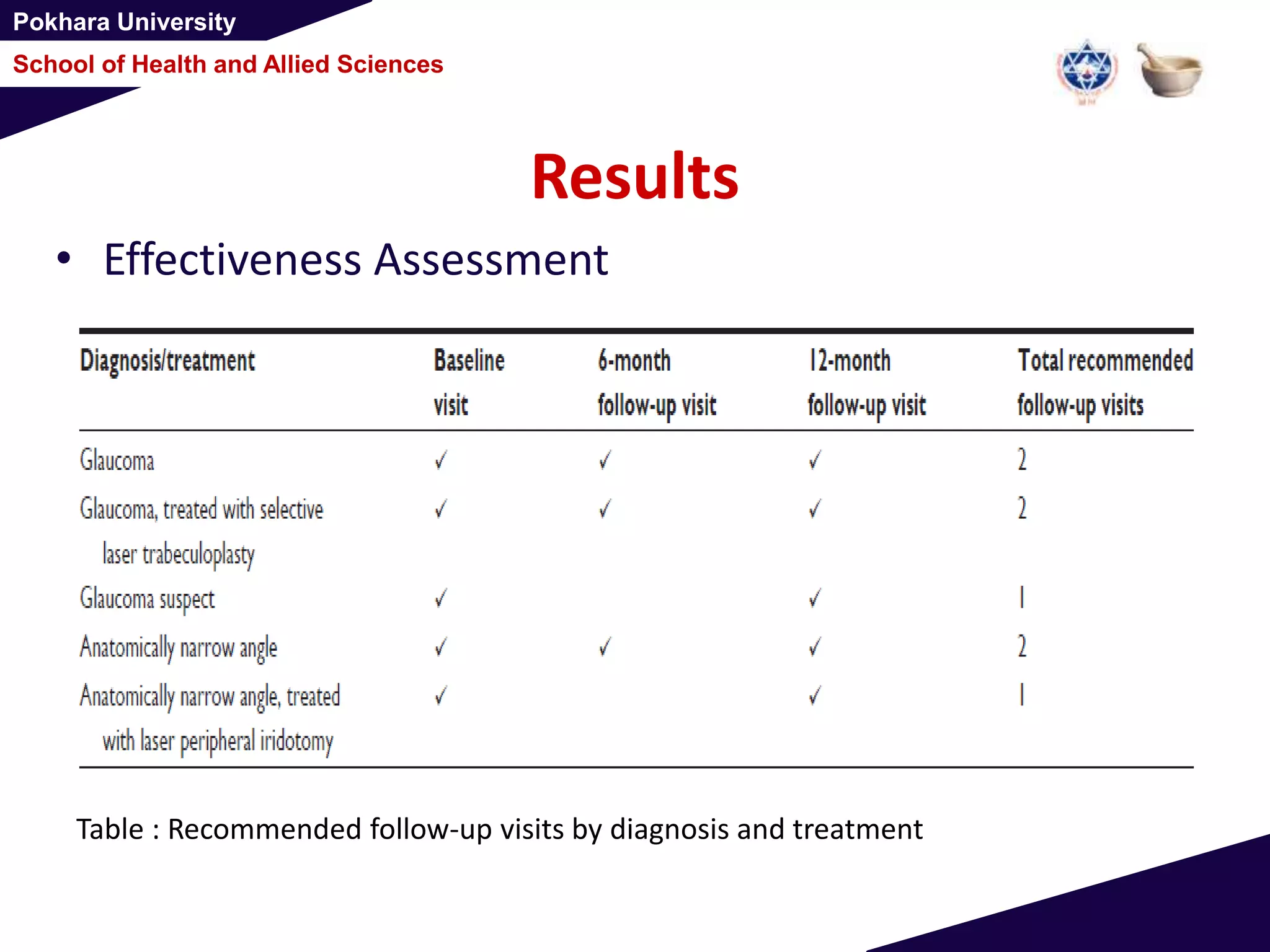
• Effectiveness Assessment
Table : Recommended follow-up visits by diagnosis and treatment
Pokhara University
School of Health and Allied Sciences
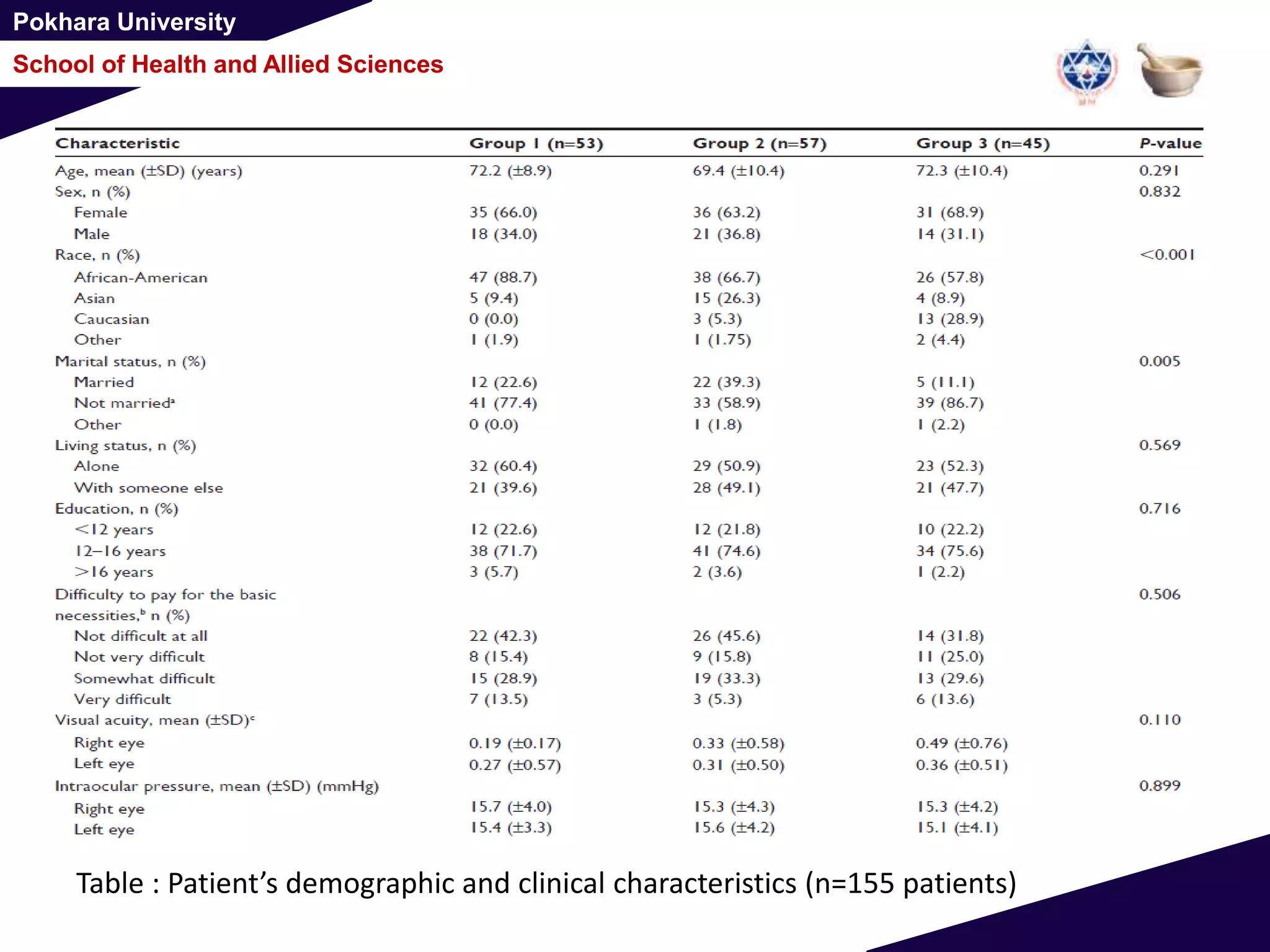
Table : Patient’s demographic and clinical characteristics (n=155 patients)
Pokhara University
School of Health and Allied Sciences
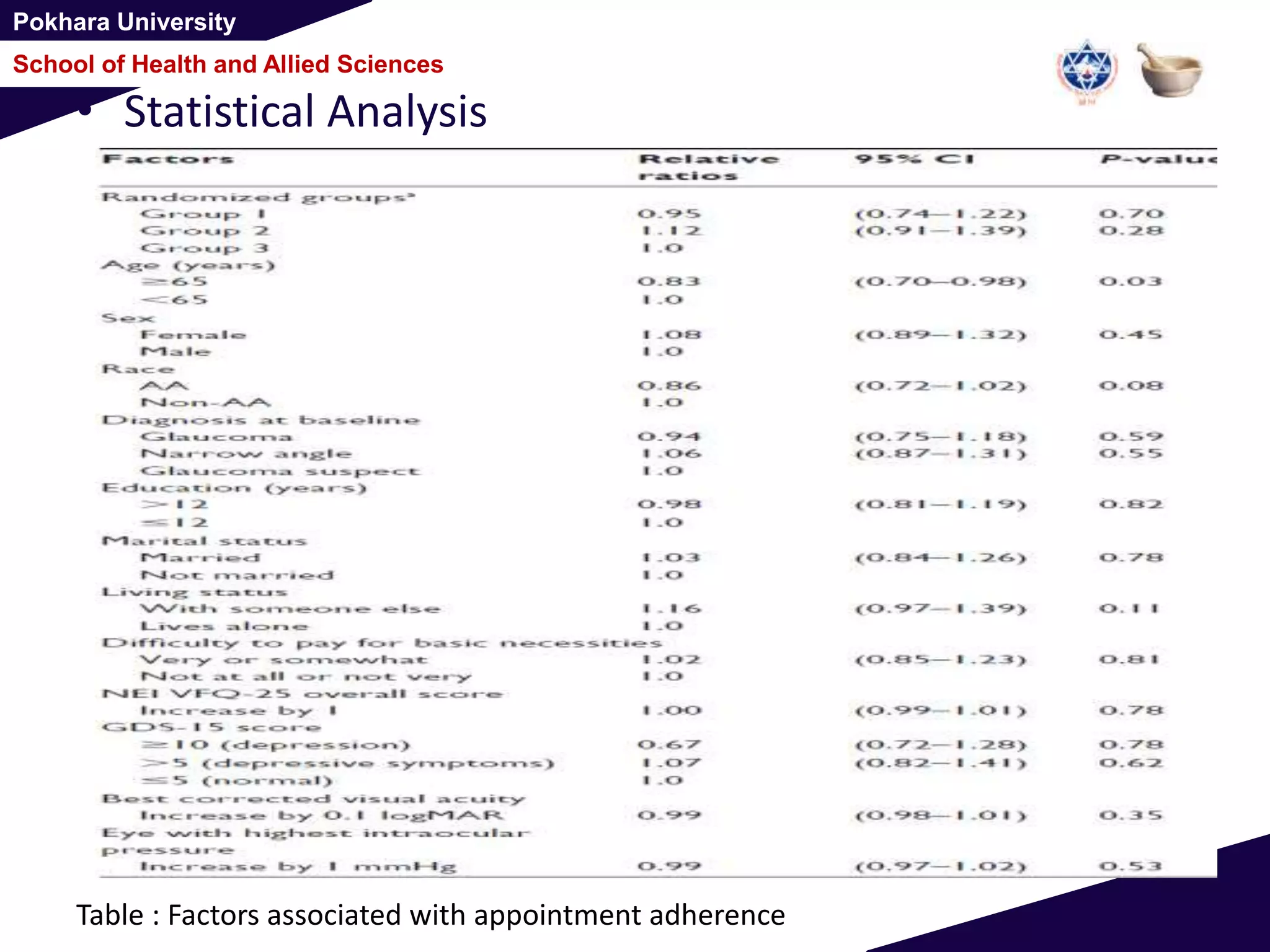
• Statistical Analysis
Table : Factors associated with appointment adherence
Pokhara University
School of Health and Allied Sciences
• The appointment adherence rates were compared
among the three groups using chi-square test at a
significance level of 0.05
Pokhara University
School of Health and Allied Sciences
Pokhara University
School of Health and Allied Sciences
Pokhara University
School of Health and Allied Sciences
Pokhara University
School of Health and Allied Sciences
Pokhara University
School of Health and Allied Sciences
Pokhara University
School of Health and Allied Sciences
References
• Hark AL, Johnson MD, Berardi G, Patel S N, Zeng L,
Dai Y, Mayro LE, Waisbourd M and Katz JL (2016) A
Randomized, Controlled Trial to Test the
Effectiveness of a Glaucoma Patient Navigator to
Improve Appointment Adherence, Dovepress Journal
10, 1739–1748.
• Freeman HP (2012) The origin, evolution, and
principles of patient navigation, Cancer Epidemiol
Biomarkers Prev 21(10),1614–1617.

A Randomized, Controlled Trial to Test the Effectiveness of a Glaucoma Patient Navigator to Improve Appointment Adherence

  • 1.
    Pokhara University School ofHealth and Allied Sciences A Randomized, Controlled Trial to Test the Effectiveness of a Glaucoma Patient Navigator to Improve Appointment Adherence Presented By : Deepa kumari karn Seminar 3nd , M Pharm (C.P), 1st Sem
  • 2.
    Pokhara University School ofHealth and Allied Sciences Table of Content • Introduction • Research Question • Literature Review • Objective – General Objective – Specific Objective • Rational of Study
  • 3.
    Pokhara University School ofHealth and Allied Sciences • Methods – Study design – Sample size • Results
  • 4.
    Pokhara University School ofHealth and Allied Sciences • Methods – Study design – Participants – Sample size • Results – Efficacy assessment – Statistical Analysis • Discussion • Conclusion • References 5/29/2017 4
  • 5.
    Pokhara University School ofHealth and Allied Sciences Introduction • Glaucoma is a progressive neurodegenerative disorder that affects the optic nerve and the inner layers of the retina • Appropriate treatment and follow-up eye care are crucial in preventing vision loss due to glaucoma • Various research suggested that there are various factors that is associated with the poor follow up adherence among those people diagnosed with glaucoma who were prescribed intraocular pressure- lowering eye drops
  • 6.
    Pokhara University School ofHealth and Allied Sciences • A patient navigator is a member of a health-care team who helps patients “navigate” the health-care system and get timely care • To determine the impact of a patient navigator on glaucoma eye care follow-up adherence, the researcher initiated a 1-year prospective, randomized, controlled trial in an urban community setting versus office-based setting
  • 7.
    Pokhara University School ofHealth and Allied Sciences Research Question • What is the impact of a patient navigator on glaucoma eye care follow-up adherence, in 1-year prospective, randomized, controlled trial?
  • 8.
    Pokhara University School ofHealth and Allied Sciences Literature Review • The patient navigator concept was first introduced in the 1990s by Dr Harold Freeman to help females obtain breast cancer screening • Patient navigation programs have been shown in several randomized, controlled trials to improve appointment adherence, initiation of treatment, and patient’s quality of life
  • 9.
    Pokhara University School ofHealth and Allied Sciences • Patient navigators have been utilized in a variety of medical fields with the navigators serving to help patients schedule doctor’s appointments, determine insurance requirements, arrange transportation, make appointment reminder calls, and accompany patients to their appointments • There was limited data on the use of a patient navigator in an ophthalmic patient population and its efficacy in improving follow-up adherence and preventing vision loss, particularly among patients diagnosed with glaucomatous diseases
  • 10.
    Pokhara University School ofHealth and Allied Sciences Figure: Role of the Patient Navigator
  • 11.
    Pokhara University School ofHealth and Allied Sciences Objective • General Objective – To determine the impact of a patient navigator on glaucoma eye care follow-up adherence in an urban community setting versus office-based setting • Specific Objective – Assessment of the patient for the eligibility for the inclusion for the research – To evaluate how community- and office-based interventions affected disease progression by assessing changes in clinical diagnoses
  • 12.
    Pokhara University School ofHealth and Allied Sciences – Collection of the patient’s demographic and clinical characteristics – Assessment of medication adherence, and a complete eye examination
  • 13.
    Pokhara University School ofHealth and Allied Sciences Rational of Study • There was limited data on the use of a patient navigator in an ophthalmic patient population and its efficacy in improving follow-up adherence and preventing vision loss, particularly among patients diagnosed with glaucomatous diseases
  • 14.
    Pokhara University School ofHealth and Allied Sciences Methods • Study Design:- – This study was a randomized, controlled trial where subjects were equally randomized into one of three groups for a 1-year period – Approved by the Institutional Review Board of Wills Eye Hospital and conducted in accordance to the Declaration of Helsinki – Subjects were equally randomized into one of three groups for a 1-year period
  • 15.
    Pokhara University School ofHealth and Allied Sciences • Group 1 (G1) received follow-up eye care in a community-based setting with assistance from a patient navigator • Group 2 (G2) received follow-up eye care in an office- based setting with assistance from a patient navigator • Group 3 (G3) received follow-up eye care in an office- based setting without a patient navigator
  • 16.
    Pokhara University School ofHealth and Allied Sciences • Sample size
  • 17.
    Pokhara University School ofHealth and Allied Sciences Results • Effectiveness Assessment Table : Recommended follow-up visits by diagnosis and treatment
  • 18.
    Pokhara University School ofHealth and Allied Sciences Table : Patient’s demographic and clinical characteristics (n=155 patients)
  • 19.
    Pokhara University School ofHealth and Allied Sciences • Statistical Analysis Table : Factors associated with appointment adherence
  • 20.
    Pokhara University School ofHealth and Allied Sciences • The appointment adherence rates were compared among the three groups using chi-square test at a significance level of 0.05
  • 21.
    Pokhara University School ofHealth and Allied Sciences
  • 22.
    Pokhara University School ofHealth and Allied Sciences
  • 23.
    Pokhara University School ofHealth and Allied Sciences
  • 24.
    Pokhara University School ofHealth and Allied Sciences
  • 25.
    Pokhara University School ofHealth and Allied Sciences
  • 26.
    Pokhara University School ofHealth and Allied Sciences References • Hark AL, Johnson MD, Berardi G, Patel S N, Zeng L, Dai Y, Mayro LE, Waisbourd M and Katz JL (2016) A Randomized, Controlled Trial to Test the Effectiveness of a Glaucoma Patient Navigator to Improve Appointment Adherence, Dovepress Journal 10, 1739–1748. • Freeman HP (2012) The origin, evolution, and principles of patient navigation, Cancer Epidemiol Biomarkers Prev 21(10),1614–1617.