PRESENTATION
        ON
PHRASES AND CLAUSES
SENTENCE
INTRODUCTION
SENTENCE

Sentences are made of two parts: the subject
             and the predicate.

   The subject is the person or thing that acts or
    is described in the sentence.
   The predicate, on the other hand, is that action
    or description.

    Complete sentences need both the subject
                and the predicate.
CONJUNCTION
A CONJUNCTION is a word that connects or joins
  together words, phrases, clauses, or sentences.

EXAMPLES:

   Rob and I went to the movies.
   Susan appreciated the flowers; nevertheless, a
    Corvette would be a finer a gift.
   The bank robber dodged the bullet while Joey
    was shot seventeen times in the tibia.
COORDINATING CONJUNCTION

Coordinating conjunctions connect two equal
             parts of a sentence.

EXAMPLES:

   I dodged the bullet, but Joey was shot
    seventeen times in the tibia.
    We ordered pizza but we couldn’t pay for it.
CONJUNCTIVE ADVERB
 When the job of an adverb is to connect ideas, we call
   it a conjunctive adverb. A conjunctive adverb can
        join two main clauses. In this situation, the
     conjunctive adverb behaves like a coordinating
      conjunction, connecting two complete ideas.
EXAMPLES:

   The thunder and lightning were intense;
    consequently, the crowd dispersed.
   John was tired after a long day at school. Therefore,
    he immediately took a nap when he got home.
SUBORDINATE CONJUNCTION

Subordinate conjunctions connect two unequal
 parts, e.g., dependent and independent clauses.

EXAMPLES:

   Susan appreciated the flowers even though a
    Corvette would be a finer gift.
   The gods thundered in the heavens as mortals
    below cowered in fear.
SENTENCE STRUCTURE RULES

   [Independent Clause] , pure conjunction [independent
                            clause]
 The gods thundered in the heavens, and the mortals below

   cowered in fear.
 [Independent clause] ; conjunctive adverb , [independent
                            clause]
 The gods thundered in the heavens; furthermore, the
   mortals below cowered in fear.
        [Independent clause] ; [independent clause]
 The gods thundered in the heavens; the mortals below

   cowered in fear.
SENTENCE STRUCTURE RULES

      [Dependent clause] , [independent clause]
 While the gods thundered in the heavens, the mortals

  below cowered in fear.
     [Dependent clause] subordinate conjunction
                   [independent clause]
 The gods thundered in the heavens as mortals below

  cowered in fear.
[Independent clause] conjunction [dependent clause]
 The gods thundered in the heavens and mortals below

  cowered in fear.
PHRASES
INTRODUCTION
A phrase is a collection of words that may have nouns
or verbals, but it does not have a subject doing a verb.
       The following are examples of phrases:

                 leaving behind the dog
                 smashing into a fence
                 before the first test
                 after the devastation
                 between ignorance and intelligence
                 broken into thousands of pieces
                 because of her glittering smile
In these examples above, you will find nouns (dog, fence, test,
devastation, ignorance, intelligence, thousands, pieces). You also
have some verbal(leaving, smashing), but in no case is the noun
functioning as a subject doing a predicate verb.
TYPES OF PHRASES

        Noun Phrase
        Verb Phrase

     Adjectival Phrase

     Adverbial Phrase

   Prepositional Phrase

     Participial Phrase

         Appositives

      Infinitive Phrase

       Gerund Phrase

     Absolute Phrase
NOUN PHRASE

   A noun phrase or nominal phrase is
    a phrase which has noun (or indefinite
    pronoun) as its head word.
Examples:
   Almost every sentence contains at least one
    noun phrase.
   The election year politics are annoying for many people.
   Current economic weakness may be a result of high
    energy prices.
VERB PHRASE
   Verb phrases are easy to recognize.
    They consist of a verb and all the
    related helping words. Verb phrases
    function as single-word verbs, to
    express action or to link subject and
    complement.
Examples:
   Walking on the ice, she slipped and fell.
   She was walking to the mall.
   Open the door to let the fresh air in.
ADJECTIVAL PHRASE

   An adjectival phrase usually starts
    with a preposition (e.g., of, in, on) or
    a participle (e.g., taken, leaving) and
    follows the noun it is modifying.

Examples:

   This is the end of a very long road.
   My sister is fond of animals.
   Did you see the man leaving the shop?
ADVERBIAL PHRASE
   An adverbial phrase is a group of related
    words which play the role of an adverb. Like
    all phrases, an adverbial phrase does not
    include a subject and a verb.

Examples:
   Tony decided to move to Slough in June last year.
   Darcy can build a card pyramid in less than a minute.
   As long as the wind speed is sufficient, the electrical
    energy will be continuously generated.
PREPOSITIONAL PHRASE

   A prepositional phrase begins with
    a preposition and ends with
    a noun or pronoun.

Examples:
   The hamster sprinted across its cage.
   There are a number of factors.
   The bus went along Cam St. and hit the top of the
    tunnel.
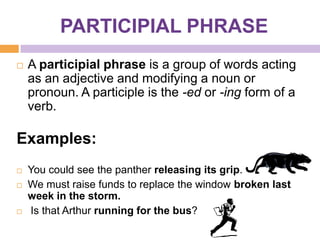
PARTICIPIAL PHRASE
   A participial phrase is a group of words acting
    as an adjective and modifying a noun or
    pronoun. A participle is the -ed or -ing form of a
    verb.

Examples:
   You could see the panther releasing its grip.
   We must raise funds to replace the window broken last
    week in the storm.
   Is that Arthur running for the bus?
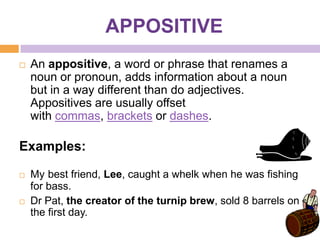
APPOSITIVE
   An appositive, a word or phrase that renames a
    noun or pronoun, adds information about a noun
    but in a way different than do adjectives.
    Appositives are usually offset
    with commas, brackets or dashes.

Examples:

   My best friend, Lee, caught a whelk when he was fishing
    for bass.
   Dr Pat, the creator of the turnip brew, sold 8 barrels on
    the first day.
INFINITIVE PHRASE
   An infinitive phrase is formed from an infinitive
    and other related words. An infinitive is the word
    "to" followed by a verb. This type of phrase
    functions as a noun, an adjective, or an adverb.

Examples:
   To get an appointment with him requires a great amount
    of patience. (As a noun)
   The decision to eliminate vacations was very unpopular.
    (As an adjective)
    He wrote a letter to raise funds for the foundation. (As an
    adverb)
GERUND PHRASE
   A gerund is a verb with an "ing" ending that functions as
    a noun. Gerund phrases look like some participial
    phrases. The difference is that participial phrases
    function as adjectives; gerund phrases function as
    nouns.

Examples:
   Eating blackberries without washing them will make
    you ill.
    I am not prepared to authorize climbing the cliffs in the
    dark.
   So, you think beating eggs with a fork is acceptable, do
    you?
ABSOLUTE PHRASE
   An absolute phrase combines a noun and
    a participle with any companying modifiers or
    objects. Absolute phrases resemble clauses, but
    the predicate is incomplete.

Examples:
   The plumber disappeared into the hole, a pipe wrench
    in his hand.
   Our fingers scraping the leftover frosting off the
    plates.
   Her arms folded across her chest.
CLAUSES
INTRODUCTION
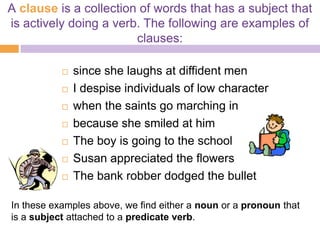
A clause is a collection of words that has a subject that
is actively doing a verb. The following are examples of
                        clauses:

              since she laughs at diffident men
              I despise individuals of low character
              when the saints go marching in
              because she smiled at him
              The boy is going to the school
              Susan appreciated the flowers
              The bank robber dodged the bullet

In these examples above, we find either a noun or a pronoun that
is a subject attached to a predicate verb.
SENTENCES CAN BE BROKEN DOWN
              INTO CLAUSES

EXAMPLE:
 The boy is going to the school, and he is going to
                      eat there.
    This is a complete sentence composed of two clauses.

         There are mainly two types of clauses:
   Independent clauses and subordinate or
    dependent clauses.

    A sentence can either contain two independent
    clauses or dependent and independent clauses.
DEPENDENT CLAUSE
   Cannot stand by themselves.
   Do not express a complete thought.

      Subordinating Conjunction or Relative
          Pronoun+ Subject + Predicate

Examples:
   Unless you want to go.
   Because I care.
   And you lose your cool.
INDEPENDENT CLAUSE
   Can stand by itself or with a dependent.
   Expresses a complete thought.

       Subject + Predicate (no conjunction)

Examples:
   I ran.
   Fractions are fun.
   Pizza tastes good.
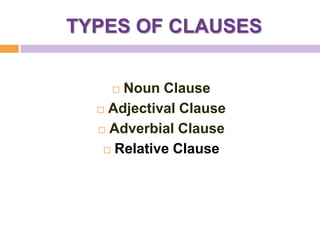
TYPES OF CLAUSES


     Noun Clause
   Adjectival Clause

   Adverbial Clause

    Relative Clause
NOUN CLAUSE
   A noun clause is a group of words used as
    a noun. A noun clause can play any of the
    functions a noun plays: subject, direct
    object, object of preposition, subjective or
    object complement

Examples:
   Most microcomputers use what are called flexible
    diskettes for program and data storage.
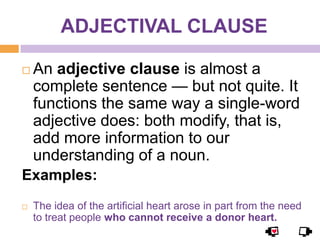
ADJECTIVAL CLAUSE

   An adjective clause is almost a
    complete sentence — but not quite. It
    functions the same way a single-word
    adjective does: both modify, that is,
    add more information to our
    understanding of a noun.
Examples:
   The idea of the artificial heart arose in part from the need
    to treat people who cannot receive a donor heart.
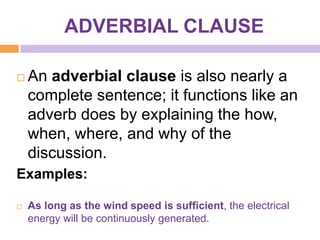
ADVERBIAL CLAUSE

   An adverbial clause is also nearly a
    complete sentence; it functions like an
    adverb does by explaining the how,
    when, where, and why of the
    discussion.
Examples:

   As long as the wind speed is sufficient, the electrical
    energy will be continuously generated.
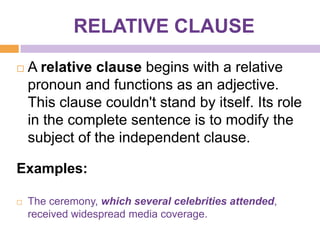
RELATIVE CLAUSE

   A relative clause begins with a relative
    pronoun and functions as an adjective.
    This clause couldn't stand by itself. Its role
    in the complete sentence is to modify the
    subject of the independent clause.

Examples:

   The ceremony, which several celebrities attended,
    received widespread media coverage.
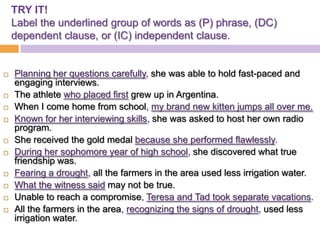
TRY IT!
    Label the underlined group of words as (P) phrase, (DC)
    dependent clause, or (IC) independent clause.


   Planning her questions carefully, she was able to hold fast-paced and
    engaging interviews.
   The athlete who placed first grew up in Argentina.
   When I come home from school, my brand new kitten jumps all over me.
   Known for her interviewing skills, she was asked to host her own radio
    program.
   She received the gold medal because she performed flawlessly.
   During her sophomore year of high school, she discovered what true
    friendship was.
   Fearing a drought, all the farmers in the area used less irrigation water.
   What the witness said may not be true.
   Unable to reach a compromise, Teresa and Tad took separate vacations.
   All the farmers in the area, recognizing the signs of drought, used less
    irrigation water.
THAKYOU

Phrase and Clause

  • 2.
    PRESENTATION ON PHRASES AND CLAUSES
  • 3.
  • 4.
    SENTENCE Sentences are madeof two parts: the subject and the predicate.  The subject is the person or thing that acts or is described in the sentence.  The predicate, on the other hand, is that action or description. Complete sentences need both the subject and the predicate.
  • 5.
    CONJUNCTION A CONJUNCTION isa word that connects or joins together words, phrases, clauses, or sentences. EXAMPLES:  Rob and I went to the movies.  Susan appreciated the flowers; nevertheless, a Corvette would be a finer a gift.  The bank robber dodged the bullet while Joey was shot seventeen times in the tibia.
  • 6.
    COORDINATING CONJUNCTION Coordinating conjunctionsconnect two equal parts of a sentence. EXAMPLES:  I dodged the bullet, but Joey was shot seventeen times in the tibia.  We ordered pizza but we couldn’t pay for it.
  • 7.
    CONJUNCTIVE ADVERB Whenthe job of an adverb is to connect ideas, we call it a conjunctive adverb. A conjunctive adverb can join two main clauses. In this situation, the conjunctive adverb behaves like a coordinating conjunction, connecting two complete ideas. EXAMPLES:  The thunder and lightning were intense; consequently, the crowd dispersed.  John was tired after a long day at school. Therefore, he immediately took a nap when he got home.
  • 8.
    SUBORDINATE CONJUNCTION Subordinate conjunctionsconnect two unequal parts, e.g., dependent and independent clauses. EXAMPLES:  Susan appreciated the flowers even though a Corvette would be a finer gift.  The gods thundered in the heavens as mortals below cowered in fear.
  • 9.
    SENTENCE STRUCTURE RULES [Independent Clause] , pure conjunction [independent clause]  The gods thundered in the heavens, and the mortals below cowered in fear. [Independent clause] ; conjunctive adverb , [independent clause]  The gods thundered in the heavens; furthermore, the mortals below cowered in fear. [Independent clause] ; [independent clause]  The gods thundered in the heavens; the mortals below cowered in fear.
  • 10.
    SENTENCE STRUCTURE RULES [Dependent clause] , [independent clause]  While the gods thundered in the heavens, the mortals below cowered in fear. [Dependent clause] subordinate conjunction [independent clause]  The gods thundered in the heavens as mortals below cowered in fear. [Independent clause] conjunction [dependent clause]  The gods thundered in the heavens and mortals below cowered in fear.
  • 11.
  • 12.
    A phrase isa collection of words that may have nouns or verbals, but it does not have a subject doing a verb. The following are examples of phrases:  leaving behind the dog  smashing into a fence  before the first test  after the devastation  between ignorance and intelligence  broken into thousands of pieces  because of her glittering smile In these examples above, you will find nouns (dog, fence, test, devastation, ignorance, intelligence, thousands, pieces). You also have some verbal(leaving, smashing), but in no case is the noun functioning as a subject doing a predicate verb.
  • 13.
    TYPES OF PHRASES  Noun Phrase  Verb Phrase  Adjectival Phrase  Adverbial Phrase  Prepositional Phrase  Participial Phrase  Appositives  Infinitive Phrase  Gerund Phrase  Absolute Phrase
  • 14.
    NOUN PHRASE  A noun phrase or nominal phrase is a phrase which has noun (or indefinite pronoun) as its head word. Examples:  Almost every sentence contains at least one noun phrase.  The election year politics are annoying for many people.  Current economic weakness may be a result of high energy prices.
  • 15.
    VERB PHRASE  Verb phrases are easy to recognize. They consist of a verb and all the related helping words. Verb phrases function as single-word verbs, to express action or to link subject and complement. Examples:  Walking on the ice, she slipped and fell.  She was walking to the mall.  Open the door to let the fresh air in.
  • 16.
    ADJECTIVAL PHRASE  An adjectival phrase usually starts with a preposition (e.g., of, in, on) or a participle (e.g., taken, leaving) and follows the noun it is modifying. Examples:  This is the end of a very long road.  My sister is fond of animals.  Did you see the man leaving the shop?
  • 17.
    ADVERBIAL PHRASE  An adverbial phrase is a group of related words which play the role of an adverb. Like all phrases, an adverbial phrase does not include a subject and a verb. Examples:  Tony decided to move to Slough in June last year.  Darcy can build a card pyramid in less than a minute.  As long as the wind speed is sufficient, the electrical energy will be continuously generated.
  • 18.
    PREPOSITIONAL PHRASE  A prepositional phrase begins with a preposition and ends with a noun or pronoun. Examples:  The hamster sprinted across its cage.  There are a number of factors.  The bus went along Cam St. and hit the top of the tunnel.
  • 19.
    PARTICIPIAL PHRASE  A participial phrase is a group of words acting as an adjective and modifying a noun or pronoun. A participle is the -ed or -ing form of a verb. Examples:  You could see the panther releasing its grip.  We must raise funds to replace the window broken last week in the storm.  Is that Arthur running for the bus?
  • 20.
    APPOSITIVE  An appositive, a word or phrase that renames a noun or pronoun, adds information about a noun but in a way different than do adjectives. Appositives are usually offset with commas, brackets or dashes. Examples:  My best friend, Lee, caught a whelk when he was fishing for bass.  Dr Pat, the creator of the turnip brew, sold 8 barrels on the first day.
  • 21.
    INFINITIVE PHRASE  An infinitive phrase is formed from an infinitive and other related words. An infinitive is the word "to" followed by a verb. This type of phrase functions as a noun, an adjective, or an adverb. Examples:  To get an appointment with him requires a great amount of patience. (As a noun)  The decision to eliminate vacations was very unpopular. (As an adjective)  He wrote a letter to raise funds for the foundation. (As an adverb)
  • 22.
    GERUND PHRASE  A gerund is a verb with an "ing" ending that functions as a noun. Gerund phrases look like some participial phrases. The difference is that participial phrases function as adjectives; gerund phrases function as nouns. Examples:  Eating blackberries without washing them will make you ill.  I am not prepared to authorize climbing the cliffs in the dark.  So, you think beating eggs with a fork is acceptable, do you?
  • 23.
    ABSOLUTE PHRASE  An absolute phrase combines a noun and a participle with any companying modifiers or objects. Absolute phrases resemble clauses, but the predicate is incomplete. Examples:  The plumber disappeared into the hole, a pipe wrench in his hand.  Our fingers scraping the leftover frosting off the plates.  Her arms folded across her chest.
  • 24.
  • 25.
    A clause isa collection of words that has a subject that is actively doing a verb. The following are examples of clauses:  since she laughs at diffident men  I despise individuals of low character  when the saints go marching in  because she smiled at him  The boy is going to the school  Susan appreciated the flowers  The bank robber dodged the bullet In these examples above, we find either a noun or a pronoun that is a subject attached to a predicate verb.
  • 26.
    SENTENCES CAN BEBROKEN DOWN INTO CLAUSES EXAMPLE:  The boy is going to the school, and he is going to eat there. This is a complete sentence composed of two clauses. There are mainly two types of clauses:  Independent clauses and subordinate or dependent clauses. A sentence can either contain two independent clauses or dependent and independent clauses.
  • 27.
    DEPENDENT CLAUSE  Cannot stand by themselves.  Do not express a complete thought. Subordinating Conjunction or Relative Pronoun+ Subject + Predicate Examples:  Unless you want to go.  Because I care.  And you lose your cool.
  • 28.
    INDEPENDENT CLAUSE  Can stand by itself or with a dependent.  Expresses a complete thought. Subject + Predicate (no conjunction) Examples:  I ran.  Fractions are fun.  Pizza tastes good.
  • 29.
    TYPES OF CLAUSES  Noun Clause  Adjectival Clause  Adverbial Clause  Relative Clause
  • 30.
    NOUN CLAUSE  A noun clause is a group of words used as a noun. A noun clause can play any of the functions a noun plays: subject, direct object, object of preposition, subjective or object complement Examples:  Most microcomputers use what are called flexible diskettes for program and data storage.
  • 31.
    ADJECTIVAL CLAUSE  An adjective clause is almost a complete sentence — but not quite. It functions the same way a single-word adjective does: both modify, that is, add more information to our understanding of a noun. Examples:  The idea of the artificial heart arose in part from the need to treat people who cannot receive a donor heart.
  • 32.
    ADVERBIAL CLAUSE  An adverbial clause is also nearly a complete sentence; it functions like an adverb does by explaining the how, when, where, and why of the discussion. Examples:  As long as the wind speed is sufficient, the electrical energy will be continuously generated.
  • 33.
    RELATIVE CLAUSE  A relative clause begins with a relative pronoun and functions as an adjective. This clause couldn't stand by itself. Its role in the complete sentence is to modify the subject of the independent clause. Examples:  The ceremony, which several celebrities attended, received widespread media coverage.
  • 34.
    TRY IT! Label the underlined group of words as (P) phrase, (DC) dependent clause, or (IC) independent clause.  Planning her questions carefully, she was able to hold fast-paced and engaging interviews.  The athlete who placed first grew up in Argentina.  When I come home from school, my brand new kitten jumps all over me.  Known for her interviewing skills, she was asked to host her own radio program.  She received the gold medal because she performed flawlessly.  During her sophomore year of high school, she discovered what true friendship was.  Fearing a drought, all the farmers in the area used less irrigation water.  What the witness said may not be true.  Unable to reach a compromise, Teresa and Tad took separate vacations.  All the farmers in the area, recognizing the signs of drought, used less irrigation water.
  • 35.