ENGLISH GRAMMAR
EASYTO UNDERSTAND; EASY TO LEARN
Class I to XII
By Gopal Krushna Panda
“Adjectives”
Nouns
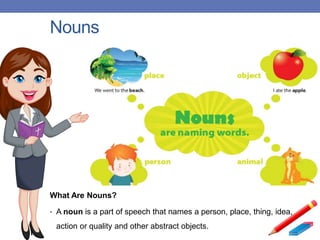
What Are Nouns?
• A noun is a part of speech that names a person, place, thing, idea,
action or quality and other abstract objects.
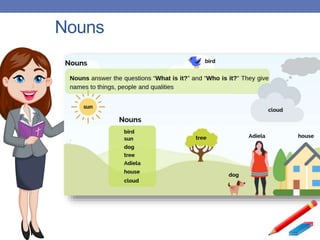
Nouns
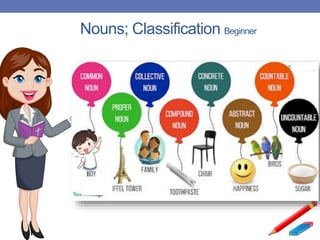
Nouns; Classification
Nouns; Classification Beginner
Nouns
Common noun
• A common noun is any nonspecific person, place or thing
• A common noun is a noun that refers to people or things in general,
e.g. boy, country, bridge, city, birth, day, happiness.
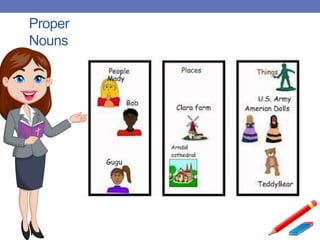
Proper noun
• A proper noun is any specific person, place, living being, or thing.
• A proper noun can be a name, places, companies, and trademarks.
In the English language, all proper nouns are capitalized, which
makes them easy to recognize.
• It is a name that identifies a particular person, place, or thing,
e.g. Steven, Africa, London, Monday. In written English, proper
nouns begin with capital letters.
Proper Nouns
Names of people, places and organisations are called proper
nouns. We spell proper nouns with a capital letter:
Muhammad Ali Birmingham India Oxford University the United Nations
Dashera Deepavali Easter Ramadan Thanksgiving
We use capital letters for festivals:
We use capital letters for people's titles:
I was talking to Doctor Wilson recently.
Everything depends on President Obama.
When we give the names of books, films, plays and paintings, we
use capital letters for the nouns, adjectives and verbs in the name:
I have been reading The Old Man and the Sea.
Beatrix Potter wrote The Tale of Peter Rabbit.
You can see the Mona Lisa in the Louvre.
Sometimes we use a person's name to refer to something they have
created:
Recently a Van Gogh was sold for 15 million dollars.
We were listening to Mozart.
I'm reading an Agatha Christie.
Common
Nouns
Proper
Nouns
Nouns
Abstract noun
• An abstract noun is a noun which refers to ideas, qualities,
and conditions - something that can't be perceived with the five
senses or touched and things which have no physical reality,
e.g. truth, danger, happiness, time, friendship, humour.
Concrete noun
• A concrete noun is a noun which refers to people and to things that
exist physically and can be seen, touched, smelled, heard, or
tasted. Examples include dog, building, coffee, tree, rain, beach,
tune.
Abstract
Nouns
Concrete
Nouns
Nouns
Collective nouns
• Collective nouns refer to groups of people or things, e.g. audience,
family, government, team, jury.
• In American English, most collective nouns are treated as singular,
with a singular verb:
• The whole family was at the table.
• In British English, the preceding sentence would be correct, but it
would also be correct to treat the collective noun as a plural, with a
plural verb:
• The whole family were at the table.
Singular Noun
Refer to one person, place things, or idea
Example: Cat, dog, ship, monkey, hero etc…
Plural Noun
Refer to more than one person, place things, or idea
Example: Dogs, cats, ships, babies etc..
Collective Nouns
Nouns
Countable nouns
Countable nouns have two forms: singular and plural.
Singular count nouns refer to one person or thing:
a teacher a book a wish an idea
teachers books wishes ideas
Plural count nouns refer to more than one person or thing:
the English teacher that book a wish my latest idea
Singular count nouns cannot be used alone. They must have a determiner:
book > books
school > schools
friend > friends
We usually add –s to make a plural noun:
Nouns
Countable nouns Plural count nouns
class > classes
watch > watches
gas > gases
wish > wishes
box > boxes
potato > potatoes
We add –es to nouns ending in
–s, –ch, –sh, –ss, –x and –o:
When a noun ends in a consonant and –y,
we make the plural with –ies: lady > ladies
country > countries
party > parties
boy > boys
day > days
play > plays
If a noun ends in a vowel and –y,
we simply add –s:
Nouns
Countable nouns Plural count nouns
man > men
woman > women
child > children
person > people
foot > feet
Some common nouns
have irregular plurals:
Plural count nouns do not have a general determiner when they
refer to people or things in general:
Computers are very expensive.
Do you sell old books?
But they may have a specific determiner:
Those computers are very expensive.
The books in that shop are very expensive.
Her sisters live there.
or a quantifier or a numeral::
some new books a few teachers lots of good ideas
two new books three wishes
Countable Nouns
Uncountable Nouns
Uncountable Nouns
• Uncountable nouns are for the things that we cannot count
with numbers. They may be the names for abstract ideas or
qualities or for physical objects that are too small or too
amorphous to be counted (liquids, powders, gases, etc.).
• We do not use uncountable nouns in the plural and we
do not use them with the indefinite article a/an:
• We ate a lot of food. (NOT foods)
We bought some new furniture. (NOT furnitures)
That's useful information. (NOT a useful information)
• We can use some quantifiers with uncount nouns:
• He gave me some useful advice.
They gave us a lot of information.
• Uncountable nouns often refer to:
• Substances: food, water, wine, salt, bread, iron
Human feelings or qualities: anger, cruelty, happiness, honesty, pride
Activities: help, sleep, travel, work
Abstract ideas: beauty, death, fun, life
Uncountable Nouns
advice accommodation baggage equipment
furniture homework knowledge luggage
machinery money news traffic
Some common nouns in English like information are uncountable
nouns even though they have plurals in other languages:
Let me give you some advice.
How much luggage have you got?
a piece of ... a bit of ... an item of ...
pieces of ... bits of ... items of ...
Let me give you a piece of advice.
That's a useful piece of equipment.
We bought a few bits of furniture for the new apartment.
She had six separate items of luggage.
However, accommodation, money and traffic cannot be made countable
in this way. We need to use other expressions:
I've lived in three flats/apartments. (NOT bits of accommodation)
Smith received three large sums of money. (NOT pieces of money)
We got stuck in two traffic jams. (NOT pieces of traffic)
If we want to make these things countable, we use expressions like:
Common problems with countable and
uncountable nouns
Substances as countable or uncountable nouns
• Substances are usually uncountable nouns:
Would you like some cheese?
Coffee keeps me awake at night.
Wine makes me sleepy.
• but they can also be used as count nouns:
I'd like a coffee, please. = I'd like a [cup of] coffee.
May I have a white wine? = May I have a [glass of] white wine?
They sell a lot of coffees. = They sell a lot of [different kinds of] coffee.
I prefer white wines to red. = I prefer [different kinds of] white wine to red.
They had over twenty cheeses. = They had over twenty [types of] cheese.
This is an excellent soft cheese. = This [kind of] soft cheese is excellent.
Common problems with countable and
uncountable nouns
Nouns with both a count and an uncount form
Some nouns have both a count and an uncount form. Their
meanings are closely related:
George had hopes of promotion.
We should always have hope.
There's a danger of avalanches on the mountain.
Some people enjoy danger.
Nouns with two meanings
Some nouns have two meanings, one count and the other uncount:
Can I have a glass of water?
I cut myself on some glass.
Is English a difficult language?
Linguistics is the study of language.
The Times is an excellent paper.
It's made of paper.
Common problems with countable and
uncountable nouns
business industry property wood
power time work hair
Other nouns like this are:
Subjects of study: mathematics, physics, economics, etc.
Activities: gymnastics, athletics, etc.
Games: cards, darts, billiards, etc.
Diseases: mumps, measles, rabies, etc.
Economics is a very difficult subject.
Billiards is easier than pool or snooker.
Uncountable nouns that end in –s
Some uncountable nouns end in –s. They look like plural count
nouns, but they are not.
Nouns like this generally refer to:
Phrase
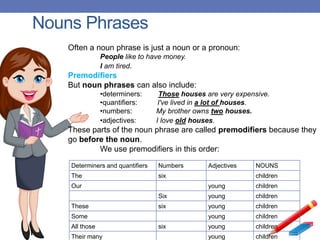
Nouns Phrases
Often a noun phrase is just a noun or a pronoun:
People like to have money.
I am tired.
Premodifiers
But noun phrases can also include:
•determiners: Those houses are very expensive.
•quantifiers: I've lived in a lot of houses.
•numbers: My brother owns two houses.
•adjectives: I love old houses.
These parts of the noun phrase are called premodifiers because they
go before the noun.
We use premodifiers in this order:
Determiners and quantifiers Numbers Adjectives NOUNS
The six children
Our young children
Six young children
These six young children
Some young children
All those six young children
Their many young children
COMING UP NEXT…
“Pronoun ”
By Gopal Krushna Panda

Understanding nouns

  • 1.
    ENGLISH GRAMMAR EASYTO UNDERSTAND;EASY TO LEARN Class I to XII By Gopal Krushna Panda “Adjectives”
  • 2.
    Nouns What Are Nouns? •A noun is a part of speech that names a person, place, thing, idea, action or quality and other abstract objects.
  • 3.
  • 4.
  • 5.
  • 6.
    Nouns Common noun • Acommon noun is any nonspecific person, place or thing • A common noun is a noun that refers to people or things in general, e.g. boy, country, bridge, city, birth, day, happiness. Proper noun • A proper noun is any specific person, place, living being, or thing. • A proper noun can be a name, places, companies, and trademarks. In the English language, all proper nouns are capitalized, which makes them easy to recognize. • It is a name that identifies a particular person, place, or thing, e.g. Steven, Africa, London, Monday. In written English, proper nouns begin with capital letters.
  • 7.
    Proper Nouns Names ofpeople, places and organisations are called proper nouns. We spell proper nouns with a capital letter: Muhammad Ali Birmingham India Oxford University the United Nations Dashera Deepavali Easter Ramadan Thanksgiving We use capital letters for festivals: We use capital letters for people's titles: I was talking to Doctor Wilson recently. Everything depends on President Obama. When we give the names of books, films, plays and paintings, we use capital letters for the nouns, adjectives and verbs in the name: I have been reading The Old Man and the Sea. Beatrix Potter wrote The Tale of Peter Rabbit. You can see the Mona Lisa in the Louvre. Sometimes we use a person's name to refer to something they have created: Recently a Van Gogh was sold for 15 million dollars. We were listening to Mozart. I'm reading an Agatha Christie.
  • 8.
  • 9.
  • 10.
    Nouns Abstract noun • Anabstract noun is a noun which refers to ideas, qualities, and conditions - something that can't be perceived with the five senses or touched and things which have no physical reality, e.g. truth, danger, happiness, time, friendship, humour. Concrete noun • A concrete noun is a noun which refers to people and to things that exist physically and can be seen, touched, smelled, heard, or tasted. Examples include dog, building, coffee, tree, rain, beach, tune.
  • 11.
  • 12.
  • 13.
    Nouns Collective nouns • Collectivenouns refer to groups of people or things, e.g. audience, family, government, team, jury. • In American English, most collective nouns are treated as singular, with a singular verb: • The whole family was at the table. • In British English, the preceding sentence would be correct, but it would also be correct to treat the collective noun as a plural, with a plural verb: • The whole family were at the table. Singular Noun Refer to one person, place things, or idea Example: Cat, dog, ship, monkey, hero etc… Plural Noun Refer to more than one person, place things, or idea Example: Dogs, cats, ships, babies etc..
  • 14.
  • 15.
    Nouns Countable nouns Countable nounshave two forms: singular and plural. Singular count nouns refer to one person or thing: a teacher a book a wish an idea teachers books wishes ideas Plural count nouns refer to more than one person or thing: the English teacher that book a wish my latest idea Singular count nouns cannot be used alone. They must have a determiner: book > books school > schools friend > friends We usually add –s to make a plural noun:
  • 16.
    Nouns Countable nouns Pluralcount nouns class > classes watch > watches gas > gases wish > wishes box > boxes potato > potatoes We add –es to nouns ending in –s, –ch, –sh, –ss, –x and –o: When a noun ends in a consonant and –y, we make the plural with –ies: lady > ladies country > countries party > parties boy > boys day > days play > plays If a noun ends in a vowel and –y, we simply add –s:
  • 17.
    Nouns Countable nouns Pluralcount nouns man > men woman > women child > children person > people foot > feet Some common nouns have irregular plurals: Plural count nouns do not have a general determiner when they refer to people or things in general: Computers are very expensive. Do you sell old books? But they may have a specific determiner: Those computers are very expensive. The books in that shop are very expensive. Her sisters live there. or a quantifier or a numeral:: some new books a few teachers lots of good ideas two new books three wishes
  • 18.
  • 19.
  • 21.
    Uncountable Nouns • Uncountablenouns are for the things that we cannot count with numbers. They may be the names for abstract ideas or qualities or for physical objects that are too small or too amorphous to be counted (liquids, powders, gases, etc.). • We do not use uncountable nouns in the plural and we do not use them with the indefinite article a/an: • We ate a lot of food. (NOT foods) We bought some new furniture. (NOT furnitures) That's useful information. (NOT a useful information) • We can use some quantifiers with uncount nouns: • He gave me some useful advice. They gave us a lot of information. • Uncountable nouns often refer to: • Substances: food, water, wine, salt, bread, iron Human feelings or qualities: anger, cruelty, happiness, honesty, pride Activities: help, sleep, travel, work Abstract ideas: beauty, death, fun, life
  • 22.
    Uncountable Nouns advice accommodationbaggage equipment furniture homework knowledge luggage machinery money news traffic Some common nouns in English like information are uncountable nouns even though they have plurals in other languages: Let me give you some advice. How much luggage have you got? a piece of ... a bit of ... an item of ... pieces of ... bits of ... items of ... Let me give you a piece of advice. That's a useful piece of equipment. We bought a few bits of furniture for the new apartment. She had six separate items of luggage. However, accommodation, money and traffic cannot be made countable in this way. We need to use other expressions: I've lived in three flats/apartments. (NOT bits of accommodation) Smith received three large sums of money. (NOT pieces of money) We got stuck in two traffic jams. (NOT pieces of traffic) If we want to make these things countable, we use expressions like:
  • 23.
    Common problems withcountable and uncountable nouns Substances as countable or uncountable nouns • Substances are usually uncountable nouns: Would you like some cheese? Coffee keeps me awake at night. Wine makes me sleepy. • but they can also be used as count nouns: I'd like a coffee, please. = I'd like a [cup of] coffee. May I have a white wine? = May I have a [glass of] white wine? They sell a lot of coffees. = They sell a lot of [different kinds of] coffee. I prefer white wines to red. = I prefer [different kinds of] white wine to red. They had over twenty cheeses. = They had over twenty [types of] cheese. This is an excellent soft cheese. = This [kind of] soft cheese is excellent.
  • 24.
    Common problems withcountable and uncountable nouns Nouns with both a count and an uncount form Some nouns have both a count and an uncount form. Their meanings are closely related: George had hopes of promotion. We should always have hope. There's a danger of avalanches on the mountain. Some people enjoy danger. Nouns with two meanings Some nouns have two meanings, one count and the other uncount: Can I have a glass of water? I cut myself on some glass. Is English a difficult language? Linguistics is the study of language. The Times is an excellent paper. It's made of paper.
  • 25.
    Common problems withcountable and uncountable nouns business industry property wood power time work hair Other nouns like this are: Subjects of study: mathematics, physics, economics, etc. Activities: gymnastics, athletics, etc. Games: cards, darts, billiards, etc. Diseases: mumps, measles, rabies, etc. Economics is a very difficult subject. Billiards is easier than pool or snooker. Uncountable nouns that end in –s Some uncountable nouns end in –s. They look like plural count nouns, but they are not. Nouns like this generally refer to:
  • 26.
  • 27.
    Nouns Phrases Often anoun phrase is just a noun or a pronoun: People like to have money. I am tired. Premodifiers But noun phrases can also include: •determiners: Those houses are very expensive. •quantifiers: I've lived in a lot of houses. •numbers: My brother owns two houses. •adjectives: I love old houses. These parts of the noun phrase are called premodifiers because they go before the noun. We use premodifiers in this order: Determiners and quantifiers Numbers Adjectives NOUNS The six children Our young children Six young children These six young children Some young children All those six young children Their many young children
  • 31.
    COMING UP NEXT… “Pronoun” By Gopal Krushna Panda