VERB FORMS
Class 9 – ENGLISH GRAMMAR
Mrs. Sheetal Thomas
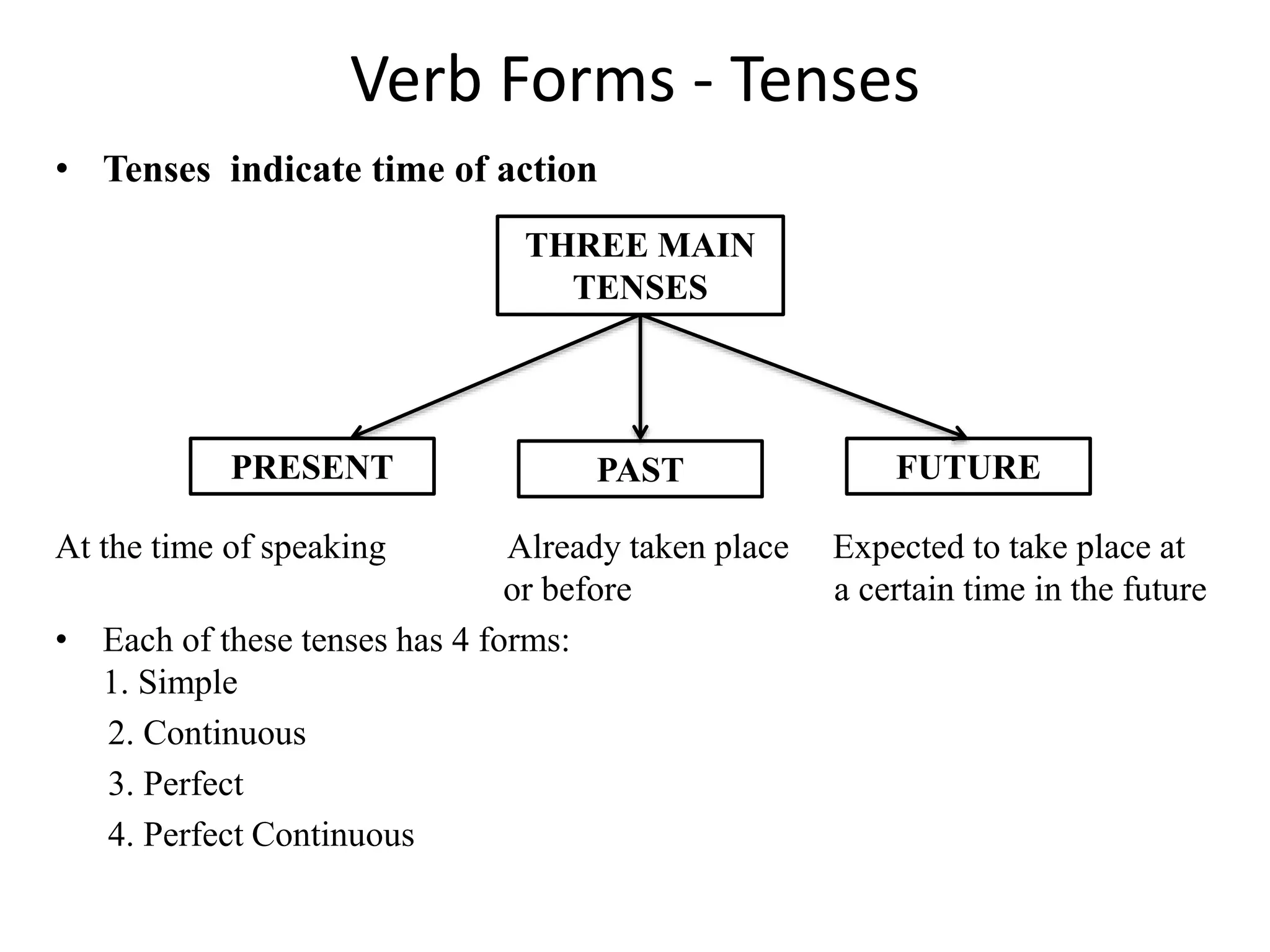
Verb Forms - Tenses
• Tenses indicate time of action
At the time of speaking Already taken place Expected to take place at
or before a certain time in the future
• Each of these tenses has 4 forms:
1. Simple
2. Continuous
3. Perfect
4. Perfect Continuous
THREE MAIN
TENSES
PRESENT PAST FUTURE
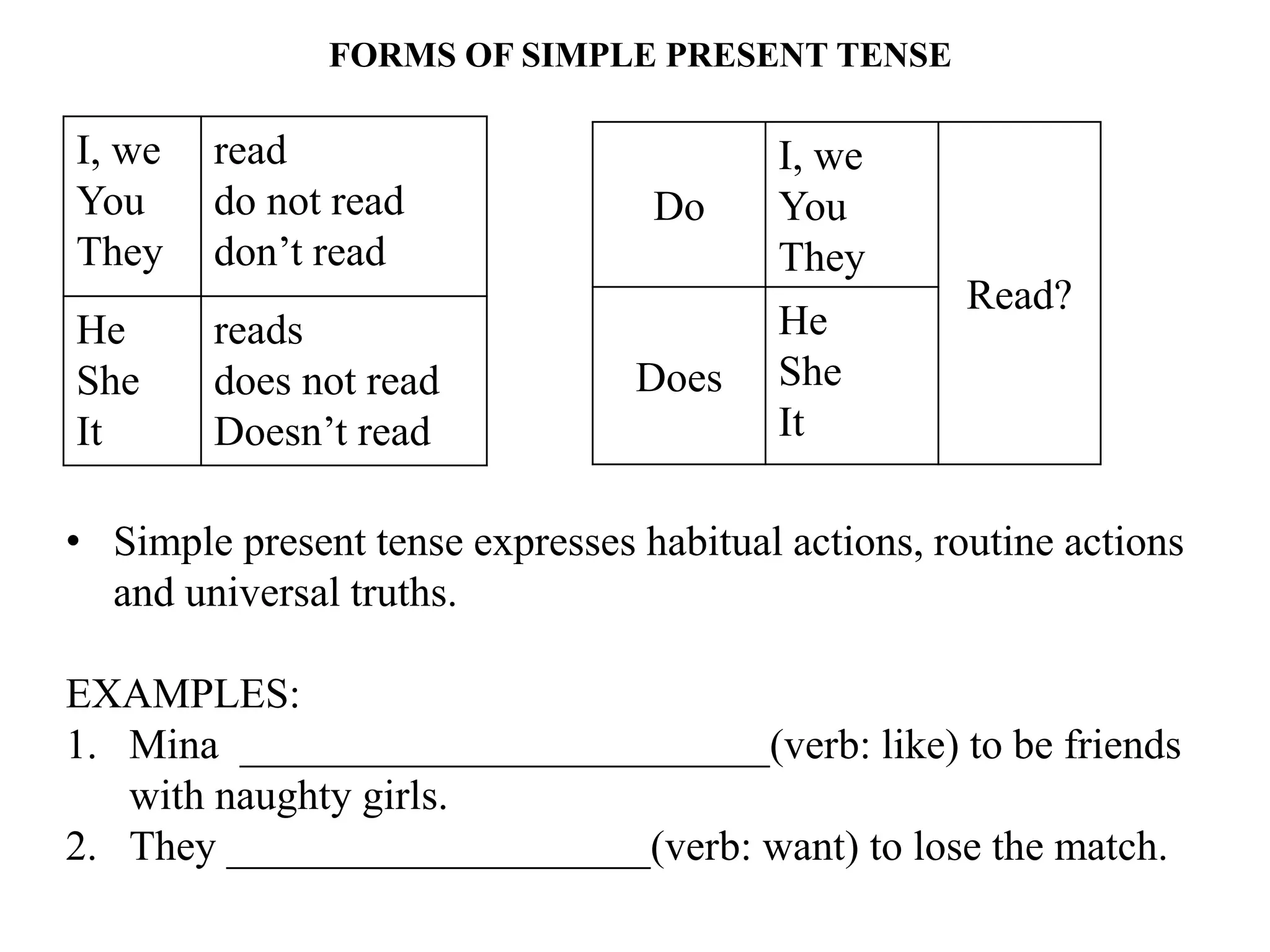
FORMS OF SIMPLE PRESENT TENSE
I, we
You
They
read
do not read
don’t read
He
She
It
reads
does not read
Doesn’t read
Do
I, we
You
They
Read?
Does
He
She
It
• Simple present tense expresses habitual actions, routine actions
and universal truths.
EXAMPLES:
1. Mina _________________________(verb: like) to be friends
with naughty girls.
2. They ____________________(verb: want) to lose the match.
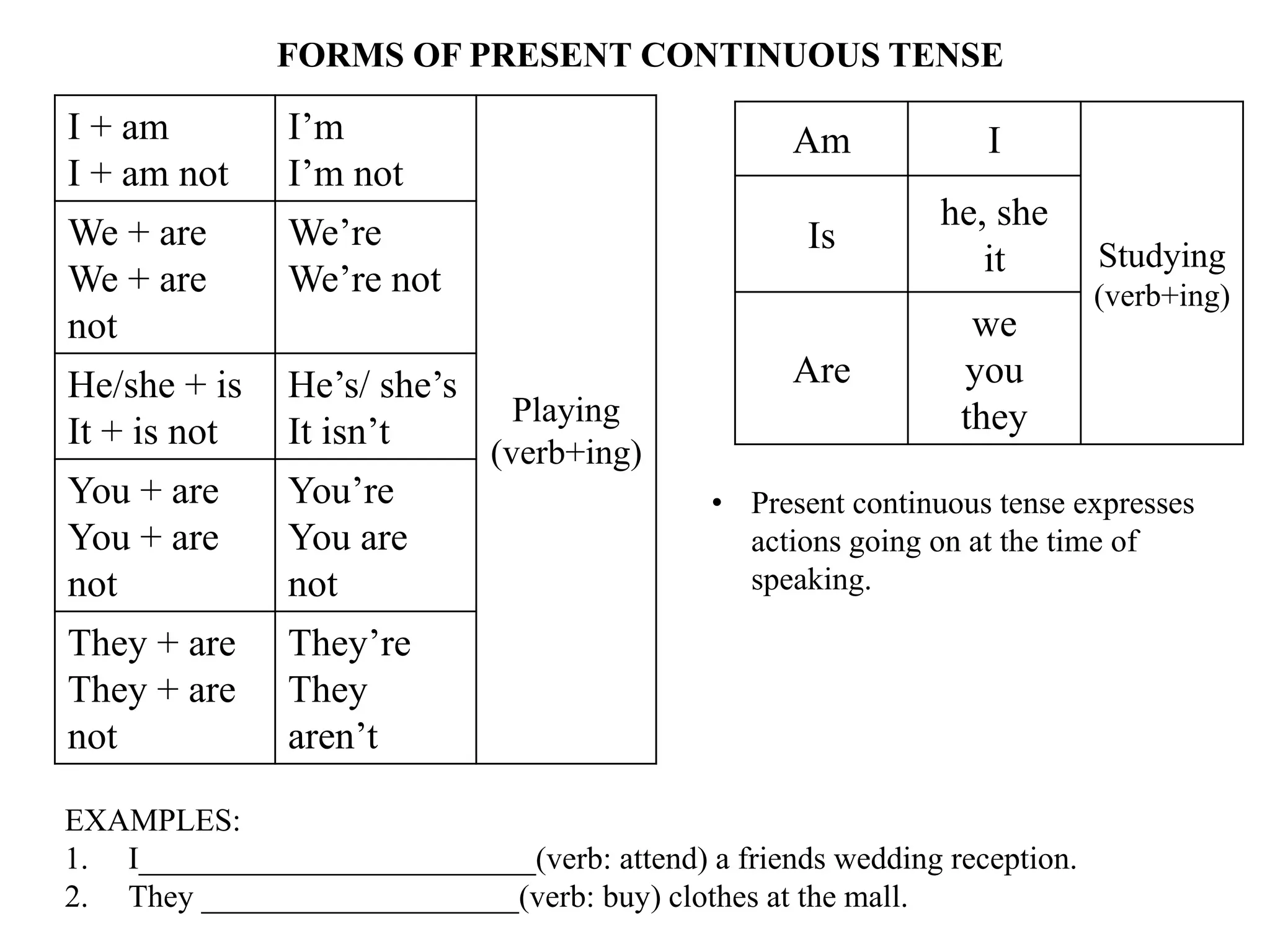
FORMS OF PRESENT CONTINUOUS TENSE
I + am
I + am not
I’m
I’m not
Playing
(verb+ing)
We + are
We + are
not
We’re
We’re not
He/she + is
It + is not
He’s/ she’s
It isn’t
You + are
You + are
not
You’re
You are
not
They + are
They + are
not
They’re
They
aren’t
Am I
Studying
(verb+ing)
Is
he, she
it
Are
we
you
they
EXAMPLES:
1. I_________________________(verb: attend) a friends wedding reception.
2. They ____________________(verb: buy) clothes at the mall.
• Present continuous tense expresses
actions going on at the time of
speaking.
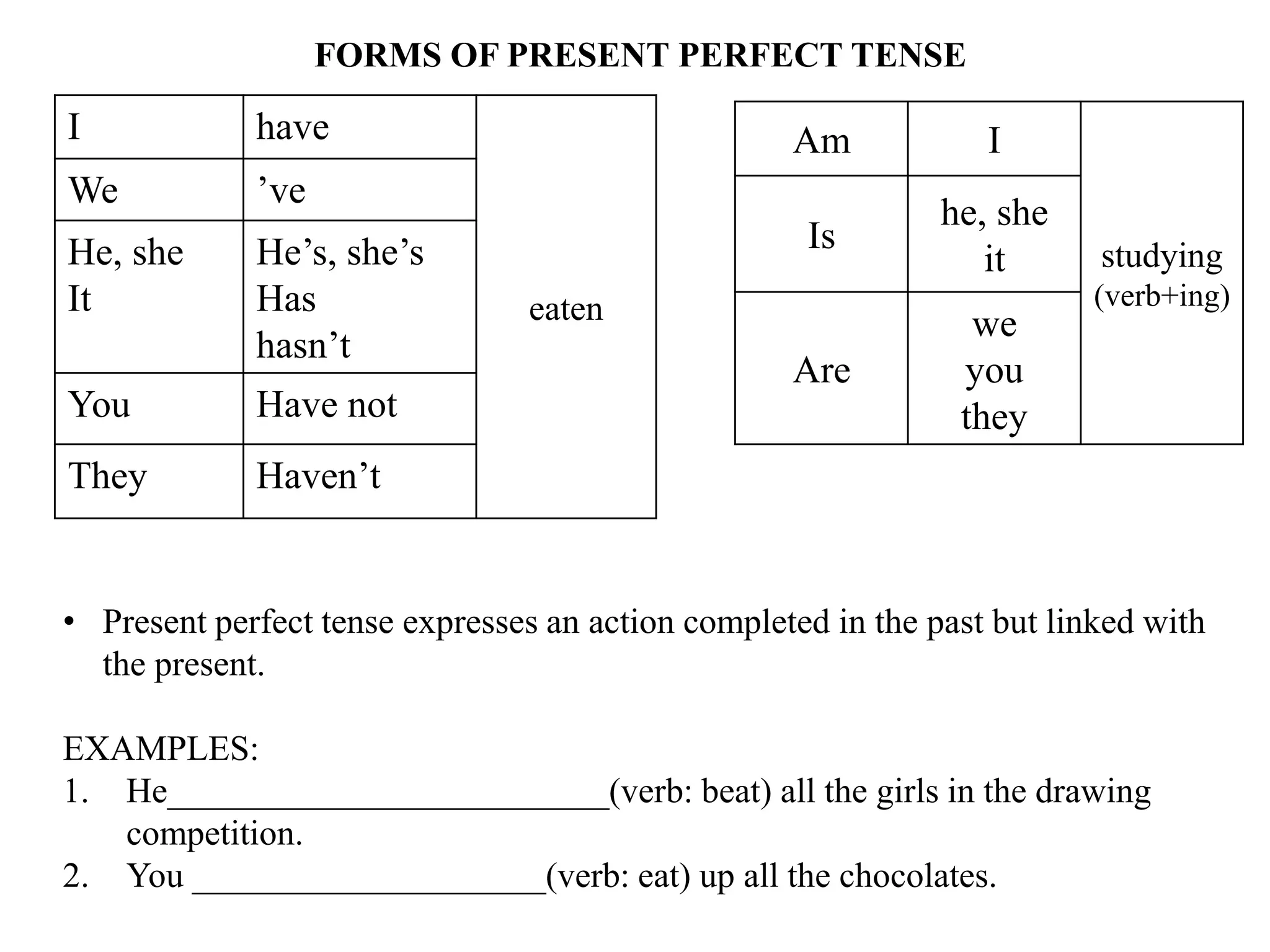
FORMS OF PRESENT PERFECT TENSE
I have
eaten
We ’ve
He, she
It
He’s, she’s
Has
hasn’t
You Have not
They Haven’t
Am I
studying
(verb+ing)
Is
he, she
it
Are
we
you
they
• Present perfect tense expresses an action completed in the past but linked with
the present.
EXAMPLES:
1. He_________________________(verb: beat) all the girls in the drawing
competition.
2. You ____________________(verb: eat) up all the chocolates.
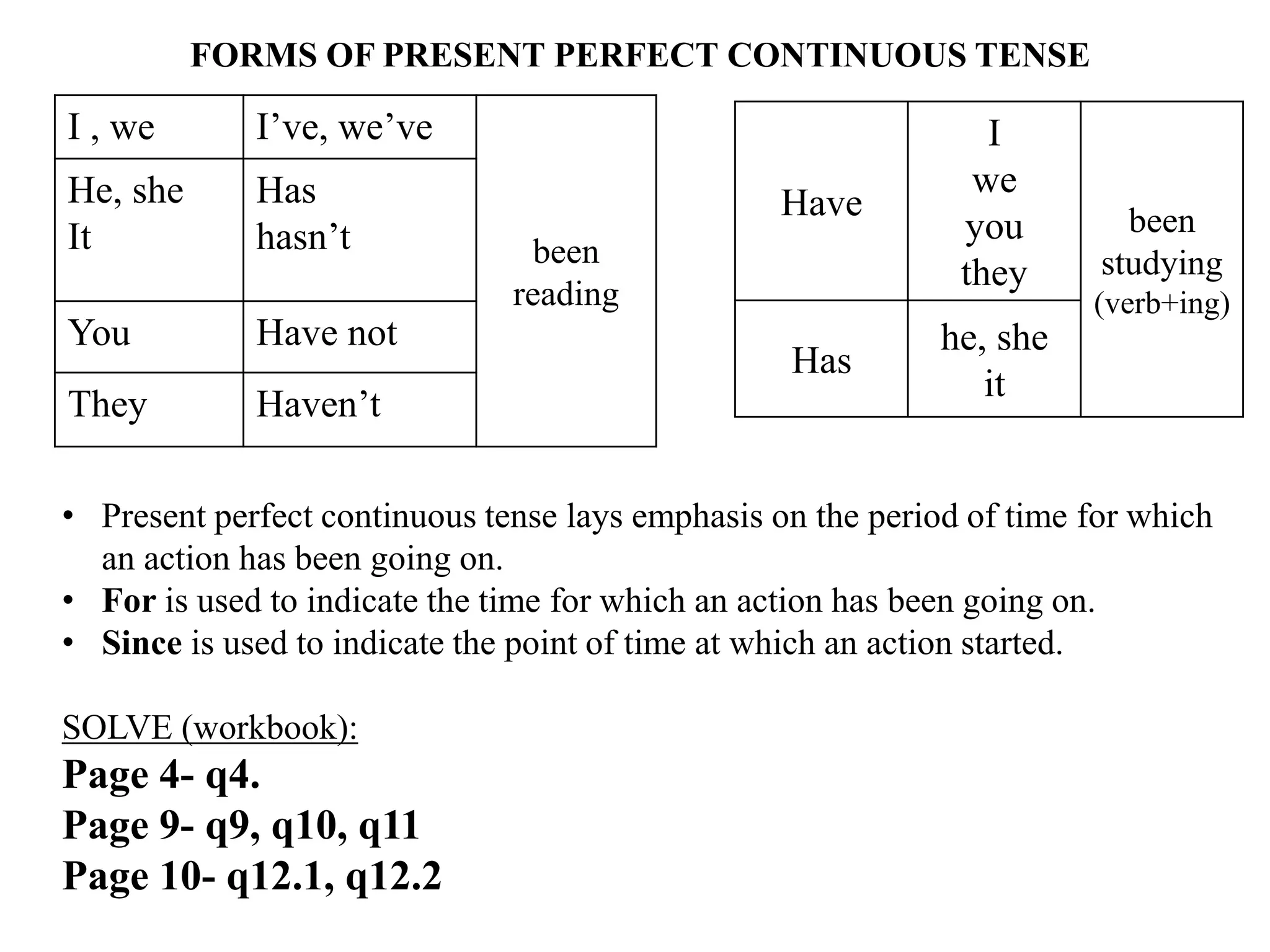
FORMS OF PRESENT PERFECT CONTINUOUS TENSE
I , we I’ve, we’ve
been
reading
He, she
It
Has
hasn’t
You Have not
They Haven’t
Have
I
we
you
they
been
studying
(verb+ing)
Has
he, she
it
• Present perfect continuous tense lays emphasis on the period of time for which
an action has been going on.
• For is used to indicate the time for which an action has been going on.
• Since is used to indicate the point of time at which an action started.
SOLVE (workbook):
Page 4- q4.
Page 9- q9, q10, q11
Page 10- q12.1, q12.2
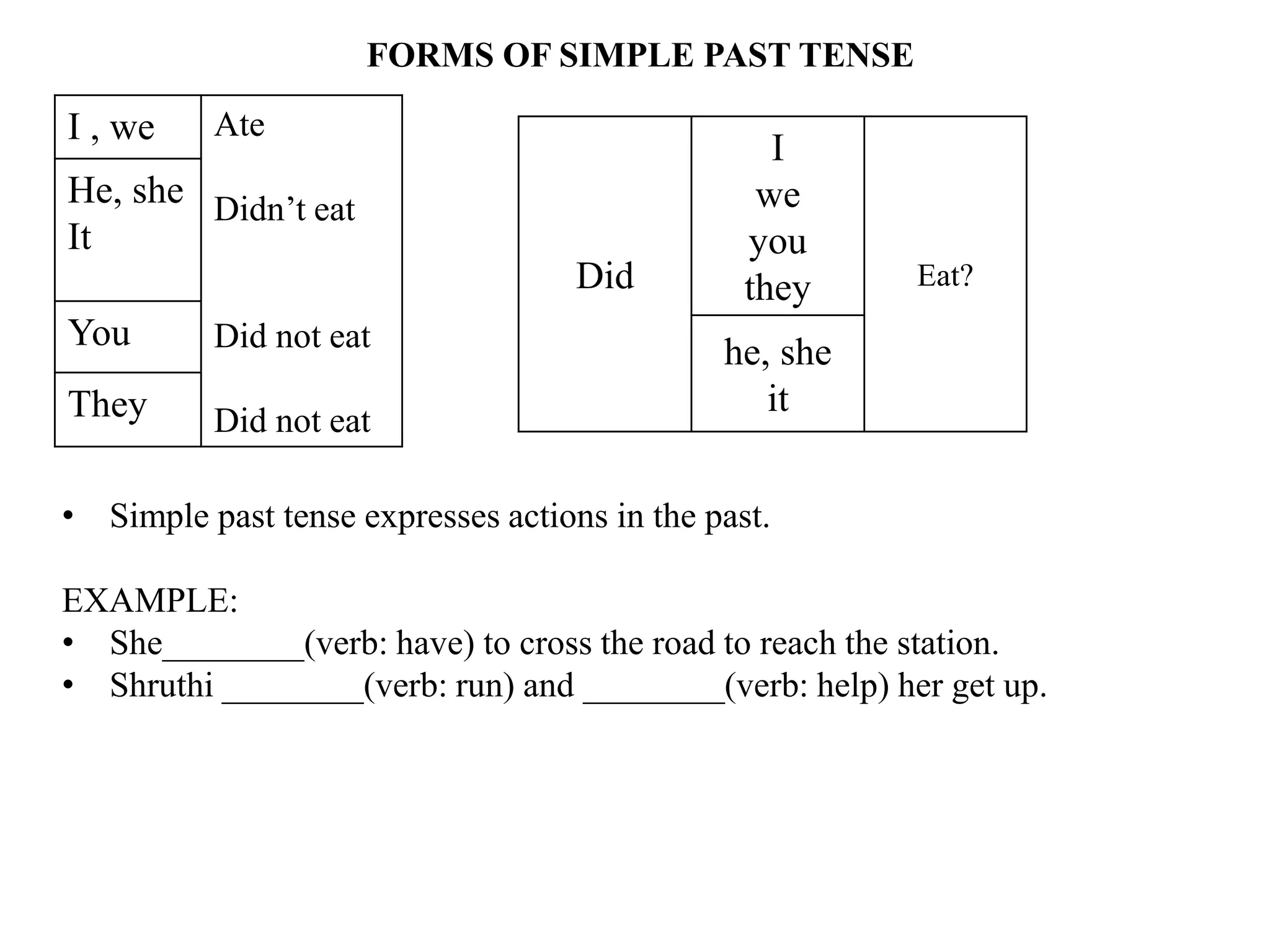
FORMS OF SIMPLE PAST TENSE
I , we Ate
Didn’t eat
Did not eat
Did not eat
He, she
It
You
They
Did
I
we
you
they Eat?
he, she
it
• Simple past tense expresses actions in the past.
EXAMPLE:
• She________(verb: have) to cross the road to reach the station.
• Shruthi ________(verb: run) and ________(verb: help) her get up.
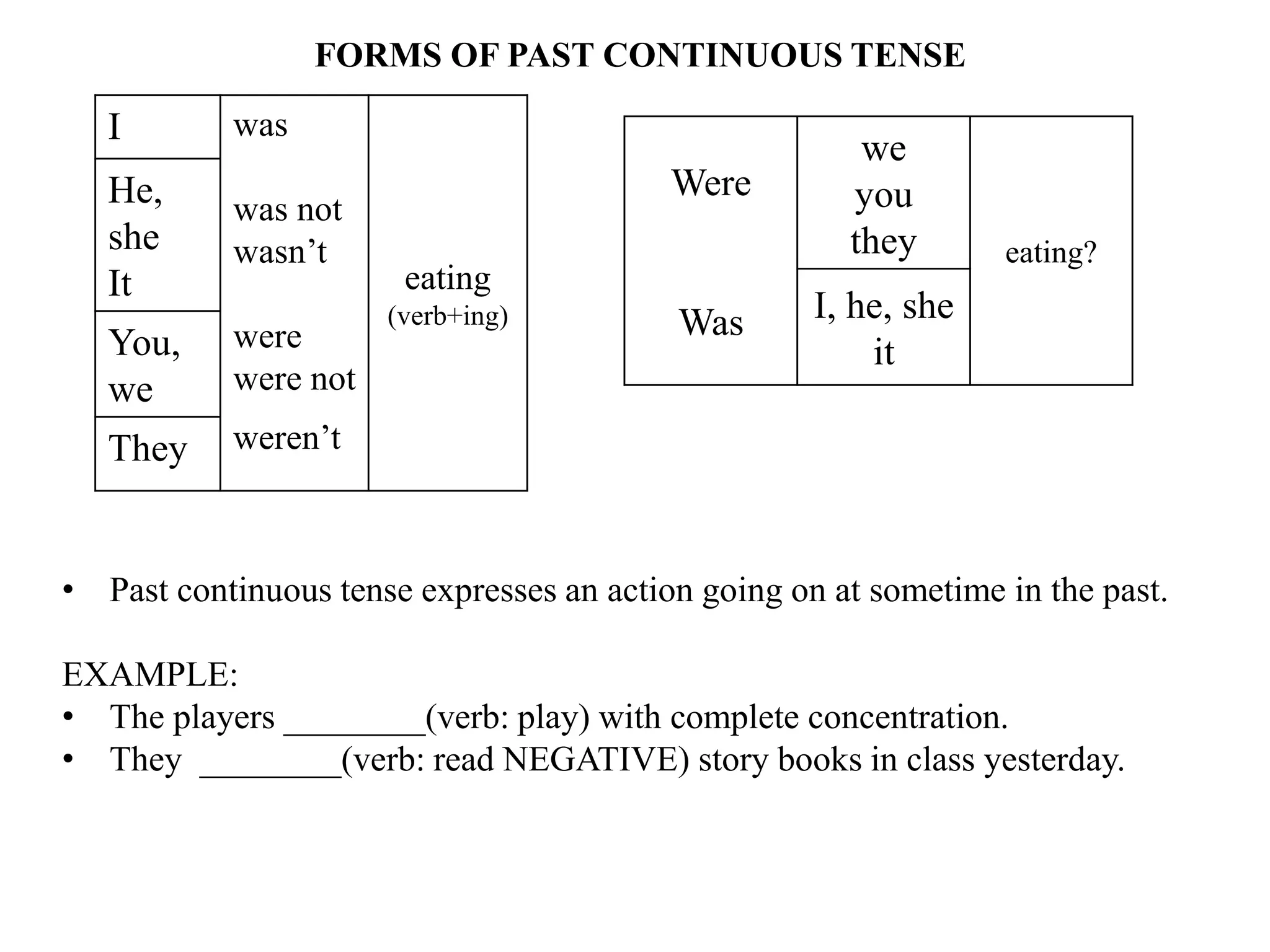
FORMS OF PAST CONTINUOUS TENSE
I was
was not
wasn’t
were
were not
weren’t
eating
(verb+ing)
He,
she
It
You,
we
They
Were
Was
we
you
they eating?
I, he, she
it
• Past continuous tense expresses an action going on at sometime in the past.
EXAMPLE:
• The players ________(verb: play) with complete concentration.
• They ________(verb: read NEGATIVE) story books in class yesterday.
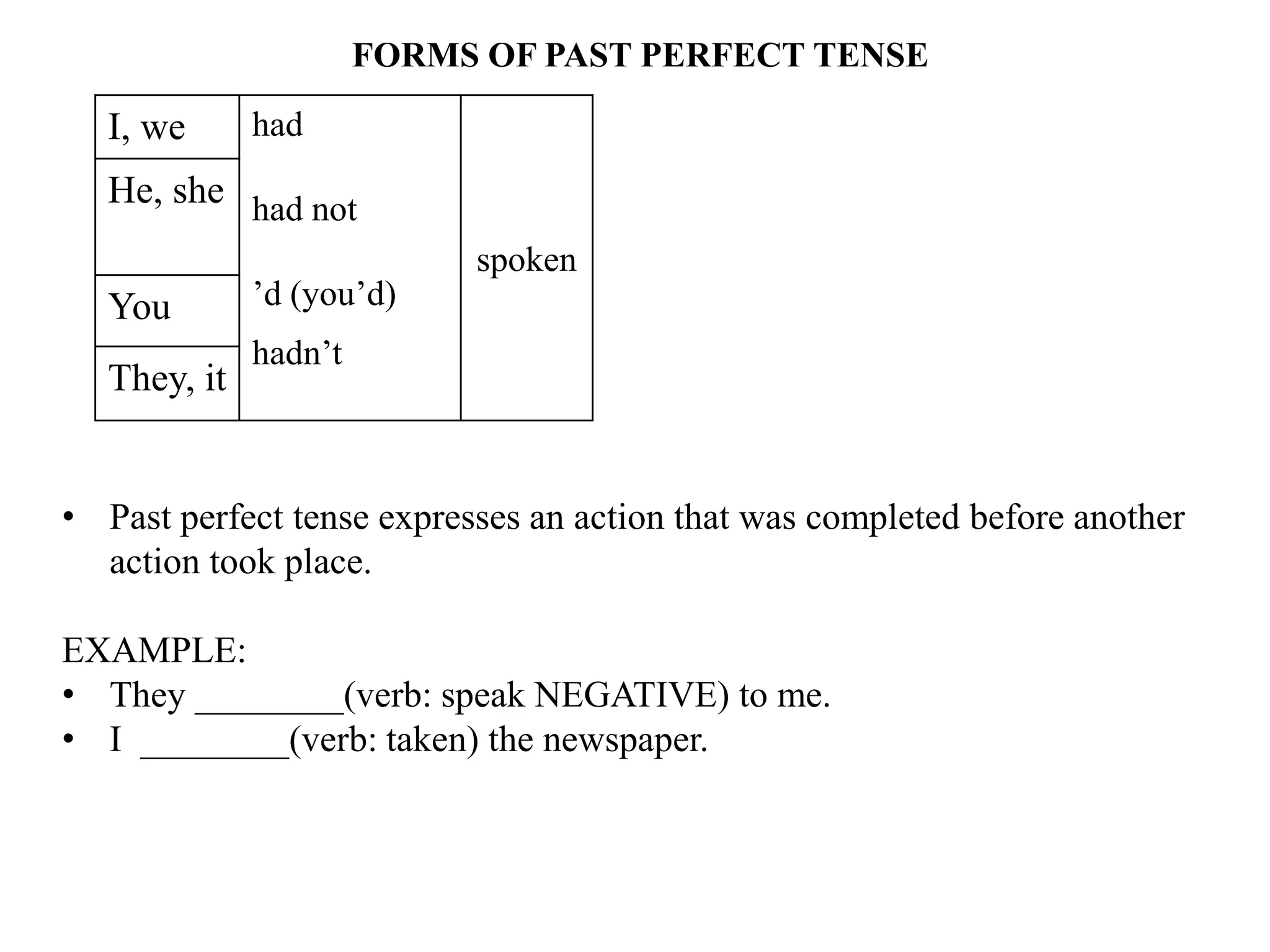
FORMS OF PAST PERFECT TENSE
I, we had
had not
’d (you’d)
hadn’t
spoken
He, she
You
They, it
• Past perfect tense expresses an action that was completed before another
action took place.
EXAMPLE:
• They ________(verb: speak NEGATIVE) to me.
• I ________(verb: taken) the newspaper.
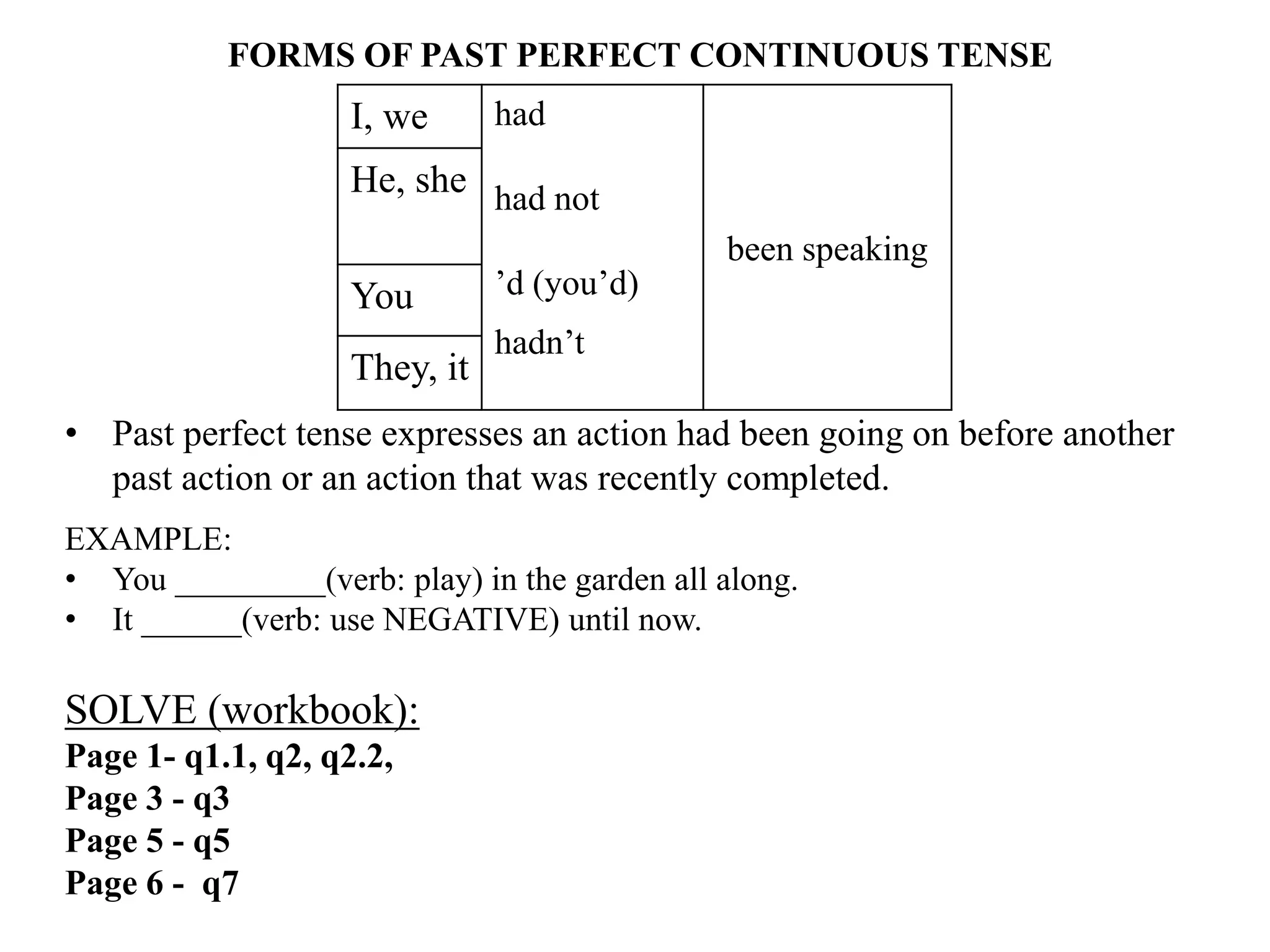
FORMS OF PAST PERFECT CONTINUOUS TENSE
I, we had
had not
’d (you’d)
hadn’t
been speaking
He, she
You
They, it
• Past perfect tense expresses an action had been going on before another
past action or an action that was recently completed.
EXAMPLE:
• You _________(verb: play) in the garden all along.
• It ______(verb: use NEGATIVE) until now.
SOLVE (workbook):
Page 1- q1.1, q2, q2.2,
Page 3 - q3
Page 5 - q5
Page 6 - q7
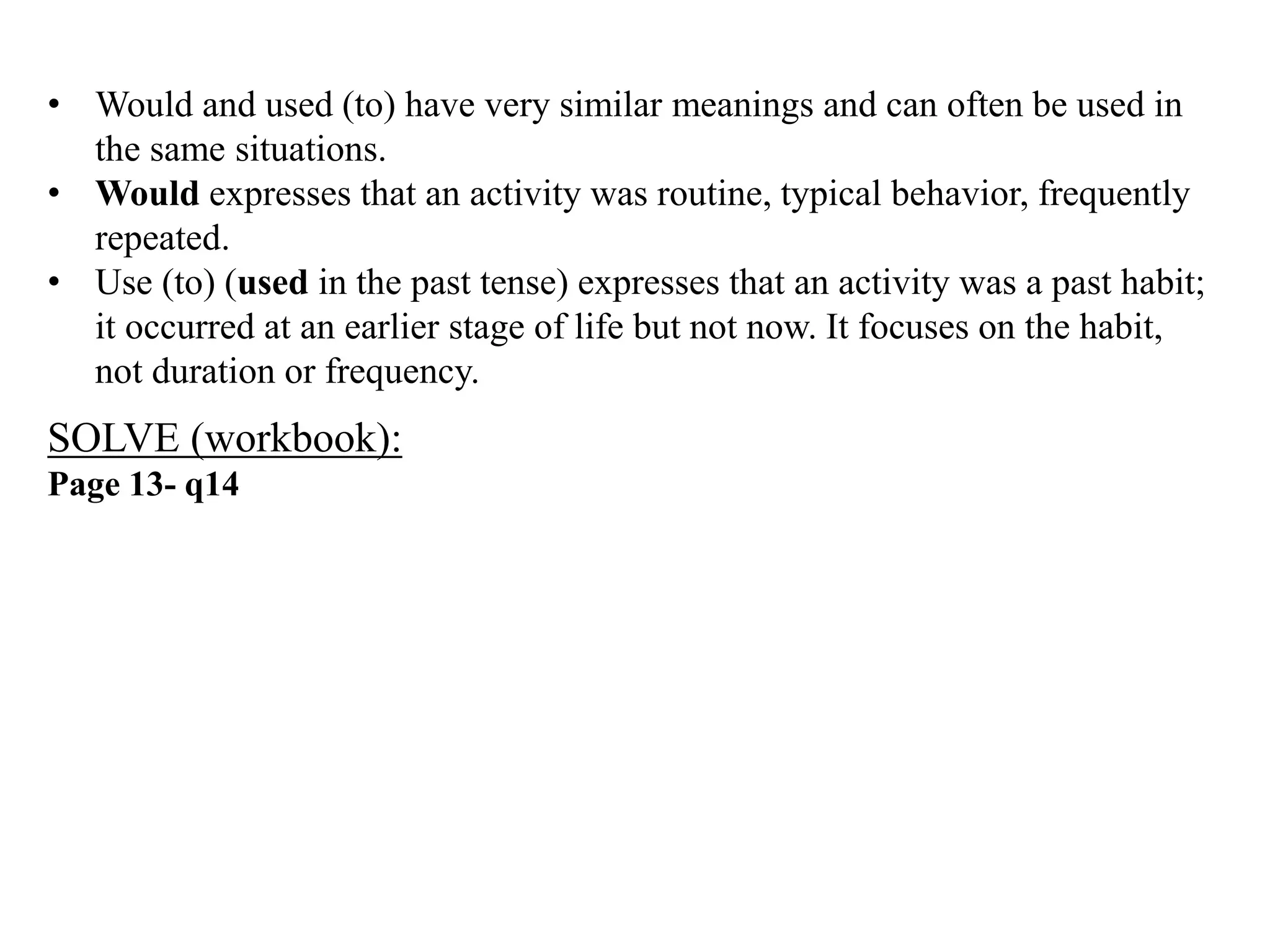
• Would and used (to) have very similar meanings and can often be used in
the same situations.
• Would expresses that an activity was routine, typical behavior, frequently
repeated.
• Use (to) (used in the past tense) expresses that an activity was a past habit;
it occurred at an earlier stage of life but not now. It focuses on the habit,
not duration or frequency.
SOLVE (workbook):
Page 13- q14
The Verb - To Have
Forms of To Have
Present Past Continuous
I / you / we / they have had having
he / she / it has had having
• As a main verb “to have” implies the meaning of possession.
• For example: “I have a job.”
• The verb “to have” is used as an auxiliary verb to help other verbs create the
perfect tense.
- auxiliary verb have [+ past participle]
• For example, “I have read a lot of books,”
• It does not take the continuous form "I having" - for that we have to use the
auxiliary verb be.
• For example: “I am having a shower.”
SOLVE (workbook):
Page 7 – q8
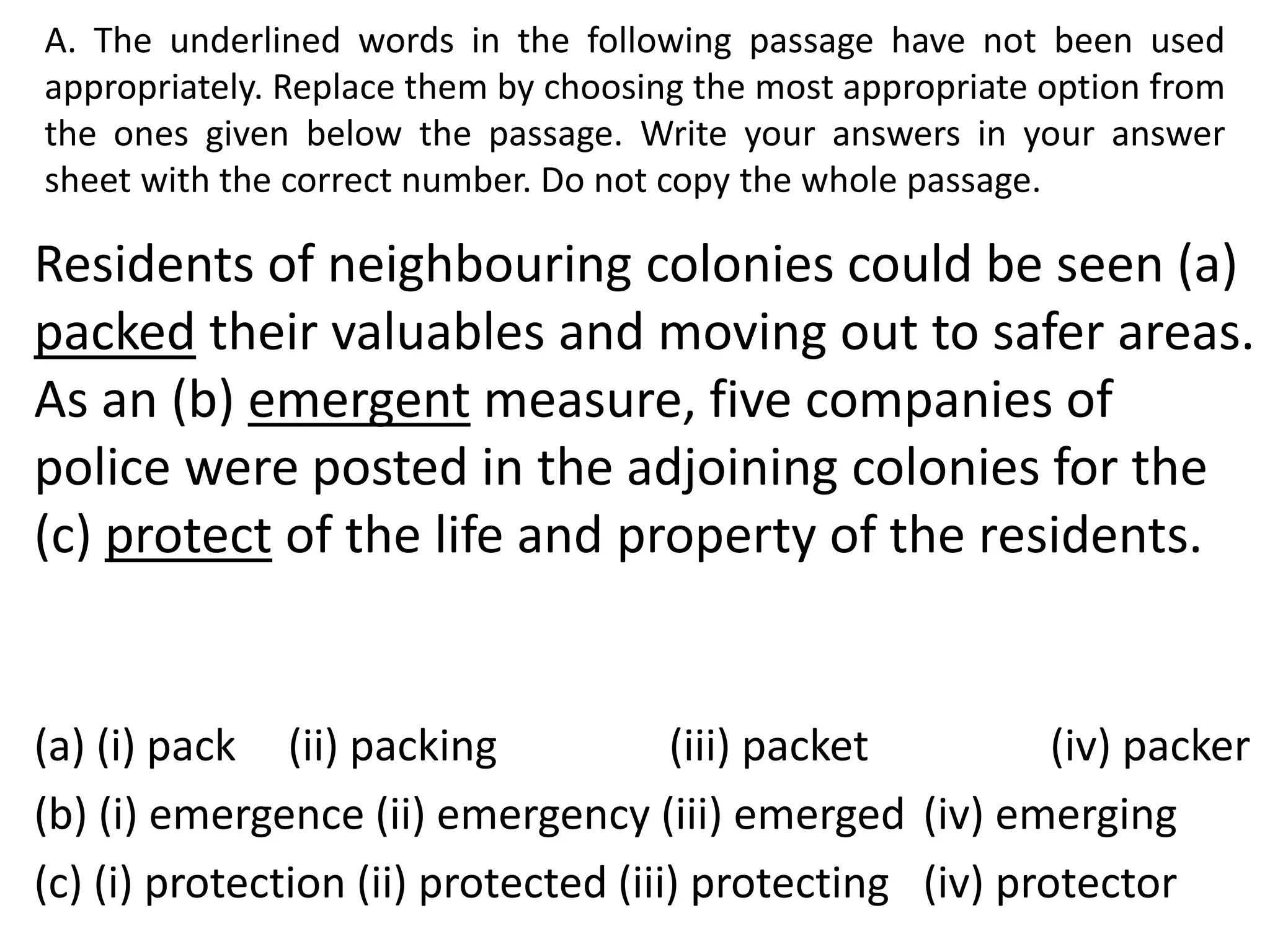
A. The underlined words in the following passage have not been used
appropriately. Replace them by choosing the most appropriate option from
the ones given below the passage. Write your answers in your answer
sheet with the correct number. Do not copy the whole passage.
Residents of neighbouring colonies could be seen (a)
packed their valuables and moving out to safer areas.
As an (b) emergent measure, five companies of
police were posted in the adjoining colonies for the
(c) protect of the life and property of the residents.
(a) (i) pack (ii) packing (iii) packet (iv) packer
(b) (i) emergence (ii) emergency (iii) emerged (iv) emerging
(c) (i) protection (ii) protected (iii) protecting (iv) protector
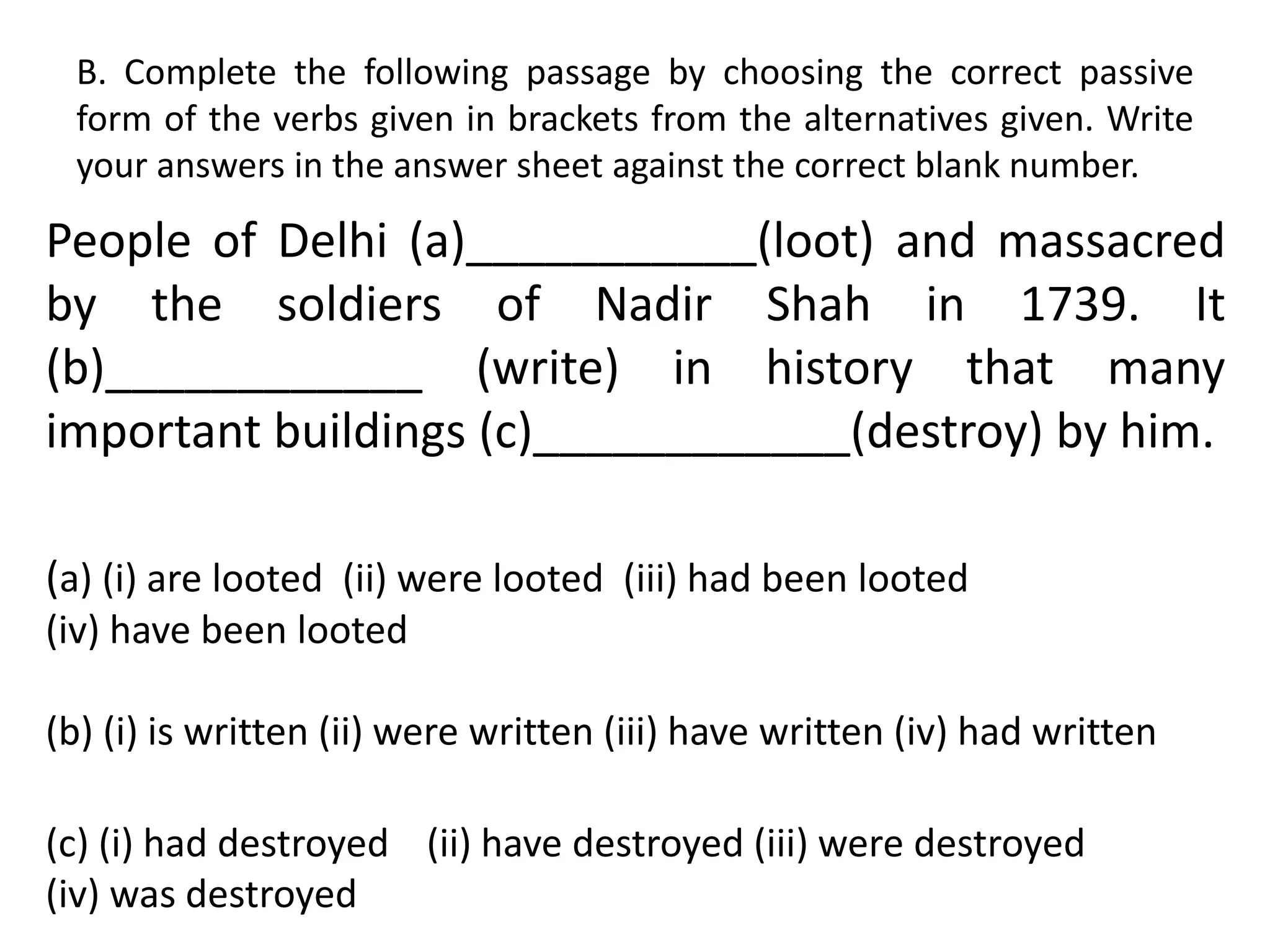
B. Complete the following passage by choosing the correct passive
form of the verbs given in brackets from the alternatives given. Write
your answers in the answer sheet against the correct blank number.
People of Delhi (a)___________(loot) and massacred
by the soldiers of Nadir Shah in 1739. It
(b)____________ (write) in history that many
important buildings (c)____________(destroy) by him.
(a) (i) are looted (ii) were looted (iii) had been looted
(iv) have been looted
(b) (i) is written (ii) were written (iii) have written (iv) had written
(c) (i) had destroyed (ii) have destroyed (iii) were destroyed
(iv) was destroyed

Verb forms tenses class 9 cbse

  • 1.
    VERB FORMS Class 9– ENGLISH GRAMMAR Mrs. Sheetal Thomas
  • 2.
    Verb Forms -Tenses • Tenses indicate time of action At the time of speaking Already taken place Expected to take place at or before a certain time in the future • Each of these tenses has 4 forms: 1. Simple 2. Continuous 3. Perfect 4. Perfect Continuous THREE MAIN TENSES PRESENT PAST FUTURE
  • 3.
    FORMS OF SIMPLEPRESENT TENSE I, we You They read do not read don’t read He She It reads does not read Doesn’t read Do I, we You They Read? Does He She It • Simple present tense expresses habitual actions, routine actions and universal truths. EXAMPLES: 1. Mina _________________________(verb: like) to be friends with naughty girls. 2. They ____________________(verb: want) to lose the match.
  • 4.
    FORMS OF PRESENTCONTINUOUS TENSE I + am I + am not I’m I’m not Playing (verb+ing) We + are We + are not We’re We’re not He/she + is It + is not He’s/ she’s It isn’t You + are You + are not You’re You are not They + are They + are not They’re They aren’t Am I Studying (verb+ing) Is he, she it Are we you they EXAMPLES: 1. I_________________________(verb: attend) a friends wedding reception. 2. They ____________________(verb: buy) clothes at the mall. • Present continuous tense expresses actions going on at the time of speaking.
  • 5.
    FORMS OF PRESENTPERFECT TENSE I have eaten We ’ve He, she It He’s, she’s Has hasn’t You Have not They Haven’t Am I studying (verb+ing) Is he, she it Are we you they • Present perfect tense expresses an action completed in the past but linked with the present. EXAMPLES: 1. He_________________________(verb: beat) all the girls in the drawing competition. 2. You ____________________(verb: eat) up all the chocolates.
  • 6.
    FORMS OF PRESENTPERFECT CONTINUOUS TENSE I , we I’ve, we’ve been reading He, she It Has hasn’t You Have not They Haven’t Have I we you they been studying (verb+ing) Has he, she it • Present perfect continuous tense lays emphasis on the period of time for which an action has been going on. • For is used to indicate the time for which an action has been going on. • Since is used to indicate the point of time at which an action started. SOLVE (workbook): Page 4- q4. Page 9- q9, q10, q11 Page 10- q12.1, q12.2
  • 7.
    FORMS OF SIMPLEPAST TENSE I , we Ate Didn’t eat Did not eat Did not eat He, she It You They Did I we you they Eat? he, she it • Simple past tense expresses actions in the past. EXAMPLE: • She________(verb: have) to cross the road to reach the station. • Shruthi ________(verb: run) and ________(verb: help) her get up.
  • 8.
    FORMS OF PASTCONTINUOUS TENSE I was was not wasn’t were were not weren’t eating (verb+ing) He, she It You, we They Were Was we you they eating? I, he, she it • Past continuous tense expresses an action going on at sometime in the past. EXAMPLE: • The players ________(verb: play) with complete concentration. • They ________(verb: read NEGATIVE) story books in class yesterday.
  • 9.
    FORMS OF PASTPERFECT TENSE I, we had had not ’d (you’d) hadn’t spoken He, she You They, it • Past perfect tense expresses an action that was completed before another action took place. EXAMPLE: • They ________(verb: speak NEGATIVE) to me. • I ________(verb: taken) the newspaper.
  • 10.
    FORMS OF PASTPERFECT CONTINUOUS TENSE I, we had had not ’d (you’d) hadn’t been speaking He, she You They, it • Past perfect tense expresses an action had been going on before another past action or an action that was recently completed. EXAMPLE: • You _________(verb: play) in the garden all along. • It ______(verb: use NEGATIVE) until now. SOLVE (workbook): Page 1- q1.1, q2, q2.2, Page 3 - q3 Page 5 - q5 Page 6 - q7
  • 11.
    • Would andused (to) have very similar meanings and can often be used in the same situations. • Would expresses that an activity was routine, typical behavior, frequently repeated. • Use (to) (used in the past tense) expresses that an activity was a past habit; it occurred at an earlier stage of life but not now. It focuses on the habit, not duration or frequency. SOLVE (workbook): Page 13- q14
  • 12.
    The Verb -To Have Forms of To Have Present Past Continuous I / you / we / they have had having he / she / it has had having • As a main verb “to have” implies the meaning of possession. • For example: “I have a job.” • The verb “to have” is used as an auxiliary verb to help other verbs create the perfect tense. - auxiliary verb have [+ past participle] • For example, “I have read a lot of books,” • It does not take the continuous form "I having" - for that we have to use the auxiliary verb be. • For example: “I am having a shower.” SOLVE (workbook): Page 7 – q8
  • 13.
    A. The underlinedwords in the following passage have not been used appropriately. Replace them by choosing the most appropriate option from the ones given below the passage. Write your answers in your answer sheet with the correct number. Do not copy the whole passage. Residents of neighbouring colonies could be seen (a) packed their valuables and moving out to safer areas. As an (b) emergent measure, five companies of police were posted in the adjoining colonies for the (c) protect of the life and property of the residents. (a) (i) pack (ii) packing (iii) packet (iv) packer (b) (i) emergence (ii) emergency (iii) emerged (iv) emerging (c) (i) protection (ii) protected (iii) protecting (iv) protector
  • 14.
    B. Complete thefollowing passage by choosing the correct passive form of the verbs given in brackets from the alternatives given. Write your answers in the answer sheet against the correct blank number. People of Delhi (a)___________(loot) and massacred by the soldiers of Nadir Shah in 1739. It (b)____________ (write) in history that many important buildings (c)____________(destroy) by him. (a) (i) are looted (ii) were looted (iii) had been looted (iv) have been looted (b) (i) is written (ii) were written (iii) have written (iv) had written (c) (i) had destroyed (ii) have destroyed (iii) were destroyed (iv) was destroyed