ZES 1133Technical English 1Adverb
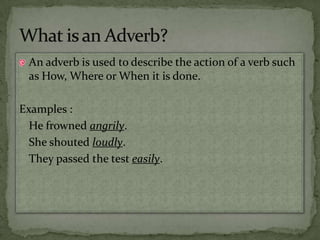
An adverb is used to describe the action of a verb such as How, Where or When it is done.Examples :	He frowned angrily.	She shouted loudly.	They passed the test easily.What is an Adverb?
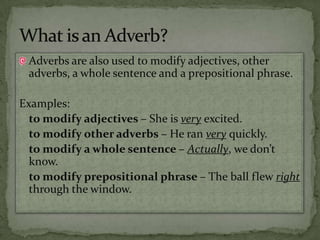
Adverbs are also used to modify adjectives, other adverbs, a whole sentence and a prepositional phrase.Examples:to modify adjectives – She is very excited.to modify other adverbs – He ran very quickly.to modify a whole sentence – Actually, we don’t know.to modify prepositional phrase – The ball flew right through the window.What is an Adverb?
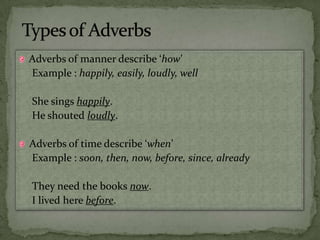
Types of AdverbsAdverbs of manner describe ‘how’Example : happily, easily, loudly, wellShe sings happily.He shouted loudly.Adverbs of time describe ‘when’Example : soon, then, now, before, since, alreadyThey need the books now.I lived here before.
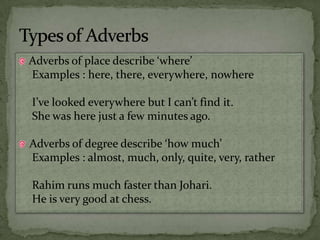
Adverbs of place describe ‘where’Examples : here, there, everywhere, nowhereI’ve looked everywhere but I can’t find it.She was here just a few minutes ago.Adverbs of degree describe ‘how much’Examples : almost, much, only, quite, very, ratherRahim runs much faster than Johari.He is very good at chess.Types of Adverbs
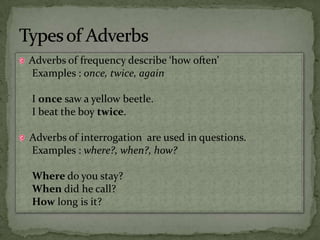
Adverbs of frequency describe ‘how often’Examples : once, twice, againI once saw a yellow beetle.I beat the boy twice.Adverbs of interrogation  are used in questions.Examples : where?, when?, how?Where do you stay?When did he call?How long is it?Types of Adverbs
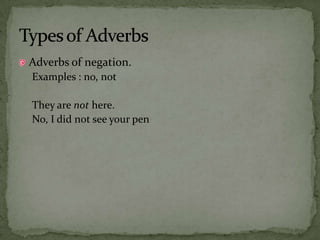
Adverbs of negation. Examples : no, notThey are not here.No, I did not see your penTypes of Adverbs
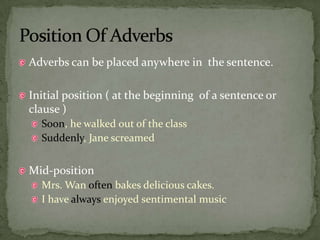
Adverbs can be placed anywhere in  the sentence.Initial position ( at the beginning  of a sentence or clause )Soon, he walked out of the class Suddenly, Jane screamedMid-position Mrs. Wan often bakes delicious cakes.I have always enjoyed sentimental musicPosition Of Adverbs
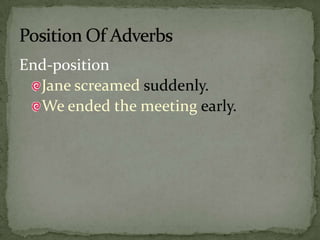
End-position Jane screamed suddenly.We ended the meeting early.Position Of Adverbs
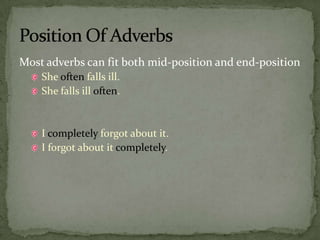
Most adverbs can fit both mid-position and end-positionShe often falls ill.She falls ill often.I completely forgot about it.I forgot about it completely.Position Of Adverbs
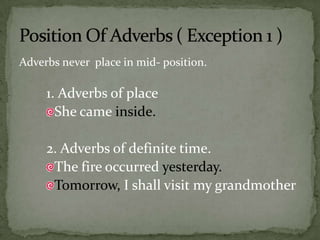
Adverbs never  place in mid- position.1. Adverbs of placeShe came inside.2. Adverbs of definite time.The fire occurred yesterday.Tomorrow, I shall visit my grandmother Position Of Adverbs ( Exception 1 )
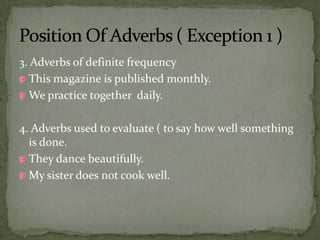
3. Adverbs of definite frequencyThis magazine is published monthly.We practice together  daily.4. Adverbs used to evaluate ( to say how well something is done.They dance beautifully.My sister does not cook well.Position Of Adverbs ( Exception 1 )
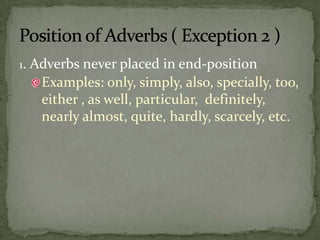
1. Adverbs never placed in end-position Examples: only, simply, also, specially, too, either , as well, particular,  definitely, nearly almost, quite, hardly, scarcely, etc.Position of Adverbs ( Exception 2 )
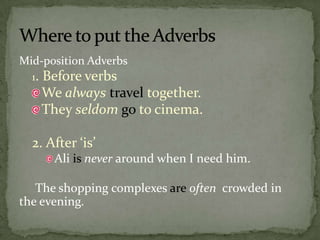
Mid-position Adverbs 1. Before verbsWe alwaystravel together.They seldomgo to cinema.2. After ‘is’Ali is never around when I need him.The shopping complexes areoften  crowded in the evening.Where to put the Adverbs
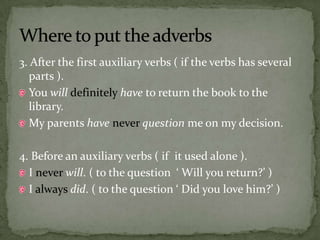
3. After the first auxiliary verbs ( if the verbs has several parts ).You willdefinitelyhave to return the book to the library.My parents haveneverquestion me on my decision.4. Before an auxiliary verbs ( if it used alone ).I never will. ( to the question  ‘ Will you return?’ )I always did. ( to the question ‘ Did you love him?’ )Where to put the adverbs
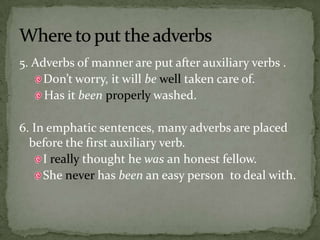
5. Adverbs of manner are put after auxiliary verbs .Don’t worry, it will bewelltaken care of.Has it beenproperly washed.6. In emphatic sentences, many adverbs are placed before the first auxiliary verb.I really thought he was an honest fellow.She never has beenan easy person  to deal with.Where to put the adverbs
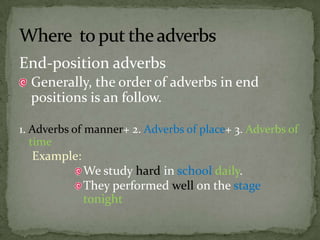
End-position adverbs Generally, the order of adverbs in end positions is an follow.1. Adverbs of manner+ 2. Adverbs of place+ 3. Adverbs of timeExample:We study hard in schooldaily.They performed well on the stagetonightWhere  to put the adverbs
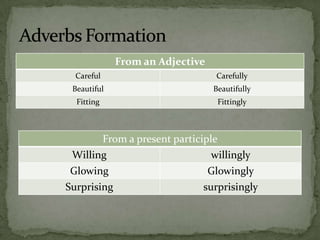
Adverbs Formation
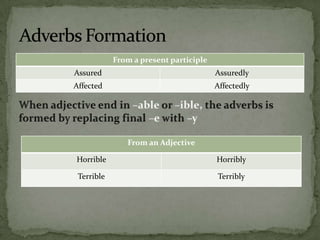
Adverbs FormationWhen adjective end in –able or –ible, the adverbs is formed by replacing final –e with –y
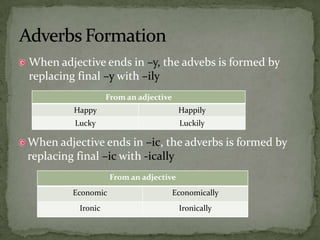
When adjective ends in –y, the advebs is formed by replacing final –y with –ilyWhen adjective ends in –ic, the adverbs is formed by replacing final –icwith -icallyAdverbs Formation
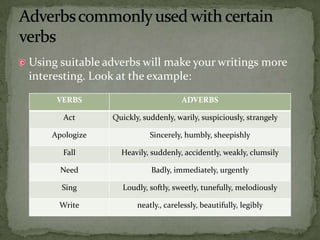
Using suitable adverbs will make your writings more interesting. Look at the example:Adverbs commonly used with certain verbs
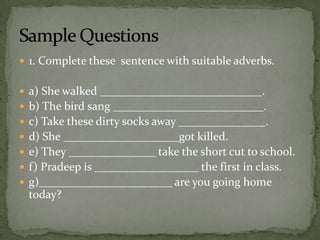
1. Complete these  sentence with suitable adverbs.a) She walked ____________________________.b) The bird sang __________________________.c) Take these dirty socks away _______________.d) She ____________________got killed.e) They _______________ take the short cut to school.f) Pradeep is __________________ the first in class.g)_______________________ are you going home today?Sample Questions
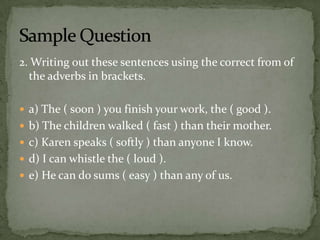
2. Writing out these sentences using the correct from of the adverbs in brackets.a) The ( soon ) you finish your work, the ( good ).b) The children walked ( fast ) than their mother.c) Karen speaks ( softly ) than anyone I know.d) I can whistle the ( loud ).e) He can do sums ( easy ) than any of us.Sample Question

Adverb

  • 1.
  • 2.
    An adverb isused to describe the action of a verb such as How, Where or When it is done.Examples : He frowned angrily. She shouted loudly. They passed the test easily.What is an Adverb?
  • 3.
    Adverbs are alsoused to modify adjectives, other adverbs, a whole sentence and a prepositional phrase.Examples:to modify adjectives – She is very excited.to modify other adverbs – He ran very quickly.to modify a whole sentence – Actually, we don’t know.to modify prepositional phrase – The ball flew right through the window.What is an Adverb?
  • 4.
    Types of AdverbsAdverbsof manner describe ‘how’Example : happily, easily, loudly, wellShe sings happily.He shouted loudly.Adverbs of time describe ‘when’Example : soon, then, now, before, since, alreadyThey need the books now.I lived here before.
  • 5.
    Adverbs of placedescribe ‘where’Examples : here, there, everywhere, nowhereI’ve looked everywhere but I can’t find it.She was here just a few minutes ago.Adverbs of degree describe ‘how much’Examples : almost, much, only, quite, very, ratherRahim runs much faster than Johari.He is very good at chess.Types of Adverbs
  • 6.
    Adverbs of frequencydescribe ‘how often’Examples : once, twice, againI once saw a yellow beetle.I beat the boy twice.Adverbs of interrogation are used in questions.Examples : where?, when?, how?Where do you stay?When did he call?How long is it?Types of Adverbs
  • 7.
    Adverbs of negation.Examples : no, notThey are not here.No, I did not see your penTypes of Adverbs
  • 8.
    Adverbs can beplaced anywhere in the sentence.Initial position ( at the beginning of a sentence or clause )Soon, he walked out of the class Suddenly, Jane screamedMid-position Mrs. Wan often bakes delicious cakes.I have always enjoyed sentimental musicPosition Of Adverbs
  • 9.
    End-position Jane screamedsuddenly.We ended the meeting early.Position Of Adverbs
  • 10.
    Most adverbs canfit both mid-position and end-positionShe often falls ill.She falls ill often.I completely forgot about it.I forgot about it completely.Position Of Adverbs
  • 11.
    Adverbs never place in mid- position.1. Adverbs of placeShe came inside.2. Adverbs of definite time.The fire occurred yesterday.Tomorrow, I shall visit my grandmother Position Of Adverbs ( Exception 1 )
  • 12.
    3. Adverbs ofdefinite frequencyThis magazine is published monthly.We practice together daily.4. Adverbs used to evaluate ( to say how well something is done.They dance beautifully.My sister does not cook well.Position Of Adverbs ( Exception 1 )
  • 13.
    1. Adverbs neverplaced in end-position Examples: only, simply, also, specially, too, either , as well, particular, definitely, nearly almost, quite, hardly, scarcely, etc.Position of Adverbs ( Exception 2 )
  • 14.
    Mid-position Adverbs 1.Before verbsWe alwaystravel together.They seldomgo to cinema.2. After ‘is’Ali is never around when I need him.The shopping complexes areoften crowded in the evening.Where to put the Adverbs
  • 15.
    3. After thefirst auxiliary verbs ( if the verbs has several parts ).You willdefinitelyhave to return the book to the library.My parents haveneverquestion me on my decision.4. Before an auxiliary verbs ( if it used alone ).I never will. ( to the question ‘ Will you return?’ )I always did. ( to the question ‘ Did you love him?’ )Where to put the adverbs
  • 16.
    5. Adverbs ofmanner are put after auxiliary verbs .Don’t worry, it will bewelltaken care of.Has it beenproperly washed.6. In emphatic sentences, many adverbs are placed before the first auxiliary verb.I really thought he was an honest fellow.She never has beenan easy person to deal with.Where to put the adverbs
  • 17.
    End-position adverbs Generally,the order of adverbs in end positions is an follow.1. Adverbs of manner+ 2. Adverbs of place+ 3. Adverbs of timeExample:We study hard in schooldaily.They performed well on the stagetonightWhere to put the adverbs
  • 18.
  • 19.
    Adverbs FormationWhen adjectiveend in –able or –ible, the adverbs is formed by replacing final –e with –y
  • 20.
    When adjective endsin –y, the advebs is formed by replacing final –y with –ilyWhen adjective ends in –ic, the adverbs is formed by replacing final –icwith -icallyAdverbs Formation
  • 21.
    Using suitable adverbswill make your writings more interesting. Look at the example:Adverbs commonly used with certain verbs
  • 22.
    1. Complete these sentence with suitable adverbs.a) She walked ____________________________.b) The bird sang __________________________.c) Take these dirty socks away _______________.d) She ____________________got killed.e) They _______________ take the short cut to school.f) Pradeep is __________________ the first in class.g)_______________________ are you going home today?Sample Questions
  • 23.
    2. Writing outthese sentences using the correct from of the adverbs in brackets.a) The ( soon ) you finish your work, the ( good ).b) The children walked ( fast ) than their mother.c) Karen speaks ( softly ) than anyone I know.d) I can whistle the ( loud ).e) He can do sums ( easy ) than any of us.Sample Question