Table of Contents
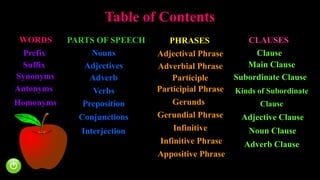
WORDS
Prefix
Suffix
Synonyms
Antonyms
Homonyms
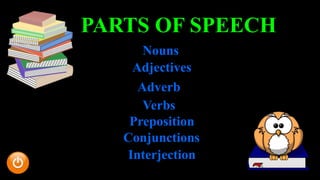
PARTS OF SPEECH
Nouns
Adjectives
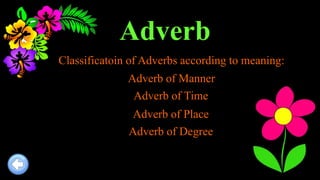
Adverb
Verbs
Preposition
Conjunctions
Interjection
Adjectival Phrase
PHRASES
Adverbial Phrase
Participle
Participial Phrase
Gerunds
Gerundial Phrase
Infinitive
Infinitive Phrase
CLAUSES
Main Clause
Subordinate Clause
Kinds of Subordinate
Clause
Adjective Clause
Noun Clause
Adverb Clause
Appositive Phrase
Clause
WORDS
Prefix
Suffix
Synonyms
Antonyms
Homonyms
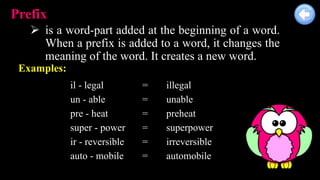
Prefix
 is a word-part added at the beginning of a word.
When a prefix is added to a word, it changes the
meaning of the word. It creates a new word.
Examples:
il - legal = illegal
un - able = unable
pre - heat = preheat
super - power = superpower
ir - reversible = irreversible
auto - mobile = automobile
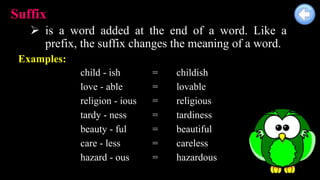
Suffix
 is a word added at the end of a word. Like a
prefix, the suffix changes the meaning of a word.
Examples:
child - ish = childish
love - able = lovable
religion - ious = religious
tardy - ness = tardiness
beauty - ful = beautiful
care - less = careless
hazard - ous = hazardous
Synonyms
 are words that are similar in meaning
Examples:
smart = clever
proud = flamboyant
courage = valor
mock = humiliate
null = void
afraid = scared
honest = truthful
funny = hillarious
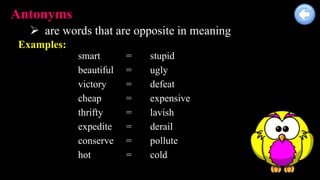
Antonyms
 are words that are opposite in meaning
Examples:
smart = stupid
beautiful = ugly
victory = defeat
cheap = expensive
thrifty = lavish
expedite = derail
conserve = pollute
hot = cold
Homonyms
 are words that sound alike but have different
meanings and spellings
Examples:
new = knew
mad = mud
love = lab
dye = die
bad = bud
god = gad
ode = odd
knot = not
PARTS OF SPEECH
Nouns
Adjectives
Adverb
Verbs
Preposition
Conjunctions
Interjection
Nouns
Classification of Nouns
Common
Proper
Collective
Concrete
Abstract
Count
Mass
Nouns
 is a subordinate clause which, like an adjective
modifies a noun or a pronoun.
Classification of Nouns
 is a noun in which does not name a particular
person, place or thing. Common nouns are not
capitalized.
Examples:
boy, planet, tree, university, shoes, bag
Common Nouns
Proper Nouns
 is the name of a particular person, place or thing.
Examples:
Pedro, Jupiter, Narra, Maria
Collective Noun
 is the name for a group of persons, animals or things.
Examples:
Committee, flock, herd, team
Concrete Noun
Examples:
beauty, love, kindness, justice
 names an object which can be perceived by the senses.
Examples:
chair, umbrella, phone, book
Abstract Noun
 names a quality, a characteristic or an idea.
Count Noun
 a noun that can be counted
Examples:
persons, books, students, trees
Mass Noun
 a noun that cannot be counted
Examples:
stars, sand, sugar, hair
Adjectives
Classification of Adjectives
Descriptive
Limiting
Proper
Demonstrative
Articles
Pronouns
Adjectives
Classification of Adjectives
 is a word used to modify or limit a noun or a pronoun.
 adjectives that modify a noun or a pronoun in terms of
size, shape, color, texture, smell, age, and physical
appearance.
Descriptive
Limiting
 adjectives that refer to number or order cardinal
Examples: round, beautiful, tall, old
Examples:
round, beautiful, tall, old
 adjectives that are made from proper noun
Proper Adjectives
Demonstrative
 adjectives that are also used as a demonstrative pronoun.
Examples: round, beautiful, tall, old
Examples: that book, those chairs, this bag, these pencils
Articles
 adjectives that precede a noun. a and an are indefinite
articles and the is a definite article.
Examples: the book, a book, an apple, a dog
Pronouns
 can also be used as adjectives.
Examples: our teacher, my brother, his house, her family
Adverb
Classificatoin of Adverbs according to meaning:
Adverb of Manner
Adverb of Time
Adverb of Place
Adverb of Degree
 is a word that modifies a verb, an adjective or another
adverb.
Classification of Adverbs according to meaning:
Adverb of Manner
Examples:
immediately, melodiously, here
Adverb
 tells how the action was done and ends with suffix - ly.
Adverb of Time
 tells when the action indicated by the verb took place.
Examples:
arrived late, came early
Adverb of Place
Examples:
teaches here, walked out
 tells the location indicated by the verb.
Adverb of Degree
 tells the amount of the adjective quality and the
verb action.
Examples:
very tired, quite welvery tired, quite well
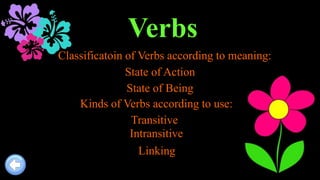
Classificatoin of Verbs according to meaning:
Verbs
Transitive
State of Being
Kinds of Verbs according to use:
State of Action
Intransitive
Linking
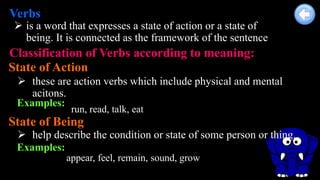
 is a word that expresses a state of action or a state of
being. It is connected as the framework of the sentence
Classification of Verbs according to meaning:
State of Action
Examples:
run, read, talk, eat
Verbs
 these are action verbs which include physical and mental
acitons.
State of Being
Examples:
appear, feel, remain, sound, grow
 help describe the condition or state of some person or thing.
Kinds of Verbs according to Use:
Transitive Verbs
Examples: The students left the car at the park.
The guard picked the ball.
 are verbs that need a direct object.
Intransitive Verbs
Examples: The dog run towards the man.
They went to the party.
 are verbs that do not need a direct object. They likewise
express state of action.
Linking Verbs
 verbs that link or copulate the subject to a word or words
Examples: The girl is dancing and singing.
Examples:
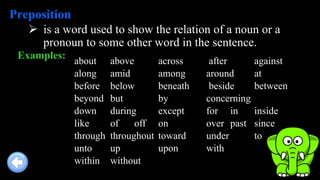
about above across after against
along amid among around at
before below beneath beside between
beyond but by concerning
down during except for in inside
like of off on over past since
through throughout toward under to
unto up upon with
within without
 is a word used to show the relation of a noun or a
pronoun to some other word in the sentence.
Preposition
Kinds of Conjunctions
Conjunctions
Coordinating Conjunctions
Correlative Conjunctions
Subordinating Conjunctions
 is a word which joins words and group of words
Kinds of Conjunctions
Coordinating Conjunctions
Examples:
Conjunction
Correlative Conjunctions
either…or; neither…nor; both…and; not…but also
Examples:
and, but, or, nor
Subordinating Conjunctions
Examples: after, although, as, as much, as, because before,
how, in as much as, in order, that, provided than,
though, till, unless, when
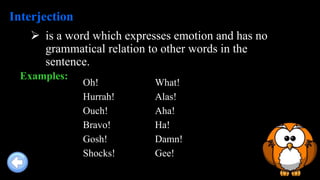
 is a word which expresses emotion and has no
grammatical relation to other words in the
sentence.
Interjection
Examples:
Oh! What!
Hurrah! Alas!
Ouch! Aha!
Bravo! Ha!
Gosh! Damn!
Shocks! Gee!
Adjectival Phrase
PHRASES
Adverbial Phrase
Participle
Participial Phrase
Gerunds
Gerundial Phrase
Infinitive
Infinitive Phrase
Appositive Phrase
Adjectival Phrase
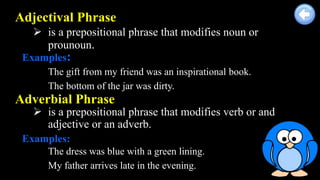
 is a prepositional phrase that modifies noun or
prounoun.
Examples:
The gift from my friend was an inspirational book.
The bottom of the jar was dirty.
Adverbial Phrase
 is a prepositional phrase that modifies verb or and
adjective or an adverb.
The dress was blue with a green lining.
My father arrives late in the evening.
Examples:
Participle
 is word which acts as both a verb and an adjective.
Participial Phrase
 is a group of related words containing a participle. It
acts as an adjective to modify a noun or a pronoun.
Frightened by the news, my brother turned off the tv.
Angered by his younger brother, Rudy turned off the light in
the room.
Examples:
Gerunds
 are verbals that look like a verb because they end in-
ing but function as a noun.
Gerundial Phrase
 is a phrase containing a gerund. It functions as a
noun inside the sentence.
Jolina enjoys singing sentimental songs.
Collecting stamps is her favourite past-time.
Examples:
Infinitive
 is a verbal consisting of the preposition to followed by
the verb. It is primarily used as a noun. But may also be
used as an adjective or an adverb.
Infinitive Phrase
 is a phrase containing an infinitive. It functions
as a noun or a modifier inside the sentence.
Examples:
I have an exciting news to tell to everybody.
Her new assignment is to watch the kids playing.
Appositive Phrase
 is a phrase which follows a noun or a pronoun and
means the same thing.
Mr. Garcia, our English teacher, left the room.
I received information from Anne, my secretary
Examples:
CLAUSES
Main Clause
Subordinate Clause
Kinds of Subordinate Clause
Adjective Clause
Noun Clause
Adverb Clause
Clause
Clause
 is a group of words that contains a verb and its
subject and is used as a part of the sentence.
Main Clause (Independent Clause)
 a clause that expresses a complete thought and can
stand by itself as a sentence.
Examples: He just invented the story.
She needs a glass of water.
Subordinate Clause (Dependent Clause)
 a clause that expresses a complete thought and can
stand by itself as a sentence.
Examples: Since she did not attend her classes regularly,
The teacher almost caught Marlon.
Kinds of Subordinate Clause
Adjective Clause
 is a subordinate clause which, like an adjective
modifies a noun or a pronoun.
Examples:
Cecille is the kind of person who never gets upset so easily.
Mrs. Nicadao showed pictures which were taken in Vigan.
Noun Clause
 is a subordinate clause used as a noun.
Examples:
What the teacher said was not clear.
Your patience with me is what I need right now.
Adverb Clause
 is a subordinate clause which, like an adverb,
modifies a verb or an adjective or an adverb.
Examples:
The athletes run because they were told to.
Karenina is as pretty as a girl can be.

English Structure

  • 2.
    Table of Contents WORDS Prefix Suffix Synonyms Antonyms Homonyms PARTSOF SPEECH Nouns Adjectives Adverb Verbs Preposition Conjunctions Interjection Adjectival Phrase PHRASES Adverbial Phrase Participle Participial Phrase Gerunds Gerundial Phrase Infinitive Infinitive Phrase CLAUSES Main Clause Subordinate Clause Kinds of Subordinate Clause Adjective Clause Noun Clause Adverb Clause Appositive Phrase Clause
  • 3.
  • 4.
    Prefix  is aword-part added at the beginning of a word. When a prefix is added to a word, it changes the meaning of the word. It creates a new word. Examples: il - legal = illegal un - able = unable pre - heat = preheat super - power = superpower ir - reversible = irreversible auto - mobile = automobile
  • 5.
    Suffix  is aword added at the end of a word. Like a prefix, the suffix changes the meaning of a word. Examples: child - ish = childish love - able = lovable religion - ious = religious tardy - ness = tardiness beauty - ful = beautiful care - less = careless hazard - ous = hazardous
  • 6.
    Synonyms  are wordsthat are similar in meaning Examples: smart = clever proud = flamboyant courage = valor mock = humiliate null = void afraid = scared honest = truthful funny = hillarious
  • 7.
    Antonyms  are wordsthat are opposite in meaning Examples: smart = stupid beautiful = ugly victory = defeat cheap = expensive thrifty = lavish expedite = derail conserve = pollute hot = cold
  • 8.
    Homonyms  are wordsthat sound alike but have different meanings and spellings Examples: new = knew mad = mud love = lab dye = die bad = bud god = gad ode = odd knot = not
  • 9.
  • 10.
  • 11.
    Nouns  is asubordinate clause which, like an adjective modifies a noun or a pronoun. Classification of Nouns  is a noun in which does not name a particular person, place or thing. Common nouns are not capitalized. Examples: boy, planet, tree, university, shoes, bag Common Nouns Proper Nouns  is the name of a particular person, place or thing. Examples: Pedro, Jupiter, Narra, Maria
  • 12.
    Collective Noun  isthe name for a group of persons, animals or things. Examples: Committee, flock, herd, team Concrete Noun Examples: beauty, love, kindness, justice  names an object which can be perceived by the senses. Examples: chair, umbrella, phone, book Abstract Noun  names a quality, a characteristic or an idea.
  • 13.
    Count Noun  anoun that can be counted Examples: persons, books, students, trees Mass Noun  a noun that cannot be counted Examples: stars, sand, sugar, hair
  • 14.
  • 15.
    Adjectives Classification of Adjectives is a word used to modify or limit a noun or a pronoun.  adjectives that modify a noun or a pronoun in terms of size, shape, color, texture, smell, age, and physical appearance. Descriptive Limiting  adjectives that refer to number or order cardinal Examples: round, beautiful, tall, old Examples: round, beautiful, tall, old
  • 16.
     adjectives thatare made from proper noun Proper Adjectives Demonstrative  adjectives that are also used as a demonstrative pronoun. Examples: round, beautiful, tall, old Examples: that book, those chairs, this bag, these pencils Articles  adjectives that precede a noun. a and an are indefinite articles and the is a definite article. Examples: the book, a book, an apple, a dog Pronouns  can also be used as adjectives. Examples: our teacher, my brother, his house, her family
  • 17.
    Adverb Classificatoin of Adverbsaccording to meaning: Adverb of Manner Adverb of Time Adverb of Place Adverb of Degree
  • 18.
     is aword that modifies a verb, an adjective or another adverb. Classification of Adverbs according to meaning: Adverb of Manner Examples: immediately, melodiously, here Adverb  tells how the action was done and ends with suffix - ly. Adverb of Time  tells when the action indicated by the verb took place. Examples: arrived late, came early
  • 19.
    Adverb of Place Examples: teacheshere, walked out  tells the location indicated by the verb. Adverb of Degree  tells the amount of the adjective quality and the verb action. Examples: very tired, quite welvery tired, quite well
  • 20.
    Classificatoin of Verbsaccording to meaning: Verbs Transitive State of Being Kinds of Verbs according to use: State of Action Intransitive Linking
  • 21.
     is aword that expresses a state of action or a state of being. It is connected as the framework of the sentence Classification of Verbs according to meaning: State of Action Examples: run, read, talk, eat Verbs  these are action verbs which include physical and mental acitons. State of Being Examples: appear, feel, remain, sound, grow  help describe the condition or state of some person or thing.
  • 22.
    Kinds of Verbsaccording to Use: Transitive Verbs Examples: The students left the car at the park. The guard picked the ball.  are verbs that need a direct object. Intransitive Verbs Examples: The dog run towards the man. They went to the party.  are verbs that do not need a direct object. They likewise express state of action. Linking Verbs  verbs that link or copulate the subject to a word or words Examples: The girl is dancing and singing.
  • 23.
    Examples: about above acrossafter against along amid among around at before below beneath beside between beyond but by concerning down during except for in inside like of off on over past since through throughout toward under to unto up upon with within without  is a word used to show the relation of a noun or a pronoun to some other word in the sentence. Preposition
  • 24.
    Kinds of Conjunctions Conjunctions CoordinatingConjunctions Correlative Conjunctions Subordinating Conjunctions
  • 25.
     is aword which joins words and group of words Kinds of Conjunctions Coordinating Conjunctions Examples: Conjunction Correlative Conjunctions either…or; neither…nor; both…and; not…but also Examples: and, but, or, nor Subordinating Conjunctions Examples: after, although, as, as much, as, because before, how, in as much as, in order, that, provided than, though, till, unless, when
  • 26.
     is aword which expresses emotion and has no grammatical relation to other words in the sentence. Interjection Examples: Oh! What! Hurrah! Alas! Ouch! Aha! Bravo! Ha! Gosh! Damn! Shocks! Gee!
  • 27.
    Adjectival Phrase PHRASES Adverbial Phrase Participle ParticipialPhrase Gerunds Gerundial Phrase Infinitive Infinitive Phrase Appositive Phrase
  • 28.
    Adjectival Phrase  isa prepositional phrase that modifies noun or prounoun. Examples: The gift from my friend was an inspirational book. The bottom of the jar was dirty. Adverbial Phrase  is a prepositional phrase that modifies verb or and adjective or an adverb. The dress was blue with a green lining. My father arrives late in the evening. Examples:
  • 29.
    Participle  is wordwhich acts as both a verb and an adjective. Participial Phrase  is a group of related words containing a participle. It acts as an adjective to modify a noun or a pronoun. Frightened by the news, my brother turned off the tv. Angered by his younger brother, Rudy turned off the light in the room. Examples: Gerunds  are verbals that look like a verb because they end in- ing but function as a noun.
  • 30.
    Gerundial Phrase  isa phrase containing a gerund. It functions as a noun inside the sentence. Jolina enjoys singing sentimental songs. Collecting stamps is her favourite past-time. Examples: Infinitive  is a verbal consisting of the preposition to followed by the verb. It is primarily used as a noun. But may also be used as an adjective or an adverb.
  • 31.
    Infinitive Phrase  isa phrase containing an infinitive. It functions as a noun or a modifier inside the sentence. Examples: I have an exciting news to tell to everybody. Her new assignment is to watch the kids playing. Appositive Phrase  is a phrase which follows a noun or a pronoun and means the same thing. Mr. Garcia, our English teacher, left the room. I received information from Anne, my secretary Examples:
  • 32.
    CLAUSES Main Clause Subordinate Clause Kindsof Subordinate Clause Adjective Clause Noun Clause Adverb Clause Clause
  • 33.
    Clause  is agroup of words that contains a verb and its subject and is used as a part of the sentence. Main Clause (Independent Clause)  a clause that expresses a complete thought and can stand by itself as a sentence. Examples: He just invented the story. She needs a glass of water. Subordinate Clause (Dependent Clause)  a clause that expresses a complete thought and can stand by itself as a sentence. Examples: Since she did not attend her classes regularly, The teacher almost caught Marlon.
  • 34.
    Kinds of SubordinateClause Adjective Clause  is a subordinate clause which, like an adjective modifies a noun or a pronoun. Examples: Cecille is the kind of person who never gets upset so easily. Mrs. Nicadao showed pictures which were taken in Vigan. Noun Clause  is a subordinate clause used as a noun. Examples: What the teacher said was not clear. Your patience with me is what I need right now.
  • 35.
    Adverb Clause  isa subordinate clause which, like an adverb, modifies a verb or an adjective or an adverb. Examples: The athletes run because they were told to. Karenina is as pretty as a girl can be.