

The Major Rules:
Tools and Techniques
  of Photography
Rule of Thirds
1. Foreground
2. Middle Ground
3. Background
The main point of interest     . Image by Trey Ratcliff.


should be two thirds of the
way up from the bottom of
the photo.
Photographs generally
have three distinct areas of
interest.
Golden Section
The places where the
horizontal and vertical lines
intersect are where points
of interest exist, the so
called golden points.
Divide the image into
three sections
diagonally, from lower left
to upper right. Important
elements of the image
should be contained by the
middle diagonal section.
Lines of image are more
dynamic if they are
moving diagonally.
Dominant Foreground
Any element placed in the
extreme foreground of an
image acts as an entry point.
Provides a sense of depth and
scale, acts as a visual magnet
that pulls the entire image
together.
Perspective
Where an image is taken from can be as important as how it was taken.
Perspective adds interest by giving viewers a look at something from a
place they have not seen before, and what is new is interesting.
Contrast
Contrast is a way to control an image and determine where the audience
will look when they view the picture. Use contrast by putting a light
subject on a dark background, or a dark subject on a light background.
Remember that large contrasts with small, and wide contrasts with
narrow.
Color
The eye is attracted to colors that are bright, vivid, and saturated, and
drift away from colors that are dull, faded, and unsaturated. Use color to
control where in the image the viewer's attention will be focused.
Texture
Texture is a function of light.
Strong, directional light
from one side creates texture
by illuminating one side of
an object, and creating
shadows on the other side.
Texture gives an image depth
and detail.
Framing
Using one compositional element to frame, or emphasize another. The
framing element focuses the viewer's attention on the main subject.
Background
The background of a subject is anything behind it. By controlling the
background; keeping it simple both in terms of elements, color, and
tone, the viewer is directed towards the main subject.
Lines:
Leading Lines, Curves and Zig-Zags
                           Leading Lines bring
                           the viewer's eye from
                           the entry point of the
                           image to main
                           subject.

                           Curves and Zig-
                           Zags take the viewer
                           along the path that
                           the artist wants them
                           to go.


                           Image by Pierre Metivier
Diagonal lines express energy and movement
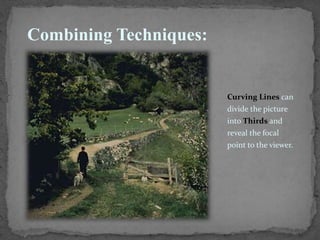
Combining Techniques:


                        Curving Lines can
                        divide the picture
                        into Thirds and
                        reveal the focal
                        point to the viewer.
Balancing Elements
Placing your main subject off-center, as with the rule of thirds can leave a void in
the scene which can make it feel empty. You should balance the 'weight' of your
subject by including another object of lesser importance to fill the space.


                                              Image by Shannon Kokoska.
Symmetry
and Patterns

We are surrounded by
symmetry and patterns, both
natural and man-made. They
can make for very eye-
catching compositions.


                              Image by Fabio Montalto
Symmetry of Shapes
http://www.flickr.com/photos/11445691@N02/2828441697/


http://www.flickr.com/photos/shannonmary/118306328/

http://www.flickr.com/photos/feuilllu/227310839/in/photostream/lightbox/

http://photoinf.com/General/KODAK/photoProgramCompBig38.jpg

http://www.digital-photography-school.com/4-rules-of-composition-for-
landscape-photography
http://photoinf.com/General/Arnold_Kaplan/The_Magic_Of_Selective_
Vision_-_Photo_Composition.htm

http://www.photographymad.com/pages/view/10-top-photography-
composition-rules
http://photoinf.com/General/KODAK/guidelines_for_better_photographic
_composition_simplicity.html

Photo Composition