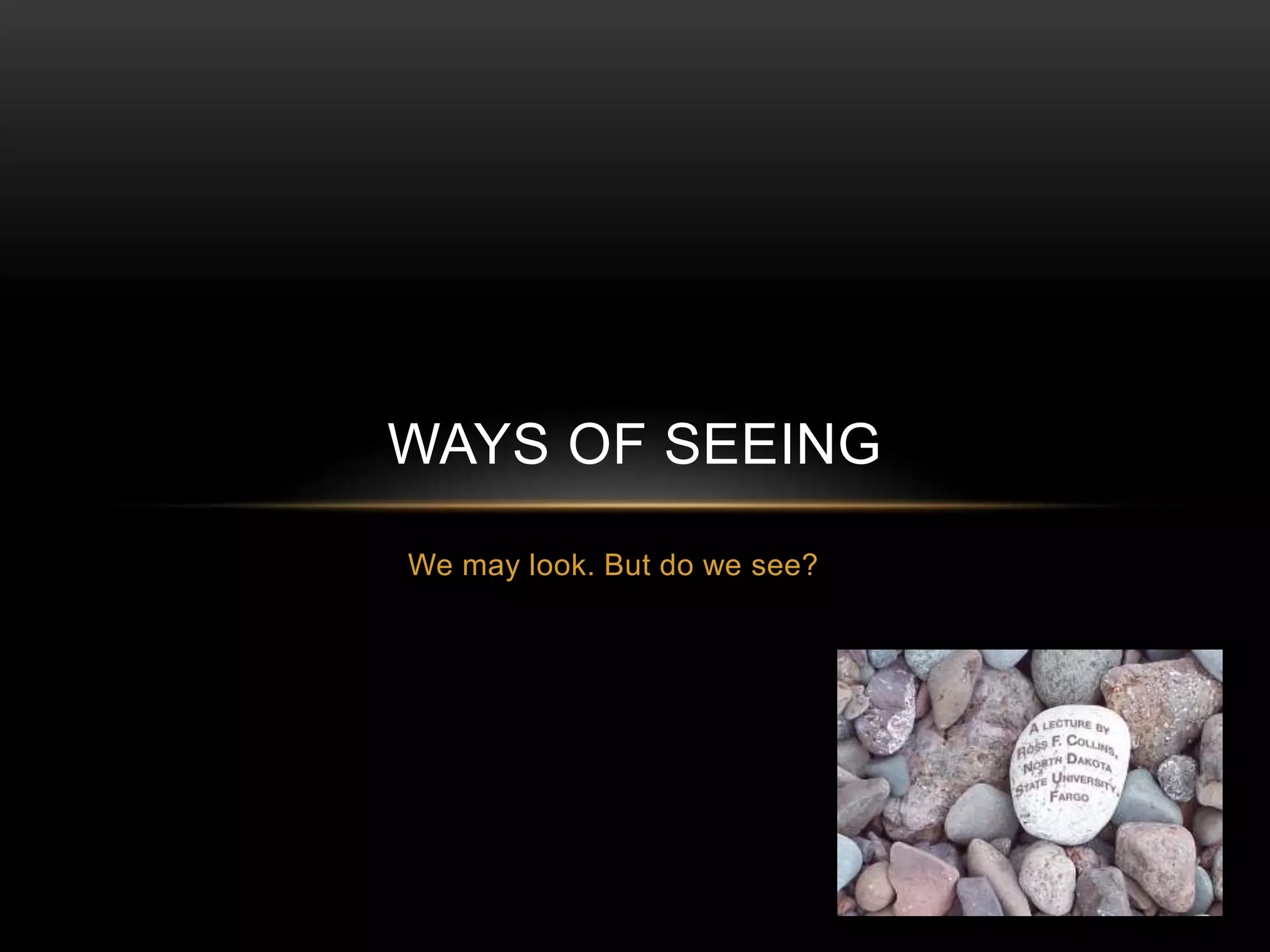
WAYS OF SEEING 
We may look. But do we see?
THE ART OF SEEING 
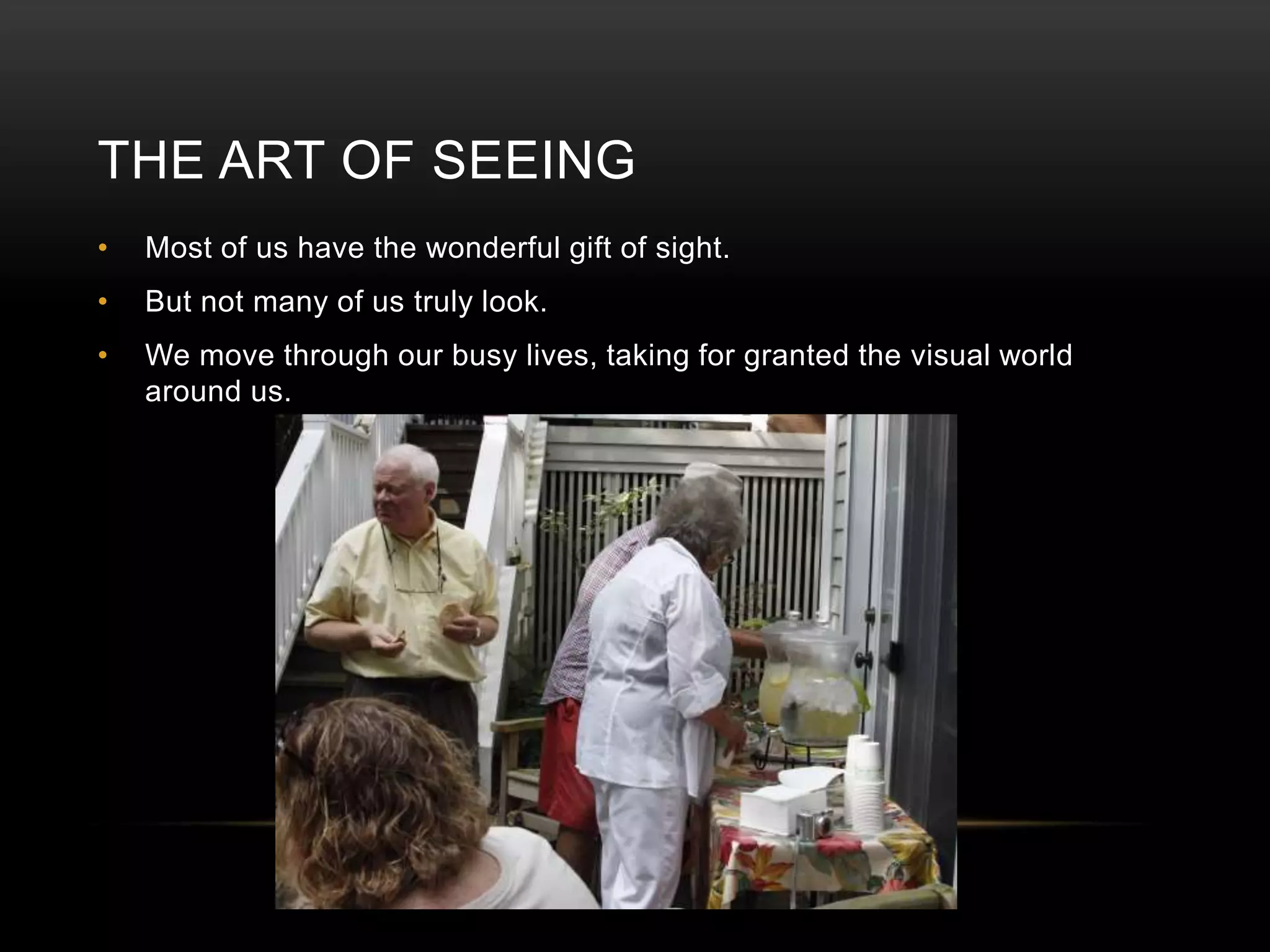
• Most of us have the wonderful gift of sight. 
• But not many of us truly look. 
• We move through our busy lives, taking for granted the visual world 
around us.
SHAPES, PATTERNS AND COLORS 
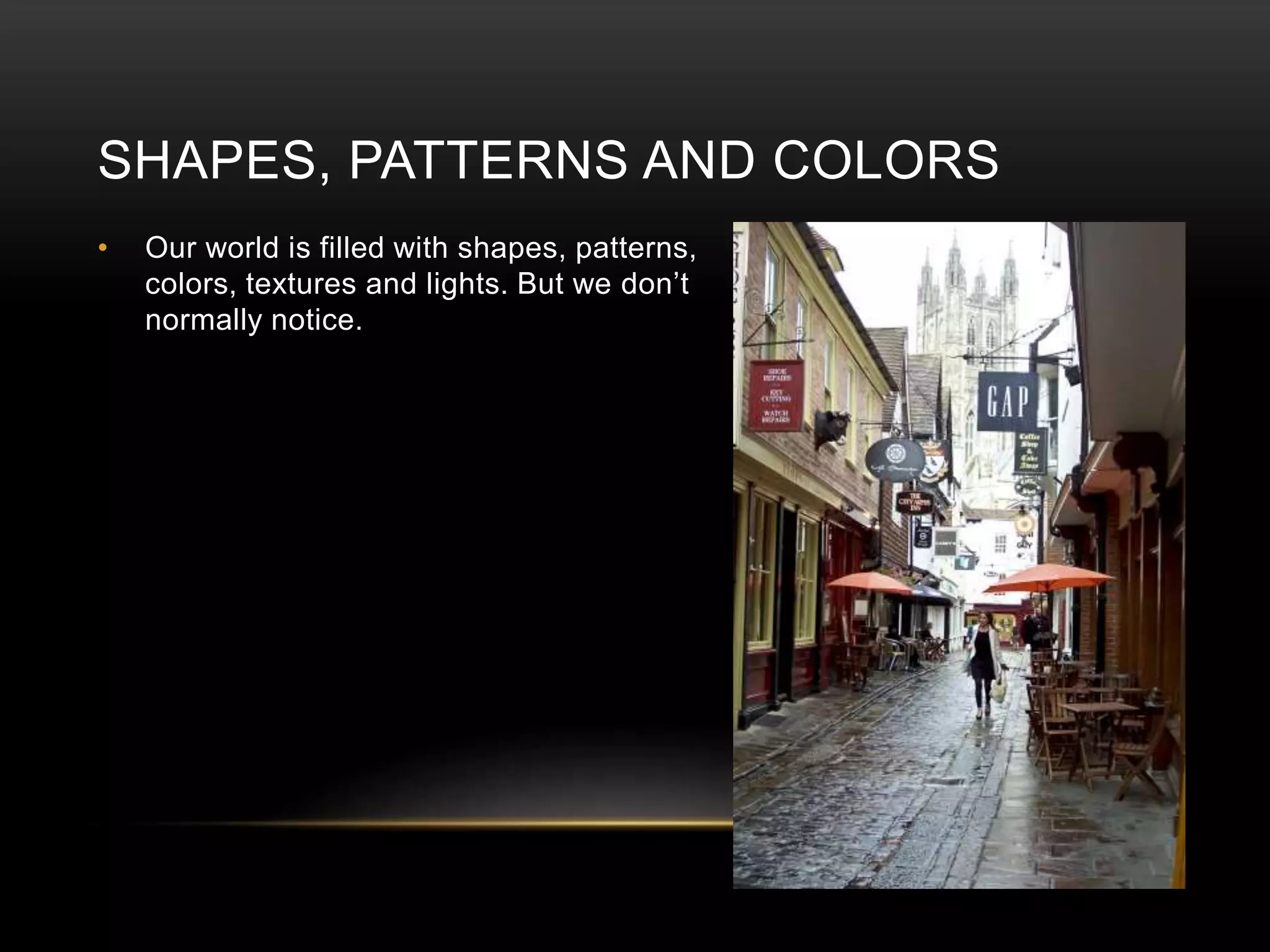
• Our world is filled with shapes, patterns, 
colors, textures and lights. But we don’t 
normally notice.
OUR MAKE-UP WORLD OF IMAGES 
• When we draw, paint, or take a photo, we create a world in an image. 
• We create an abstraction of our physical world. 
• When we do this, we are forced to take a closer look at the details around 
us. 
• We realize how many complex things go together to create our physical 
world, and how difficult that is to portray in art and photography.
VISUAL RESEARCH 
• Gestalt research has shown people do not look at the physical world in 
discrete ways. 
• In other words, we don’t look at single objects or parts, put them together 
in our minds, and come up with a view, like adding a sum of numbers. 
• Instead, we see everything all at once, as a whole.
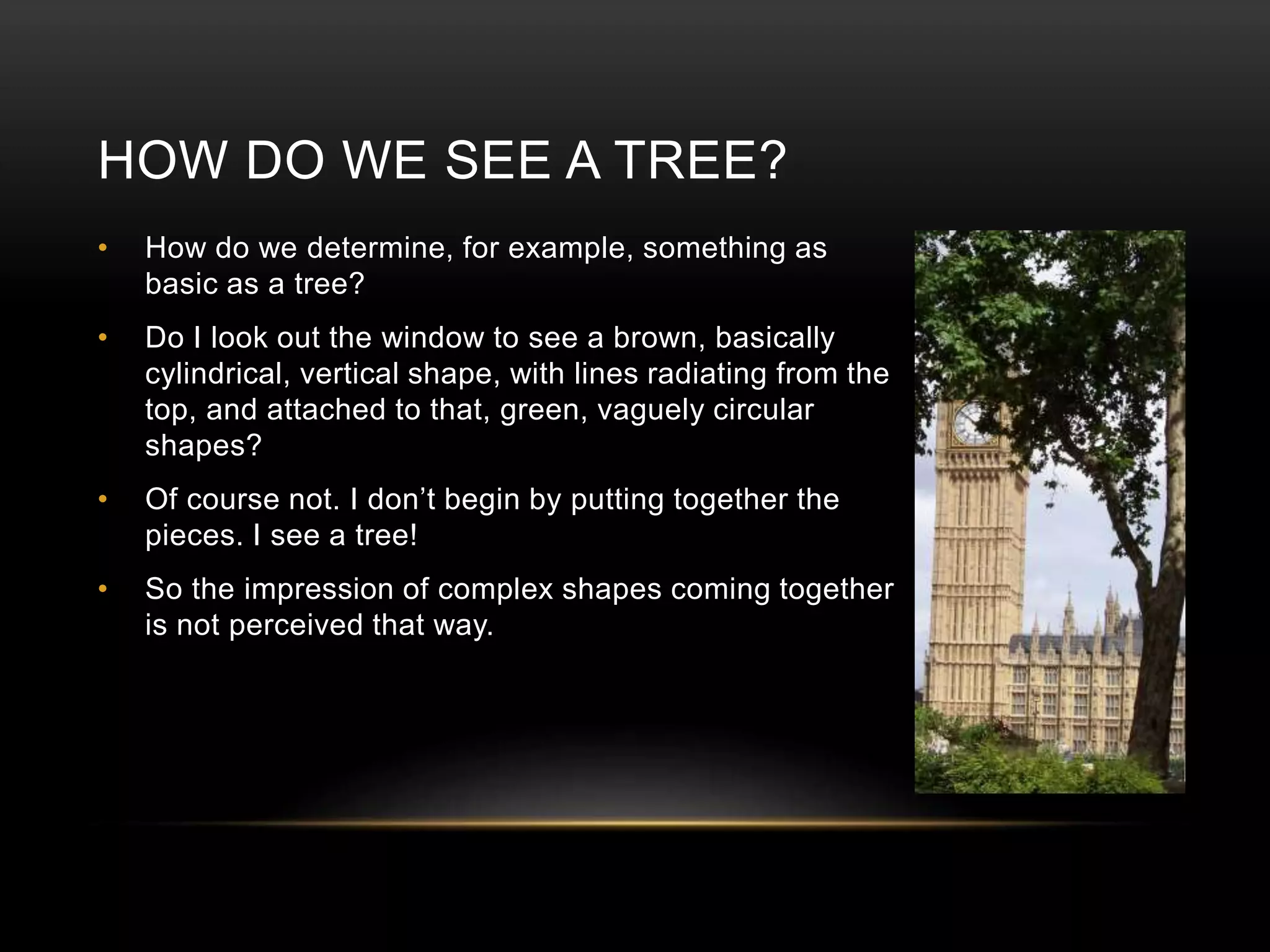
HOW DO WE SEE A TREE? 
• How do we determine, for example, something as 
basic as a tree? 
• Do I look out the window to see a brown, basically 
cylindrical, vertical shape, with lines radiating from the 
top, and attached to that, green, vaguely circular 
shapes? 
• Of course not. I don’t begin by putting together the 
pieces. I see a tree! 
• So the impression of complex shapes coming together 
is not perceived that way.
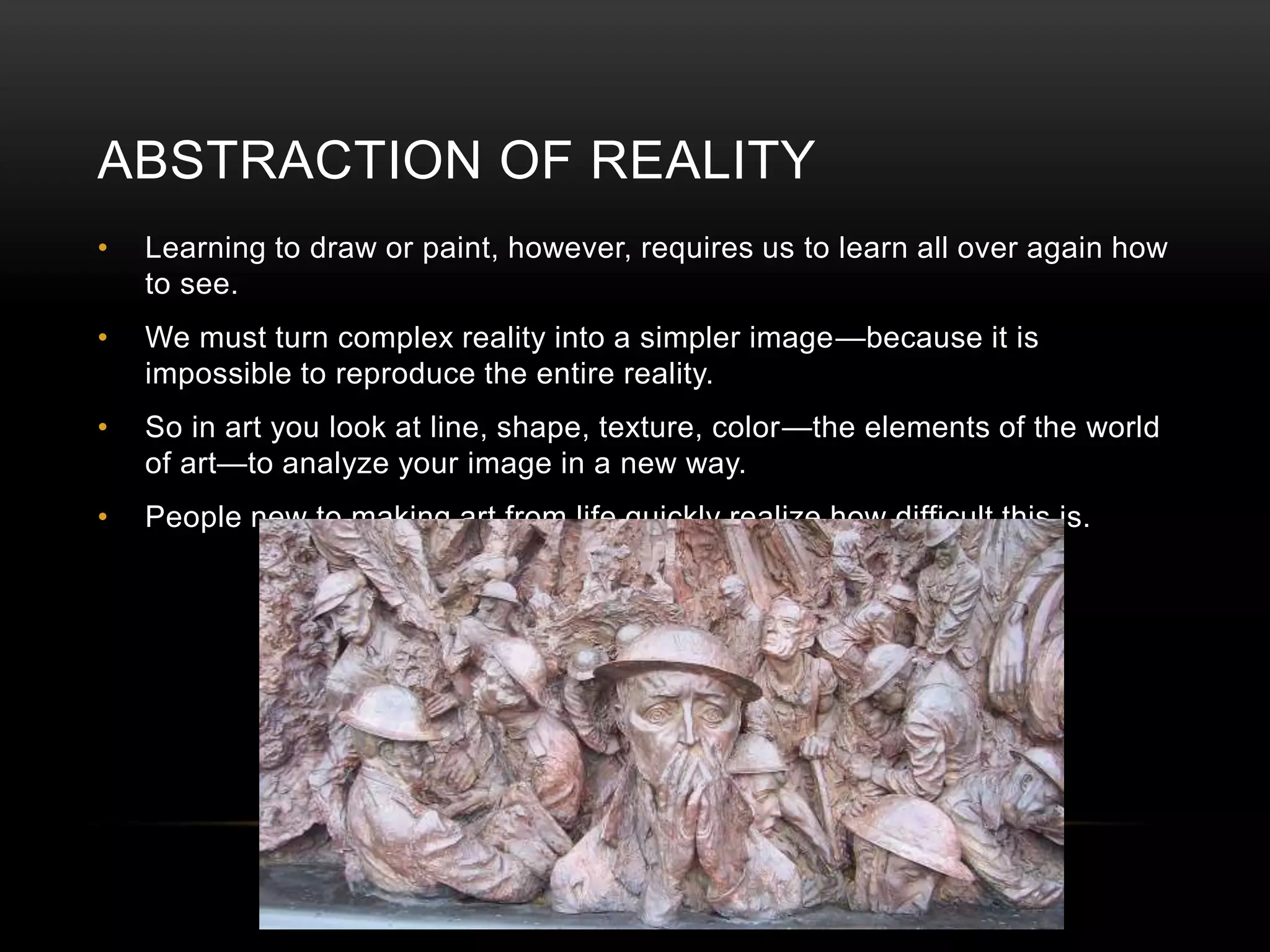
ABSTRACTION OF REALITY 
• Learning to draw or paint, however, requires us to learn all over again how 
to see. 
• We must turn complex reality into a simpler image—because it is 
impossible to reproduce the entire reality. 
• So in art you look at line, shape, texture, color—the elements of the world 
of art—to analyze your image in a new way. 
• People new to making art from life quickly realize how difficult this is.
NOT THE REAL WORLD 
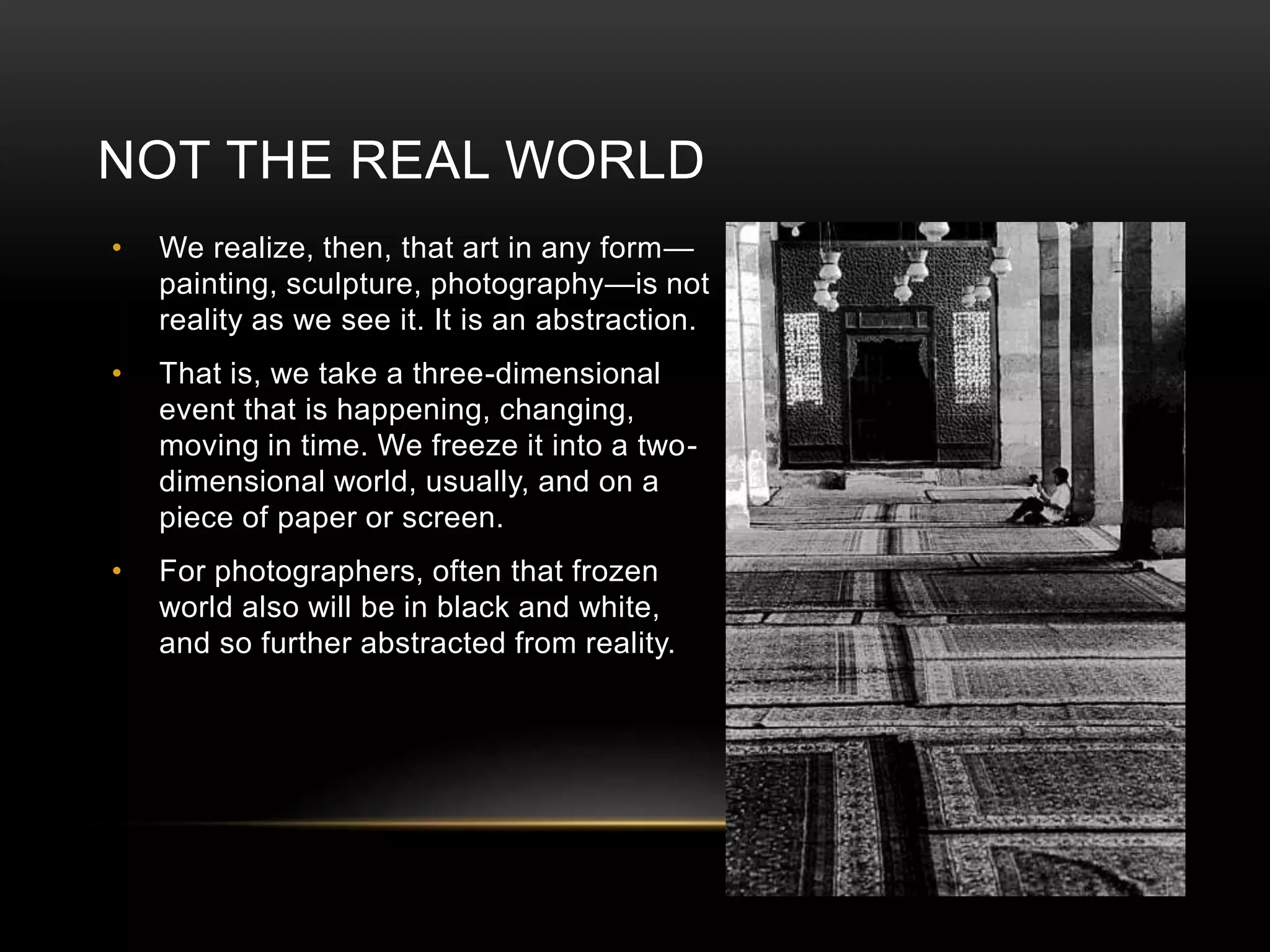
• We realize, then, that art in any form— 
painting, sculpture, photography—is not 
reality as we see it. It is an abstraction. 
• That is, we take a three-dimensional 
event that is happening, changing, 
moving in time. We freeze it into a two-dimensional 
world, usually, and on a 
piece of paper or screen. 
• For photographers, often that frozen 
world also will be in black and white, 
and so further abstracted from reality.
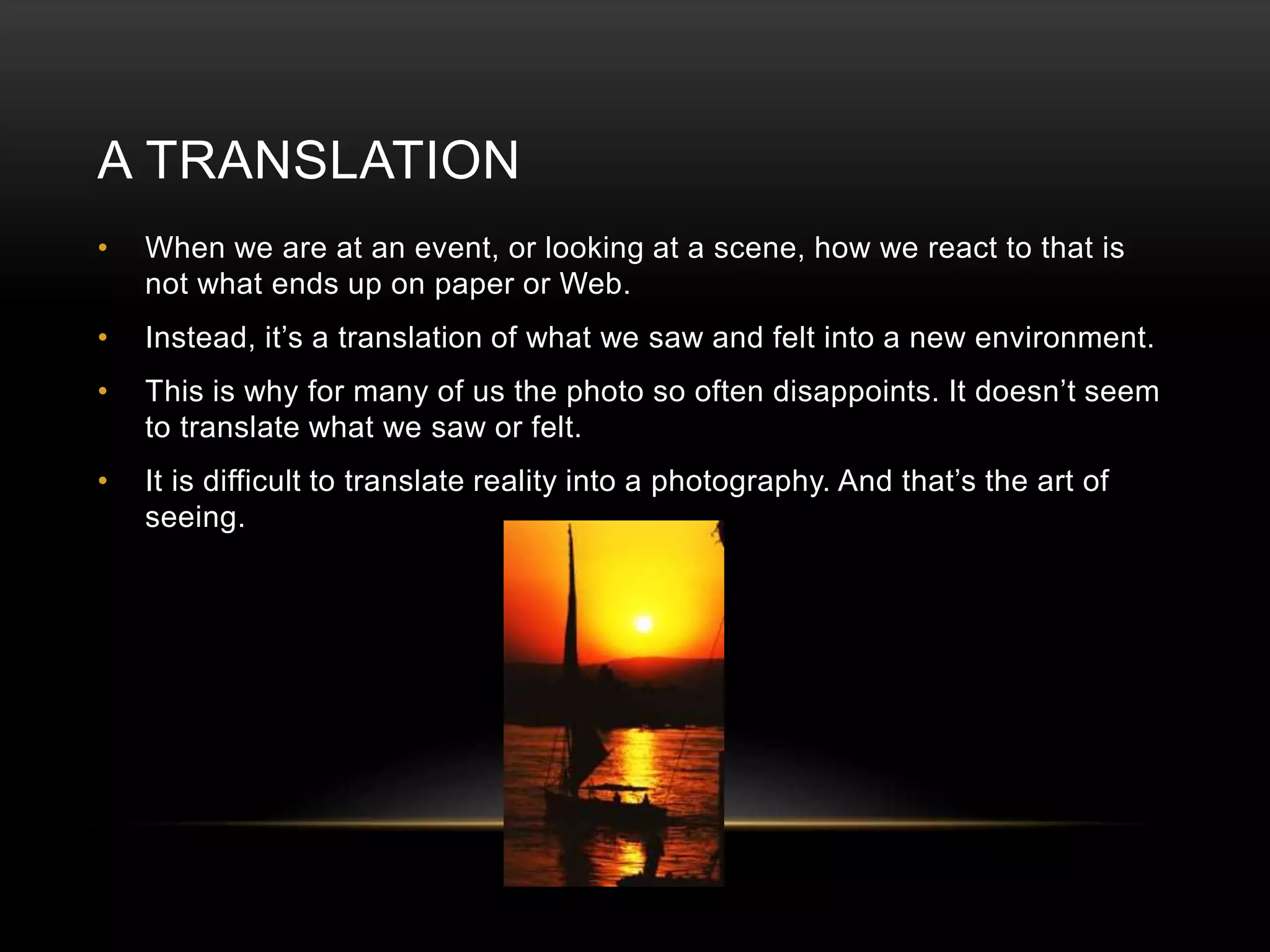
A TRANSLATION 
• When we are at an event, or looking at a scene, how we react to that is 
not what ends up on paper or Web. 
• Instead, it’s a translation of what we saw and felt into a new environment. 
• This is why for many of us the photo so often disappoints. It doesn’t seem 
to translate what we saw or felt. 
• It is difficult to translate reality into a photography. And that’s the art of 
seeing.
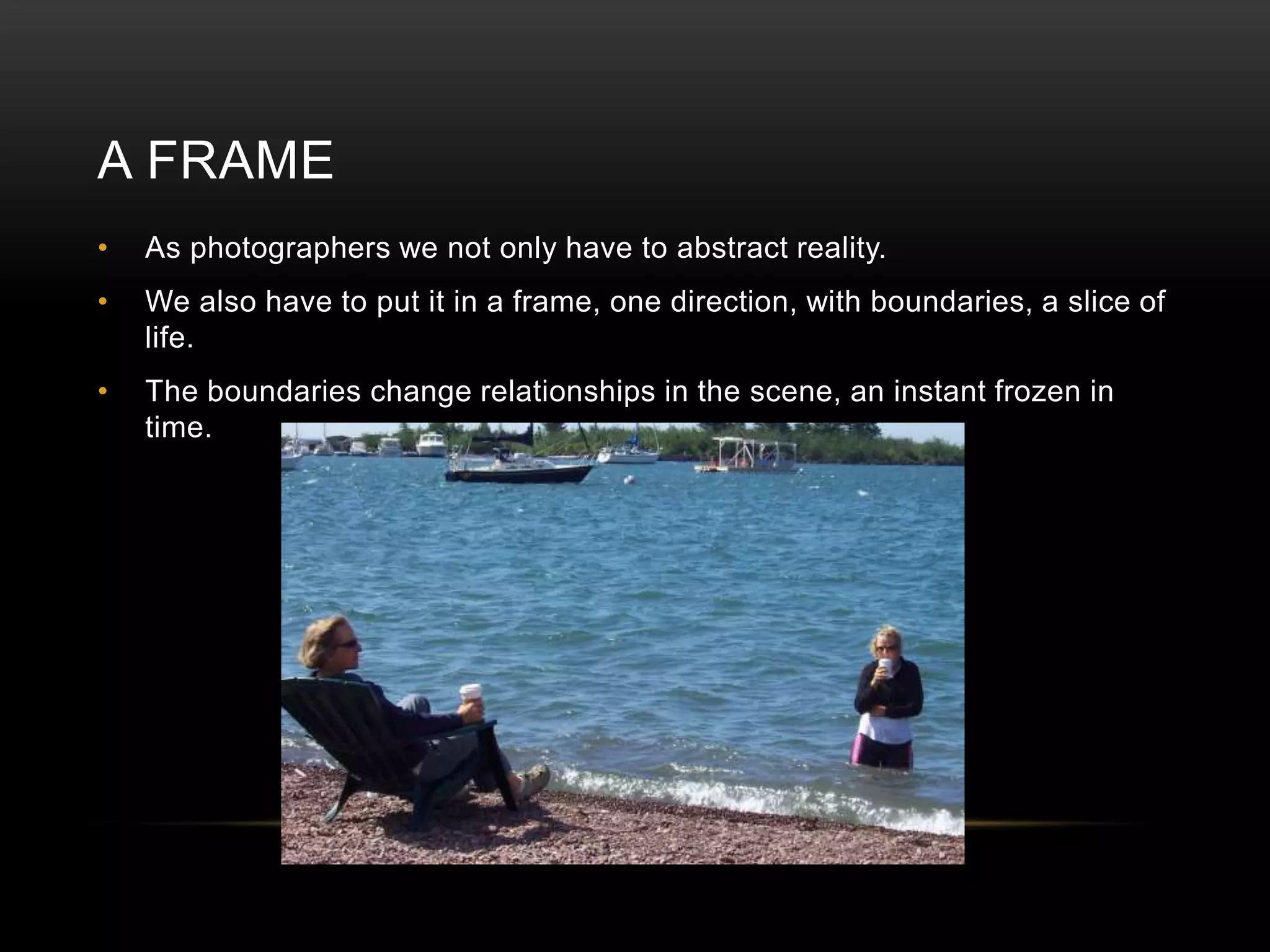
A FRAME 
• As photographers we not only have to abstract reality. 
• We also have to put it in a frame, one direction, with boundaries, a slice of 
life. 
• The boundaries change relationships in the scene, an instant frozen in 
time.
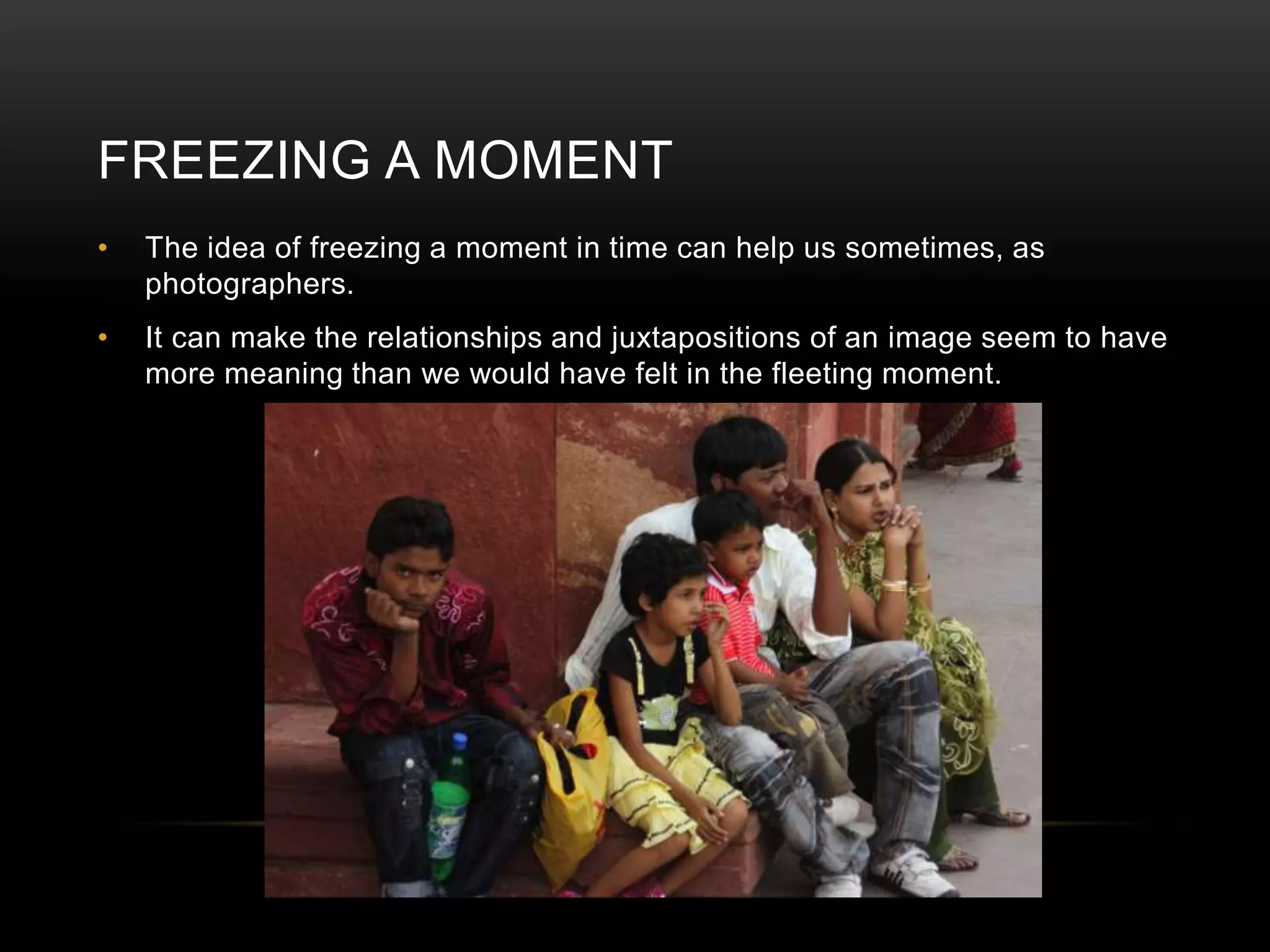
FREEZING A MOMENT 
• The idea of freezing a moment in time can help us sometimes, as 
photographers. 
• It can make the relationships and juxtapositions of an image seem to have 
more meaning than we would have felt in the fleeting moment.
THE FLEETING MOMENT 
• Sometimes this works. Sometimes it doesn’t. 
• The key, then, to taking better photos is to look at reality in a different way 
from the way we saw it in the past. 
• That is, as photographers say, learn to see.
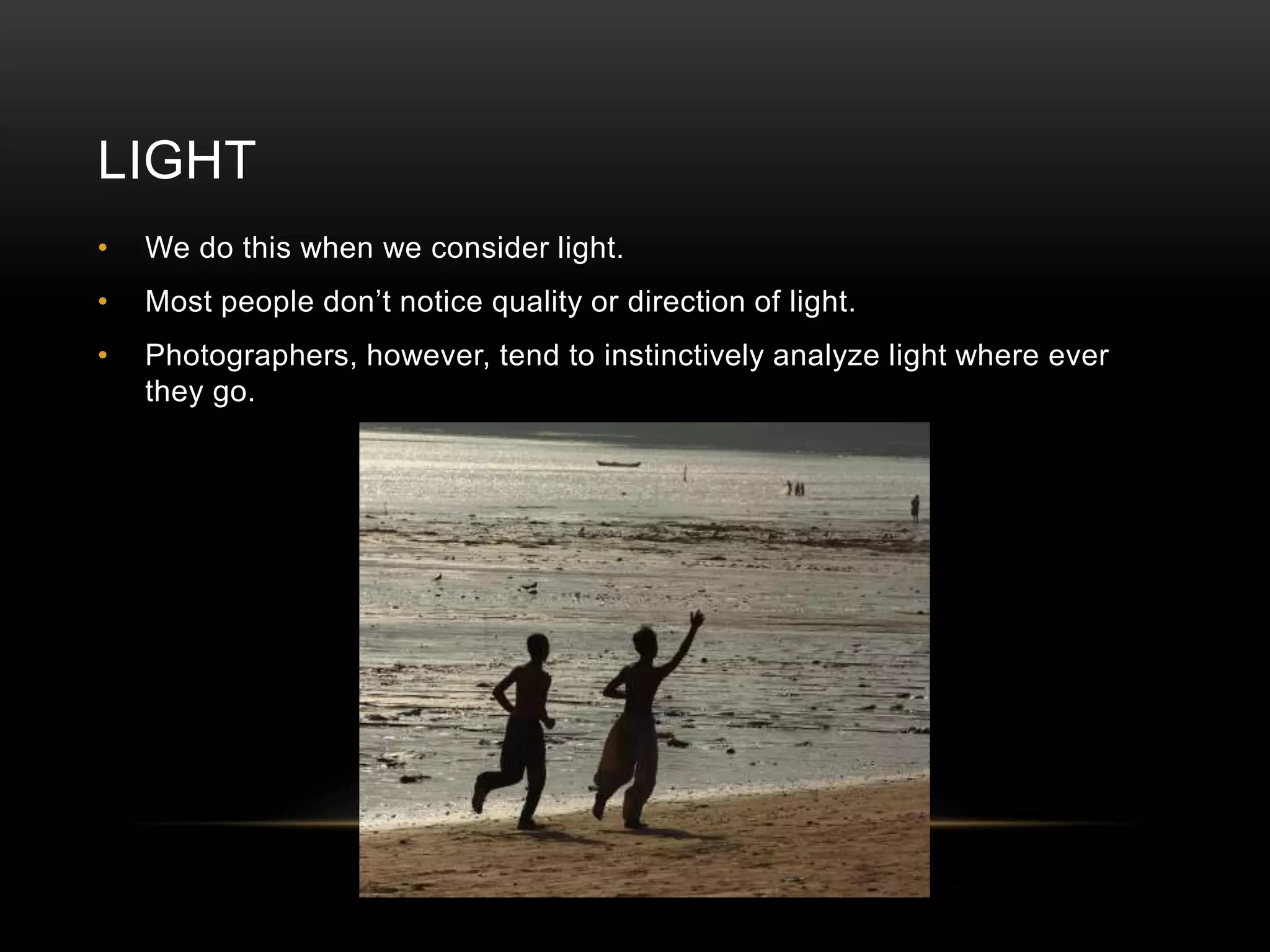
LIGHT 
• We do this when we consider light. 
• Most people don’t notice quality or direction of light. 
• Photographers, however, tend to instinctively analyze light where ever 
they go.
BEYOND BASICS 
• Once we understand the basics of light, we can go on to consider other 
aspects of a scene. 
• How do we make choices? 
• To begin with, try to visualize yourself as the photographer of other 
images you like. Why did the photographer choose what she did? Why did 
he leave out what he did?
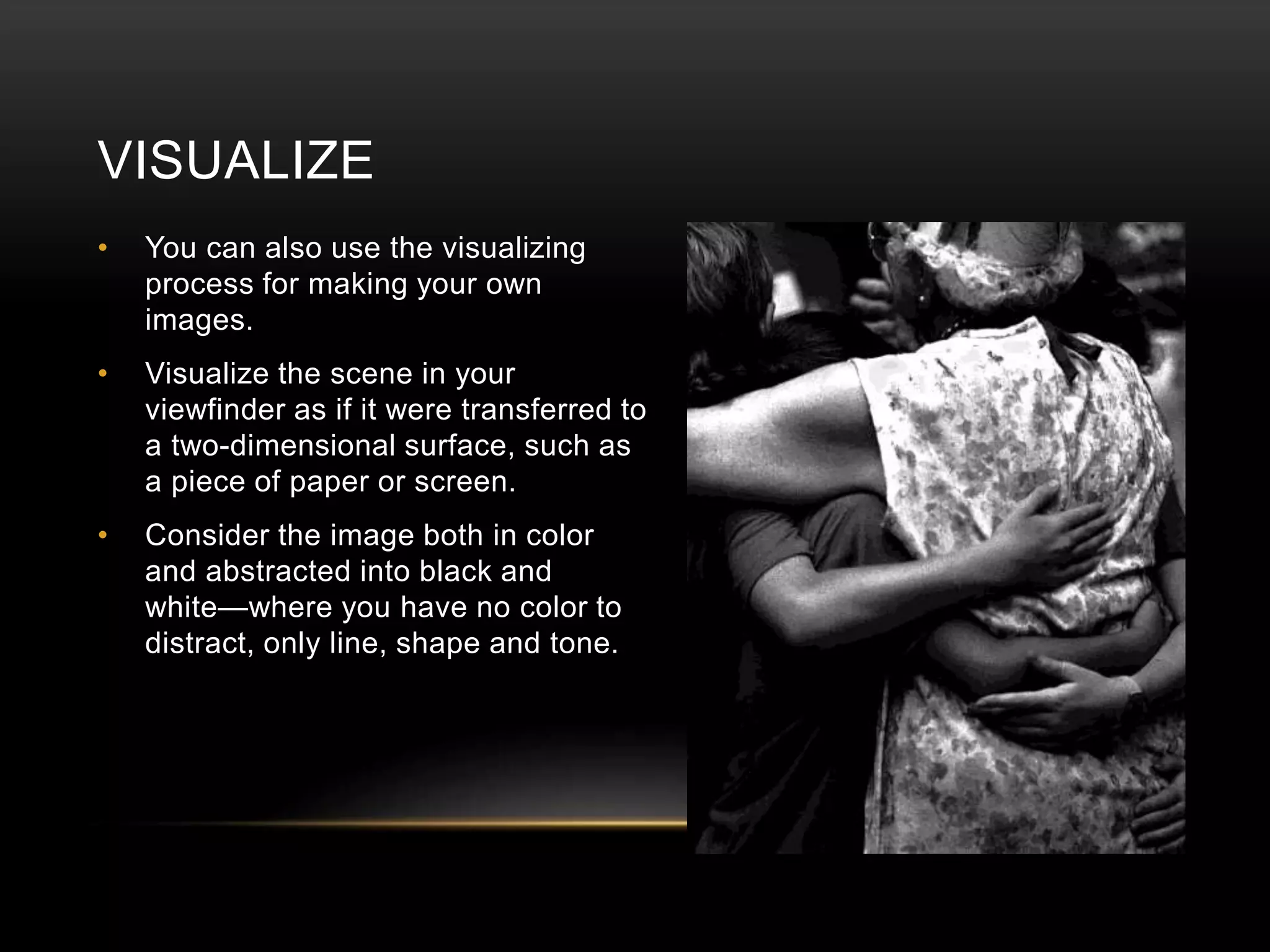
VISUALIZE 
• You can also use the visualizing 
process for making your own 
images. 
• Visualize the scene in your 
viewfinder as if it were transferred to 
a two-dimensional surface, such as 
a piece of paper or screen. 
• Consider the image both in color 
and abstracted into black and 
white—where you have no color to 
distract, only line, shape and tone.
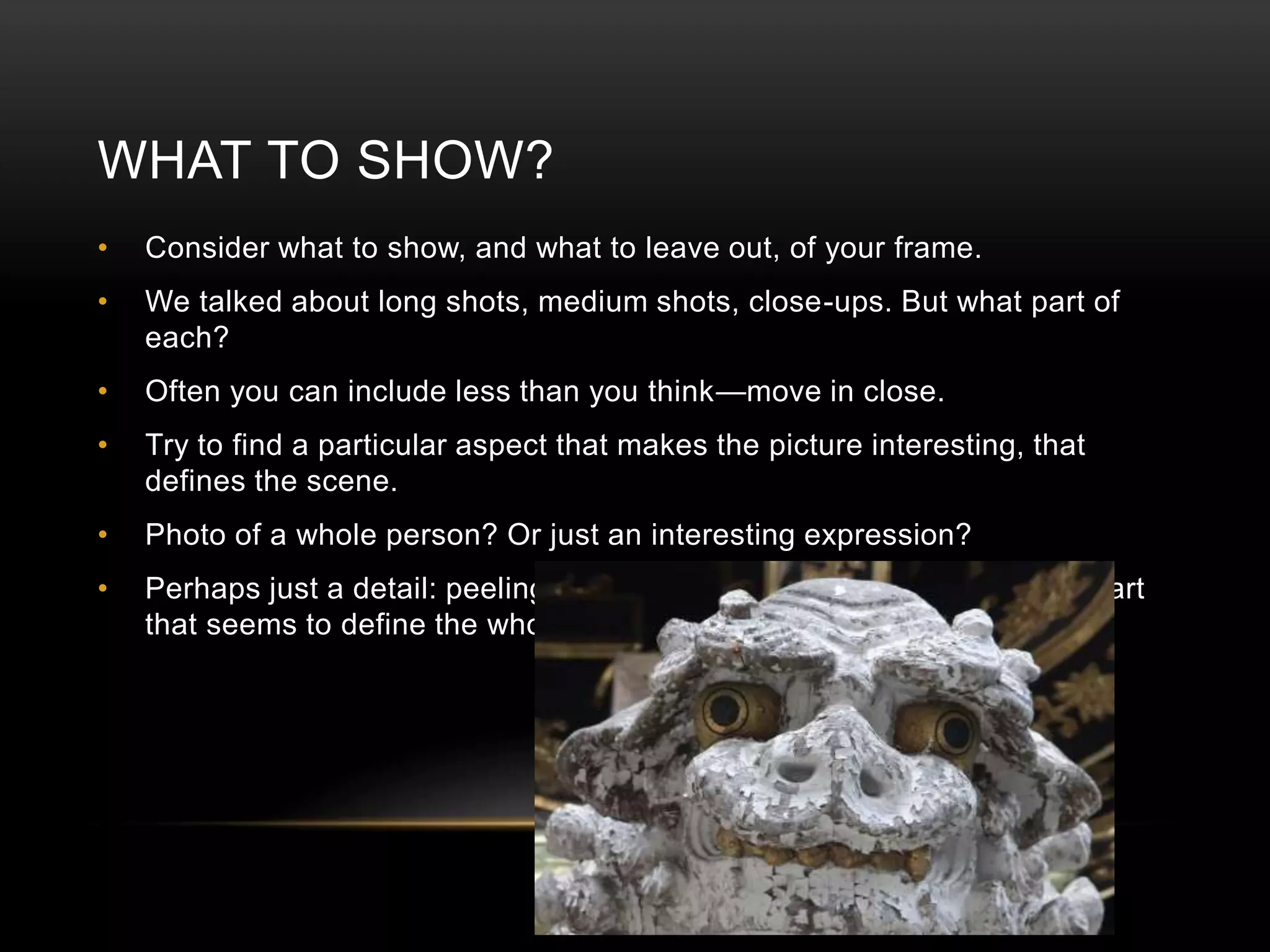
WHAT TO SHOW? 
• Consider what to show, and what to leave out, of your frame. 
• We talked about long shots, medium shots, close-ups. But what part of 
each? 
• Often you can include less than you think—move in close. 
• Try to find a particular aspect that makes the picture interesting, that 
defines the scene. 
• Photo of a whole person? Or just an interesting expression? 
• Perhaps just a detail: peeling paint, worn cloths, rough wood. Fine a part 
that seems to define the whole.
WHAT IS THE PHOTO ABOUT? 
• Before shooting it’s helpful to decide what you really want to emphasize in 
a photo. 
• Why are you taking this photo? What is really important? 
• Look at the edges of a frame. Are you cutting off things you want to keep? 
• Use your viewfinder to isolate parts of a scene, to determine what you 
want to emphasize. 
• Note that a photographer starts with everything and subtracts. An artist 
starts with nothing and adds. 
• Photographers can’t control a scene the way artists can.
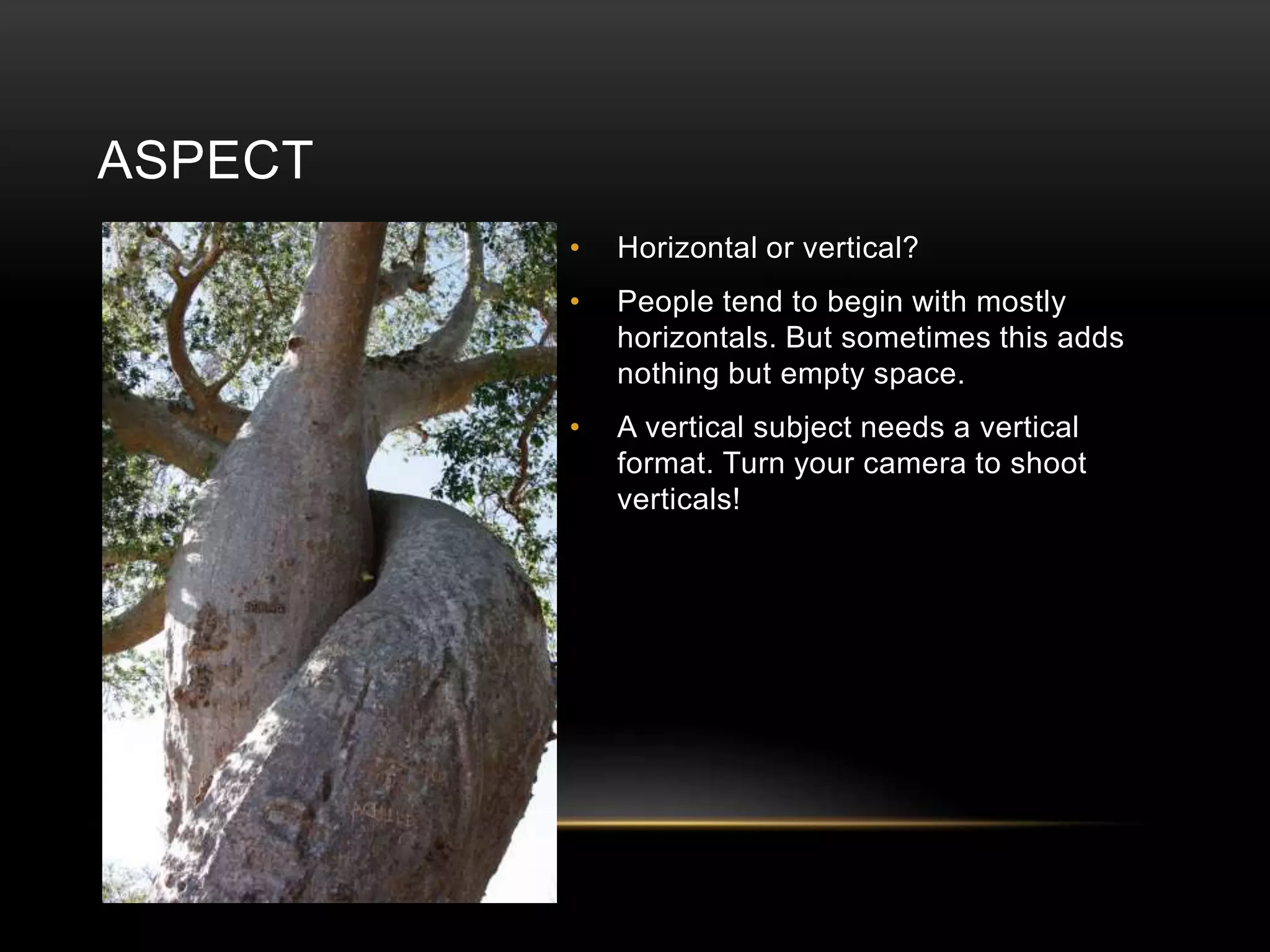
ASPECT 
• Horizontal or vertical? 
• People tend to begin with mostly 
horizontals. But sometimes this adds 
nothing but empty space. 
• A vertical subject needs a vertical 
format. Turn your camera to shoot 
verticals!
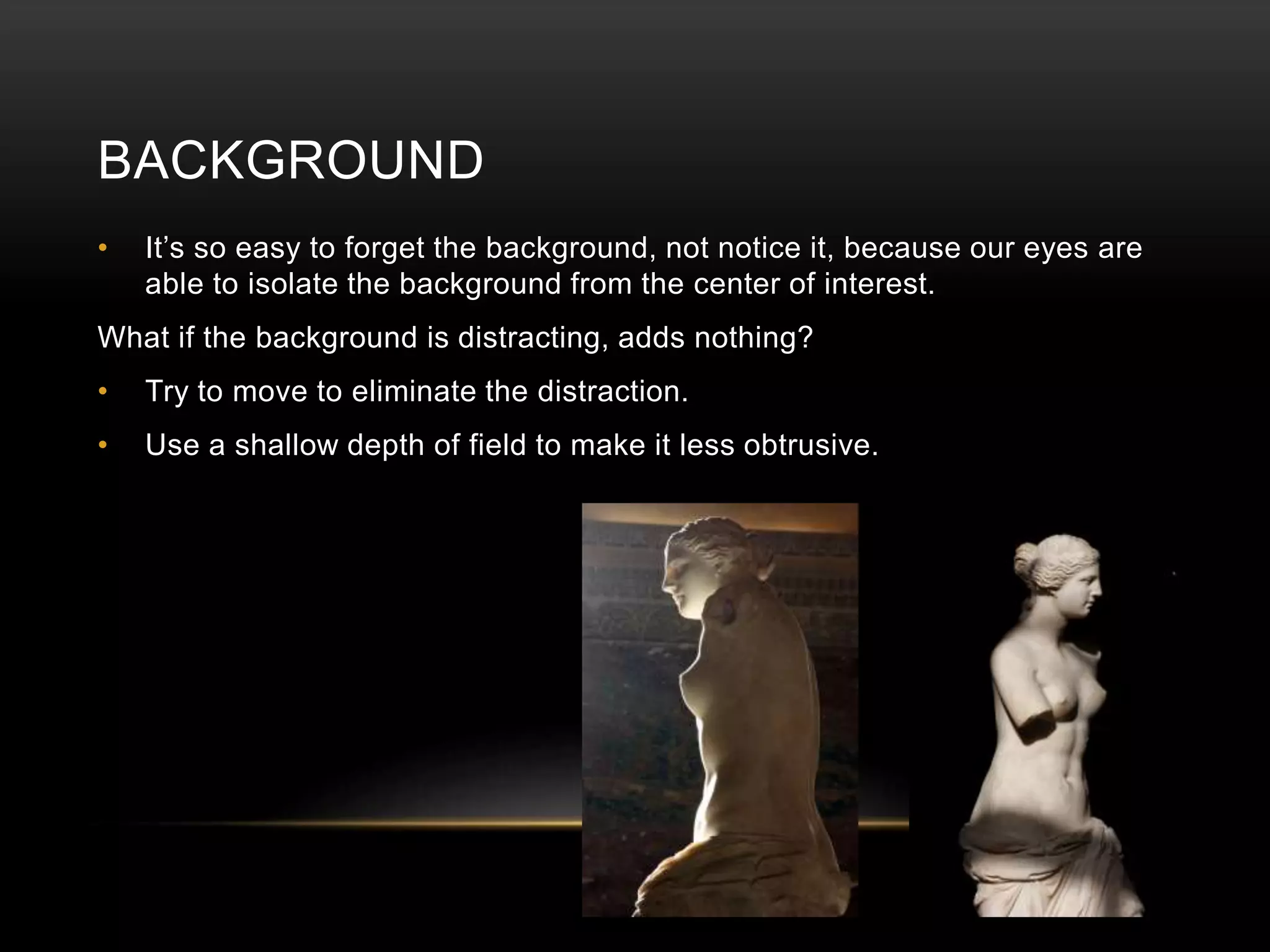
BACKGROUND 
• It’s so easy to forget the background, not notice it, because our eyes are 
able to isolate the background from the center of interest. 
What if the background is distracting, adds nothing? 
• Try to move to eliminate the distraction. 
• Use a shallow depth of field to make it less obtrusive.
ISOLATING 
• We can’t control images in mass media photography the way painters 
can. 
• We have to grab them quickly. 
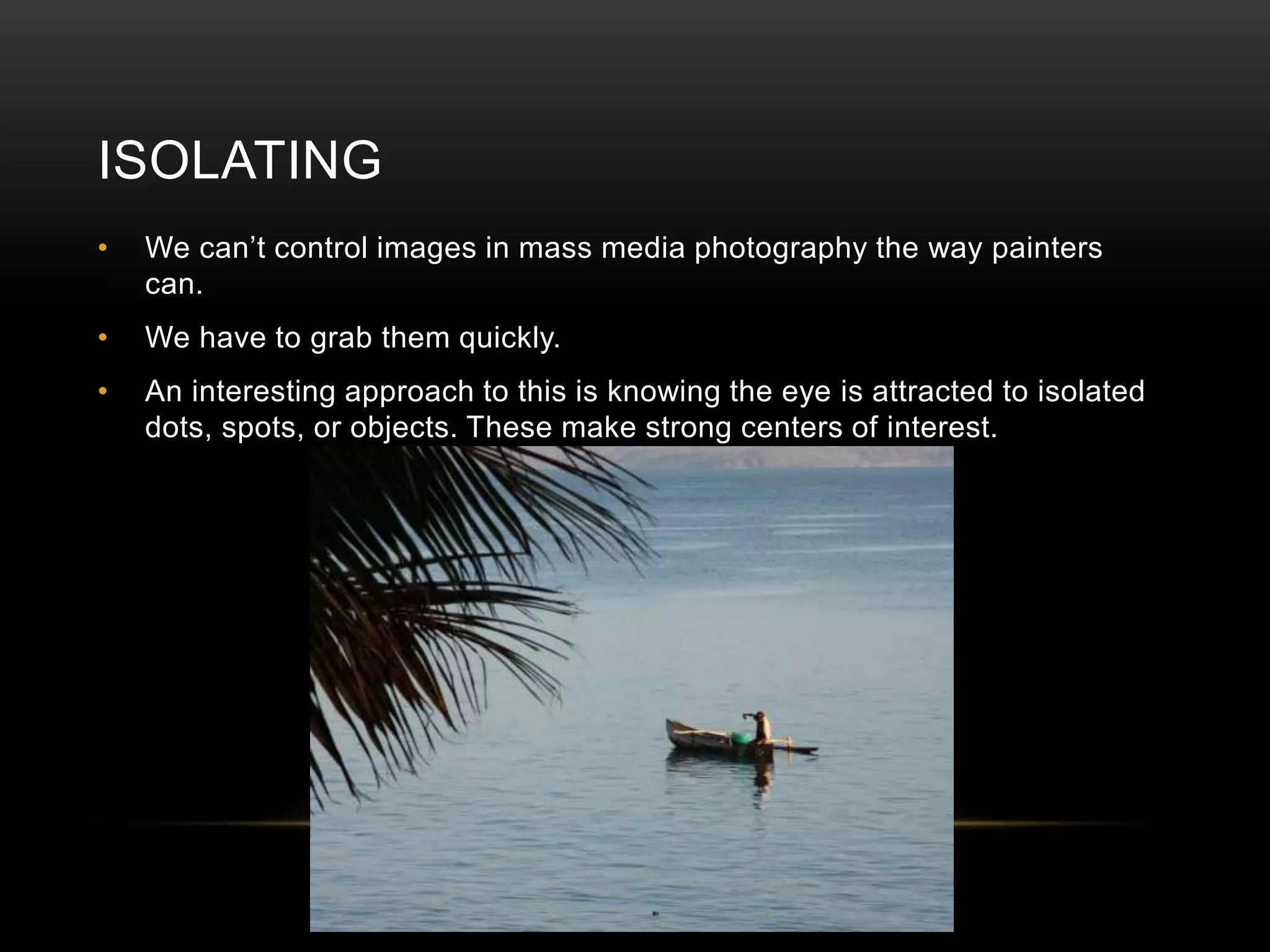
• An interesting approach to this is knowing the eye is attracted to isolated 
dots, spots, or objects. These make strong centers of interest.
ASSOCIATIONS 
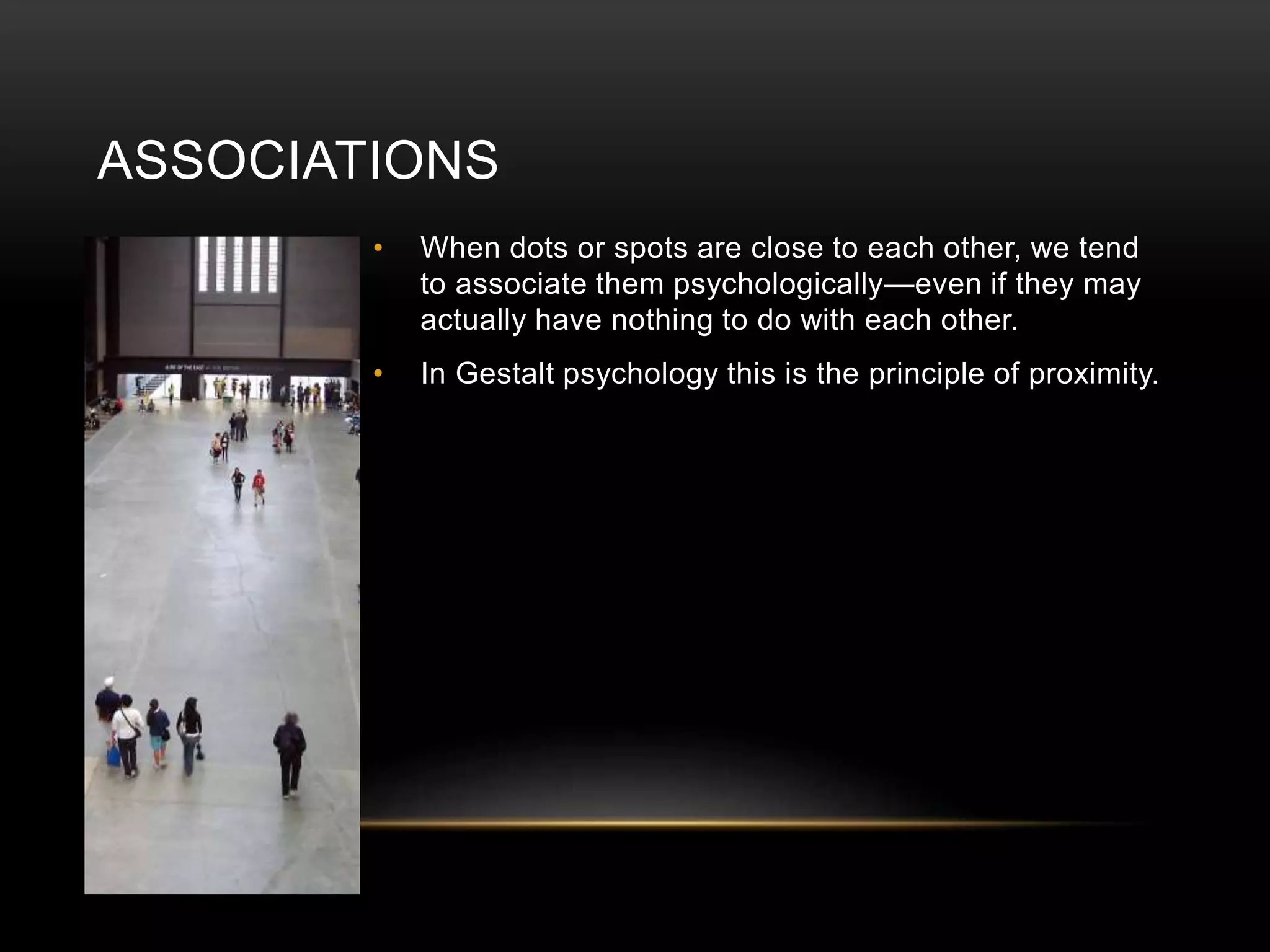
• When dots or spots are close to each other, we tend 
to associate them psychologically—even if they may 
actually have nothing to do with each other. 
• In Gestalt psychology this is the principle of proximity.
EMPHASIS 
• Photographers are challenged trying to emphasize interesting parts of a 
photo, while de-emphasizing other parts. 
• In an actual scene, with so many objects demanding equal attention, how 
do we indicate what a viewer should look at first?
EMPHASIS 
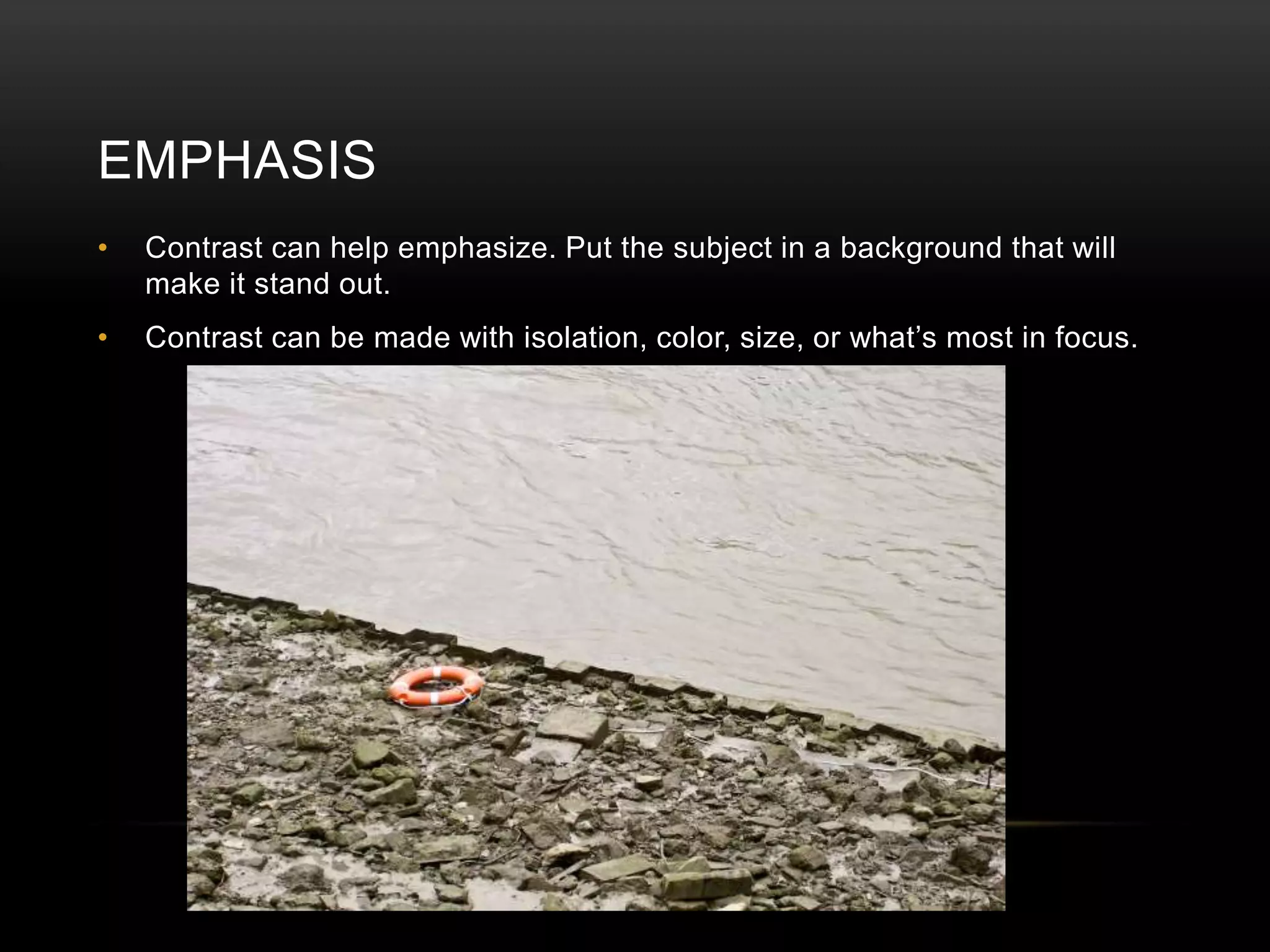
• Contrast can help emphasize. Put the subject in a background that will 
make it stand out. 
• Contrast can be made with isolation, color, size, or what’s most in focus.
BALANCE 
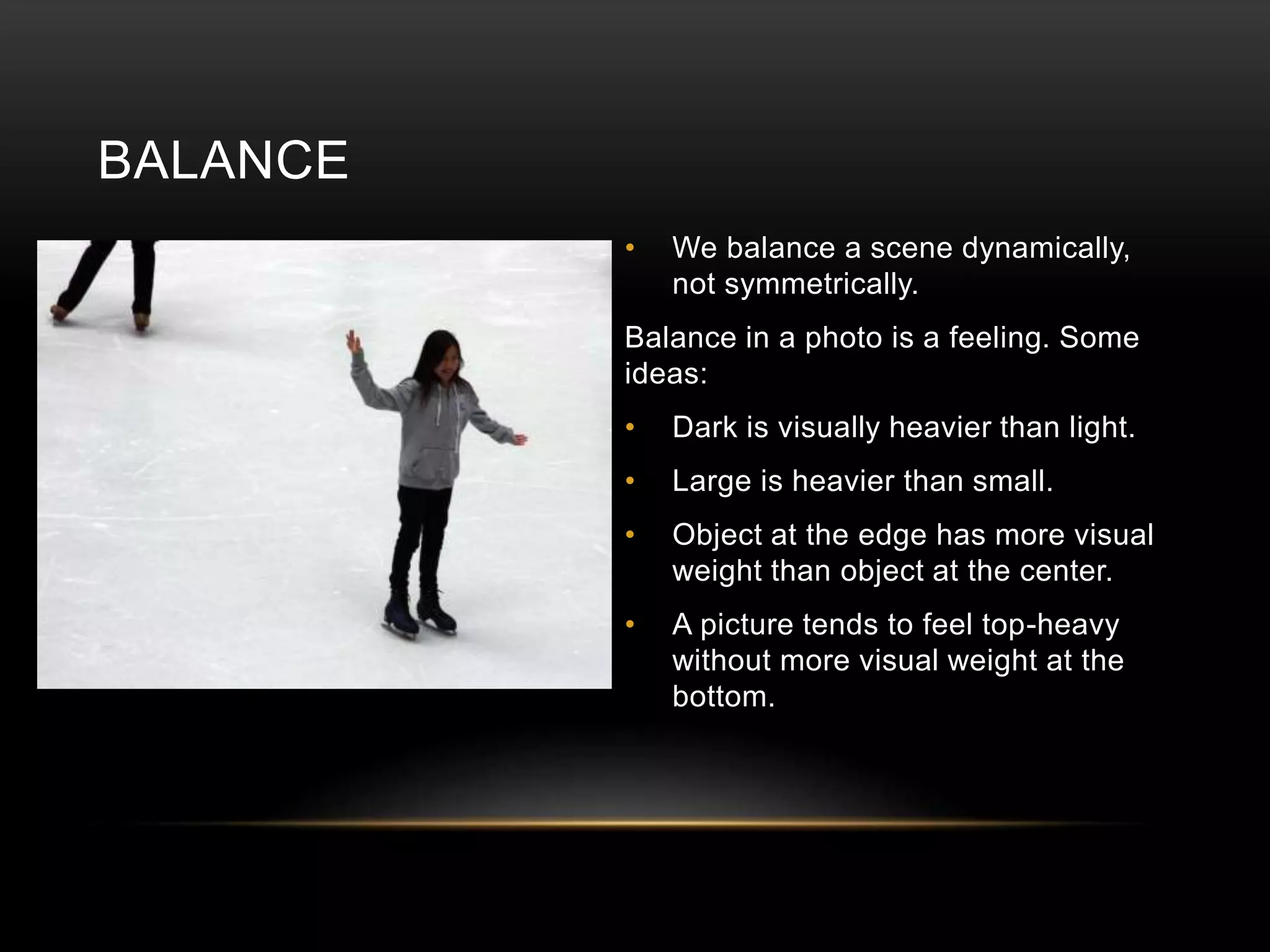
• We balance a scene dynamically, 
not symmetrically. 
Balance in a photo is a feeling. Some 
ideas: 
• Dark is visually heavier than light. 
• Large is heavier than small. 
• Object at the edge has more visual 
weight than object at the center. 
• A picture tends to feel top-heavy 
without more visual weight at the 
bottom.
BALANCE 
• Balance in your viewfinder is a feeling. 
• If the view doesn’t feel right, try moving. Even a slight change may feel 
more balanced. 
• But balance should not emphasize perfect symmetry. Tension makes the 
photo more interesting. 
• The “rule of thirds” is designed to build tension, dynamic balance into a 
photo.
SHARPNESS 
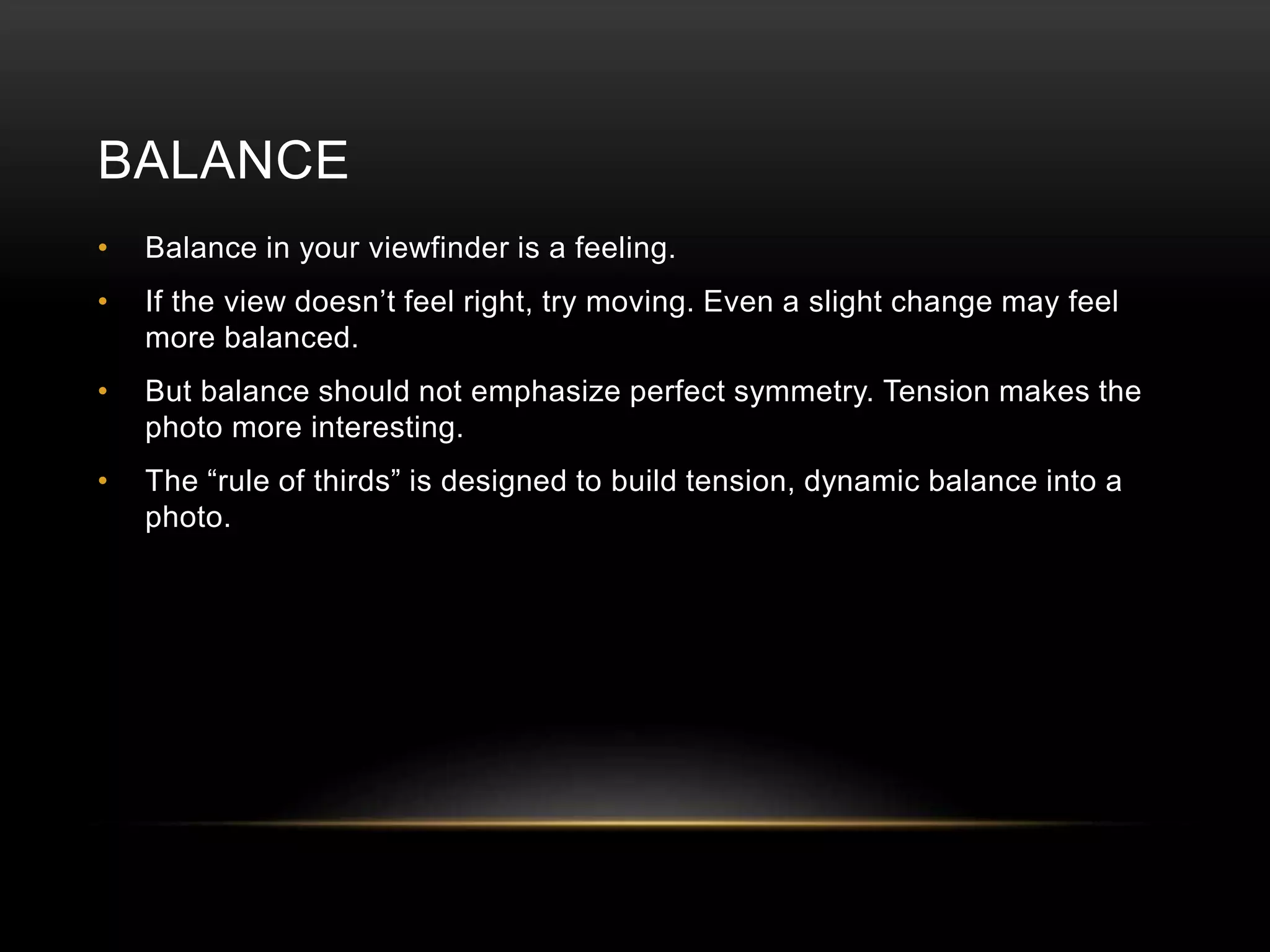
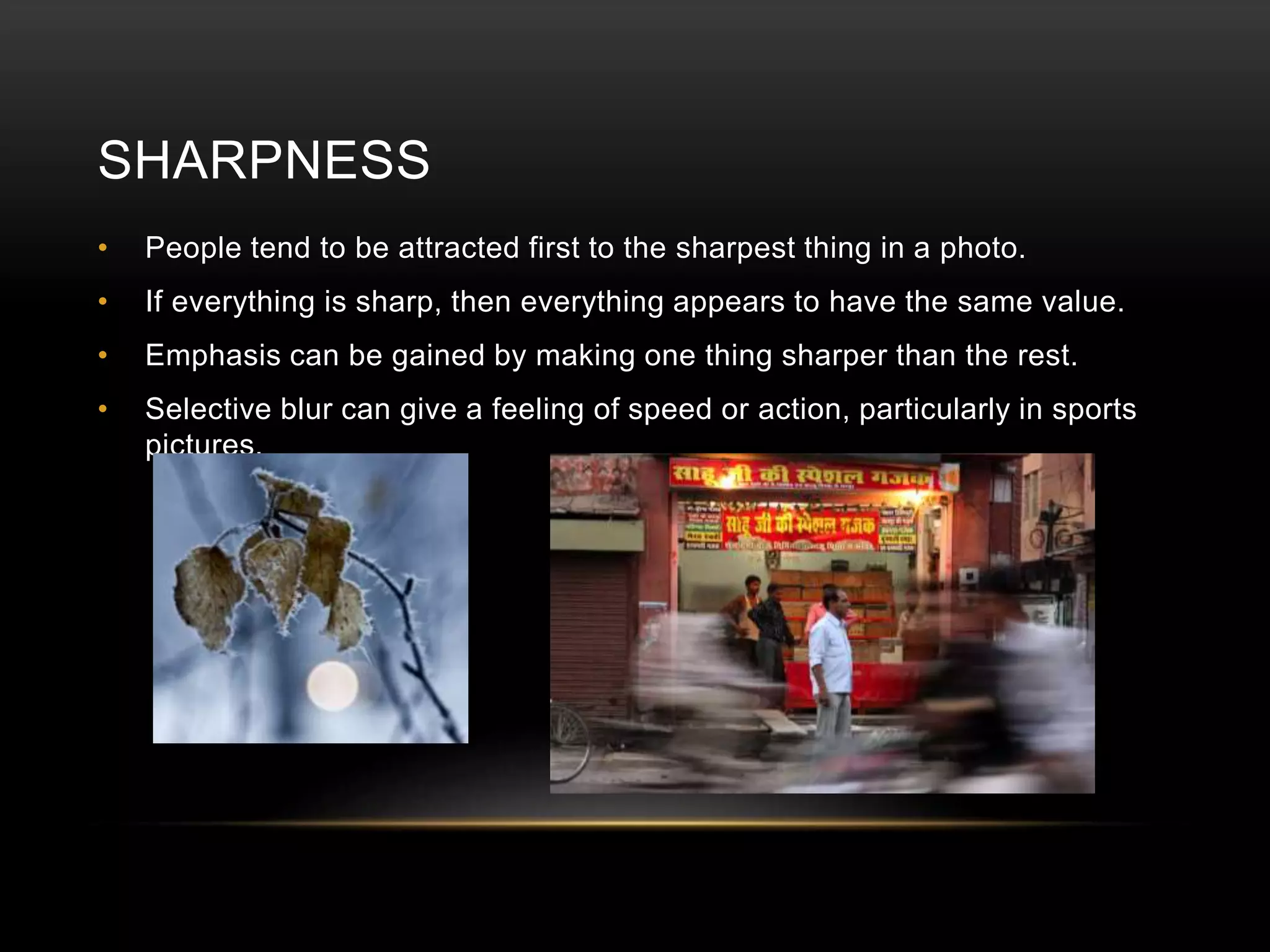
• People tend to be attracted first to the sharpest thing in a photo. 
• If everything is sharp, then everything appears to have the same value. 
• Emphasis can be gained by making one thing sharper than the rest. 
• Selective blur can give a feeling of speed or action, particularly in sports 
pictures.
INTENTIONAL BLUR 
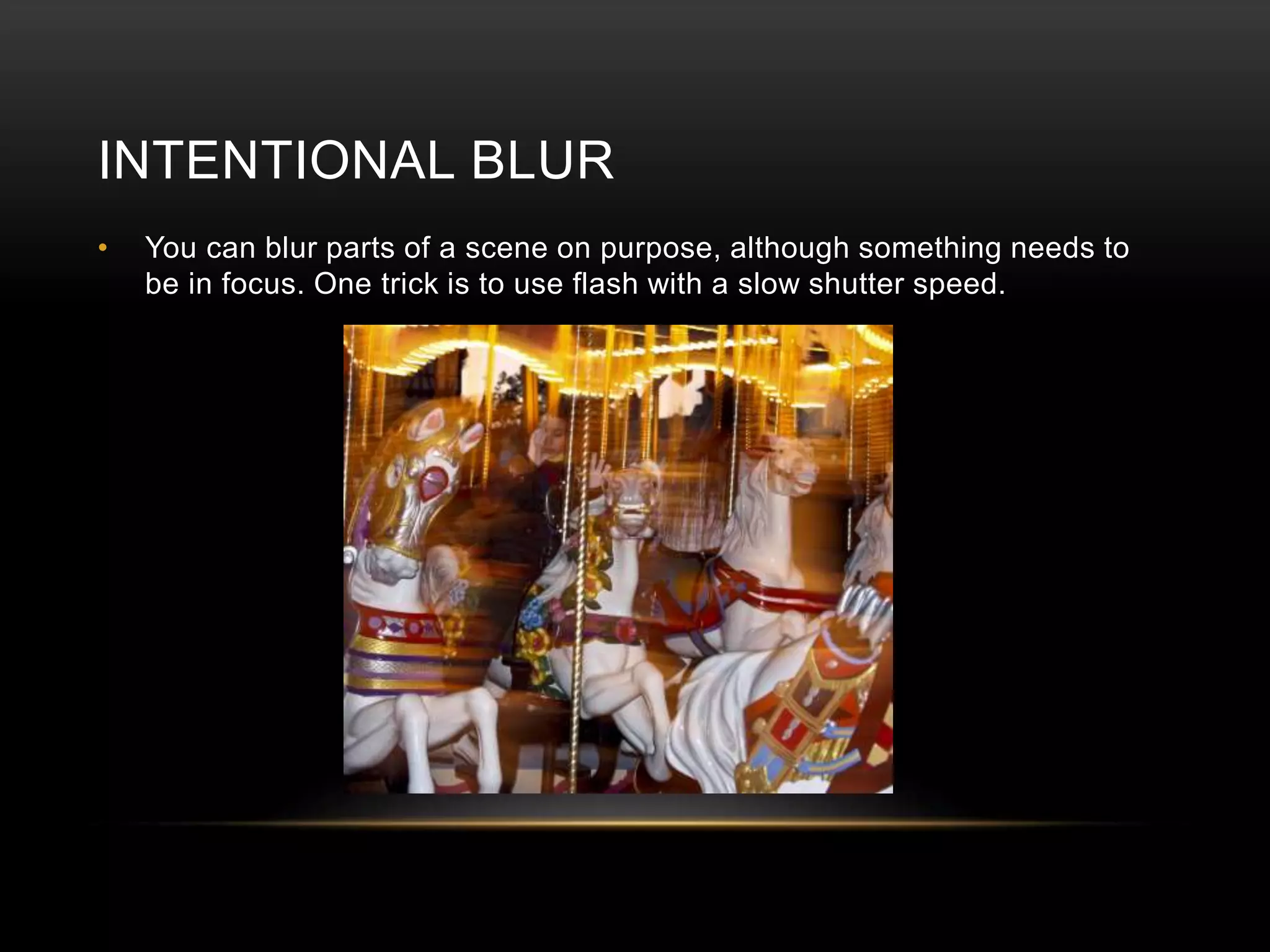
• You can blur parts of a scene on purpose, although something needs to 
be in focus. One trick is to use flash with a slow shutter speed.
TONAL RELATIONSHIPS 
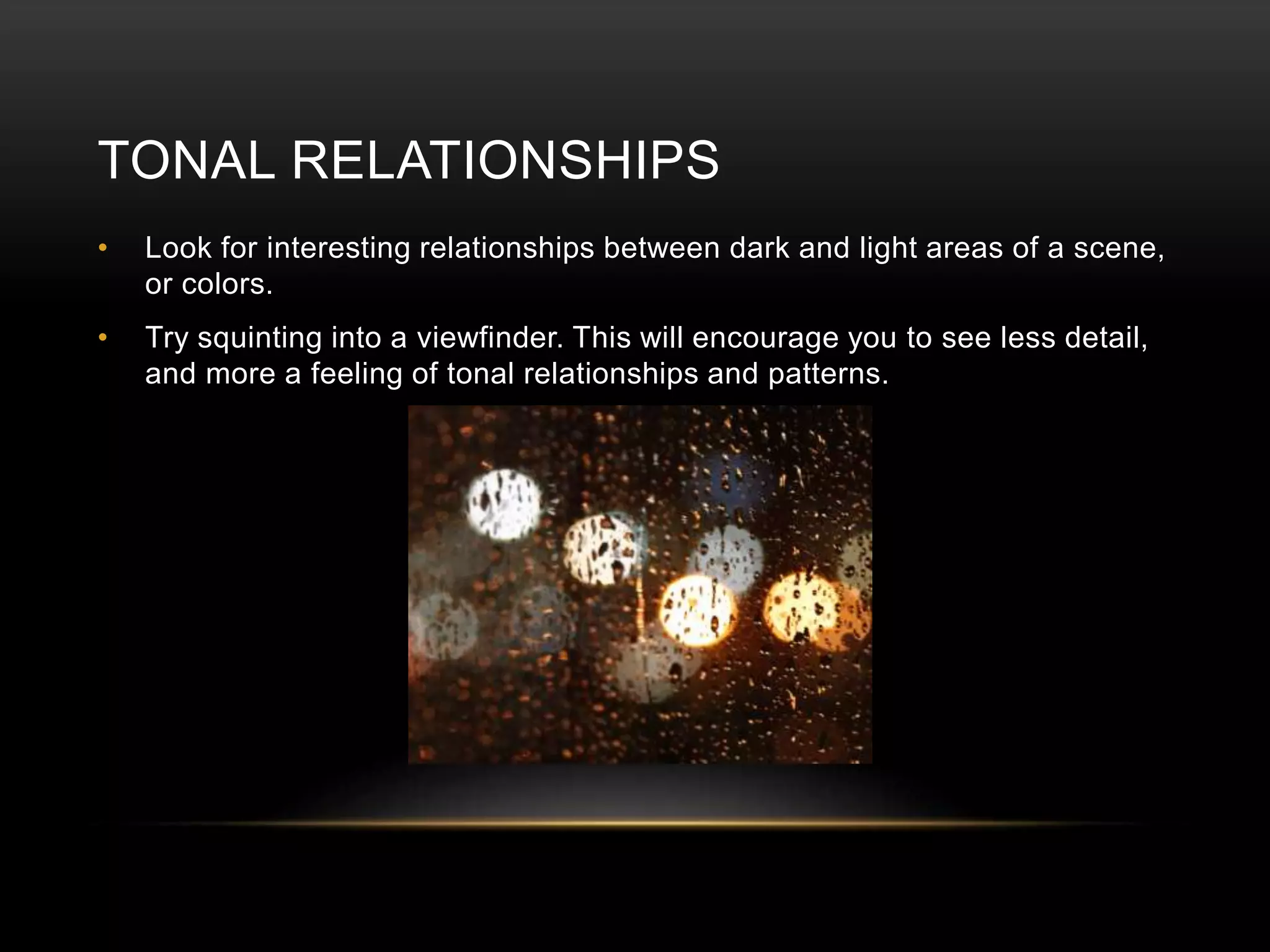
• Look for interesting relationships between dark and light areas of a scene, 
or colors. 
• Try squinting into a viewfinder. This will encourage you to see less detail, 
and more a feeling of tonal relationships and patterns.
RIM LIGHTING 
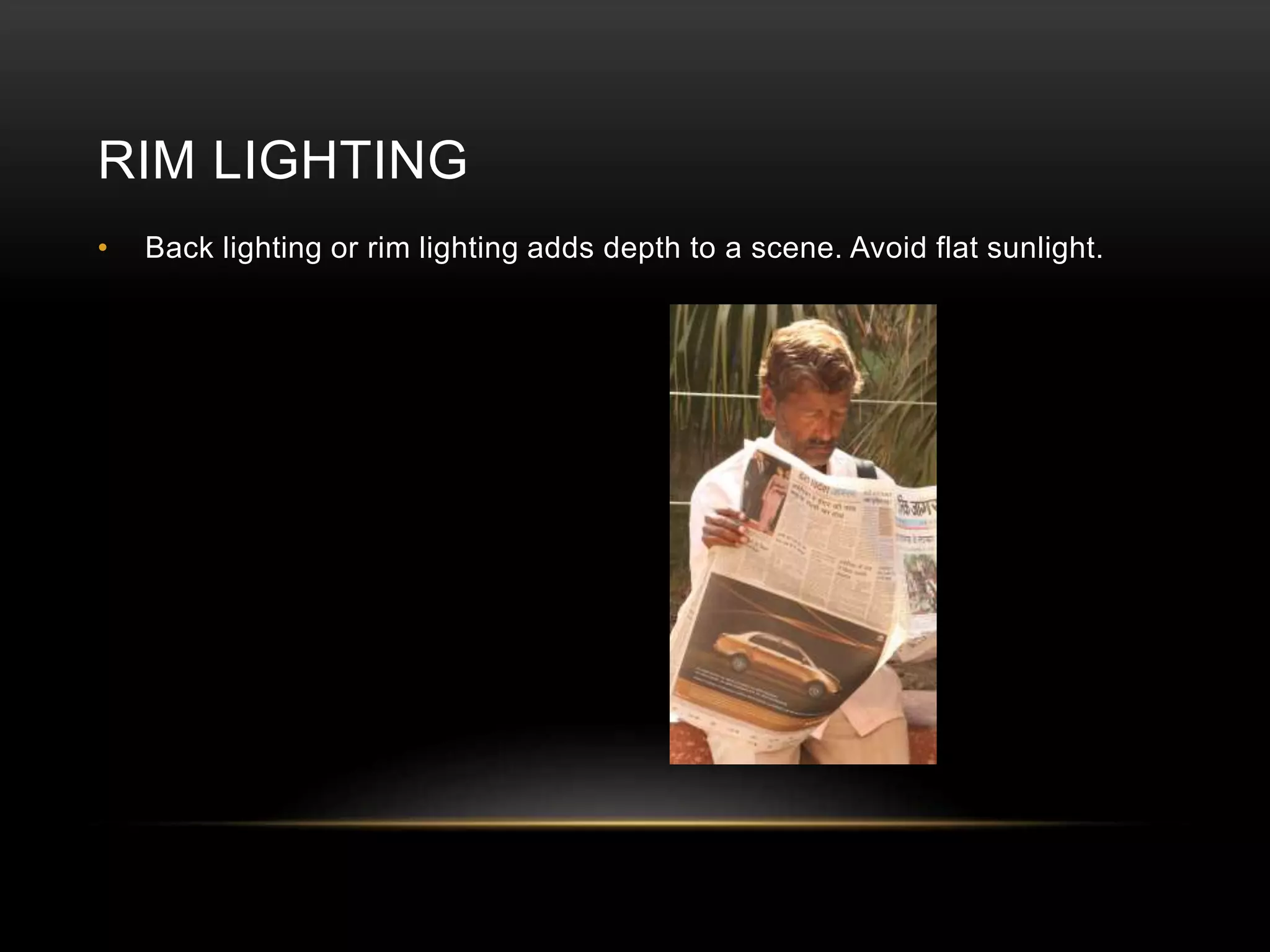
• Back lighting or rim lighting adds depth to a scene. Avoid flat sunlight.
SHADOWS 
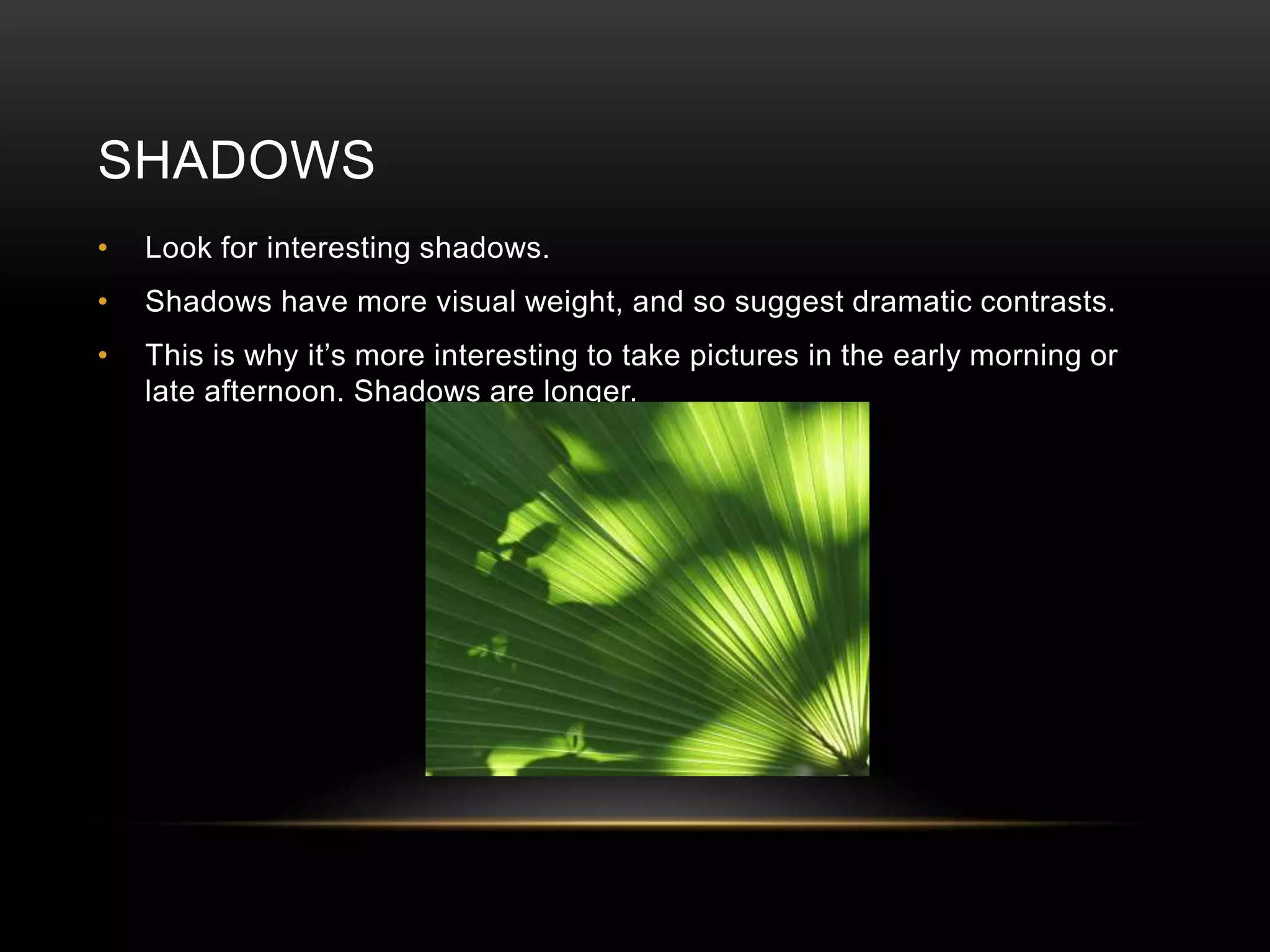
• Look for interesting shadows. 
• Shadows have more visual weight, and so suggest dramatic contrasts. 
• This is why it’s more interesting to take pictures in the early morning or 
late afternoon. Shadows are longer.
A VIDEO OF WAYS TO SEE 
• Here in video form we can study more ways to see. 
http://www.youtube.com/watch?v=YDMGfJ2VVs4&list=UU1MN7rBkZ0-q_ZJTOD1Ea-Q&index=14

Waystosee copy

  • 1.
    WAYS OF SEEING We may look. But do we see?
  • 2.
    THE ART OFSEEING • Most of us have the wonderful gift of sight. • But not many of us truly look. • We move through our busy lives, taking for granted the visual world around us.
  • 3.
    SHAPES, PATTERNS ANDCOLORS • Our world is filled with shapes, patterns, colors, textures and lights. But we don’t normally notice.
  • 4.
    OUR MAKE-UP WORLDOF IMAGES • When we draw, paint, or take a photo, we create a world in an image. • We create an abstraction of our physical world. • When we do this, we are forced to take a closer look at the details around us. • We realize how many complex things go together to create our physical world, and how difficult that is to portray in art and photography.
  • 5.
    VISUAL RESEARCH •Gestalt research has shown people do not look at the physical world in discrete ways. • In other words, we don’t look at single objects or parts, put them together in our minds, and come up with a view, like adding a sum of numbers. • Instead, we see everything all at once, as a whole.
  • 6.
    HOW DO WESEE A TREE? • How do we determine, for example, something as basic as a tree? • Do I look out the window to see a brown, basically cylindrical, vertical shape, with lines radiating from the top, and attached to that, green, vaguely circular shapes? • Of course not. I don’t begin by putting together the pieces. I see a tree! • So the impression of complex shapes coming together is not perceived that way.
  • 7.
    ABSTRACTION OF REALITY • Learning to draw or paint, however, requires us to learn all over again how to see. • We must turn complex reality into a simpler image—because it is impossible to reproduce the entire reality. • So in art you look at line, shape, texture, color—the elements of the world of art—to analyze your image in a new way. • People new to making art from life quickly realize how difficult this is.
  • 8.
    NOT THE REALWORLD • We realize, then, that art in any form— painting, sculpture, photography—is not reality as we see it. It is an abstraction. • That is, we take a three-dimensional event that is happening, changing, moving in time. We freeze it into a two-dimensional world, usually, and on a piece of paper or screen. • For photographers, often that frozen world also will be in black and white, and so further abstracted from reality.
  • 9.
    A TRANSLATION •When we are at an event, or looking at a scene, how we react to that is not what ends up on paper or Web. • Instead, it’s a translation of what we saw and felt into a new environment. • This is why for many of us the photo so often disappoints. It doesn’t seem to translate what we saw or felt. • It is difficult to translate reality into a photography. And that’s the art of seeing.
  • 10.
    A FRAME •As photographers we not only have to abstract reality. • We also have to put it in a frame, one direction, with boundaries, a slice of life. • The boundaries change relationships in the scene, an instant frozen in time.
  • 11.
    FREEZING A MOMENT • The idea of freezing a moment in time can help us sometimes, as photographers. • It can make the relationships and juxtapositions of an image seem to have more meaning than we would have felt in the fleeting moment.
  • 12.
    THE FLEETING MOMENT • Sometimes this works. Sometimes it doesn’t. • The key, then, to taking better photos is to look at reality in a different way from the way we saw it in the past. • That is, as photographers say, learn to see.
  • 13.
    LIGHT • Wedo this when we consider light. • Most people don’t notice quality or direction of light. • Photographers, however, tend to instinctively analyze light where ever they go.
  • 14.
    BEYOND BASICS •Once we understand the basics of light, we can go on to consider other aspects of a scene. • How do we make choices? • To begin with, try to visualize yourself as the photographer of other images you like. Why did the photographer choose what she did? Why did he leave out what he did?
  • 15.
    VISUALIZE • Youcan also use the visualizing process for making your own images. • Visualize the scene in your viewfinder as if it were transferred to a two-dimensional surface, such as a piece of paper or screen. • Consider the image both in color and abstracted into black and white—where you have no color to distract, only line, shape and tone.
  • 16.
    WHAT TO SHOW? • Consider what to show, and what to leave out, of your frame. • We talked about long shots, medium shots, close-ups. But what part of each? • Often you can include less than you think—move in close. • Try to find a particular aspect that makes the picture interesting, that defines the scene. • Photo of a whole person? Or just an interesting expression? • Perhaps just a detail: peeling paint, worn cloths, rough wood. Fine a part that seems to define the whole.
  • 17.
    WHAT IS THEPHOTO ABOUT? • Before shooting it’s helpful to decide what you really want to emphasize in a photo. • Why are you taking this photo? What is really important? • Look at the edges of a frame. Are you cutting off things you want to keep? • Use your viewfinder to isolate parts of a scene, to determine what you want to emphasize. • Note that a photographer starts with everything and subtracts. An artist starts with nothing and adds. • Photographers can’t control a scene the way artists can.
  • 18.
    ASPECT • Horizontalor vertical? • People tend to begin with mostly horizontals. But sometimes this adds nothing but empty space. • A vertical subject needs a vertical format. Turn your camera to shoot verticals!
  • 19.
    BACKGROUND • It’sso easy to forget the background, not notice it, because our eyes are able to isolate the background from the center of interest. What if the background is distracting, adds nothing? • Try to move to eliminate the distraction. • Use a shallow depth of field to make it less obtrusive.
  • 20.
    ISOLATING • Wecan’t control images in mass media photography the way painters can. • We have to grab them quickly. • An interesting approach to this is knowing the eye is attracted to isolated dots, spots, or objects. These make strong centers of interest.
  • 21.
    ASSOCIATIONS • Whendots or spots are close to each other, we tend to associate them psychologically—even if they may actually have nothing to do with each other. • In Gestalt psychology this is the principle of proximity.
  • 22.
    EMPHASIS • Photographersare challenged trying to emphasize interesting parts of a photo, while de-emphasizing other parts. • In an actual scene, with so many objects demanding equal attention, how do we indicate what a viewer should look at first?
  • 23.
    EMPHASIS • Contrastcan help emphasize. Put the subject in a background that will make it stand out. • Contrast can be made with isolation, color, size, or what’s most in focus.
  • 24.
    BALANCE • Webalance a scene dynamically, not symmetrically. Balance in a photo is a feeling. Some ideas: • Dark is visually heavier than light. • Large is heavier than small. • Object at the edge has more visual weight than object at the center. • A picture tends to feel top-heavy without more visual weight at the bottom.
  • 25.
    BALANCE • Balancein your viewfinder is a feeling. • If the view doesn’t feel right, try moving. Even a slight change may feel more balanced. • But balance should not emphasize perfect symmetry. Tension makes the photo more interesting. • The “rule of thirds” is designed to build tension, dynamic balance into a photo.
  • 26.
    SHARPNESS • Peopletend to be attracted first to the sharpest thing in a photo. • If everything is sharp, then everything appears to have the same value. • Emphasis can be gained by making one thing sharper than the rest. • Selective blur can give a feeling of speed or action, particularly in sports pictures.
  • 27.
    INTENTIONAL BLUR •You can blur parts of a scene on purpose, although something needs to be in focus. One trick is to use flash with a slow shutter speed.
  • 28.
    TONAL RELATIONSHIPS •Look for interesting relationships between dark and light areas of a scene, or colors. • Try squinting into a viewfinder. This will encourage you to see less detail, and more a feeling of tonal relationships and patterns.
  • 29.
    RIM LIGHTING •Back lighting or rim lighting adds depth to a scene. Avoid flat sunlight.
  • 30.
    SHADOWS • Lookfor interesting shadows. • Shadows have more visual weight, and so suggest dramatic contrasts. • This is why it’s more interesting to take pictures in the early morning or late afternoon. Shadows are longer.
  • 31.
    A VIDEO OFWAYS TO SEE • Here in video form we can study more ways to see. http://www.youtube.com/watch?v=YDMGfJ2VVs4&list=UU1MN7rBkZ0-q_ZJTOD1Ea-Q&index=14