Pendidikan Bahasa Inggris
Fakultas Bahasa dan Seni
Universitas Negeri Yogyakarta
PHONOLOGY
Introduction to Linguistics
Dosen Pembimbing : Siti Mukminatun S.S., M.Hum
Bella Kirana (16202241025)
Ninda Striratna Taj Hanun (16202241038)
Amalia Hani Nugrahaeni (16202244012)
Salma Hamalna Suryaningrum (16202244041)
What is phonology?
Phonology : studies how sounds are organized in
particular languages (Panevov’a dan Hana, 2010)
Phonology : the study of how speech sounds form
pattern of sounds in a language and across
language. For formally, phonology is the study of
the categorical organization of speech sounds in
languages; how speech sounds are organized in
the mind and used to convey meaning.
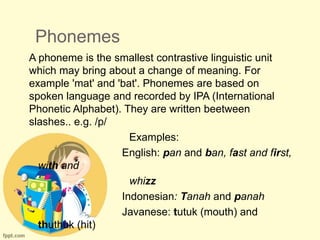
Phonemes
A phoneme is the smallest contrastive linguistic unit
which may bring about a change of meaning. For
example 'mat' and 'bat'. Phonemes are based on
spoken language and recorded by IPA (International
Phonetic Alphabet). They are written beetween
slashes.. e.g. /p/
Examples:
English: pan and ban, fast and first,
with and
whizz
Indonesian: Tanah and panah
Javanese: tutuk (mouth) and
thuthuk (hit)
Phones
A phone is a unit of speech sound. It may refer to
any speech sound or gesture without regard of its
place in phonology of a language. A phoneme is a
set of phones or a set of sound features that are
thought of as the same element within the
phonology of a particular language.
 the realization of a phoneme
Symbols: using narrow
transcription.
Example:
[p], [ph] are the realization/phones
of /p/
Allophones
Allophones are variations of phonemes. So, they
are set of possible spoken sounds used to
prounounce one single phoneme.
Example:
[pʰ] (as in pin) and [p] (as in spin) are allophones
of the phoneme /p/. They are written in brackets.
Minimal pairs
 A minimal pair are two words with distinct meanings that
differ by only one sound found in the same position in
each form.
 The only way we can create a minimal pair with reference
to the two sounds involved is to put them in exactly the
same environment in terms of word position and the
surrounding context. To clarify further, the pair: jail–Yale
shows the contrast between /dʒ/ and /j/ in initial
position, budge–buzz focuses on the contrast between
/dʒ/ and /z/ in final position, while witch–wish
contrasts /t∫/ and /ʃ/ in final position. It should be noted
that minimal pairs include forms that have
different spellings, as evidenced in jail–Yale. (Yavas and
Wiley-Blackwell, 2011)
Example :
Minimal Pairs /e/ and /eı/ wet wait
Minimal Pairs /f/ and /v/ fan van
Complementary Distribution
 The two sounds, that always occur in different
environment, they never occur at the same position
Example :
spat[spæt] pat[phæt] - spat[sphæt]
pat[pæt]
spool[spul] pool[phul] - spool[sphul]
pool[pul]
Free Variation
 Two (or more) sounds appear in the same position,
but it does not make a different meaning
Example :
[lip] leap or [liph] leap
[sowp] soap or [sowph] soap
In English, [p] and [ph] are allophones of the same
phoneme
Consonant of English
Vowel of English
Diphtong of English
Tripthong of English
Word Stress
In many language, including English, one or more
of the syllables in every content word are
stressed.
Stress can be contrastive in English.
For example:
Word “pervert” and “subject”
Pérvert (noun) and pervért (verb)
Súbject (noun) and subjéct (verb)
Epenthesis (segment insertion)
 Inserts a syllabic or non-syllabic segment within an
existing string of segments
 The process of inserting a consonant or vowel
 Insert a [ə] before the plural morpheme /z/ when a
regular noun ends in a sibilant, giving [əz].
∅ → ə / [+sibilant] ___ [+sibilant]
e.g. Judge /ʤʌʤ/ judges /
ʤʌʤz/ 
/ʤʌʤəz/
Phonological Rules
 Assimilation
 Dissimilation
 Segment Deletion
 Epenthesis
 Metathesis
Assimilation
 The vowel nasalization rule is an assimilation rule
that makes neighboring segments more similar by
adding the feature [+nasal] to the vowel.
 Occurs when one segment influences another
 Results from a sound becoming more like another
nearby sound in terms of one of more of its
phonetic characteristics
Example :
news /z/ but newspaper /s/
A sound becomes similar to the
following
sound
V -> [+nasal]/_[+nasal]$
Dissimilation
 It certain segments becomes less similar to other
segments.
 Results in two sounds becoming less alike in articulatory
or acoustic terms
 The resulting sequence of sounds is easier to articulate
and distinguish
e.g. fifths [fθs] → [fts]
-al -ar
anecdot-al
angul-ar
annu-al
annul-ar
Segment Deletion
 Removes a segment from certain phonetic contexts
Such rule occurs in casual or rapid speech.
In English, [ə] is often deleted
 e.g. suppose [səpə́uz] --> [səpuz]
mystery general memory funeral vigorous Barbara
mystry genral memry funral vigrous Barbra
 Delete a /g/ in a word initially before a nasal
consonant or before a syllable-final nasal
consonant.
eg. sign/signature, design/ designation,
malign/malignant, paradigm/paradigmatic
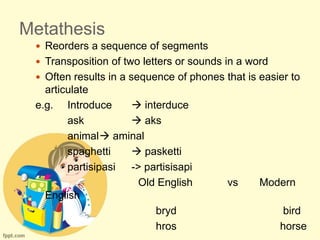
Metathesis
 Reorders a sequence of segments
 Transposition of two letters or sounds in a word
 Often results in a sequence of phones that is easier to
articulate
e.g. Introduce  interduce
ask  aks
animal aminal
spaghetti  pasketti
partisipasi -> partisisapi
Old English vs Modern
English
bryd bird
hros horse
References
 http://allabout-linguistics.group.chef.ac.uk/branches-of
-linguistics/phonology/
 https://www.bayt.com/en/specialties/q/23493/what
-is-the-difference-between-phoneme-phone-and-
allophone/
 https://www.bayt.com/en/specialties/q/23493/what
-is-the-difference-between-phoneme-phone-and-
allophone/
 https://www.bayt.com/en/specialties/q/23493/what-is-
the-difference-between-phoneme-phone-and-
allophone/
 https://www.englishclub.com/pronunciation/minimal-
pairs.htm
 (Fromkin: 253)
 (Fromkin p. 243)
 (Fromkin p. 245)
 (Fromkin p. 248)
 (Fromkin p. 247)
 http://slideplayer.com/slide/3853432/

Phonology presentation

  • 1.
    Pendidikan Bahasa Inggris FakultasBahasa dan Seni Universitas Negeri Yogyakarta PHONOLOGY Introduction to Linguistics Dosen Pembimbing : Siti Mukminatun S.S., M.Hum Bella Kirana (16202241025) Ninda Striratna Taj Hanun (16202241038) Amalia Hani Nugrahaeni (16202244012) Salma Hamalna Suryaningrum (16202244041)
  • 2.
    What is phonology? Phonology: studies how sounds are organized in particular languages (Panevov’a dan Hana, 2010) Phonology : the study of how speech sounds form pattern of sounds in a language and across language. For formally, phonology is the study of the categorical organization of speech sounds in languages; how speech sounds are organized in the mind and used to convey meaning.
  • 3.
    Phonemes A phoneme isthe smallest contrastive linguistic unit which may bring about a change of meaning. For example 'mat' and 'bat'. Phonemes are based on spoken language and recorded by IPA (International Phonetic Alphabet). They are written beetween slashes.. e.g. /p/ Examples: English: pan and ban, fast and first, with and whizz Indonesian: Tanah and panah Javanese: tutuk (mouth) and thuthuk (hit)
  • 4.
    Phones A phone isa unit of speech sound. It may refer to any speech sound or gesture without regard of its place in phonology of a language. A phoneme is a set of phones or a set of sound features that are thought of as the same element within the phonology of a particular language.  the realization of a phoneme Symbols: using narrow transcription. Example: [p], [ph] are the realization/phones of /p/
  • 5.
    Allophones Allophones are variationsof phonemes. So, they are set of possible spoken sounds used to prounounce one single phoneme. Example: [pʰ] (as in pin) and [p] (as in spin) are allophones of the phoneme /p/. They are written in brackets.
  • 6.
    Minimal pairs  Aminimal pair are two words with distinct meanings that differ by only one sound found in the same position in each form.  The only way we can create a minimal pair with reference to the two sounds involved is to put them in exactly the same environment in terms of word position and the surrounding context. To clarify further, the pair: jail–Yale shows the contrast between /dʒ/ and /j/ in initial position, budge–buzz focuses on the contrast between /dʒ/ and /z/ in final position, while witch–wish contrasts /t∫/ and /ʃ/ in final position. It should be noted that minimal pairs include forms that have different spellings, as evidenced in jail–Yale. (Yavas and Wiley-Blackwell, 2011) Example : Minimal Pairs /e/ and /eı/ wet wait Minimal Pairs /f/ and /v/ fan van
  • 7.
    Complementary Distribution  Thetwo sounds, that always occur in different environment, they never occur at the same position Example : spat[spæt] pat[phæt] - spat[sphæt] pat[pæt] spool[spul] pool[phul] - spool[sphul] pool[pul]
  • 8.
    Free Variation  Two(or more) sounds appear in the same position, but it does not make a different meaning Example : [lip] leap or [liph] leap [sowp] soap or [sowph] soap In English, [p] and [ph] are allophones of the same phoneme
  • 9.
  • 11.
  • 13.
  • 14.
  • 15.
    Word Stress In manylanguage, including English, one or more of the syllables in every content word are stressed. Stress can be contrastive in English. For example: Word “pervert” and “subject” Pérvert (noun) and pervért (verb) Súbject (noun) and subjéct (verb)
  • 16.
    Epenthesis (segment insertion) Inserts a syllabic or non-syllabic segment within an existing string of segments  The process of inserting a consonant or vowel  Insert a [ə] before the plural morpheme /z/ when a regular noun ends in a sibilant, giving [əz]. ∅ → ə / [+sibilant] ___ [+sibilant] e.g. Judge /ʤʌʤ/ judges / ʤʌʤz/  /ʤʌʤəz/
  • 17.
    Phonological Rules  Assimilation Dissimilation  Segment Deletion  Epenthesis  Metathesis
  • 18.
    Assimilation  The vowelnasalization rule is an assimilation rule that makes neighboring segments more similar by adding the feature [+nasal] to the vowel.  Occurs when one segment influences another  Results from a sound becoming more like another nearby sound in terms of one of more of its phonetic characteristics Example : news /z/ but newspaper /s/ A sound becomes similar to the following sound V -> [+nasal]/_[+nasal]$
  • 19.
    Dissimilation  It certainsegments becomes less similar to other segments.  Results in two sounds becoming less alike in articulatory or acoustic terms  The resulting sequence of sounds is easier to articulate and distinguish e.g. fifths [fθs] → [fts] -al -ar anecdot-al angul-ar annu-al annul-ar
  • 20.
    Segment Deletion  Removesa segment from certain phonetic contexts Such rule occurs in casual or rapid speech. In English, [ə] is often deleted  e.g. suppose [səpə́uz] --> [səpuz] mystery general memory funeral vigorous Barbara mystry genral memry funral vigrous Barbra  Delete a /g/ in a word initially before a nasal consonant or before a syllable-final nasal consonant. eg. sign/signature, design/ designation, malign/malignant, paradigm/paradigmatic
  • 21.
    Metathesis  Reorders asequence of segments  Transposition of two letters or sounds in a word  Often results in a sequence of phones that is easier to articulate e.g. Introduce  interduce ask  aks animal aminal spaghetti  pasketti partisipasi -> partisisapi Old English vs Modern English bryd bird hros horse
  • 23.
    References  http://allabout-linguistics.group.chef.ac.uk/branches-of -linguistics/phonology/  https://www.bayt.com/en/specialties/q/23493/what -is-the-difference-between-phoneme-phone-and- allophone/ https://www.bayt.com/en/specialties/q/23493/what -is-the-difference-between-phoneme-phone-and- allophone/  https://www.bayt.com/en/specialties/q/23493/what-is- the-difference-between-phoneme-phone-and- allophone/  https://www.englishclub.com/pronunciation/minimal- pairs.htm
  • 24.
     (Fromkin: 253) (Fromkin p. 243)  (Fromkin p. 245)  (Fromkin p. 248)  (Fromkin p. 247)  http://slideplayer.com/slide/3853432/

Editor's Notes

  • #2 Tidak perlu mencantumkan email UNY. Cukup email kalian. Benahi penulisan linguistics
  • #3 Yang kedua dari sumber mana? Ambil dari buku-buku yang sudah ibu share. Setelah itu simpulkan dari berbagai definisi itu.
  • #4 Tambah contoh minimal pair dalam Bahasa inggris sehingga akan membantu pemahaman teman-teman.
  • #6 Cek spelling
  • #7 Tambah contoh minimal pair terutama yang beda spelling (baik vowel maupun consonant) supaya teman-teman tahu bahwa minimal pair itu bukan berdasar pada spelling seperti halnya pada Bahasa Indonesia.
  • #8 Cek penulisan p diawal kata. Karena dari situ nanti, amalia dapat menjelaskan letak complementary distribution.
  • #9 Contoh belum secara jelas menggambarkan penjelasan free variation.
  • #16 Tunjukkan tanda “stress” dalam contoh tesebut sehingga pembaca akan mengetahui peran “stress” dalam suatu kata.
  • #19 Berikan contoh. Penjelasan ini masih terlalu umum.
  • #22 Diambil dari mana contoh ini?
  • #24 Tulislah referensi secara lengkap di sini.