Applied Linguistics
Chapter 2: Phonology –
The Sound Pattern of Language
WESTERN UNIVERSITY
• Lecturer: Mr.VATH VARY
• Contact: 017 471 1117/varyvath@gmail.com
Linguistics
Sounds Structures Meaning
Phonology
Phonetics Syntax
Morphology Semantics Pragmatics
What is Phonology?
• Phonology is the study of how
sounds pattern in a language.
Describes the ways we can discover the
unconscious systems underlying speech.
Phonetics
is concerned with the
physical production
and perception of
speech sounds
Focuses on individual
sounds
Phonology
describes the ways in
which sounds function
within a language to
encode meaning.
is about the underlying
design, the blueprint of
each sound type, which
serves as the constant basis
of all the variations in
different physical
articulations of that sound
type in different contexts.
What Does It MeanWhenWe Say We Know aWord?
• Knowing a word means
knowing both its sounds
and its meaning.
Phonemes
• Sounds in a given language that
are heard by its native speakers as
distinct sounds and that result in a
difference in meaning when
interchanged.
Consonant Sounds: 24 Vowel Sounds: 21
Minimal Pairs or Set
What is Minimal pair?
• A pair of words that differ only in
one sound in the same position.
 These words form a minimal
set with pat–bat, fan–van, or
site–side.
• The difference between pat and bat, between teal and deal, and between
thigh and thy are minimal (i.e., they are identical except for one sound that
occurs in the same place in the word). For that reason, they are called
minimal pairs.
Phonemes
• … a unit of sound that
makes a difference in the
meaning of a word.
• Slashes /… / are used to
enclose phonemes
• The phoneme, /p/, is the
representation of the
sound in the mind of the
English speaker
Allophones
• … are predictable variants
of one phoneme.
• Square brackets […] are
used for allophones.
• The allophones, pie [p ]
ʰ and
spy [p], are how that mental
representation is produced in
actual speech depending on
the phonetic environment.
Example
Phonemes and Allophones
Consider the /p/ of English, for instance.
• Hold your hand or a piece of paper in front of your
mouth and say the words pat and spat.
• When you pronounce pat you should feel a puff of air
on your hand that you do not feel when you say spat.
• Making this puff of air is called aspiration.
• We call the p in pit aspirated and
transcribe it using a small raised [ ]
ʰ
after the [p].
• The p in spit is unaspirated and is
transcribed with a regular [p].
• Thus, pit is transcribed as [p t] and
ʰɪ
spit is transcribed as [sp t].
ɪ
Example
This is where the ESL teacher would come in.
Unconscious
Knowledge
• While native speakers of English know when to
produce aspirated voiceless stops and when to
produce unaspirated voiceless stops, they are not
explicitly taught these rules.
EFL/ESL
Learners
• Foreign/second language learners do not have
this knowledge and need to learn the rule
explicitly if they want to pronounce voiceless
stops appropriately.
Explicit
Teaching
• By teaching the aspiration rule in
English voiceless stops, teachers can
help their students improve their
pronunciation.
Teaching
Implication
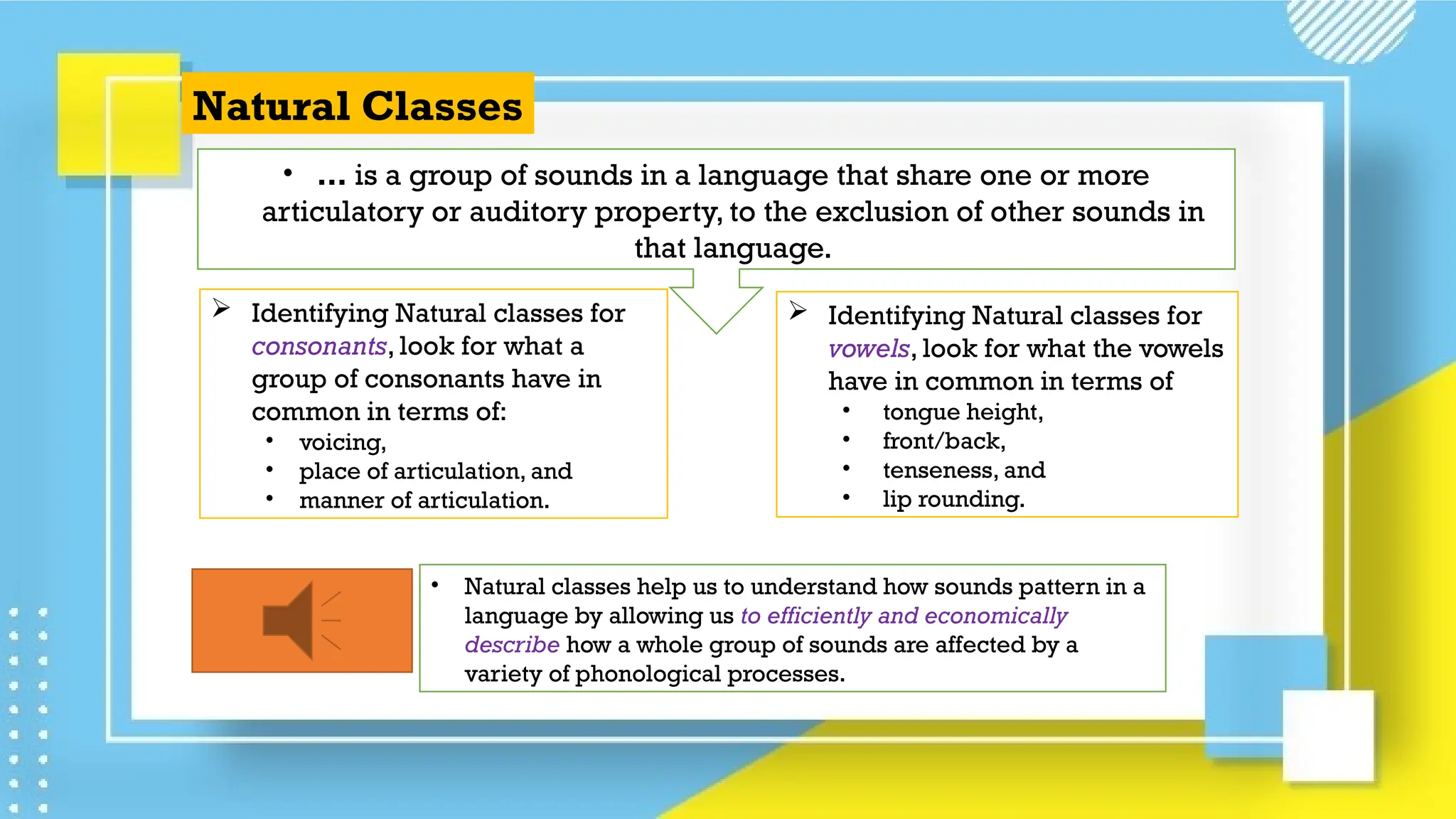
Natural Classes
• … is a group of sounds in a language that share one or more
articulatory or auditory property, to the exclusion of other sounds in
that language.
 Identifying Natural classes for
vowels, look for what the vowels
have in common in terms of
• tongue height,
• front/back,
• tenseness, and
• lip rounding.
 Identifying Natural classes for
consonants, look for what a
group of consonants have in
common in terms of:
• voicing,
• place of articulation, and
• manner of articulation.
• Natural classes help us to understand how sounds pattern in a
language by allowing us to efficiently and economically
describe how a whole group of sounds are affected by a
variety of phonological processes.
Natural Class
Canadian Raising
• Canadian Raising is a phonological rule in many dialects of North American
English that changes the pronunciation of diphthongs, [a ] and [a ], to [ ] and
ɪ ʊ ʌɪ
[ ] respectively.
ʌʊ
• It gets its name from a low vowel, [a], being raised to a mid vowel, [ ].
ʌ
• Speakers of these dialects would say out and about as [ t n b t] rather
ʌʊ ə ə ʌʊ
than [a t n ba t], and
ʊ ə ə ʊ bright light as [br t l t] rather than [bra t la t].
ʌɪ ʌɪ ɪ ɪ
• Our job as students of phonology is to
determine when the change in the
pronunciation occurs and when it does not.
• In other words, is the change in
pronunciation governed by a phonological
rule? If so, what is that rule?
Canadian Raising
• [aɪ] occurs before a voiced consonant
whereas [ʌɪ] occurs before a voiceless
consonant.
• We can also write the phonological rule in (1)
in a different way, as (2):
• (2) /aɪ/ becomes [ʌɪ] before a voiceless
consonant.
• Phonological rule
Vowel Length in English
• Let us consider another example of
allophonic variation—that of vowel
length.
• The colon [:] placed after [ ] in the words
ɪ
in the right column means that the vowel
is long.
• (3) [ ] occurs before a voiceless
ɪ
consonant while [ :] occurs before
ɪ
a voiced consonant.
• (4) / / becomes [ :] before a voiced
ɪ ɪ
consonant.
Phonological Processes
Obligatory rules
• apply in the speech of
all speakers of a
language or dialect
having the rule,
regardless of style or
rate of speaking.
Optional rules
• may or may not
apply in any given
utterance and are
responsible for
variation in speech
• All of these elements in the sound system are governed by rules.
• Our main task is to explore these phonological rules to
understand how and why sounds affect each other and to
understand our unconscious knowledge underlying these
processes.
Phonological Processes
Deletion
A phonological process
causing a segment
present at the phonemic
level to be deleted at the
phonetic level of a word
Sound is Deleted
Insertion
A phonological process
causing a segment not
present at the phonemic
level to be added to the
phonetic form of a word
Sound is added
Phonological processes may add or delete entire
segments.
Another optional rule in English is deletion in unstressed syllables.
 I want him to see.
• Careful speech: [a w nt h m t si ð s]
ɪ ə ɪ ə ɪ
• Fast speech: [a w n m t si ð s]
ɪ ə ɪ ə ɪ
• The unstressed vowel [ ], is often deleted when the next syllable is
ə
stressed in fast speech
DELETION
• Insertion is especially helpful when producing two neighboring
sounds that have very different phonetic features.
• The words warmth,tenth, and length are typically pronounced [w rm ],
ɔ θ
[t n ], and [l ].
ɛ θ ɛŋθ
• In casual speech, speakers may insert a [p] between the [m] and the
[ ] and pronounce the word [w rmp ].
θ ɔ θ
 Similarly, a [t] may be inserted between [n] and [ ] to produce
θ
[t nt ], and
ɛ θ
 a [k] may be inserted between [ ] and [ ] to produce [l k ].
ŋ θ ɛŋ θ
Insertion
• Assimilation: a
phonological process in
which a sound to become
more like a neighboring
sound in terms of one or
more of its phonetic
characteristics.
• Is One of the most common
phonological rules across
all languages.
• Assimilation occurs mainly for ease
of articulation; that is, assimilation
makes it easier to move the
articulators to produce different
sounds consecutively in fluent
speech.
Assimilation
• [r], a typically voiced sound, became voiceless after voiceless consonants,
[k] and [f], in fast speech.
• Liquids and glides after voiceless consonants: play [p ],
l̥ɛɪ prod [p ad], and
r
̥
cure [k ur] are often devoiced.
j
̥
• Devoicing is a kind of assimilation because the lack of voicing in the [p]
and [k] sounds spreads to [l], [r], and [j], making these normally voiced
sounds voiceless.
• Speaking in terms of articulatory phonetics, devoicing happens because
the vocal folds do not start vibrating immediately after the release of the
voiceless consonant closure.
Devoicing
• A phonological process in which a voiced sound becomes
voiceless.
TEACHING
IMPLICATION
Place assimilation
• A phonological process
in which the place of
articulation of a sound
becomes more like the
place of articulation of a
neighboring sound
Sound is Deleted
Manner assimilation
• A phonological process
in which the manner of
articulation of a sound
becomes more like the
manner of articulation of
a neighboring sound
Sound is added
Manner
assimilation
Words like unbeatable, unjust, and uncut are
often pronounced [ mbi b ], [ nd st], and
ə ɾə l̩ ə ʒʌ
[ k t].
əŋ ʌ
• The nasal /n/ is often pronounced as a
bilabial nasal, [m], before a bilabial sound,
as in [əmbi b ], and as a velar nasal, [ ],
ɾə l̩ ŋ
before a velar sound, as in [əŋk t].
ʌ
• The nasal stays as an alveolar nasal, [n],
before a post-alveolar affricate, [d ], in
ʒ
[ənd st].
ʒʌ
An example of place
• assimilation is the
pronunciation of the
prefix un- in English.
Assimilation
 when a sound becomes less like a neighboring sound in
terms of one of more of its phonetic characteristics.
• The word fifths [f f s] ends in a consonant cluster
ɪ θ
made up of three consecutive fricatives.
• Some speakers pronounce this word as [f fts],
ɪ
breaking up the sequence of three fricatives with a
stop.
Dissimilation
 Dissimilation is a much rarer phonological process. However,
when it does occur, it frequently serves the purpose of achieving
clearer communication by breaking up sounds that are too
similar.
• Strengthening A phonological process that makes sounds
stronger.
• Weakening, a process by which sounds become weaker.
• The flap occurs
as the middle
sound in the
words:
• butter [b r],
ʌɾə
writer [ra r],
ɪɾə
ladder [læ r],
ɾə
and tidal [ta l].
ɪɾə
• Flapping is an example
of weakening.
• American English has
an alveolar flap, [ ],
ɾ
which involves the tip of
the tongue quickly
striking the roof of the
mouth and returning to
its rest position.
Strengthening vs.Weakening
• In some dialects of English, for example, the
word ask is pronounced as aks.
• Some English-speaking adults pronounce
prescription, introduce, and cavalry as
perscription, interduce, and calvary.
• Metathesis is a phonological process that reorders sounds. In
many cases, sounds metathesize to make words easier to
pronounce or easier to understand.
Metathesis
• In each of these instances, metathesis facilitates the
pronunciation of consonant cluster sequences.
Suprasegmentals
Length Stress
Pitch:
intonation &
tone
syllable
What is Syllable?
• A unit of pronunciation having
one vowel sound,with or without
surrounding consonants, forming
the whole or a part of a word.
 Put it in another way, it is a basic unit
of speech generally containing only
one vowel sound (nucleus) and also
possibly an onset and a coda (called
the rime).
• A word is composed of one or more syllables,
and a syllable is in turn composed of one or
more phonemes.
Syllable
Syllables
Onset
 consonant(
s) at the
beginning
of a
syllable
Rime (rhyme)
 vowel and any
consonants
following it at
the end of the
syllable:
 can be further
divided into
two: Nucleus &
Coda
Nucleus
 vowel that
is the
minimum
unit of the
rime
Coda
 consonant(
s) at the
end of the
rime
Minea from 108 to 121
Syllables
Syllables
How to Help Students Improve Their Pronunciation
in a Second Language
• When trying to help students improve their
pronunciation in a second language,
• it is important to remember that second
language pronunciation problems are often
rooted in differences between what constitutes
a phoneme or a syllable in the student’s native
language versus the target language.
• Consequently, it is helpful for teachers to become
familiar with the phonology of the student’s native
language.
How to Help Students Improve Their
Pronunciation in a Second Language
• Many Spanish speakers will substitute:
• / / with /t /, and pronounce
ʃ ʃ shock as
chock and wish as witch.
• The letter v is used in Spanish
writing, the v sound does not
exist in most dialects of Spanish.
• Therefore, you might hear:
• Spanish speakers substitute
the v sound with a b sound in
English and say bat for vat,
and Boyd for void.
• They may also substitute /v/
with / /, a voiced labial
β
fricative and say [s n] for
ɛβə
seven.
• [ ] is an allophone of
β
the phoneme /b/ that
occurs between vowels.
How to Help Students Improve Their Pronunciation in a Second
Language
• Explain how the v sound is produced;
• Draw students’ attention to the fact that pronouncing /v/ involves
simply adding voicing to /f/, which they already know how to produce.
• Have students place the tip of their fingers on their throat while
saying /f/ and /v/ alternately.
• Both sounds are produced in the same way in the mouth and that the
only difference between /f/ and /v/ is the absence or presence of
voicing.
• Have students practice saying “shhh” as if telling someone to
be quiet.
• Then, students can add different vowel nuclei and coda to
form words like shhhock, shhhip,shhhine, or add different
onsets and vowels to form words like wishhh, mashhh, lushhh.
/f/ and /v/
/ /
ʃ
Unit 3 Phonology_Linguistics for L teachers.pptx

Unit 3 Phonology_Linguistics for L teachers.pptx

  • 1.
    Applied Linguistics Chapter 2:Phonology – The Sound Pattern of Language WESTERN UNIVERSITY • Lecturer: Mr.VATH VARY • Contact: 017 471 1117/varyvath@gmail.com
  • 2.
    Linguistics Sounds Structures Meaning Phonology PhoneticsSyntax Morphology Semantics Pragmatics
  • 3.
    What is Phonology? •Phonology is the study of how sounds pattern in a language. Describes the ways we can discover the unconscious systems underlying speech.
  • 4.
    Phonetics is concerned withthe physical production and perception of speech sounds Focuses on individual sounds Phonology describes the ways in which sounds function within a language to encode meaning. is about the underlying design, the blueprint of each sound type, which serves as the constant basis of all the variations in different physical articulations of that sound type in different contexts.
  • 5.
    What Does ItMeanWhenWe Say We Know aWord? • Knowing a word means knowing both its sounds and its meaning. Phonemes • Sounds in a given language that are heard by its native speakers as distinct sounds and that result in a difference in meaning when interchanged. Consonant Sounds: 24 Vowel Sounds: 21
  • 6.
    Minimal Pairs orSet What is Minimal pair? • A pair of words that differ only in one sound in the same position.  These words form a minimal set with pat–bat, fan–van, or site–side. • The difference between pat and bat, between teal and deal, and between thigh and thy are minimal (i.e., they are identical except for one sound that occurs in the same place in the word). For that reason, they are called minimal pairs.
  • 7.
    Phonemes • … aunit of sound that makes a difference in the meaning of a word. • Slashes /… / are used to enclose phonemes • The phoneme, /p/, is the representation of the sound in the mind of the English speaker Allophones • … are predictable variants of one phoneme. • Square brackets […] are used for allophones. • The allophones, pie [p ] ʰ and spy [p], are how that mental representation is produced in actual speech depending on the phonetic environment. Example
  • 8.
    Phonemes and Allophones Considerthe /p/ of English, for instance. • Hold your hand or a piece of paper in front of your mouth and say the words pat and spat. • When you pronounce pat you should feel a puff of air on your hand that you do not feel when you say spat. • Making this puff of air is called aspiration. • We call the p in pit aspirated and transcribe it using a small raised [ ] ʰ after the [p]. • The p in spit is unaspirated and is transcribed with a regular [p]. • Thus, pit is transcribed as [p t] and ʰɪ spit is transcribed as [sp t]. ɪ Example
  • 9.
    This is wherethe ESL teacher would come in. Unconscious Knowledge • While native speakers of English know when to produce aspirated voiceless stops and when to produce unaspirated voiceless stops, they are not explicitly taught these rules. EFL/ESL Learners • Foreign/second language learners do not have this knowledge and need to learn the rule explicitly if they want to pronounce voiceless stops appropriately. Explicit Teaching • By teaching the aspiration rule in English voiceless stops, teachers can help their students improve their pronunciation.
  • 10.
  • 11.
    Natural Classes • …is a group of sounds in a language that share one or more articulatory or auditory property, to the exclusion of other sounds in that language.  Identifying Natural classes for vowels, look for what the vowels have in common in terms of • tongue height, • front/back, • tenseness, and • lip rounding.  Identifying Natural classes for consonants, look for what a group of consonants have in common in terms of: • voicing, • place of articulation, and • manner of articulation. • Natural classes help us to understand how sounds pattern in a language by allowing us to efficiently and economically describe how a whole group of sounds are affected by a variety of phonological processes.
  • 12.
  • 13.
    Canadian Raising • CanadianRaising is a phonological rule in many dialects of North American English that changes the pronunciation of diphthongs, [a ] and [a ], to [ ] and ɪ ʊ ʌɪ [ ] respectively. ʌʊ • It gets its name from a low vowel, [a], being raised to a mid vowel, [ ]. ʌ • Speakers of these dialects would say out and about as [ t n b t] rather ʌʊ ə ə ʌʊ than [a t n ba t], and ʊ ə ə ʊ bright light as [br t l t] rather than [bra t la t]. ʌɪ ʌɪ ɪ ɪ • Our job as students of phonology is to determine when the change in the pronunciation occurs and when it does not. • In other words, is the change in pronunciation governed by a phonological rule? If so, what is that rule?
  • 14.
    Canadian Raising • [aɪ]occurs before a voiced consonant whereas [ʌɪ] occurs before a voiceless consonant. • We can also write the phonological rule in (1) in a different way, as (2): • (2) /aɪ/ becomes [ʌɪ] before a voiceless consonant. • Phonological rule
  • 15.
    Vowel Length inEnglish • Let us consider another example of allophonic variation—that of vowel length. • The colon [:] placed after [ ] in the words ɪ in the right column means that the vowel is long. • (3) [ ] occurs before a voiceless ɪ consonant while [ :] occurs before ɪ a voiced consonant. • (4) / / becomes [ :] before a voiced ɪ ɪ consonant.
  • 16.
    Phonological Processes Obligatory rules •apply in the speech of all speakers of a language or dialect having the rule, regardless of style or rate of speaking. Optional rules • may or may not apply in any given utterance and are responsible for variation in speech • All of these elements in the sound system are governed by rules. • Our main task is to explore these phonological rules to understand how and why sounds affect each other and to understand our unconscious knowledge underlying these processes.
  • 17.
    Phonological Processes Deletion A phonologicalprocess causing a segment present at the phonemic level to be deleted at the phonetic level of a word Sound is Deleted Insertion A phonological process causing a segment not present at the phonemic level to be added to the phonetic form of a word Sound is added Phonological processes may add or delete entire segments.
  • 18.
    Another optional rulein English is deletion in unstressed syllables.  I want him to see. • Careful speech: [a w nt h m t si ð s] ɪ ə ɪ ə ɪ • Fast speech: [a w n m t si ð s] ɪ ə ɪ ə ɪ • The unstressed vowel [ ], is often deleted when the next syllable is ə stressed in fast speech DELETION
  • 19.
    • Insertion isespecially helpful when producing two neighboring sounds that have very different phonetic features. • The words warmth,tenth, and length are typically pronounced [w rm ], ɔ θ [t n ], and [l ]. ɛ θ ɛŋθ • In casual speech, speakers may insert a [p] between the [m] and the [ ] and pronounce the word [w rmp ]. θ ɔ θ  Similarly, a [t] may be inserted between [n] and [ ] to produce θ [t nt ], and ɛ θ  a [k] may be inserted between [ ] and [ ] to produce [l k ]. ŋ θ ɛŋ θ Insertion
  • 20.
    • Assimilation: a phonologicalprocess in which a sound to become more like a neighboring sound in terms of one or more of its phonetic characteristics. • Is One of the most common phonological rules across all languages. • Assimilation occurs mainly for ease of articulation; that is, assimilation makes it easier to move the articulators to produce different sounds consecutively in fluent speech. Assimilation
  • 21.
    • [r], atypically voiced sound, became voiceless after voiceless consonants, [k] and [f], in fast speech. • Liquids and glides after voiceless consonants: play [p ], l̥ɛɪ prod [p ad], and r ̥ cure [k ur] are often devoiced. j ̥ • Devoicing is a kind of assimilation because the lack of voicing in the [p] and [k] sounds spreads to [l], [r], and [j], making these normally voiced sounds voiceless. • Speaking in terms of articulatory phonetics, devoicing happens because the vocal folds do not start vibrating immediately after the release of the voiceless consonant closure. Devoicing • A phonological process in which a voiced sound becomes voiceless.
  • 22.
  • 23.
    Place assimilation • Aphonological process in which the place of articulation of a sound becomes more like the place of articulation of a neighboring sound Sound is Deleted Manner assimilation • A phonological process in which the manner of articulation of a sound becomes more like the manner of articulation of a neighboring sound Sound is added
  • 24.
    Manner assimilation Words like unbeatable,unjust, and uncut are often pronounced [ mbi b ], [ nd st], and ə ɾə l̩ ə ʒʌ [ k t]. əŋ ʌ • The nasal /n/ is often pronounced as a bilabial nasal, [m], before a bilabial sound, as in [əmbi b ], and as a velar nasal, [ ], ɾə l̩ ŋ before a velar sound, as in [əŋk t]. ʌ • The nasal stays as an alveolar nasal, [n], before a post-alveolar affricate, [d ], in ʒ [ənd st]. ʒʌ An example of place • assimilation is the pronunciation of the prefix un- in English. Assimilation
  • 25.
     when asound becomes less like a neighboring sound in terms of one of more of its phonetic characteristics. • The word fifths [f f s] ends in a consonant cluster ɪ θ made up of three consecutive fricatives. • Some speakers pronounce this word as [f fts], ɪ breaking up the sequence of three fricatives with a stop. Dissimilation  Dissimilation is a much rarer phonological process. However, when it does occur, it frequently serves the purpose of achieving clearer communication by breaking up sounds that are too similar.
  • 26.
    • Strengthening Aphonological process that makes sounds stronger. • Weakening, a process by which sounds become weaker. • The flap occurs as the middle sound in the words: • butter [b r], ʌɾə writer [ra r], ɪɾə ladder [læ r], ɾə and tidal [ta l]. ɪɾə • Flapping is an example of weakening. • American English has an alveolar flap, [ ], ɾ which involves the tip of the tongue quickly striking the roof of the mouth and returning to its rest position. Strengthening vs.Weakening
  • 27.
    • In somedialects of English, for example, the word ask is pronounced as aks. • Some English-speaking adults pronounce prescription, introduce, and cavalry as perscription, interduce, and calvary. • Metathesis is a phonological process that reorders sounds. In many cases, sounds metathesize to make words easier to pronounce or easier to understand. Metathesis • In each of these instances, metathesis facilitates the pronunciation of consonant cluster sequences.
  • 28.
  • 29.
    What is Syllable? •A unit of pronunciation having one vowel sound,with or without surrounding consonants, forming the whole or a part of a word.  Put it in another way, it is a basic unit of speech generally containing only one vowel sound (nucleus) and also possibly an onset and a coda (called the rime). • A word is composed of one or more syllables, and a syllable is in turn composed of one or more phonemes. Syllable
  • 30.
    Syllables Onset  consonant( s) atthe beginning of a syllable Rime (rhyme)  vowel and any consonants following it at the end of the syllable:  can be further divided into two: Nucleus & Coda Nucleus  vowel that is the minimum unit of the rime Coda  consonant( s) at the end of the rime
  • 31.
    Minea from 108to 121 Syllables
  • 32.
  • 33.
    How to HelpStudents Improve Their Pronunciation in a Second Language • When trying to help students improve their pronunciation in a second language, • it is important to remember that second language pronunciation problems are often rooted in differences between what constitutes a phoneme or a syllable in the student’s native language versus the target language. • Consequently, it is helpful for teachers to become familiar with the phonology of the student’s native language.
  • 34.
    How to HelpStudents Improve Their Pronunciation in a Second Language • Many Spanish speakers will substitute: • / / with /t /, and pronounce ʃ ʃ shock as chock and wish as witch. • The letter v is used in Spanish writing, the v sound does not exist in most dialects of Spanish. • Therefore, you might hear: • Spanish speakers substitute the v sound with a b sound in English and say bat for vat, and Boyd for void. • They may also substitute /v/ with / /, a voiced labial β fricative and say [s n] for ɛβə seven. • [ ] is an allophone of β the phoneme /b/ that occurs between vowels.
  • 35.
    How to HelpStudents Improve Their Pronunciation in a Second Language • Explain how the v sound is produced; • Draw students’ attention to the fact that pronouncing /v/ involves simply adding voicing to /f/, which they already know how to produce. • Have students place the tip of their fingers on their throat while saying /f/ and /v/ alternately. • Both sounds are produced in the same way in the mouth and that the only difference between /f/ and /v/ is the absence or presence of voicing. • Have students practice saying “shhh” as if telling someone to be quiet. • Then, students can add different vowel nuclei and coda to form words like shhhock, shhhip,shhhine, or add different onsets and vowels to form words like wishhh, mashhh, lushhh. /f/ and /v/ / / ʃ