PHONE, PHONEME
AND ALLOPHONE
PHONOLGY 2024
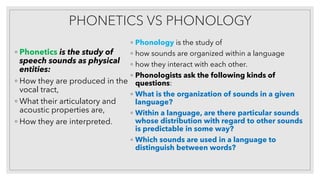
PHONETICS VS PHONOLOGY
◦ Phonetics is the study of
speech sounds as physical
entities:
◦ How they are produced in the
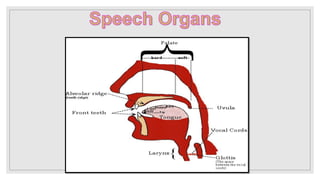
vocal tract,
◦ What their articulatory and
acoustic properties are,
◦ How they are interpreted.
◦ Phonology is the study of
◦ how sounds are organized within a language
◦ how they interact with each other.
◦ Phonologists ask the following kinds of
questions:
◦ What is the organization of sounds in a given
language?
◦ Within a language, are there particular sounds
whose distribution with regard to other sounds
is predictable in some way?
◦ Which sounds are used in a language to
distinguish between words?
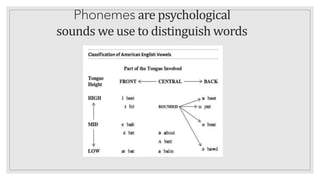
Phonemes are psychological
sounds we use to distinguish words
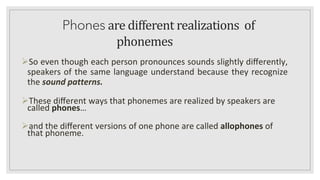
Phones are different realizations of
phonemes
➢So even though each person pronounces sounds slightly differently,
speakers of the same language understand because they recognize
the sound patterns.
➢These different ways that phonemes are realized by speakers are
called phones…
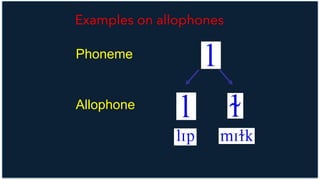
➢and the different versions of one phone are called allophones of
that phoneme.
Transcription
• Phonemes are written in slanted brackets to show idealized
transcriptions:
/eɪtθ/ /spæt/
• Phones are written in square brackets to represent actual pronunciation:
[eɪt̪θ] [spæt̚]
Transcription
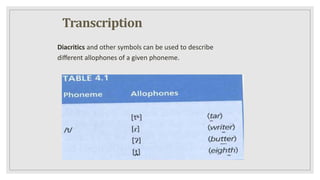
Diacritics and other symbols can be used to describe
different allophones of a given phoneme.
Transcription
You can use the symbols for other phonemes to express
allophones different pronunciations…
• Like for someone from the western US: [kɑt]
• Or someone from the eastern US: [kɔt]
• You can use diacritics to express the unreleased quality of
the /t/: [kɑt̚]
• Or for a British person who leaves out the (r) in (park), but
lengthens the vowel [ɑ] instead:
[pɑːk]
Minimal pairs & minimal sets
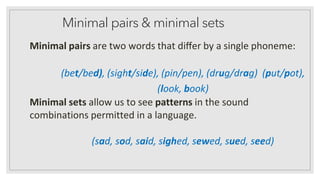
Minimal pairs are two words that differ by a single phoneme:
(bet/bed), (sight/side), (pin/pen), (drug/drag) (put/pot),
(look, book)
Minimal sets allow us to see patterns in the sound
combinations permitted in a language.
(sad, sod, said, sighed, sewed, sued, seed)
Phonotactics
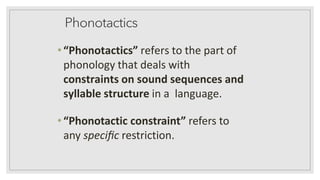
•“Phonotactics” refers to the part of
phonology that deals with
constraints on sound sequences and
syllable structure in a language.
•“Phonotactic constraint” refers to
any specific restriction.
Syllable Structure
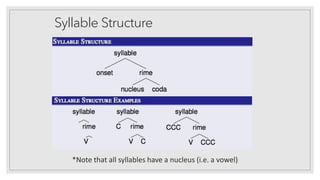
*Note that all syllables have a nucleus (i.e. a vowel)
Syllable Structure
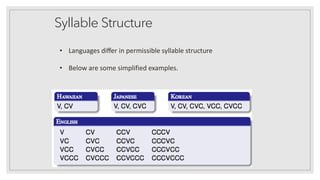
• Languages differ in permissible syllable structure
• Below are some simplified examples.
Other syllable constraints
There are further constraints on which types of consonants or vowels appear in
specific positions.
• For example, in Japanese CVC syllables, only nasals may appear on the coda
position.
There may also be dialectal variation within a language.
• For example, only some Korean speakers allow CC sequences
• Dialect A: [ilk.ta] “to read”
• Dialect B: [ik.ta] “to read”
Other syllable constraints
•Example: English disallows [ŋ] and
[ʒ] in the onset position.
•With exceptions for loanwords like
genre: /ʒɑnrə/
•English also disallows [h]
in the coda position.
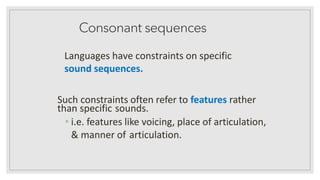
Consonant sequences
Languages have constraints on specific
sound sequences.
Such constraints often refer to features rather
than specific sounds.
• i.e. features like voicing, place of articulation,
& manner of articulation.
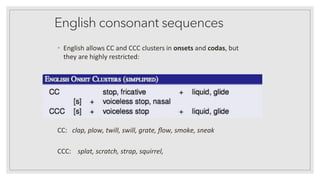
English consonant sequences
• English allows CC and CCC clusters in onsets and codas, but
they are highly restricted:
CC: clap, plow, twill, swill, grate, flow, smoke, sneak
CCC: splat, scratch, strap, squirrel,
English consonant sequences
In codas, nasals may precede voiceless stops,
but only if they share the same place of articulation.
Allowed:
jump [dʒʌmp], stunt [stʌnt], stink [stɪŋk]
*Disallowed:
*jumk [dʌmk], *stunp [stʌnp], *stingt [stɪŋt]
Constraint violations
Prohibited/disallowed sound sequences arise for various
reasons, including:
• Borrowing words from other languages tsunami
[sunami] or [tsunami]
• Putting affixes and words together sequentially. cost + s
→ *sts / often pronounced [cɑss] next store → *stst /
[nɛksstor]
Resolving constraint violations
•Delete a sound (Elision)
friendship → [frɛnʃɪp]
/ cabinet → [kæbnɪt]
Resolving constraint violations
• Delete a sound (Elision)
friendship → [frɛnʃɪp] / cabinet → [kæbnɪt]
• Insert a sound
ghosts → [goʊstəz] or [goʊstəsəz]
English Sprite → Korean [sɨ.pʱɨ.ɾa.i.tʰɨ]
Resolving constraint violations
• Delete a sound (Elision)
friendship → [frɛnʃɪp] / cabinet → [kæbnɪt]
• Insert a sound
ghosts → [goʊstəz] or [goʊstəsəz]
English Sprite → Korean [sɨ.pʱɨ.ɾa.i.tʰɨ]
• Change a sound (Assimilation)
walk /wɑk/ + --
ed /d/ → [wɑkt]
English McDonalds → Chinese [mɑt̚.don.laʊ]
Notes on foreign
accents
Because each language has its characteristic phonotactic
constraints, phonological rules, and sound inventories, it can
be challenging for speakers to pronounce (and perceive) the
phonemes and phone combination of another language.
Phonotactic constraints
• e.g. English allows syllable initial [s] + stop; Spanish does not.
Phonological rules
• e.g. English aspirates word--initialstops,SpanishandFrenchdo
not.
Notes on foreign
accents
Different sound inventories:
• e.g. French has /ʁ/, English does not.
Inability to perceive sound distinctions:
• To an English speaker, foreign vowels can be particularly tricky
to identify and produce.
• e.g. [ø] and [o] and [y] and [u] sound very similar to an English
speaker, whereas German speakers use them to distinguish
separate words.
(i.e. they are different phonemes to a German speaker)
• e.g. /ʃvyl/ (humid) and /ʃvul/ (homosexual) differ by one sound
that doesn’t exist in English.
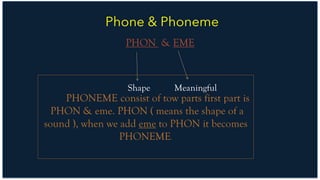
PHON & EME
Shape Meaningful
PHONEME consist of tow parts first part is
PHON & eme. PHON ( means the shape of a
sound ), when we add eme to PHON it becomes
PHONEME.
Phone & Phoneme
Timeline Lorem Ipsum
2015
Lorem ipsum dolor sit amet
2016
Lorem ipsum dolor sit amet
2017
Lorem ipsum dolor sit amet
2018
Lorem ipsum dolor sit amet
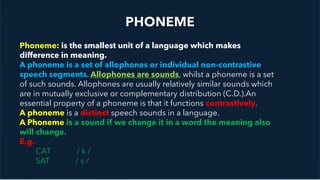
Phoneme: is the smallest unit of a language which makes
difference in meaning.
A phoneme is a set of allophones or individual non-contrastive
speech segments. Allophones are sounds, whilst a phoneme is a set
of such sounds. Allophones are usually relatively similar sounds which
are in mutually exclusive or complementary distribution (C.D.).An
essential property of a phoneme is that it functions contrastively.
A phoneme is a distinct speech sounds in a language.
A Phoneme is a sound if we change it in a word the meaning also
will change.
E.g.
CAT / k /
SAT / s /
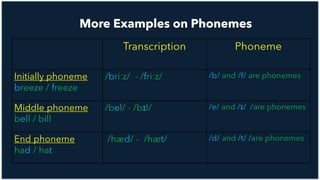
Transcription Phoneme
Initially phoneme
breeze / freeze
/briːz/ - /friːz/ /b/ and /f/ are phonemes
Middle phoneme
bell / bill
/bel/ - /bɪl/ /e/ and /ɪ/ /are phonemes
End phoneme
had / hat
/hæd/ - /hæt/ /d/ and /t/ /are phonemes
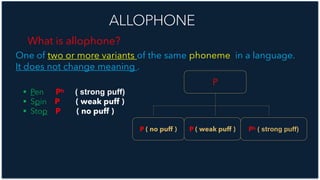
ALLOPHONE
What is allophone?
One of two or more variants of the same phoneme in a language.
It does not change meaning .
▪ Pen Pʰ ( strong puff)
▪ Spin P ( weak puff )
▪ Stop P ( no puff )
P
Pʰ ( strong puff)
P ( weak puff )
P ( no puff )
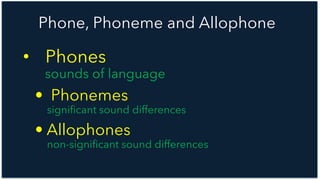
PHONEME AND ALLOPHONE
• Phones
sounds of language
• Phonemes
significant sound differences
• Allophones
non-significant sound differences
Phone, Phoneme and Allophone
Phoneme
Allophone
Phoneme
Allophone
[ ]
◦Scientific study of production,
transmission & reception of
human speech sounds
Phonetics
•Consonants
(Obstruction in the
passage of airstream)
•Vowels
(No obstruction in the
passage of airstream)
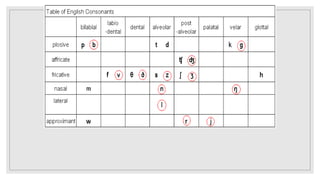
Consonant Sounds
Consonant sounds can be classified
according to three dimensions:
1. Voicing (voiceless or voiced)
2. The Place of Articulation (where
the sound is made)
3. The Manner of Articulation (how
the sound is made)
Voicing
◦ A sound is voiced if the vocal
cords vibrate.
◦ A sound is voiceless if the vocal
cords are not vibrating.
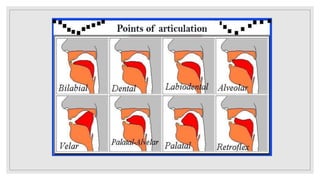
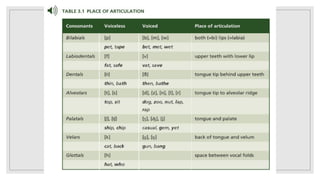
Place of Articulation
1. Bilabial- two lips touching each other
2. Labio dental- lower lip touches the upper teeth
3. Dental- tip of the tongue and the inner edge of
the upper teeth
4. Alveolar- tip of the tongue and hard palate
5. Palatal- the tongue
and hard palate
6. Velar- dorsal tongue
and soft palate
7. Glottal- throat passage
Manner of Articulation
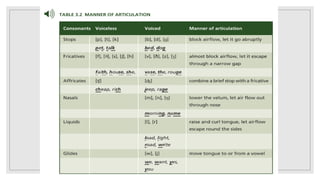
1. StopS/ploSiveS- These are the sounds
produced when the air stream is
blocked completely before it is abruptly
released.
2. FricativeS- These are the sounds
produced when the air stream is
compressed and passes through a small
opening creating friction. The sounds
3.Affricates- These are the
sounds produced when a plosive is
followed by a fricative.
4. Nasals- These are the sounds
produced when the oral cavity is
blocked, and so the air passes
through the nose.
5. lateral- Sounds are
produced when air stream moves
around the tongue in an
obstructed manner.
6. approximant- Sounds that
are close to vowel sounds.
What You Need to Know for Vowels
◦ FRONT/CENTRAL/BACK: These three refers to the position of the tongue from front to back of the mouth during
the production of the sound.
◦ HIGH/MID/LOW: This designation refers to whether the lips are rounded (O shape) or spread (no rounding) when
the sound is being made.
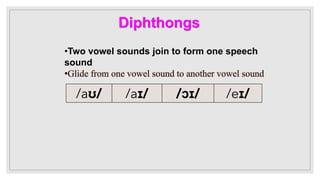
•Two vowel sounds join to form one speech
sound
/aʊ/ /aɪ/ /ɔɪ/ /eɪ/
Diphthongs
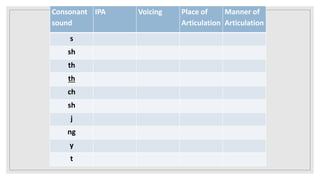
Consonant
sound
IPA Voicing Place of
Articulation
Manner of
Articulation
s
sh
th
th
ch
sh
j
ng
y
t
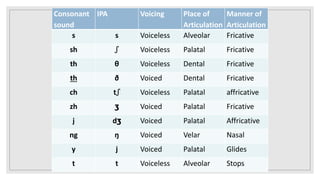
Consonant
sound
IPA Voicing Place of
Articulation
Manner of
Articulation
s s Voiceless Alveolar Fricative
sh ʃ Voiceless Palatal Fricative
th θ Voiceless Dental Fricative
th ð Voiced Dental Fricative
ch tʃ Voiceless Palatal affricative
zh ʒ Voiced Palatal Fricative
j dʒ Voiced Palatal Affricative
ng ŋ Voiced Velar Nasal
y j Voiced Palatal Glides
t t Voiceless Alveolar Stops

Phone phoneme and allophone. Explaining the concepts pdf.

  • 1.
  • 2.
    PHONETICS VS PHONOLOGY ◦Phonetics is the study of speech sounds as physical entities: ◦ How they are produced in the vocal tract, ◦ What their articulatory and acoustic properties are, ◦ How they are interpreted. ◦ Phonology is the study of ◦ how sounds are organized within a language ◦ how they interact with each other. ◦ Phonologists ask the following kinds of questions: ◦ What is the organization of sounds in a given language? ◦ Within a language, are there particular sounds whose distribution with regard to other sounds is predictable in some way? ◦ Which sounds are used in a language to distinguish between words?
  • 3.
    Phonemes are psychological soundswe use to distinguish words
  • 4.
    Phones are differentrealizations of phonemes ➢So even though each person pronounces sounds slightly differently, speakers of the same language understand because they recognize the sound patterns. ➢These different ways that phonemes are realized by speakers are called phones… ➢and the different versions of one phone are called allophones of that phoneme.
  • 5.
    Transcription • Phonemes arewritten in slanted brackets to show idealized transcriptions: /eɪtθ/ /spæt/ • Phones are written in square brackets to represent actual pronunciation: [eɪt̪θ] [spæt̚]
  • 6.
    Transcription Diacritics and othersymbols can be used to describe different allophones of a given phoneme.
  • 7.
    Transcription You can usethe symbols for other phonemes to express allophones different pronunciations… • Like for someone from the western US: [kɑt] • Or someone from the eastern US: [kɔt] • You can use diacritics to express the unreleased quality of the /t/: [kɑt̚] • Or for a British person who leaves out the (r) in (park), but lengthens the vowel [ɑ] instead: [pɑːk]
  • 8.
    Minimal pairs &minimal sets Minimal pairs are two words that differ by a single phoneme: (bet/bed), (sight/side), (pin/pen), (drug/drag) (put/pot), (look, book) Minimal sets allow us to see patterns in the sound combinations permitted in a language. (sad, sod, said, sighed, sewed, sued, seed)
  • 9.
    Phonotactics •“Phonotactics” refers tothe part of phonology that deals with constraints on sound sequences and syllable structure in a language. •“Phonotactic constraint” refers to any specific restriction.
  • 10.
    Syllable Structure *Note thatall syllables have a nucleus (i.e. a vowel)
  • 11.
    Syllable Structure • Languagesdiffer in permissible syllable structure • Below are some simplified examples.
  • 12.
    Other syllable constraints Thereare further constraints on which types of consonants or vowels appear in specific positions. • For example, in Japanese CVC syllables, only nasals may appear on the coda position. There may also be dialectal variation within a language. • For example, only some Korean speakers allow CC sequences • Dialect A: [ilk.ta] “to read” • Dialect B: [ik.ta] “to read”
  • 13.
    Other syllable constraints •Example:English disallows [ŋ] and [ʒ] in the onset position. •With exceptions for loanwords like genre: /ʒɑnrə/ •English also disallows [h] in the coda position.
  • 14.
    Consonant sequences Languages haveconstraints on specific sound sequences. Such constraints often refer to features rather than specific sounds. • i.e. features like voicing, place of articulation, & manner of articulation.
  • 15.
    English consonant sequences •English allows CC and CCC clusters in onsets and codas, but they are highly restricted: CC: clap, plow, twill, swill, grate, flow, smoke, sneak CCC: splat, scratch, strap, squirrel,
  • 16.
    English consonant sequences Incodas, nasals may precede voiceless stops, but only if they share the same place of articulation. Allowed: jump [dʒʌmp], stunt [stʌnt], stink [stɪŋk] *Disallowed: *jumk [dʌmk], *stunp [stʌnp], *stingt [stɪŋt]
  • 17.
    Constraint violations Prohibited/disallowed soundsequences arise for various reasons, including: • Borrowing words from other languages tsunami [sunami] or [tsunami] • Putting affixes and words together sequentially. cost + s → *sts / often pronounced [cɑss] next store → *stst / [nɛksstor]
  • 18.
    Resolving constraint violations •Deletea sound (Elision) friendship → [frɛnʃɪp] / cabinet → [kæbnɪt]
  • 19.
    Resolving constraint violations •Delete a sound (Elision) friendship → [frɛnʃɪp] / cabinet → [kæbnɪt] • Insert a sound ghosts → [goʊstəz] or [goʊstəsəz] English Sprite → Korean [sɨ.pʱɨ.ɾa.i.tʰɨ]
  • 20.
    Resolving constraint violations •Delete a sound (Elision) friendship → [frɛnʃɪp] / cabinet → [kæbnɪt] • Insert a sound ghosts → [goʊstəz] or [goʊstəsəz] English Sprite → Korean [sɨ.pʱɨ.ɾa.i.tʰɨ] • Change a sound (Assimilation) walk /wɑk/ + -- ed /d/ → [wɑkt] English McDonalds → Chinese [mɑt̚.don.laʊ]
  • 21.
    Notes on foreign accents Becauseeach language has its characteristic phonotactic constraints, phonological rules, and sound inventories, it can be challenging for speakers to pronounce (and perceive) the phonemes and phone combination of another language. Phonotactic constraints • e.g. English allows syllable initial [s] + stop; Spanish does not. Phonological rules • e.g. English aspirates word--initialstops,SpanishandFrenchdo not.
  • 22.
    Notes on foreign accents Differentsound inventories: • e.g. French has /ʁ/, English does not. Inability to perceive sound distinctions: • To an English speaker, foreign vowels can be particularly tricky to identify and produce. • e.g. [ø] and [o] and [y] and [u] sound very similar to an English speaker, whereas German speakers use them to distinguish separate words. (i.e. they are different phonemes to a German speaker) • e.g. /ʃvyl/ (humid) and /ʃvul/ (homosexual) differ by one sound that doesn’t exist in English.
  • 23.
    PHON & EME ShapeMeaningful PHONEME consist of tow parts first part is PHON & eme. PHON ( means the shape of a sound ), when we add eme to PHON it becomes PHONEME. Phone & Phoneme
  • 24.
    Timeline Lorem Ipsum 2015 Loremipsum dolor sit amet 2016 Lorem ipsum dolor sit amet 2017 Lorem ipsum dolor sit amet 2018 Lorem ipsum dolor sit amet Phoneme: is the smallest unit of a language which makes difference in meaning. A phoneme is a set of allophones or individual non-contrastive speech segments. Allophones are sounds, whilst a phoneme is a set of such sounds. Allophones are usually relatively similar sounds which are in mutually exclusive or complementary distribution (C.D.).An essential property of a phoneme is that it functions contrastively. A phoneme is a distinct speech sounds in a language. A Phoneme is a sound if we change it in a word the meaning also will change. E.g. CAT / k / SAT / s /
  • 25.
    Transcription Phoneme Initially phoneme breeze/ freeze /briːz/ - /friːz/ /b/ and /f/ are phonemes Middle phoneme bell / bill /bel/ - /bɪl/ /e/ and /ɪ/ /are phonemes End phoneme had / hat /hæd/ - /hæt/ /d/ and /t/ /are phonemes
  • 26.
    ALLOPHONE What is allophone? Oneof two or more variants of the same phoneme in a language. It does not change meaning . ▪ Pen Pʰ ( strong puff) ▪ Spin P ( weak puff ) ▪ Stop P ( no puff ) P Pʰ ( strong puff) P ( weak puff ) P ( no puff )
  • 27.
    PHONEME AND ALLOPHONE •Phones sounds of language • Phonemes significant sound differences • Allophones non-significant sound differences Phone, Phoneme and Allophone
  • 28.
  • 29.
  • 30.
    ◦Scientific study ofproduction, transmission & reception of human speech sounds Phonetics
  • 32.
    •Consonants (Obstruction in the passageof airstream) •Vowels (No obstruction in the passage of airstream)
  • 33.
    Consonant Sounds Consonant soundscan be classified according to three dimensions: 1. Voicing (voiceless or voiced) 2. The Place of Articulation (where the sound is made) 3. The Manner of Articulation (how the sound is made)
  • 34.
    Voicing ◦ A soundis voiced if the vocal cords vibrate. ◦ A sound is voiceless if the vocal cords are not vibrating.
  • 35.
    Place of Articulation 1.Bilabial- two lips touching each other 2. Labio dental- lower lip touches the upper teeth 3. Dental- tip of the tongue and the inner edge of the upper teeth 4. Alveolar- tip of the tongue and hard palate
  • 36.
    5. Palatal- thetongue and hard palate 6. Velar- dorsal tongue and soft palate 7. Glottal- throat passage
  • 40.
    Manner of Articulation 1.StopS/ploSiveS- These are the sounds produced when the air stream is blocked completely before it is abruptly released. 2. FricativeS- These are the sounds produced when the air stream is compressed and passes through a small opening creating friction. The sounds
  • 41.
    3.Affricates- These arethe sounds produced when a plosive is followed by a fricative. 4. Nasals- These are the sounds produced when the oral cavity is blocked, and so the air passes through the nose.
  • 42.
    5. lateral- Soundsare produced when air stream moves around the tongue in an obstructed manner. 6. approximant- Sounds that are close to vowel sounds.
  • 44.
    What You Needto Know for Vowels ◦ FRONT/CENTRAL/BACK: These three refers to the position of the tongue from front to back of the mouth during the production of the sound. ◦ HIGH/MID/LOW: This designation refers to whether the lips are rounded (O shape) or spread (no rounding) when the sound is being made.
  • 45.
    •Two vowel soundsjoin to form one speech sound /aʊ/ /aɪ/ /ɔɪ/ /eɪ/ Diphthongs
  • 46.
    Consonant sound IPA Voicing Placeof Articulation Manner of Articulation s sh th th ch sh j ng y t
  • 47.
    Consonant sound IPA Voicing Placeof Articulation Manner of Articulation s s Voiceless Alveolar Fricative sh ʃ Voiceless Palatal Fricative th θ Voiceless Dental Fricative th ð Voiced Dental Fricative ch tʃ Voiceless Palatal affricative zh ʒ Voiced Palatal Fricative j dʒ Voiced Palatal Affricative ng ŋ Voiced Velar Nasal y j Voiced Palatal Glides t t Voiceless Alveolar Stops