Phonology: The sound patterns of languageLCD 101: Introduction to Language2011 FallRyan1
ObjectivesPhonemes, phone and allophonesMinimal PairsPhonotacticsSyllables and clustersPhonological processesTo observe how the same phones are organized differently among languagesSolve Phonology problems/data sets2
What do phonologists ask?What is the organization of sounds in a given language?Of all the sounds in a language, which are predictable and which are unpredictable in particular contexts or environments?Which sounds affect the identities of words?3
IntroductionPhonetics – investigation of the physical production of speech sounds. We looked at the articulatory mechanisms of the human vocal tractIn physical terms, there are an infinite number of ways a word like “me” will be producedIndividuals pronounce a particular word differently on every occasion4
IntroductionDifferences in pronouncing a word?    bad cold, tired, angry, regional/dialectal differences, size of person, etc.Phonology helps us consistently recognize the different versions of a word, e.g. “me” as the form [mi], and not [ni], [si], [ma], [mo]5
What is Phonology?Phonetics and Phonology - both can be generally described as the study of speech soundsPhonetics – specifically the study of how speech sounds are produced, what their physical properties are, and how they’re producedPhonology – the description of the systems and patterns of speech sounds; based on a theory of what every speaker of a language unconsciously knows about the sound patterns of that language 6
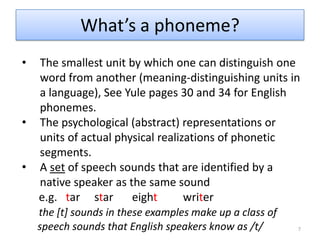
What’s a phoneme?7The smallest unit by which one can distinguish one word from another (meaning-distinguishing units in a language), See Yule pages 30 and 34 for English phonemes.
The psychological (abstract) representations or units of actual physical realizations of phonetic segments.
A set of speech sounds that are identified by a native speaker as the same sound      e.g.   tar	   star	     eightwriter the [t] sounds in these examples make up a class of       speech sounds that English speakers know as /t/
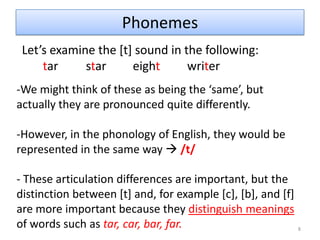
Phonemes8Let’s examine the [t] sound in the following:tar	star	     eightwriter       We might think of these as being the ‘same’, but actually they are pronounced quite differently.
However, in the phonology of English, they would be represented in the same way  /t/- These articulation differences are important, but the distinction between [t] and, for example [c], [b], and [f] are more important because they distinguish meanings of words such as tar, car, bar, far.
Phonemes9Note: Phonetics - brackets [ ] are conventionally used to indicate a phonetic/physical segment. Phonology – slashes /  / are used to indicate an abstract segmentAn essential property of phonemes: function contrastively.
e.g. In English /r/ and /m/ are phonemes because they are the only basis for contrast in words such as ‘rowing’ and ‘mowing’.
Contrastive property test: if substituting one sound for another will result in a change of meaning, then you have phonemes. Other examples?Phones and Allophones10PHONES: general term for speech soundsALLOPHONES: the different speech sounds of a phoneme  are called allophonesLet’s look at some examples of phonemes and allophones….
English Phoneme /t/11Phoneme
 Allophones of /t/12English Phoneme /p/[ph] and [p] are the allophones of the same phoneme /p/ in English:/p/ phoneme[ph][p] allophones                      ‘paper’     ‘spill’The ‘p’ in ‘paper’ is normally pronounced with aspiration. That is, there is a release of a puff of air. The ‘p’ in ‘spill’ is normally not aspirated.
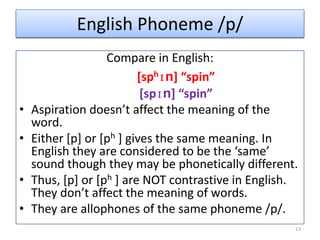
Phonemes and Allophones13English Phoneme /p/Compare in English:[sphɪn] “spin”[spɪn] “spin”Aspiration doesn’t affect the meaning of the word.
Either [p] or [ph ] gives the same meaning. In English they are considered to be the ‘same’ sound though they may be phonetically different.
Thus, [p] or [ph ] are NOT contrastive in English. They don’t affect the meaning of words.
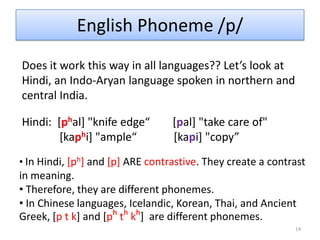
They are allophones of the same phoneme /p/. English Phoneme /p/14Does it work this way in all languages?? Let’s look at Hindi, an Indo-Aryan language spoken in northern and central India. Hindi:  [phal] "knife edge“        [pal] "take care of"  [kaphi] "ample“             [kapi] "copy”In Hindi, [ph] and [p] ARE contrastive. They create a contrast in meaning.
 Therefore, they are different phonemes.
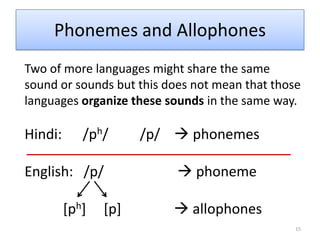
 In Chinese languages, Icelandic, Korean, Thai, and Ancient Greek, [p t k] and [pʰtʰkʰ] are different phonemes. Phonemes and Allophones15Two of more languages might share the same sound or sounds but this does not mean that those languages organize these sounds in the same way.Hindi:      /ph/         /p/     phonemesEnglish:   /p/                      phoneme           [ph]     [p]                allophones
Writing Conventions:16Allophone or Phoneme?/p/			4. [i]/æ/			5. /z/[p]			6. [th]
Detour: Aspiration in English17PHONETIC FACT: There is a burst or puff of air after the /p/ in pill, till, and kill, that is absent in spill, still, and skill.ASPIRATION: The period between the release of the closure of a consonant and the start of the vocal cord activity for the vowel that comes after it. This period is usually felt as a puff of air.		pill [phɪl] 		spill [spɪl]		till [thɪl] 		still [stɪl]		kill [khɪl] 		skill [skɪl]
Detour: Aspiration in English18Aspiration Rule in English: Aspiration occurs on all voiceless stops [p, t, k] occurring as the first sound in a stressed syllable.• Although aspirated stops and unaspirated stops are physically different , we consider both to be the same sound in English.• For English, aspiration is not employed to create a     meaning difference (unlike in Hindi, for example). The diacritic(=special mark) for aspiration in the IPA is a superscript [h]
Narrow vs. broad transcriptionNon-language Examples19Allophones – different versions of the same underlying representationThe human mind also ignores other physical/perceptible differences which are not relevant for particular purposesphoneme
Non-language Examples20Allophones – different versions of the same underlying representationThe human mind also ignores other physical/perceptible differences which are not relevant for particular purposesphoneme
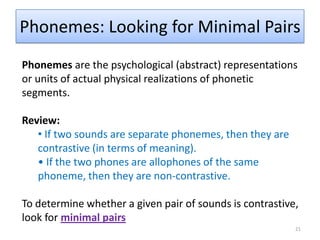
Phonemes: Looking for Minimal Pairs21Phonemes are the psychological (abstract) representations or units of actual physical realizations of phonetic segments.Review: If two sounds are separate phonemes, then they are contrastive (in terms of meaning).• If the two phones are allophones of the same phoneme, then they are non-contrastive.To determine whether a given pair of sounds is contrastive, look for minimal pairs
Minimal Pairs22A minimal pair is a pair of words that:have different meanings
  are pronounced the same except for one soundExamples:[teɪk] vs. [teɪp]        "take" vs. "tape“
[tim] vs. [dim]         "team" vs. "deem“
[kapi] vs. [kaphi]     "copy" vs. "ample" (Hindi)Minimal Pairs23Do [l] and [r] belong to the same phoneme in English?      Look for minimal pairs!	   [lif] "leaf“               [læk] "lack“             [rif] "reef“              [ræk] "rack“Since we have minimal pairs that contain [l] and [r], we can say that [l] and [r] are contrastive. Thus they are separate phonemes and are are NOT allophones of the same phoneme.  Phonemes   /l/   /r/
Minimal Pairs24Are [r] and [l] contrastive in other languages? Let’s look at Korean, a language spoken in Korea (some linguists classify it as a language isolate, others consider it an Altaic language).   Minimal pairs??      [param] "wind“                   [pal] "foot“[ irim] "name“                      [mal] "horse“
Minimal Pairs:Korean [r] and [l]25In Korean, minimal pairs can never be found for [l] and [r]; these sounds do not occur in the same position in words.
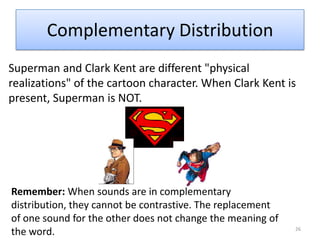
The dataset reveals that [r] occurs between two vowels but [l] occurs at the end of words.             V___V                                                _____#occurs between vowels                occurs at the end of words Thus, [l] and [r] are in complementary distribution in Korean. They are mutually exclusive. In the same context, you can never find both.Complementary Distribution26Superman and Clark Kent are different "physical realizations" of the cartoon character. When Clark Kent is present, Superman is NOT.Remember: When sounds are in complementary distribution, they cannot be contrastive. The replacement of one sound for the other does not change the meaning of the word.
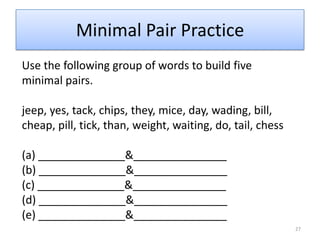
Minimal Pair Practice27Use the following group of words to build five minimal pairs.jeep, yes, tack, chips, they, mice, day, wading, bill, cheap, pill, tick, than, weight, waiting, do, tail, chess(a) ______________&_______________(b) ______________&_______________(c) ______________&_______________(d) ______________&_______________(e) ______________&_______________
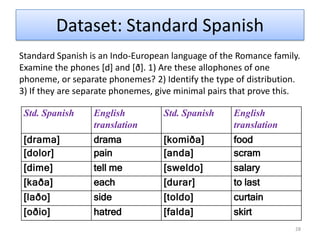
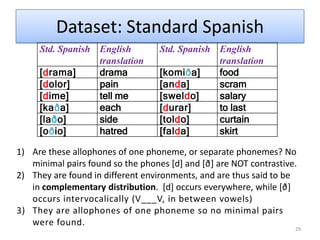
Dataset: Standard Spanish28Standard Spanish is an Indo-European language of the Romance family. Examine the phones [d] and [ð]. 1) Are these allophones of one phoneme, or separate phonemes? 2) Identify the type of distribution. 3) If they are separate phonemes, give minimal pairs that prove this.
Dataset: Standard Spanish29Are these allophones of one phoneme, or separate phonemes? No minimal pairs found so the phones [d] and [ð] are NOT contrastive.  They are found in different environments, and are thus said to be in complementary distribution.  [d] occurs everywhere, while [ð] occurs intervocalically (V___V, in between vowels)They are allophones of one phoneme so no minimal pairs were found.
Dataset: Sindhi Sindhi is an Indo-European language of the Indo-Aryan family, spoken in Pakistan and India. 30Examine the distribution of the phones [p], [ph], and [b]. 1) Determine if the three are allophones of separate phonemes, or allophones of the same phoneme. 2) What is your evidence? 3) Is the relationship between the sounds the same as in English? Why or why not? In Sandhi and English, /p/ and /b/ are separate phonemes. In English, [p ph] are allophones of the same phoneme, but in Sindi they’re phonemes.
Review: a comparison 31
Phonotactics the permitted arrangement of sounds32big, rig, fig, dig, wig, lig, vigHow do we know that ‘lig’ and ‘vig’ could be viewed as possible words in English? Our phonological knowledge of the pattern of      sounds in English wordsWhat about [tsɪg] or [tnɪg]?  These words have been formed without obeying some PHONOTACTIC constraints on the sequence or position of English phonemes.
Phonotactic constraints: restrictions on possible combinations of sounds, these constraints operate on a unit larger than the single segment/phonemeSyllable structure: 33Phonotacticssyllable            onset                 rhyme                            nucleus         coda   consonant(s)   vowel  consonant(s)Basicelements of the syllable:onset – can be empty or have one or more consonants
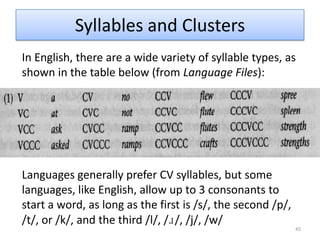
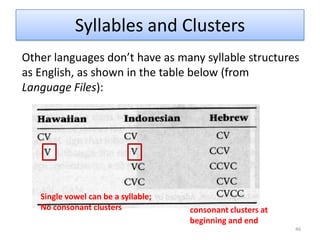
rhyme – consists of the nucleus (a vowel or vowel-like sound) and  coda (can be empty or have one or more consonantsSyllables and Clusters34What must a syllable contain?   At the minimum, A VOWEL or VOWEL-like sound           e.g. English – ‘a’, ‘I’, ‘a.bove’Symbol for syllable
Syllables and Clusters35syllableCV.CVConset           rhyme‘Ja.nice’                                      nucleus    coda             consonant(s)   vowel     consonant(s)opendʒæ     closed       n            	     ɪ         s
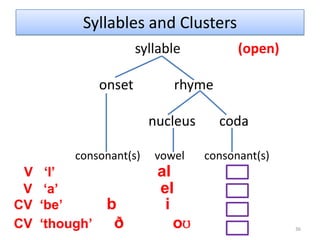
Syllables and Clusters36syllable(open)onset            rhyme                                   nucleus       coda                consonant(s)     vowel       consonant(s)  V   ‘I’                       aΙ    V   ‘a’                       eΙCV  ‘be’            b           iCV  ‘though’      ð           oʊ
Syllables and Clusters37syllable(closed)onset            rhyme                                      nucleus    coda        consonant(s)      vowel     consonant(s)‘of’                                          Ʊ                  v ‘mug’         m                  Ʌ                  g
Syllables and Clusters38σ(closed)Onset           Rhyme                        Nucleus    Coda         C       C           V              C    ConsonantClusterCCVC  ‘step’        s        t          ɛ              p
Syllables and Clusters39σ(closed)Onset           Rhyme                        Nucleus    Coda            C                 V           C    CConsonant ClusterCVCC  ‘tans’       tæ       n   s
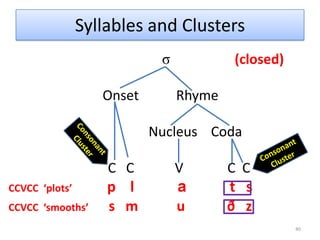
Syllables and Clusters40σ(closed)Onset           Rhyme                        Nucleus    Coda            C   C            V             C  CConsonantClusterConsonant ClusterCCVCC  ‘plots’              p    l            at   sCCVCC  ‘smooths’s   m           u            ð   z
41Syllables Additional Detail to Yulesyllable                (open)CVV‘I’,‘eye’           onset                            rhyme                                      nucleus         coda  consonant(s)          V       V       consonant(s)aI
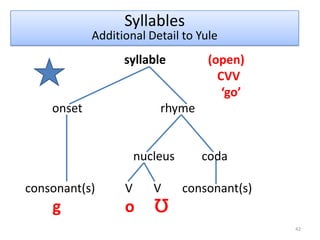
42Syllables Additional Detail to Yulesyllable              (open)CVV‘go’           onset                          rhyme                                      nucleus         coda  consonant(s)          V       V       consonant(s)         g                o     Ʊ

3 phonology slides

  • 1.
    Phonology: The soundpatterns of languageLCD 101: Introduction to Language2011 FallRyan1
  • 2.
    ObjectivesPhonemes, phone andallophonesMinimal PairsPhonotacticsSyllables and clustersPhonological processesTo observe how the same phones are organized differently among languagesSolve Phonology problems/data sets2
  • 3.
    What do phonologistsask?What is the organization of sounds in a given language?Of all the sounds in a language, which are predictable and which are unpredictable in particular contexts or environments?Which sounds affect the identities of words?3
  • 4.
    IntroductionPhonetics – investigationof the physical production of speech sounds. We looked at the articulatory mechanisms of the human vocal tractIn physical terms, there are an infinite number of ways a word like “me” will be producedIndividuals pronounce a particular word differently on every occasion4
  • 5.
    IntroductionDifferences in pronouncinga word? bad cold, tired, angry, regional/dialectal differences, size of person, etc.Phonology helps us consistently recognize the different versions of a word, e.g. “me” as the form [mi], and not [ni], [si], [ma], [mo]5
  • 6.
    What is Phonology?Phoneticsand Phonology - both can be generally described as the study of speech soundsPhonetics – specifically the study of how speech sounds are produced, what their physical properties are, and how they’re producedPhonology – the description of the systems and patterns of speech sounds; based on a theory of what every speaker of a language unconsciously knows about the sound patterns of that language 6
  • 7.
    What’s a phoneme?7Thesmallest unit by which one can distinguish one word from another (meaning-distinguishing units in a language), See Yule pages 30 and 34 for English phonemes.
  • 8.
    The psychological (abstract)representations or units of actual physical realizations of phonetic segments.
  • 9.
    A set ofspeech sounds that are identified by a native speaker as the same sound e.g. tar star eightwriter the [t] sounds in these examples make up a class of speech sounds that English speakers know as /t/
  • 10.
    Phonemes8Let’s examine the[t] sound in the following:tar star eightwriter We might think of these as being the ‘same’, but actually they are pronounced quite differently.
  • 11.
    However, in thephonology of English, they would be represented in the same way  /t/- These articulation differences are important, but the distinction between [t] and, for example [c], [b], and [f] are more important because they distinguish meanings of words such as tar, car, bar, far.
  • 12.
    Phonemes9Note: Phonetics -brackets [ ] are conventionally used to indicate a phonetic/physical segment. Phonology – slashes / / are used to indicate an abstract segmentAn essential property of phonemes: function contrastively.
  • 13.
    e.g. In English/r/ and /m/ are phonemes because they are the only basis for contrast in words such as ‘rowing’ and ‘mowing’.
  • 14.
    Contrastive property test:if substituting one sound for another will result in a change of meaning, then you have phonemes. Other examples?Phones and Allophones10PHONES: general term for speech soundsALLOPHONES: the different speech sounds of a phoneme are called allophonesLet’s look at some examples of phonemes and allophones….
  • 15.
  • 16.
    Allophones of/t/12English Phoneme /p/[ph] and [p] are the allophones of the same phoneme /p/ in English:/p/ phoneme[ph][p] allophones ‘paper’ ‘spill’The ‘p’ in ‘paper’ is normally pronounced with aspiration. That is, there is a release of a puff of air. The ‘p’ in ‘spill’ is normally not aspirated.
  • 17.
    Phonemes and Allophones13EnglishPhoneme /p/Compare in English:[sphɪn] “spin”[spɪn] “spin”Aspiration doesn’t affect the meaning of the word.
  • 18.
    Either [p] or[ph ] gives the same meaning. In English they are considered to be the ‘same’ sound though they may be phonetically different.
  • 19.
    Thus, [p] or[ph ] are NOT contrastive in English. They don’t affect the meaning of words.
  • 20.
    They are allophonesof the same phoneme /p/. English Phoneme /p/14Does it work this way in all languages?? Let’s look at Hindi, an Indo-Aryan language spoken in northern and central India. Hindi: [phal] "knife edge“ [pal] "take care of" [kaphi] "ample“ [kapi] "copy”In Hindi, [ph] and [p] ARE contrastive. They create a contrast in meaning.
  • 21.
    Therefore, theyare different phonemes.
  • 22.
    In Chineselanguages, Icelandic, Korean, Thai, and Ancient Greek, [p t k] and [pʰtʰkʰ] are different phonemes. Phonemes and Allophones15Two of more languages might share the same sound or sounds but this does not mean that those languages organize these sounds in the same way.Hindi: /ph/ /p/  phonemesEnglish: /p/  phoneme [ph] [p]  allophones
  • 23.
    Writing Conventions:16Allophone orPhoneme?/p/ 4. [i]/æ/ 5. /z/[p] 6. [th]
  • 24.
    Detour: Aspiration inEnglish17PHONETIC FACT: There is a burst or puff of air after the /p/ in pill, till, and kill, that is absent in spill, still, and skill.ASPIRATION: The period between the release of the closure of a consonant and the start of the vocal cord activity for the vowel that comes after it. This period is usually felt as a puff of air. pill [phɪl] spill [spɪl] till [thɪl] still [stɪl] kill [khɪl] skill [skɪl]
  • 25.
    Detour: Aspiration inEnglish18Aspiration Rule in English: Aspiration occurs on all voiceless stops [p, t, k] occurring as the first sound in a stressed syllable.• Although aspirated stops and unaspirated stops are physically different , we consider both to be the same sound in English.• For English, aspiration is not employed to create a meaning difference (unlike in Hindi, for example). The diacritic(=special mark) for aspiration in the IPA is a superscript [h]
  • 26.
    Narrow vs. broadtranscriptionNon-language Examples19Allophones – different versions of the same underlying representationThe human mind also ignores other physical/perceptible differences which are not relevant for particular purposesphoneme
  • 27.
    Non-language Examples20Allophones –different versions of the same underlying representationThe human mind also ignores other physical/perceptible differences which are not relevant for particular purposesphoneme
  • 28.
    Phonemes: Looking forMinimal Pairs21Phonemes are the psychological (abstract) representations or units of actual physical realizations of phonetic segments.Review: If two sounds are separate phonemes, then they are contrastive (in terms of meaning).• If the two phones are allophones of the same phoneme, then they are non-contrastive.To determine whether a given pair of sounds is contrastive, look for minimal pairs
  • 29.
    Minimal Pairs22A minimalpair is a pair of words that:have different meanings
  • 30.
    arepronounced the same except for one soundExamples:[teɪk] vs. [teɪp] "take" vs. "tape“
  • 31.
    [tim] vs. [dim] "team" vs. "deem“
  • 32.
    [kapi] vs. [kaphi] "copy" vs. "ample" (Hindi)Minimal Pairs23Do [l] and [r] belong to the same phoneme in English? Look for minimal pairs! [lif] "leaf“ [læk] "lack“ [rif] "reef“ [ræk] "rack“Since we have minimal pairs that contain [l] and [r], we can say that [l] and [r] are contrastive. Thus they are separate phonemes and are are NOT allophones of the same phoneme. Phonemes  /l/ /r/
  • 33.
    Minimal Pairs24Are [r]and [l] contrastive in other languages? Let’s look at Korean, a language spoken in Korea (some linguists classify it as a language isolate, others consider it an Altaic language). Minimal pairs?? [param] "wind“ [pal] "foot“[ irim] "name“ [mal] "horse“
  • 34.
    Minimal Pairs:Korean [r]and [l]25In Korean, minimal pairs can never be found for [l] and [r]; these sounds do not occur in the same position in words.
  • 35.
    The dataset revealsthat [r] occurs between two vowels but [l] occurs at the end of words. V___V _____#occurs between vowels occurs at the end of words Thus, [l] and [r] are in complementary distribution in Korean. They are mutually exclusive. In the same context, you can never find both.Complementary Distribution26Superman and Clark Kent are different "physical realizations" of the cartoon character. When Clark Kent is present, Superman is NOT.Remember: When sounds are in complementary distribution, they cannot be contrastive. The replacement of one sound for the other does not change the meaning of the word.
  • 36.
    Minimal Pair Practice27Usethe following group of words to build five minimal pairs.jeep, yes, tack, chips, they, mice, day, wading, bill, cheap, pill, tick, than, weight, waiting, do, tail, chess(a) ______________&_______________(b) ______________&_______________(c) ______________&_______________(d) ______________&_______________(e) ______________&_______________
  • 37.
    Dataset: Standard Spanish28StandardSpanish is an Indo-European language of the Romance family. Examine the phones [d] and [ð]. 1) Are these allophones of one phoneme, or separate phonemes? 2) Identify the type of distribution. 3) If they are separate phonemes, give minimal pairs that prove this.
  • 38.
    Dataset: Standard Spanish29Arethese allophones of one phoneme, or separate phonemes? No minimal pairs found so the phones [d] and [ð] are NOT contrastive. They are found in different environments, and are thus said to be in complementary distribution. [d] occurs everywhere, while [ð] occurs intervocalically (V___V, in between vowels)They are allophones of one phoneme so no minimal pairs were found.
  • 39.
    Dataset: Sindhi Sindhiis an Indo-European language of the Indo-Aryan family, spoken in Pakistan and India. 30Examine the distribution of the phones [p], [ph], and [b]. 1) Determine if the three are allophones of separate phonemes, or allophones of the same phoneme. 2) What is your evidence? 3) Is the relationship between the sounds the same as in English? Why or why not? In Sandhi and English, /p/ and /b/ are separate phonemes. In English, [p ph] are allophones of the same phoneme, but in Sindi they’re phonemes.
  • 40.
  • 41.
    Phonotactics the permittedarrangement of sounds32big, rig, fig, dig, wig, lig, vigHow do we know that ‘lig’ and ‘vig’ could be viewed as possible words in English? Our phonological knowledge of the pattern of sounds in English wordsWhat about [tsɪg] or [tnɪg]? These words have been formed without obeying some PHONOTACTIC constraints on the sequence or position of English phonemes.
  • 42.
    Phonotactic constraints: restrictionson possible combinations of sounds, these constraints operate on a unit larger than the single segment/phonemeSyllable structure: 33Phonotacticssyllable onset rhyme nucleus coda consonant(s) vowel consonant(s)Basicelements of the syllable:onset – can be empty or have one or more consonants
  • 43.
    rhyme – consistsof the nucleus (a vowel or vowel-like sound) and coda (can be empty or have one or more consonantsSyllables and Clusters34What must a syllable contain? At the minimum, A VOWEL or VOWEL-like sound e.g. English – ‘a’, ‘I’, ‘a.bove’Symbol for syllable
  • 44.
    Syllables and Clusters35syllableCV.CVConset rhyme‘Ja.nice’ nucleus coda consonant(s) vowel consonant(s)opendʒæ closed n ɪ s
  • 45.
    Syllables and Clusters36syllable(open)onset rhyme nucleus coda consonant(s) vowel consonant(s) V ‘I’ aΙ V ‘a’ eΙCV ‘be’ b iCV ‘though’ ð oʊ
  • 46.
    Syllables and Clusters37syllable(closed)onset rhyme nucleus coda consonant(s) vowel consonant(s)‘of’ Ʊ v ‘mug’ m Ʌ g
  • 47.
    Syllables and Clusters38σ(closed)Onset Rhyme Nucleus Coda C C V C ConsonantClusterCCVC ‘step’ s t ɛ p
  • 48.
    Syllables and Clusters39σ(closed)Onset Rhyme Nucleus Coda C V C CConsonant ClusterCVCC ‘tans’ tæ n s
  • 49.
    Syllables and Clusters40σ(closed)Onset Rhyme Nucleus Coda C C V C CConsonantClusterConsonant ClusterCCVCC ‘plots’ p l at sCCVCC ‘smooths’s m u ð z
  • 50.
    41Syllables Additional Detailto Yulesyllable (open)CVV‘I’,‘eye’ onset rhyme nucleus coda consonant(s) V V consonant(s)aI
  • 51.
    42Syllables Additional Detailto Yulesyllable (open)CVV‘go’ onset rhyme nucleus coda consonant(s) V V consonant(s) g o Ʊ