English consonants Work in the same group Scan chapters 4 & 6 again Discuss the answers to the following questions
English consonants Define the following terms: manners of articulation  plosives initial, medial and final positions of a plosive aspiration fortis vs lenis fricatives affricates homorganic
English consonants What are the three properties used for describing a consonant? How is a plosive produced? What are the English plosives? How does aspiration take place? And when? What are the English fricatives? What are the English affricates?
English consonants Manners of articulation: the particular way the airstream is obstructed Plosives Affricates  Fricatives Nasals Approximants (central, lateral)
English consonants Plosives: Oral stops The air is stopped completely in the oral cavity for a brief period Then it explodes with the release of the closure, producing loud-enough noise to be heard English plosives:   Bilabials:  p, b Alveolars:  t, d Velars:  k, g
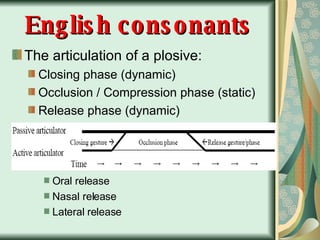
English consonants The articulation of a plosive: Closing phase (dynamic) Occlusion / Compression phase (static) Release phase (dynamic) Oral release Nasal release Lateral release
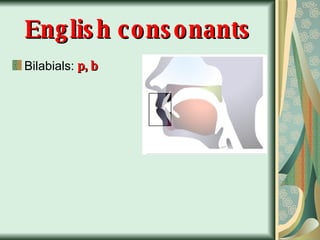
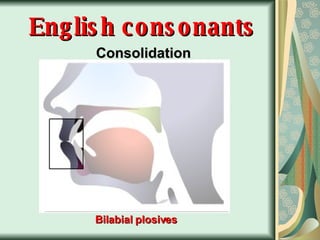
English consonants Bilabials:  p, b
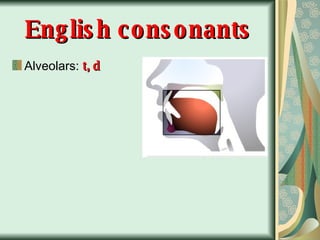
English consonants Alveolars:  t, d
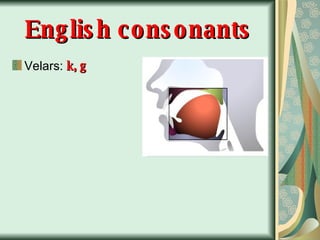
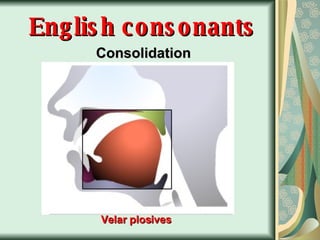
English consonants Velars:  k, g
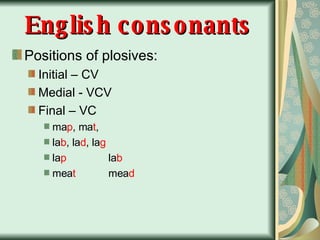
English consonants Positions of plosives: Initial – CV Medial - VCV Final - VC
English consonants Initial – CV Voiced plosives: released with weak plosion  Voiceless plosives: released with audible plosion     aspiration
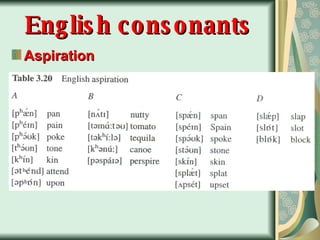
English consonants Aspiration The phenomenon in which a small “puff of air” escapes through the vocal folds after the release phase. Transcribed as [  C h   ]
English consonants Aspiration
English consonants Aspiration rule: Voiceless stops become aspirated when they occur syllable initially before stressed vowels (in a stressed syllable).     /  C  / Examples: pot spot repeat compass top stop attack contour kid skid akin condemn [  C h  ] / $  _  V  [+stress] [  C  ] / elsewhere [-voiced] [+stop]
English consonants Positions of plosives: Initial – CV: scarcely voiced Medial - VCV Final – VC: scarcely voiced
English consonants Positions of plosives: Initial – CV Medial - VCV Final – VC ma p , ma t ,  la b , la d , la g la p la b mea t mea d
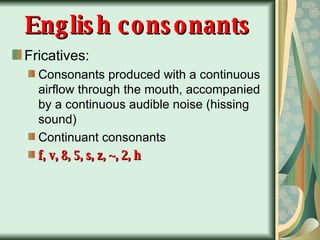
English consonants Fricatives: Consonants produced with a continuous airflow through the mouth, accompanied by a continuous audible noise (hissing sound) Continuant consonants f, v, 8, 5, s, z, ~, 2, h
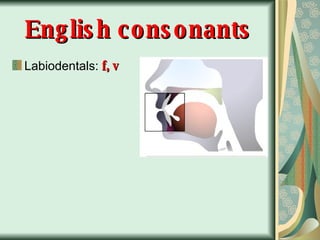
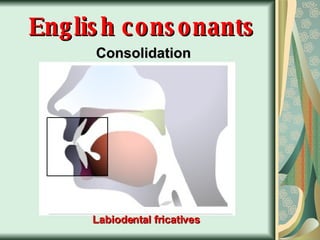
English consonants Labiodentals:  f, v
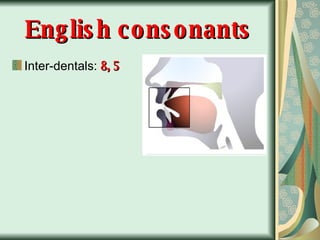
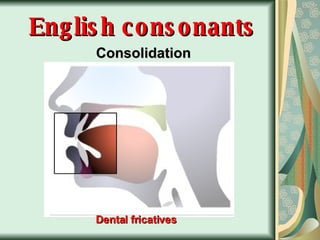
English consonants Inter-dentals:  8, 5
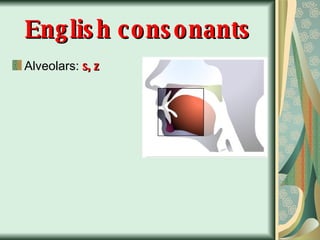
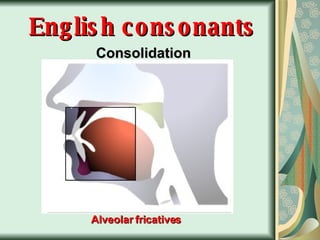
English consonants Alveolars:  s, z
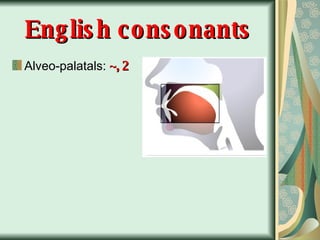
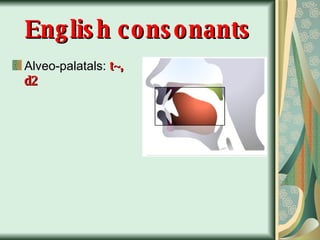
English consonants Alveo-palatals:  ~, 2
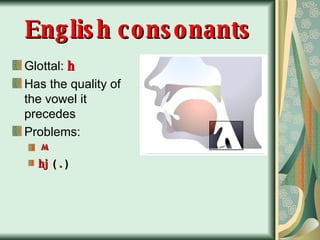
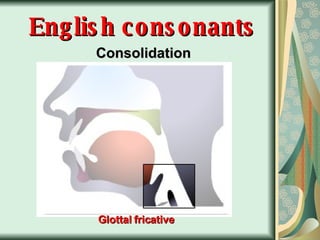
English consonants Glottal:  h Has the quality of the vowel it precedes Problems: hj  (  .  ) w
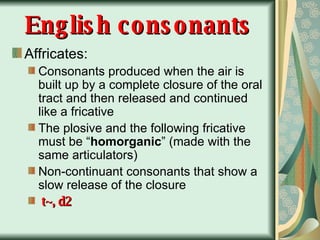
English consonants Affricates: Consonants produced when the air is built up by a complete closure of the oral tract and then released and continued like a fricative The plosive and the following fricative must be “ homorganic ” (made with the same articulators) Non-continuant consonants that show a slow release of the closure t~, d2
English consonants Alveo-palatals:  t~, d2
English consonants Fortis consonants Produced with more force Usually thought of as voiceless p, t, k, s, f, ~, t~ Lenis consonants Produced with less force Usually thought of as voiced b, d, g, v, z, 2, d2
English consonants Fortis consonants Syllable – final:    shortening a preceding vowel or   l, m, n, 7 mop mob rich ridge Syllable – initial:    devoicing a following approximant ( l, r, w, j ) play lay tray ray quick wick
English consonants Consolidation Alveolar plosives
English consonants Consolidation Dental fricatives
English consonants Consolidation Bilabial plosives
English consonants Consolidation Alveolar fricatives
English consonants Consolidation Affricates
English consonants Consolidation Labiodental fricatives
English consonants Consolidation Glottal fricative
English consonants Consolidation Velar plosives
English consonants Consolidation Alveo-palatal fricatives
Preparation for next class Review: Plosives Fricatives Affricates  Aspiration Shortening of vowels before a fortis consonant Devoicing of approximants after a fortis consonant Read  Chapter 5 Chapter 7

C6 English Consonants