





Psychologist and M.B.A.
(Human Resource Development)
Pharmacist & M.B.A
( Marketing )
Topic:
Understanding Anxiety And
Depression Disorders
 Feeling anxious about how to finish large
course within stipulated time?
 You may welcome this anxiety, at least to
a certain extent.
 It would help you learn quickly and to get
good marks.
 Anxiety is, indeed, a common reaction to
stress.
 It saves us from being careless and
hence from accidental disasters.
 Unless you have anxiety about your examination, you
would not study.
 Unless the mother has anxiety over her baby’s health
she might forget to care for the infant.
 Unless you have anxiety you would step over the
snake and get bitten.
 But anxiety turns into a disorder when you are so
anxious that you have a breakdown at the examination
hall, forgetting everything.
 Anxiety is a disorder when the mother is so anxious
that her baby may fall ill that she spends the day and
night praying to God, and ultimately fails to feed the
baby.
 Anxiety is a disorder when you faint if somebody
names a snake.
 Anxiety disorder is a group of disorders each of
which need special attention and
understanding.
 You know that in classifying disorders, we
usually follow either the Diagnostic and
statistical Manual, Version IV TR (DSM IV TR)
 or International Classification of Diseases,
Version 10 (ICD 10).
 Panic disorder with or without
agoraphobia
 Phobic disorders of the specific or social
type
 Generalized anxiety disorder
 Obsessive compulsive disorder
 Post traumatic stress disorder
 Anxiety Disorder is a blanket term that covers a
number of disorders.
 In this context, you must be aware of the difference
between fear and anxiety.
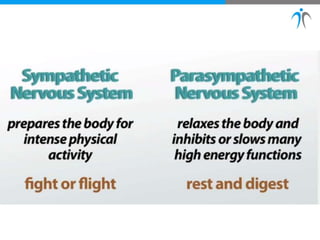
 Fear is a basic emotion of human beings. It is
associated with the perception of a real threatening
situation and involves the ‘fight or flight’ response
activated by the sympathetic nervous system.
 If a thug attacks you in the street, you would feel
intense fear.
 Then, you would either run for dear life, or hit him back.
 Thus fear involves cognition of the threatening object,
subjective cognition of being in danger, physiological
components like increased heart rate, and behavioural
components like running or hitting.
 Physiological changes and some kind of
behavioural reaction.
 But unlike fear, it has no immediate threat.
 If you cannot go out of your home because you
are always apprehending an attack from a thug
(hoodlum), it is anxiety.
 You are projecting the threatening situation in
future and reacting to it as if it is imminent.
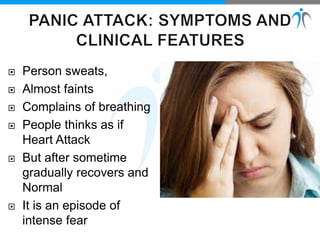
 Person sweats,
 Almost faints
 Complains of breathing
 People thinks as if
Heart Attack
 But after sometime
gradually recovers and
Normal
 It is an episode of
intense fear
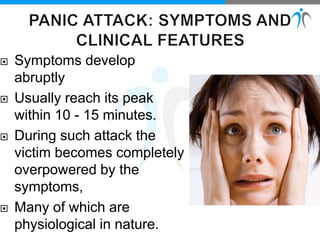
 Symptoms develop
abruptly
 Usually reach its peak
within 10 - 15 minutes.
 During such attack the
victim becomes completely
overpowered by the
symptoms,
 Many of which are
physiological in nature.
 The DSM IV TR mandates that a person would be
diagnosed as suffering from panic disorder if she
had
 Anxity Disorders, Panic and Phobias
 Generalised Anxiety Disorder and Other Mild
Mental Disorders
 experienced recurrent unexpected attacks
 is persistently concerned with having another
attack.
 This condition must go on for at least one month.
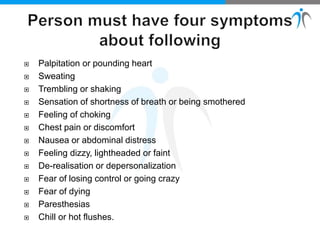
 Palpitation or pounding heart
 Sweating
 Trembling or shaking
 Sensation of shortness of breath or being smothered
 Feeling of choking
 Chest pain or discomfort
 Nausea or abdominal distress
 Feeling dizzy, lightheaded or faint
 De-realisation or depersonalization
 Fear of losing control or going crazy
 Fear of dying
 Paresthesias
 Chill or hot flushes.
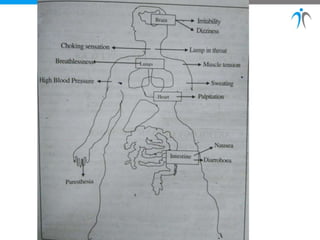
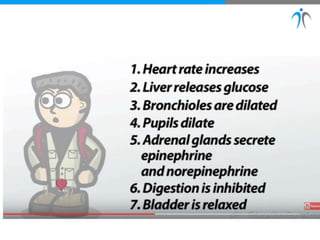
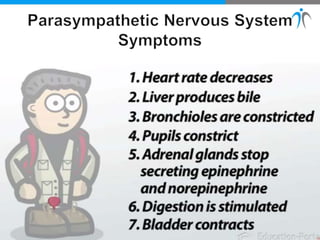
The reactions are
usually those associated
with activation of
sympathetic nervous
system.
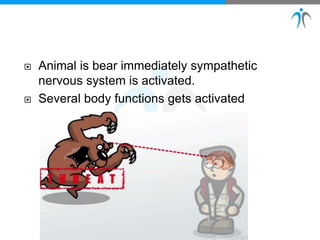
 Animal is bear immediately sympathetic
nervous system is activated.
 Several body functions gets activated
 The Greek word ‘agora’ which means public
places or assembly of people.
 Panic attacks can be with or without
agoraphobia.
 Typically, panic attacks with agoraphobia seem
to be precipitated by attending a cinema hall, a
shopping mall, a cue for tickets, tunnels, trains
and aircrafts or so on, where a large number of
people congregate
 And escape in case of a panic attack may be
difficult.
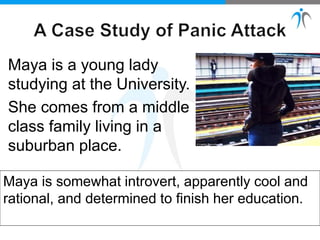
Maya is a young lady
studying at the University.
She comes from a middle
class family living in a
suburban place.
Maya is somewhat introvert, apparently cool and
rational, and determined to finish her education.
 She regularly takes the underground
Metro rail to come to the University.
 One day while waiting for the train, she
had some kind of physical discomfort.
 However, she ignored it and boarded the
train.
 The train was moderately crowded and
she did not get a seat.
 She stood in front of the seat reserved for
ladies.
 A few minutes later, she felt choked and
nauseated, started sweating profusely
 and her discomfort was so strong that she
asked the elderly lady sitting in front of her for
help.
 This lady immediately offered her a seat and
asked her what her problem was.
 By that time, Maya was trembling and had
started crying. “I am going to die” – she cried.
 Other passengers came forward to help, gave
her water to drink, and at the next station they
took Maya out of the train and contacted the
authority
 Maya was taken to a hospital and her father
was informed.
 By the time her father arrived, Maya had been
feeling much better.
 The doctors had found a rapid pulse rate, but
did not get anything indicating cardiac problem.
 Maya had retrospectively reported extreme fear
of being choked to death, especially as she
was in an underground train and could not
jump out and run for the sunlight up on the
streets.
 The word ‘Phobia’ derives from the name of the
Greek god ‘Phobos’ who used to frighten his
enemies.
 A phobia is an intense and irrational fear of
some object, living being or situation.
 Do you get notably disturbed if a cockroach
flies around and falls on your body?
 Of course nobody would love to touch a
cockroach, but some people get completely
panicky at the thought of touching it.
 Depending upon how severe it is, this may be a
phobic reaction.
 One must have a persistent and
disproportionate fear of some specific object,
social situation or crowded place that actually
carries little danger.
 Exposure to the phobic stimulus almost
invariably produces intense anxiety response.
 The patient usually knows that the fear is
unreasonable, but she has no control on the
reaction.
 The phobic situation is usually avoided, or if
forced to endured, may be tolerated with great
discomfort.
 When forced to encounter the phobic stimulus, the
reactions may be like panic attack, or a little less
severe than it.
 The attention of the person facing the phobic
object is directed completely toward it, the affect is
intense fear and the behavioural reaction is
escape.
 As soon as the person can escape from the
presence of the phobic stimulus, the negative
affect and accompanying physiological reactions
subside.
 Thus the flight reaction is reinforced as it provided
relief from tension.
 Specific Phobia,
 Social Phobia and
 Agoraphobia.
 They are the irrational fear of specific objects,
animals or situations.
 Some typical examples are:
 Fear of closed space or claustrophobia,
 Fear of heights or acrophobia,
 Fear of blood or haemophobia,
 Fear of snake or Ophidiophobia,
 Fear of spider or arachnophobia,
 Fear of fire or pyrophobia
 Fear of phobias or phobophobia.
 Animal type - cued by animals or insects
 Natural environment type - cued by objects in the
environment, such as storms, heights, or water
 Blood-injection-injury type - cued by witnessing
some invasive medical procedure
 Situational type - cued by a specific situation, such
as public transportation, tunnels, bridges,
elevators, flying, driving, or enclosed spaces
 Other type - cued by other stimuli than the above,
such as of choking, vomiting, or contracting an
illness.
 Social phobias, as you may guess from its name, are persistent
irrational fear associated with presence of other people.
 Remember how we sometimes get tongue tied at the interview
boards?
 Social phobia is an extreme form of this kind of discomfort.
 Often extreme feelings of shyness and self-consciousness build
into a powerful fear, so that it becomes difficult to participate in
everyday social situations.
 People with social phobia can usually interact easily with close
and familiar persons.
 But meeting new people, talking in a group, or speaking in public
can trigger the phobic reaction.
 Often situations where one might be evaluated become the phobic
situation.
 All of us may have occasional social anxieties, especially under
judgmental situation.
 But a person with diagnosable social phobia often becomes
incapable of normal social interaction.
 You have already read about Agoraphobia in
connection with panic disorder.
 You know that it refers to the fear of public spaces
where many people congregate.
 Agoraphobia without history of panic disorder has been
given a special emphasis in DSM IV – TR.
 It develops slowly and insidiously from early
adolescence or late childhood, and gradually becomes
debilitating.
 If it is a part of the panic attack, it should be coded
within Panic disorders.
 If it occurs as a source of anxiety and a strong urge to
avoid, but does not constitute a palpable panic attack, it
should be coded within Phobia.
 Kalu, now about 24, comes from a lower class family of
fishermen.
 They earn their livelihood by fishing in shallow
backwater or rivulets streaming from big rivers.
 He had studied up to class IV in the local school, and
then left it due to poverty.
 As a child, he used to accompany his father to the
backwaters, especially where they cultivated prawns.
 Very occasionally crocodiles swim in from the big river
with which the backwater may be connected, and there
has been tales about crocodiles killing men around the
village.
 Everybody had heard these tales, but since the
appearance of crocodiles is quite rare, everybody
works in knee deep water without much anxiety.
 From early adolescence onward, Kalu gradually
became afraid of crocodiles, which then turned into
specific phobia.
 He was unable to work in the water, because if he
sees any shadow, even of underwater plants and
fish, he suffers from uncontrollable fear.
 Since Kalu’s family has no land to cultivate, and
Kalu hardly has any other skill, not being able to
work in water has practically made him a
nonearning member of the poor family.
 Kalu understands that his fear is irrational, and
never in his life time has he heard of a crocodile
actually attacking a man in their locality.
 He understands that he is becoming a burden on
his family; but he cannot overcome the intense
fear.
 While he attributes the fear to the stories he had
listened to in childhood, he knows that these are
not enough to provoke such strong reactions.
 You must have come across
some persons around you who
are known as nervous and shaky
in general.
 They seem to be very anxious
over every single step in life.
 Would I be able to go to office in time?
 Is my dress suitable for my job?
 Am I capable of what I am supposed to do?
 Will the boss be angry over me?
 Would my children come back from school
safely?
 What if my wife forgets to put off the gas
cylinder and have a terrible accident?
 Is it possible that I am robbed of my belongings
on my way back home?
 In some of such persons the anxiety becomes
so severe that their everyday functioning may
be impaired.
 In some persons there is an unnatural concern
for doing certain things in a right way.
 Am I clean enough?
 Did I lock the door properly?
 Could it so happen that I might actually choke
my baby girl to death while playing with her?
 Such doubts and over concern with
unnecessary and at times bizarre issues
constitute another category of anxiety
disorders.
 It is an over generalised anxiety
over many things.
 GAD is characterised by
excessive and irrational anxiety
over minor things
It is persistent excessive
anxiety and worries which
the person finds difficult to
control.
 Restlessness or feeling keyed up
 Being easily fatigued
 Difficulty in concentrating
 Irritability
 Muscle tension
 Sleep disturbance
At least 3 must be present to be
diagnosed as GAD
 The anxiety does not seem to be bound to one or few
specific issues.
 The person typically is terrified of different possible
mishaps.
 If you convince the person of the irrationality of one
issue, or if, in the course of natural affairs, one issue is
resolved, the person takes up a second and a third
issue and focuses on them.
 Concentration to anything for a given period of time
becomes extremely difficult, as some or other point of
anxiety always comes up.
 Like sweating, flushing, palpitation, upset
stomach, lump in throat, frequent urination,
rapid breathing, twitches and tics are common.
 The person becomes uneasy, irritable and
easily fatigued.
 Often vivid imageries of the disaster
accompany the restlessness.
 Impatience, anger outbursts and insomnia are
common.
 Many persons with GAD lead their life more or less
normally without consulting any doctor.
 They have some functional impairment and
difficulties within the family;
 but the problems may be somewhat manageable
with some support from the close ones.
 For about one third cases, spontaneous recovery
takes place at some point in life.
 For others the problem is severe enough to seek
medical consultation,
 although the chief complaint is often presented as
somatic problems or insomnia.
 Fatema, now a housewife of 35 years of age,
had always been nervous since her childhood.
 During her school days, she had been anxious
for her studies and examinations.
 She was also extremely upset if any of her
friends talked ill about her or the teachers
scolded her.
 At home she became greatly worried if her
father came home later than usual.
 She apprehended some accident.
 She was admitted to college, but did not finish
her graduation.
 She married at the age of 22.
 Her husband had a small business in the town.
 Fatema was from the very beginning
apprehensive about the possible failure of her
husband’s business and worried over any
temporary loss that occurred.
 Initially her husband was glad to see her
worried, as he interpreted it as her attachment
to him.
 Gradually he became irritated at the constant
worry and negative predictions she had.
 He tried to convince her that every business
has its own ups and downs,
 and there is nothing to be worried about.
 The effort was of little effect.
 At the age of 26 Fatema gave birth to a girl,
and after four years to a boy.
 During pregnancy she was extremely fearful
that the pregnancy would go wrong and some
damage might occur to her unborn child
 Fatema’s family consulted some ‘pirbaba’ (local
saint) who gave her some pious water
 and assured her that everything would be alright,
and she was consoled a bit.
 Now her daughter being in puberty,
 Fatema is extremely worried that some harm might
happen to her,
 and remains anxious till the girl comes back home
from school.
 Fatema fears that she might be assaulted on her
way back home.
 Fatema’s son is also growing up
 Fatema is worried that he might hurt himself
during play.
 She reports bad dreams and apprehends that
these might come true.
 She restricts her son’s movement causing lots
of argument and dissatisfaction within the
family.
 However, she becomes so anxious
 and starts crying instead of rationally justifying
her stand that her husband and children
ultimately compromise with her demands.
 Fatema remained happy and relaxed for a
negligible period of her life, always
apprehending that some danger might happe
to her and her loved ones.
 She is a frequent visitor to the ‘pirbaba’, and
remains temporarily calm only after he had
blessed her for a safe life.
 You must be acquainted with the
word obsessive and compulsive –
 These two terms have actually been
part of everyday language.
 Obsession in everyday usage means
being engrossed in specific thoughts
 You speak of being obsessed with your looks,
 Your daughter’s studies,
 Your girlfriend’s whereabouts while she is away
from you.
 You also talk of being obsessed with a
particular art form,
 of guns and rifles,
 of cars,
 of stamps from different countries.
 Compulsion means you are forced or
compelled to do something.
 In ordinary language we may use it
 To be forced from outside (compelled
by my parents)
 Or from inside (compelled by my
conscience).
 So long you are happy and in control of these
thoughts
 so long these are not disturbing despite your
earnest effort to ward them away
 They are simply fancy words and not
components of a disorder.
 Disturbing thoughts, images and impulses
often of a negative or unacceptable kind,
 despite one’s desire to get rid of it.
 Compulsion means being compelled from
within to perform certain ritualistic acts,
because otherwise you are afraid of some
danger befalling you.
 Obsessions are recurrent and persistent
thoughts, impulses or images that are
experienced as intrusive (disturbing) and
generate considerable anxiety.
 These thoughts do not concern real life
problems at the moment, and are often
irrelevant to present reality.
 The person has insight and tries to remove
these thoughts, but often cannot succeed.
 You may find unusual fear of contamination,
 Fear of harming oneself or one’s own loved ones,
 Religious themes,
 Themes of sexuality specially the unacceptable
forms,
 Wishing ill for others
 For example wishing one’s mother dead
 Doubt about whether one has accomplished things
properly.
 The person does not want to think of these, and
 when particularly aggressive and Sexual thoughts
predominate, considers herself ‘bad’.
 Yet the thoughts continue to haunt her/ him
 Like washing or checking or mental acts like
counting or praying in response to an
obsessive thought.
 Compulsions are to be done following rigid
rules to prevent or reduce the impact of some
dreaded thing or action
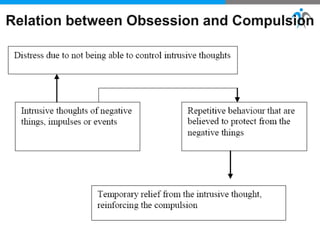
 After a compulsion is performed the person
temporarily feels relieved, but again succumbs
to the same cycle.
 Cleaning - repeated washing
 Checking - repeatedly coming back to home to
check if the door has been locked properly
 Counting - counting the number of steps one
takes before getting on the bed
 Repeating - coming back to the first word of the
line as one is not sure if she has read it properly
 Hoarding - collecting things and not being able to
organize of these things
 Ordering - arranging books on the table in a
particular order each time one leaves the table
 There may be cases where only obsession or
compulsion predominates.
 The obsessions and compulsions take plenty of
time from one’s daily routine and
 slow down the entire life process.
 For some, rituals take the whole day resulting in
the sufferer’s inability to anything else at all.
 Sometimes it results in health hazard; you may rub
and
 clean your skin so much and with such material
(like raw dettol) that there are wounds on your
body.
 Also for most people there are multiple obsessions
and compulsions.
 In the first place, the obsessive thoughts are
unpleasant and anxiety provoking.
 Compulsions reduce them to some extent,
 But the very insight that one is compelled to do
such useless things causes lack of confidence
and severe distress
 In fact World Health Organization found
obsessive compulsive disorder to be the
world’s leading cause of disability.
 It has also been associated with
unemployment, marital problem and
separation, and impaired social functioning
 Raj is a 26 years old man of considerable
intelligence.
 He comes from an upper middle class family.
 He is presently employed at a private firm.
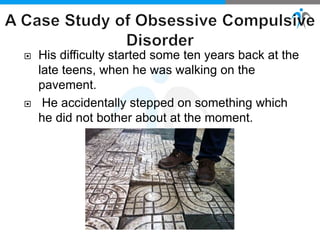
 His difficulty started some ten years back at the
late teens, when he was walking on the
pavement.
 He accidentally stepped on something which
he did not bother about at the moment.
 But back home, it came to his mind that it might
have been a used condom.
 He felt very unclean and washed himself
thoroughly
 He knew that he might have been wrong in his
interpretation, but the thought continued to
haunt him.
 Gradually he became afraid of stepping over
anything dirty on the street, be it condom,
faeces, or sputum.
 What particularly disturbs him is the vivid imagery
of the person who has grubby the street.
 Now he takes pains to look at the road very
carefully before stepping
 and if ever he sees anything he avoids that
particular street for a few days if possible.
 It so happens that the city he lives in is not
particularly clean
 and often there are actually dirty things on the
street.
 If he sees anything like this he has to wash himself
following certain rituals after he reaches home.
 Intrusive imagery of filthy sticky things haunts him
till he is back home
 and washes himself.
 He first washes his face ten times, then his arms,
chest, back and legs for specific number of times.
 He has to take care of his feet particularly, being
forced to wash them twenty five times each.
 The washing ritual has to be completed
irrespective of heat and cold,
 And irrespective of his health, even if he has fever.
 He also has to wash the surface of the soap he uses,
as that too might be contaminated.
 Since he needs about three hours to wash himself, he
takes dinner quite late
 and has difficulty waking up in the morning and coping
with the stress of his job.
 As he has to avoid certain streets on certain days, he is
often late at his office.
 His concentration is failing since he is always thinking if
there are filthy things stuck in his feet.
 With repeated warnings and humiliations from his boss
he is thinking of leaving this job
 look for another with lower salary but less demanding
conditions.
 Let us go for an embarrassing memory.
 Let us remember a situation where you were
humiliated in front of your classmates or
colleagues for a reason which was not entirely
your fault, but, yes, partially due to some lapse
of yours.
 You were anxious of course, but not only
simply anxious. You were wishing that it had
never happened.
 How could you ever be so foolish? What would
you like best now?
 Have a magic and have the memory of the
event wipe out from everybody’s brain?
 Something unusual to happen at the moment
so that everybody’s attention is directed away
from you?
 May be if you can put forth an excuse, may be
of a severe disease, you could plea not guilty?
 Both of these two groups of disorders involve
attempts on the part of the person to escape
the unpleasant stressful situation by using
particular intra-psychic mechanism.
 The overt anxieties are not present, but are
replaced by either physical symptoms or
distorting the relation between self and reality
by selective modification of memory and
identity.
 These are, respectively, the Somatoform
Disorders and the Dissociative Disorders.
 As you encounter persons suffering from these two
groups of disorders, you may discover a dramatic
expression of the symptoms.
 But you must not presuppose that these people are
necessarily faking or ‘malingering’.
 The dramatisation occurs at a level below the
consciousness, and the person, at her conscious level
actually feels only whatever she reports.
 This process makes it a challenge for the mental health
 professional to differentiate Somatoform and
Dissociative Disorders from Malingering and intentional
falsification.
 While in children the symptoms are often transient, in
adults these disorders may take a chronic and
disabling form.
 When you have been under considerable stress,
you may have experienced bodily symptoms like
headache or gastric problem.
 The psychological pain seems to take a physical or
somatic form.
 This is quite common in children and not so
common among adults.
 Teachers in junior schools are well aware of how
frequently children develop symptoms like stomach
ache and nausea in response to academic or
interpersonal stress.
 Again, you may have seen or heard stories of
people fainting whenever they encounter any
stress.
 Sometimes they may be simply faking the
symptoms to draw attention or to avoid
immediate embarrassment.
 But many a times they truly experience the
bodily pain or truly lose consciousness.
 These may be examples of Somatoform
Disorders.
 Somatoform disorders refer to a group of
disorders where the person reports physical
 complaints characteristic of bodily dysfunction.
 But investigation usually fails to elicit any actual
physical defect.
 In this unit you would learn about the
symptoms and clinical features of five major
types of Somatoform Disorders, namely,
 Somatisation Disorder
 Pain Disorder
 Hypochondriasis
 Conversion Disorder
 Body Dysmorphic Disorder
You may recognize
Somatisation disorder by
the presence of multiple
physical symptoms at
different locations of the
body.
 There must be at least 4 pain symptoms in
different sites of the body - head, neck, back
etc.)
 At least 2 gastrointestinal symptoms - diarrhea,
nausea etc.
 One sexual symptom other than pain - erectile
dysfunction, lack of desire
 One pseudo neurological symptom - fainting
 Adequate medical investigation must have
been made to exclude all known organic origin
of the symptoms.
 The symptoms of Somatisation disorder are
vague.
 The person often goes for doctor shopping and
frequent hospitalization.
 Sometimes as a result of unwarranted faulty
treatment and invasive interventions, actual
physical symptoms may occur to complicate
the issue.
 Depression and anxiety may accompany the
Somatisation symptoms.
 Rina is a 24 year old middle class married woman.
 She had lost her mother in her childhood and has been
reared up by her father.
 Before her marriage she suffered from migraine and
frequent cold.
 After marriage she had encountered difficulty at her in-
laws house.
 Her mother-in-law expected her to take some household
responsibilities which she could not complete due to her
frequent headache.
 She disliked her mother-in-law and wished her dead.
 Her husband was initially supportive of her, but gradually
became irritated due to her constant complaints.
 Rina became depressed and developed pain in her
neck and back which prevent her from sitting straight
for long.
 Her headache has become more frequent and severe.
 She also has frequent sore throats.
 She developed problem of digestion and often had
diarrhoea and nausea.
 Her hand trembles at the slightest provocation and
 she had fainted a few times after quarrelling with her
husband.
 Her sexual desire is on the declineand she complains
of pain during intercourse.
 Her husband is very dissatisfied with the state of affairs
and is contemplating divorce.
 You may find that some people experience
persistent pain in certain specific areas of the
body.
 No physical cause can usually be identified
through investigations.
 Even if some organic problem is observed, it is
inadequate to explain the stated subjective
degree of pain.
 The psychological factors are recognized as
significant precipitator of the pain symptom.
 Joseph is a 17 year old manual labourer from a tribal area,
working in the city.
 He is the oldest of three siblings.
 His father was also a labourer but lost his job due to alcoholism.
 Joseph had too often seen the troubles of his mother at home.
 In their village, Joseph often stayed away from home
 And wandered around the forests.
 He had also attended school which he liked, especially because of
a teacher who loved him.
 Joseph wanted to study in the school and had an ambition of
working in an office.
 As his father lost his job, Joseph’s mother asked him to go for
work.
 One of his father’s friends has arranged the same job for him.
 Joseph hated leaving school, but ultimately had to agree.
 He did not like the work he had to do, but did it for six
months.
 Then one day he fell from a pile of bricks and hurt his ankle.
 Treated by a doctor he recovered, but developed a pain the
back.
 He attributed it to the fall and said that it had been neglected
by the doctor.
 The pain increased and he had to leave the job.
 He had seen doctors who had investigated the probable
cause of pain.
 But nothing was found to explain it.
 Now he sits idly at home while his younger brother goes for
work.
 Hypochondriasis is characterised by fear of
physical disease.
 You may have come across persons who
suspect that they have serious diseases like
cancer and cardiac problems.
 Investigations however reveal that no organic
pathology is present.
 While many of us may occasionally read some
bodily discomfort as a sign of some serious
problem
 The person with hypochondriasis is quite
convinced about the presence of the disease.
 DSM IV –TR states that preoccupation with
fear of contracting or having a serious disease
is the main criterion of Hypochondriasis.
 The conviction is based on misinterpretation of
some transitory bodily symptom.
 For example a person may interpret a sore
throat as the first sign of throat cancer.
 You will often find the persons with
Hypochondriasis at the doctor’s door.
 But the assurances of the doctor as to the absence
of any pathology do not change their conviction.
 Rather they change doctor frequently
 start the investigations afresh.
 Often the disease they imagine is a fatal one like
cancer, severe cardiac problem or HIV / AIDS.
 Such persons often read medical bulletins, self
diagnose themselves and also try to treat
themselves.
 The treatment modes can be magical or semi
scientific.
 In the first place severity of conviction of a fixed
diagnosis is greater in Hypochondriasis.
 Secondly, Hypochondriasis is not necessarily
about many disorders, but like Pain disorder
may be located in one or two sites.
 Dinesh, 35, an upper-middle class educated employed man from a
metropolitan city had an affair with a girl who later turned out to be a
sophisticated prostitute.
 Dinesh learnt it the hard way and was both heartbroken and horrified.
 That was about six years back.
 He was afraid that he might have contracted HIV, and after much
deliberation, consulted a doctor who recommended blood test.
 Dinesh turned out to be negative, to his immediate relief.
 However, this assurance seemed to be short lived, as he never came to
believe permanently that he was not afflicted with HIV.
 After the first testing, he had a bout of severe cold which he attributed to
the same undetected virus.
 He had read plenty of information on HIV / AIDS and had learnt that a
positive finding on the blood test ensures that you have HIV, but a
negative finding may be misleading.
 He went for retesting and was again found negative.
 Now he interprets every little stomach upset and
feverish feeling as indicative of HIV.
 He spends the whole evening scrutinizing his body
 looking for swollen glands and skin rashes.
 He goes to doctors for every small ailment, though
he does not always reveal his suspicion about HIV.
 He insists on being treated with strong antibiotics
as he believes that he has low immunity.
 He rejects those doctors who prefer to treat with
lesser medicines or recommends natural cure.
 You must have heard about hysteria.
 The word comes from the Greek word
‘hysteros’ which means the womb.
 It was wrongly believed at one time that
hysteria occurs only in women because of their
suppressed sexual desire.
 The most common symptom was fainting or
paralysis of the limbs under psychosocial
pressure.
 Sigmund Freud’s concept of the
unconscious emerged from his treating of
patients with hysteria.
 His patient Anna O, a young lady with
paralysis, has been famous in the history
of Psychology and Psychoanalysis for
being key to Freud’s understanding of the
nature of the unconscious.
 Akhtar, a 30 year old man from a middle class family
was an employee of a Government Undertaking.
 His job was to supervise the loading and unloading of
goods by the workers.
 He happened to be on the factory floor when an
accident took place resulting in many workers getting
wounded.
 Akhtar was also hurt in the face and on the head and
became unconscious.
 Later on he was treated duly and declared fit by the
Medical Board of the Company.
 However, from after a few days of the accident, Akhtar
had been telling that he had become blind.
 He was tested thoroughly by the doctors who declared
that there is nothing wrong either in the peripheral (at
the level of the eyes) or central (in the brain)
mechanisms of his vision.
 Akhtar sticks to his claim, and considers
himself unfit for joining his job.
 He walks with the help of his mother and has to
take her help in all matters like finding the shirt
and guiding him to the items of food.
 He stays at his home and spends time in front
of the TV saying that he cannot see, but he can
listen
 to the music and conversations and he enjoys
that.
 He wants compensation for his disability and is
planning to sue against the Company.
 You must have seen films and read stories
where, after a psychological shock, the hero
seems to have lost his memory.
 He cannot recognise people. Nor can he
remember his own identity.
 Then suddenly, after a chain of events that
make up the story, his memory returns and
everything ends happily.
 Such stories reflect, often in an exaggerated
and over-simplified fashion, the essence of
Dissociative Disorders.
 The term ‘dissociation’ refers to the separation
of the activities of a person from conscious
awareness.
 While psychoanalysis has long since
highlighted the irrational aspects of human
mind, cognitive psychology has also been
concerned in recent years with non-conscious
processes
 Dissociative Amnesia and Fugue
 Depersonalisation Disorder
 Dissociative Identity Disorder
 Amnesia means inability to remember.
 Amnesia may appear as a psychological
escape from stress.
 But it may be a symptom in many organic
diseases also.
 Dissociative amnesia has been defined by
DSM IV – TR as a disturbance in one or more
episodes of life or inability to recall significant
events.
 In his regard neurological investigation is very
important
 It would give you the first lead. But there are
other functional differences as well.
When amnesia has an
organic basis usually you
will find that the person is
unable to remember all or
most of the recent or
remote past, or is unable
to retain newly acquired
information.
Contrarily in Dissociative
amnesia, the person is
unable to retrieve selective
portions of personal history
and that forgetting is not
explained by biological
causes.
 This usually happens following some stressful
condition.
 The information is not permanently lost.
 These can be retrieved by hypnosis, narcotic
analysis and sometimes spontaneously.
 Dissociative amnesia can be localised to a specific
period of life or may be generalised over a major
part of the person’s life.
 It can be selective, that is specific events may be
lost.
 It can be continuous also, that is nothing is
remembered beyond a certain point.
 Localised and selective amnesia are more
common.
 The word ‘fugue’ means flight.
 Dissociative fugue is a sudden unexpected travelling away
from home or work.
 This is often accompanied with amnesia.
 You may find the person with fugue confused about personal
identity and she may also assume a new identity.
 If you look into her case history you may discover that the
fugue occurred after a stressful event which probably was
difficult to handle staying in the same place.
 You know that even in Alzheimer’s Dementia, which is an
organic disease, people tend to wander away.
 The motive to flight along with absence of other symptoms of
Dementia distinguishes Dissociative fugue from wandering in
the Alzheimer’s disease.
 Bobby, 35, was a middle manager at the sales department
of a private firm.
 For the last few months he was being consistently unable
to reach the target and was receiving unpleasant feedback
from the boss and the subordinates alike.
 At home also he was having marital problems.
 One day he did not come back home from work.
 His wife waited for him till midnight and then informed the
police.
 After about seven days he was found wandering in a small
town far off from the city.
 He was having an argument with the local people near a
tea shop where he had stopped for a cup of tea.
 He had identified himself as Navin, and affirmed that he
was looking for a job.
 However he could not produce any identification or
could not say anything about his past.
 The local people had been suspicious, held him back,
and informed the police.
 When the police found Navin alias Bobby, he could not
remember his identity or how he had reached this
place.
 He was wearing the same dress he had on seven days
back. However his orientation to the time and date was
intact.
 Sometimes, under pressure, you may have felt
somewhat detached from reality.
 As if what is happening is not true, or as if you are
observing the sequence of events as an outsider.
 This is one mode of tolerating immense pain, used
automatically by the human mind.
 Depersonalization means feeling as if one is not
oneself.
 De-realisation means as if what is happening
around is not real.
 While this may happen to anybody under extreme
conditions, if a person persistently and recurrently
suffers from this kind of experiences, you may
think of diagnosing her as suffering from
Depersonalisation disorder.
 Reality testing remains intact, that is
hallucination and delusions do not occur.
 The person feels strangely detached from the
internal and external events.
 Some may imagine oneself floating above
one’s body.
 There is usually a dreamlike character in the
flow of existence, and one might be puzzled at
the isolated and unfamiliar nature of the
environment.
 Meena, 20, works as a maid servant in an affluent house.
 She had been there for about three years.
 The mistress of the house had recently noted that sometimes,
when instructed to do some job, Meena stands for a while in a
strange manner and looks vaguely around.
 Sometimes she stumbles over things and goes away to any
random direction.
 Since at other times Meena had been a lovable girl and had
worked well, the mistress had come to look upon her with
compassion.
 She suspected some epileptic problem and took Meena to a
neurologist.
 There Meena reported that for the last few months she had been
occasionally feeling ‘out of the body’, and as if ‘having no control
on her mind’.
 At those moments her thinking gets clouded and she can ‘come
back only by shaking herself violently’.
 No neurological problem was found in the investigations.
 Case history revealed that some time back she had fallen in love
with a married man and knew that it was impossible to be united
with him.
 Neither her own family, nor the family where she worked, would
approve of this union.
 The symptoms had appeared after she had strictly forbidden the
man to see her.
 The most well known example of Dissociative
Identity Disorder is the story of Dr. Jekyll and
Mr. Hyde.
 One was a philanthropist and the other a killer.
 How would you feel if you go to sleep in your
night suit at night, and wake up in the morning
 to find yourself in completely different attire and
your shoes clad with mud?
 You do not know what you did at night.
 If it happens for days, may be you are having a
different personality at night.
 DSM IV – TR - You must ensure that she has at
least two separate ego states (known as alters)
and they would be in complete control of your
thinking, feeling and acting for different periods
of times.
 Sometimes these alters are in touch with each
other; often at least one alter is unaware of the
existence of another.
 Therefore gaps in memory are common signs.
 The existence of the different alters is
persistent and recurrent and not introduced by
any chemical substance.
 These alters may have different or even
opposite nature; they may dress, eat, interact
differently.
 Often the subordinate alter works at a covert
level while the host or original personality is
operating at the surface.
 In such cases, this subordinate alter is said to
be co-conscious.
 Gradually this alter makes its presence felt,
and at one point takes over the control from the
host.
 Munna was a young boy in his teens known to be an obedient, if not a
very good student at school.
 He came from a middle class family and lived with his parents in a city. He
was shy by nature and introvert, though good at games.
 At one point of time, his parents started observing that Munna was
becoming fidgety and suppressive, unable to explain some of his time
away from home.
 There were reports form the school that he was being absent while
Munna could not remember anything.
 His parents suspected that Munna might be involved in addiction, and
brought him to a psychiatrist.
 While being asked by the doctor about his activities, Munna suddenly
spoke in a different tone and identified himself as Munim, a rough and
tough fellow with an aggressive personality and lack of concern for social
rules.
 Munim said that he knows all about Munna, the boy who feigns
innocence.
 He bunked school and went to ‘bad boys’ to learn their ways to fight the
outer world.
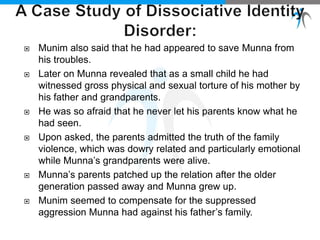
 Munim also said that he had appeared to save Munna from
his troubles.
 Later on Munna revealed that as a small child he had
witnessed gross physical and sexual torture of his mother by
his father and grandparents.
 He was so afraid that he never let his parents know what he
had seen.
 Upon asked, the parents admitted the truth of the family
violence, which was dowry related and particularly emotional
while Munna’s grandparents were alive.
 Munna’s parents patched up the relation after the older
generation passed away and Munna grew up.
 Munim seemed to compensate for the suppressed
aggression Munna had against his father’s family.
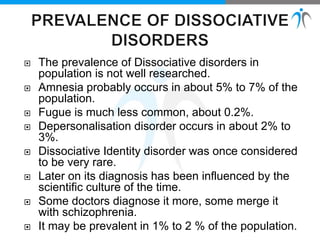
 The prevalence of Dissociative disorders in
population is not well researched.
 Amnesia probably occurs in about 5% to 7% of the
population.
 Fugue is much less common, about 0.2%.
 Depersonalisation disorder occurs in about 2% to
3%.
 Dissociative Identity disorder was once considered
to be very rare.
 Later on its diagnosis has been influenced by the
scientific culture of the time.
 Some doctors diagnose it more, some merge it
with schizophrenia.
 It may be prevalent in 1% to 2 % of the population.
Thank you
 Mood disorders are emotional disturbances
consisting of prolonged periods of excessive
sadness, excessive joyousness, or both.
 Mood disorders are categorized as depressive or
bipolar.
 In such cases, intense sadness is termed
depression and intense elation is termed mania.
 We all go through ups and downs in our mood.
Sadness is a normal reaction to life’s struggles,
setbacks, and disappointments.
 Many people use the word “depression” to
explain these kinds of feelings, but depression is
much more than just sadness.
 Depression is a form of what is known as a mood or
affective, disorder, because it is primarily concerned
with a change in mood.
1) Feelings of helplessness and hopelessness:
A bleak outlook nothing will ever get better and
there’s nothing you can do to improve your
situation.
2) Loss of interest in daily activities:
 No interest in former hobbies, pastimes,
social activities or sex.
 You’ve lost your ability to feel joy and pleasure.
3) Appetite or weight changes:
 Significant weight loss or weight gain
 Change of more than 5% of body weight in a
month
4) Sleep change:
 Either insomnia, especially waking in the early hours
of the morning or oversleeping
(also known as hypersomnia)
5) Irritability or restlessness:
 Feeling agitated, restless or on edge.
 Your tolerance level is low; everything and
everyone gets on your nerves.
6) Loss of energy:
 Feeling fatigued, sluggish and physically drained.
 Your whole body may feel heavy and even small
tasks are exhausting or take longer to
complete.
7) Self-loathing:
 Strong feelings of worthlessness or guilt
 You harshly criticize yourself for perceived faults
and mistakes.
8) Concentration problems:
 Trouble focusing, making decisions or
remembering things.
9) Unexplained aches and pains:
 An increase in physical complaints such as
headaches, back pain, aching muscles, and
stomach pain.
1) Depression that is originating from a bad or
disturbing event in one’s life
2) Depression which appears without apparent
cause.
1) Severity: (Intensity)
 Number of dysfunctions experienced in various
areas of living and relative degree of impairment
seen in those areas
2) Duration: (Period or Time)
 Whether the disorder is acute, chronic or
intermittent
 Depression, mostly determined by intensity
of the symptoms and duration of the symptoms.
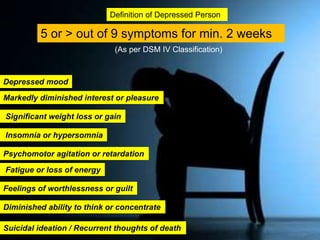
5 or > out of 9 symptoms for min. 2 weeks
Definition of Depressed Person
Depressed mood
Markedly diminished interest or pleasure
Significant weight loss or gain
Insomnia or hypersomnia
Psychomotor agitation or retardation
Diminished ability to think or concentrate
Suicidal ideation / Recurrent thoughts of death
(As per DSM IV Classification)
Fatigue or loss of energy
Feelings of worthlessness or guilt
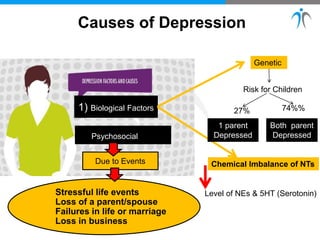
1) Biological Factors
2) Psychosocial Factors
Due to Events
Genetic
Chemical Imbalance of NTs
Risk for Children
27% 74%%
1 parent
Depressed
Both parent
Depressed
Level of NEs & 5HT (Serotonin)Stressful life events
Loss of a parent/spouse
Failures in life or marriage
Loss in business
Causes of Depression
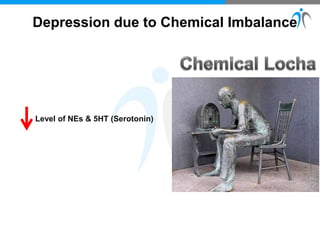
Depression due to Chemical Imbalance
Level of NEs & 5HT (Serotonin)
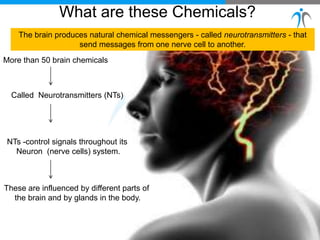
What are these Chemicals?
More than 50 brain chemicals
Called Neurotransmitters (NTs)
NTs -control signals throughout its
Neuron (nerve cells) system.
These are influenced by different parts of
the brain and by glands in the body.
The brain produces natural chemical messengers - called neurotransmitters - that
send messages from one nerve cell to another.
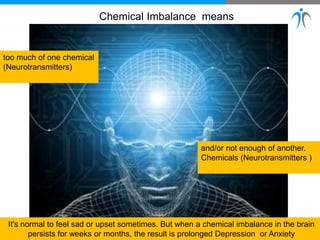
too much of one chemical
(Neurotransmitters)
and/or not enough of another.
Chemicals (Neurotransmitters )
Chemical Imbalance means
It's normal to feel sad or upset sometimes. But when a chemical imbalance in the brain
persists for weeks or months, the result is prolonged Depression or Anxiety
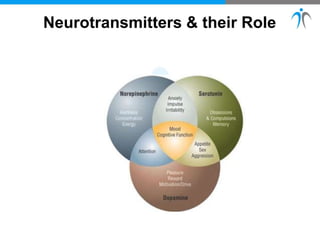
Neurotransmitters & their Role
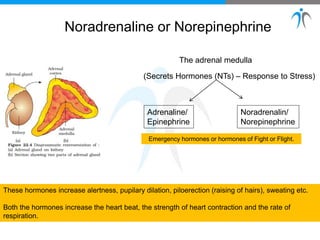
The adrenal medulla
Adrenaline/
Epinephrine
Noradrenalin/
Norepinephrine
(Secrets Hormones (NTs) – Response to Stress)
Emergency hormones or hormones of Fight or Flight.
These hormones increase alertness, pupilary dilation, piloerection (raising of hairs), sweating etc.
Both the hormones increase the heart beat, the strength of heart contraction and the rate of
respiration.
Noradrenaline or Norepinephrine
Dopamine affect mood.
When the brain doesn't produce
enough dopamine , you can feel tired,
unmotivated and foggy-headed.
Dopamine
Serotonin is known as the "feel good"
neurotransmitter because it plays an important
role in the regulation of mood.
Allow body to think and act
Low levels of serotonin can cause excessive
feelings of sadness and anxiety.
Serotonin
A fourth neurotransmitter,
called GABA, helps you
relax. When your levels of
GABA are low, you will feel
anxious and agitated.
NTs: GABA
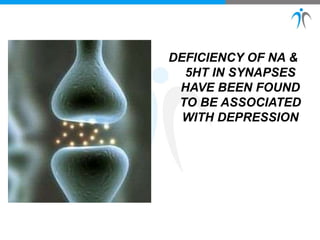
DEFICIENCY OF NA &
5HT IN SYNAPSES
HAVE BEEN FOUND
TO BE ASSOCIATED
WITH DEPRESSION
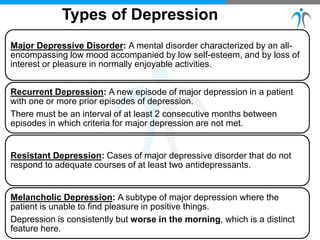
Types of Depression
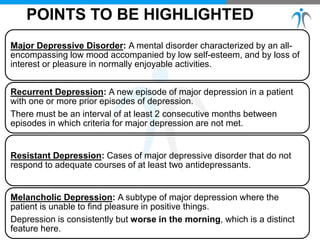
Major Depressive Disorder: A mental disorder characterized by an all-
encompassing low mood accompanied by low self-esteem, and by loss of
interest or pleasure in normally enjoyable activities.
Recurrent Depression: A new episode of major depression in a patient
with one or more prior episodes of depression.
There must be an interval of at least 2 consecutive months between
episodes in which criteria for major depression are not met.
Resistant Depression: Cases of major depressive disorder that do not
respond to adequate courses of at least two antidepressants.
Melancholic Depression: A subtype of major depression where the
patient is unable to find pleasure in positive things.
Depression is consistently but worse in the morning, which is a distinct
feature here.
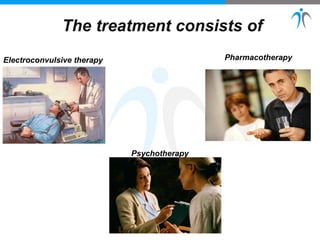
Electroconvulsive therapy Pharmacotherapy
Psychotherapy
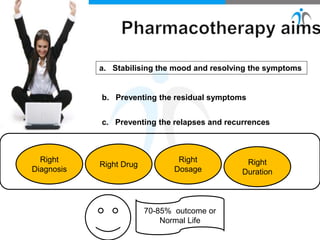
a. Stabilising the mood and resolving the symptoms
b. Preventing the residual symptoms
c. Preventing the relapses and recurrences
Right
Diagnosis
Right Drug
Right
Dosage
Right
Duration
70-85% outcome or
Normal Life
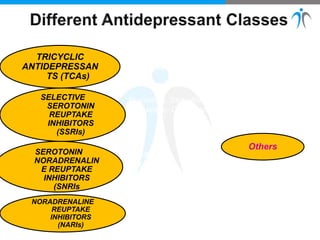
TRICYCLIC
ANTIDEPRESSAN
TS (TCAs)
SELECTIVE
SEROTONIN
REUPTAKE
INHIBITORS
(SSRIs)
SEROTONIN
NORADRENALIN
E REUPTAKE
INHIBITORS
(SNRIs
NORADRENALINE
REUPTAKE
INHIBITORS
(NARIs)
Others
Imipramine, Amitriptyline, Desipramine, Nortriptyline,
Clomipramine, Doxepin, Dothiepin, Amoxapine
Fluoxetine, Sertraline, Fluvoxamine,
Paroxetine, Citalopram and Escitalopram
Venlafaxine,
Duloxetine
Reboxetine
(Reboxxin)
Nefazodone, Bupropion,
Mirtazapine, Moclobemide
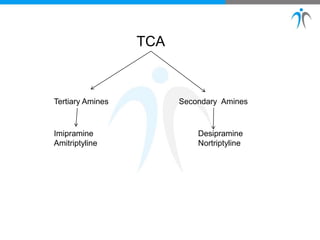
TCA
Tertiary Amines Secondary Amines
Imipramine
Amitriptyline
Desipramine
Nortriptyline
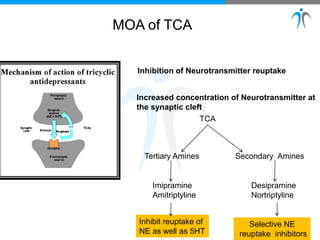
Inhibition of Neurotransmitter reuptake
Increased concentration of Neurotransmitter at
the synaptic cleft
TCA
Tertiary Amines Secondary Amines
MOA of TCA
Inhibit reuptake of
NE as well as 5HT
Selective NE
reuptake inhibitors
Imipramine
Amitriptyline
Desipramine
Nortriptyline
TCAs are very potent and are used to treat
difficult and refractory cases .
The tricyclic antidepressants were tested in a number of
clinical trials in patients with painful diabetic neuropathy.
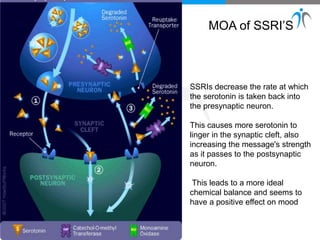
SSRIs decrease the rate at which
the serotonin is taken back into
the presynaptic neuron.
This causes more serotonin to
linger in the synaptic cleft, also
increasing the message's strength
as it passes to the postsynaptic
neuron.
This leads to a more ideal
chemical balance and seems to
have a positive effect on mood
MOA of SSRI’S
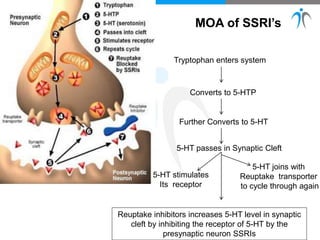
MOA of SSRI’s
Tryptophan enters system
Converts to 5-HTP
Further Converts to 5-HT
5-HT passes in Synaptic Cleft
5-HT stimulates
Its receptor
5-HT joins with
Reuptake transporter
to cycle through again
Reuptake inhibitors increases 5-HT level in synaptic
cleft by inhibiting the receptor of 5-HT by the
presynaptic neuron SSRIs
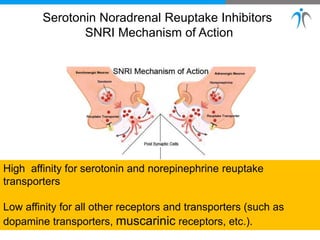
Serotonin Noradrenal Reuptake Inhibitors
SNRI Mechanism of Action
High affinity for serotonin and norepinephrine reuptake
transporters
Low affinity for all other receptors and transporters (such as
dopamine transporters, muscarinic receptors, etc.).
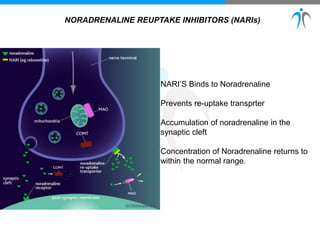
NORADRENALINE REUPTAKE INHIBITORS (NARIs)
NARI’S Binds to Noradrenaline
Prevents re-uptake transprter
Accumulation of noradrenaline in the
synaptic cleft
Concentration of Noradrenaline returns to
within the normal range.
POINTS TO BE HIGHLIGHTED
Major Depressive Disorder: A mental disorder characterized by an all-
encompassing low mood accompanied by low self-esteem, and by loss of
interest or pleasure in normally enjoyable activities.
Recurrent Depression: A new episode of major depression in a patient
with one or more prior episodes of depression.
There must be an interval of at least 2 consecutive months between
episodes in which criteria for major depression are not met.
Resistant Depression: Cases of major depressive disorder that do not
respond to adequate courses of at least two antidepressants.
Melancholic Depression: A subtype of major depression where the
patient is unable to find pleasure in positive things.
Depression is consistently but worse in the morning, which is a distinct
feature here.
References

Understanding Anxiety and Depression

  • 1.
    Psychologist and M.B.A. (HumanResource Development) Pharmacist & M.B.A ( Marketing ) Topic: Understanding Anxiety And Depression Disorders
  • 2.
     Feeling anxiousabout how to finish large course within stipulated time?  You may welcome this anxiety, at least to a certain extent.  It would help you learn quickly and to get good marks.  Anxiety is, indeed, a common reaction to stress.  It saves us from being careless and hence from accidental disasters.
  • 3.
     Unless youhave anxiety about your examination, you would not study.  Unless the mother has anxiety over her baby’s health she might forget to care for the infant.  Unless you have anxiety you would step over the snake and get bitten.  But anxiety turns into a disorder when you are so anxious that you have a breakdown at the examination hall, forgetting everything.  Anxiety is a disorder when the mother is so anxious that her baby may fall ill that she spends the day and night praying to God, and ultimately fails to feed the baby.  Anxiety is a disorder when you faint if somebody names a snake.
  • 4.
     Anxiety disorderis a group of disorders each of which need special attention and understanding.  You know that in classifying disorders, we usually follow either the Diagnostic and statistical Manual, Version IV TR (DSM IV TR)  or International Classification of Diseases, Version 10 (ICD 10).
  • 5.
     Panic disorderwith or without agoraphobia  Phobic disorders of the specific or social type  Generalized anxiety disorder  Obsessive compulsive disorder  Post traumatic stress disorder
  • 6.
     Anxiety Disorderis a blanket term that covers a number of disorders.  In this context, you must be aware of the difference between fear and anxiety.  Fear is a basic emotion of human beings. It is associated with the perception of a real threatening situation and involves the ‘fight or flight’ response activated by the sympathetic nervous system.  If a thug attacks you in the street, you would feel intense fear.  Then, you would either run for dear life, or hit him back.  Thus fear involves cognition of the threatening object, subjective cognition of being in danger, physiological components like increased heart rate, and behavioural components like running or hitting.
  • 7.
     Physiological changesand some kind of behavioural reaction.  But unlike fear, it has no immediate threat.  If you cannot go out of your home because you are always apprehending an attack from a thug (hoodlum), it is anxiety.  You are projecting the threatening situation in future and reacting to it as if it is imminent.
  • 9.
     Person sweats, Almost faints  Complains of breathing  People thinks as if Heart Attack  But after sometime gradually recovers and Normal  It is an episode of intense fear
  • 10.
     Symptoms develop abruptly Usually reach its peak within 10 - 15 minutes.  During such attack the victim becomes completely overpowered by the symptoms,  Many of which are physiological in nature.
  • 11.
     The DSMIV TR mandates that a person would be diagnosed as suffering from panic disorder if she had  Anxity Disorders, Panic and Phobias  Generalised Anxiety Disorder and Other Mild Mental Disorders  experienced recurrent unexpected attacks  is persistently concerned with having another attack.  This condition must go on for at least one month.
  • 12.
     Palpitation orpounding heart  Sweating  Trembling or shaking  Sensation of shortness of breath or being smothered  Feeling of choking  Chest pain or discomfort  Nausea or abdominal distress  Feeling dizzy, lightheaded or faint  De-realisation or depersonalization  Fear of losing control or going crazy  Fear of dying  Paresthesias  Chill or hot flushes.
  • 14.
    The reactions are usuallythose associated with activation of sympathetic nervous system.
  • 18.
     Animal isbear immediately sympathetic nervous system is activated.  Several body functions gets activated
  • 21.
     The Greekword ‘agora’ which means public places or assembly of people.  Panic attacks can be with or without agoraphobia.  Typically, panic attacks with agoraphobia seem to be precipitated by attending a cinema hall, a shopping mall, a cue for tickets, tunnels, trains and aircrafts or so on, where a large number of people congregate  And escape in case of a panic attack may be difficult.
  • 22.
    Maya is ayoung lady studying at the University. She comes from a middle class family living in a suburban place. Maya is somewhat introvert, apparently cool and rational, and determined to finish her education.
  • 23.
     She regularlytakes the underground Metro rail to come to the University.  One day while waiting for the train, she had some kind of physical discomfort.  However, she ignored it and boarded the train.  The train was moderately crowded and she did not get a seat.  She stood in front of the seat reserved for ladies.
  • 24.
     A fewminutes later, she felt choked and nauseated, started sweating profusely  and her discomfort was so strong that she asked the elderly lady sitting in front of her for help.  This lady immediately offered her a seat and asked her what her problem was.  By that time, Maya was trembling and had started crying. “I am going to die” – she cried.  Other passengers came forward to help, gave her water to drink, and at the next station they took Maya out of the train and contacted the authority
  • 25.
     Maya wastaken to a hospital and her father was informed.  By the time her father arrived, Maya had been feeling much better.  The doctors had found a rapid pulse rate, but did not get anything indicating cardiac problem.  Maya had retrospectively reported extreme fear of being choked to death, especially as she was in an underground train and could not jump out and run for the sunlight up on the streets.
  • 26.
     The word‘Phobia’ derives from the name of the Greek god ‘Phobos’ who used to frighten his enemies.  A phobia is an intense and irrational fear of some object, living being or situation.  Do you get notably disturbed if a cockroach flies around and falls on your body?  Of course nobody would love to touch a cockroach, but some people get completely panicky at the thought of touching it.  Depending upon how severe it is, this may be a phobic reaction.
  • 27.
     One musthave a persistent and disproportionate fear of some specific object, social situation or crowded place that actually carries little danger.  Exposure to the phobic stimulus almost invariably produces intense anxiety response.  The patient usually knows that the fear is unreasonable, but she has no control on the reaction.  The phobic situation is usually avoided, or if forced to endured, may be tolerated with great discomfort.
  • 28.
     When forcedto encounter the phobic stimulus, the reactions may be like panic attack, or a little less severe than it.  The attention of the person facing the phobic object is directed completely toward it, the affect is intense fear and the behavioural reaction is escape.  As soon as the person can escape from the presence of the phobic stimulus, the negative affect and accompanying physiological reactions subside.  Thus the flight reaction is reinforced as it provided relief from tension.
  • 29.
     Specific Phobia, Social Phobia and  Agoraphobia.
  • 30.
     They arethe irrational fear of specific objects, animals or situations.  Some typical examples are:  Fear of closed space or claustrophobia,  Fear of heights or acrophobia,  Fear of blood or haemophobia,  Fear of snake or Ophidiophobia,  Fear of spider or arachnophobia,  Fear of fire or pyrophobia  Fear of phobias or phobophobia.
  • 31.
     Animal type- cued by animals or insects  Natural environment type - cued by objects in the environment, such as storms, heights, or water  Blood-injection-injury type - cued by witnessing some invasive medical procedure  Situational type - cued by a specific situation, such as public transportation, tunnels, bridges, elevators, flying, driving, or enclosed spaces  Other type - cued by other stimuli than the above, such as of choking, vomiting, or contracting an illness.
  • 32.
     Social phobias,as you may guess from its name, are persistent irrational fear associated with presence of other people.  Remember how we sometimes get tongue tied at the interview boards?  Social phobia is an extreme form of this kind of discomfort.  Often extreme feelings of shyness and self-consciousness build into a powerful fear, so that it becomes difficult to participate in everyday social situations.  People with social phobia can usually interact easily with close and familiar persons.  But meeting new people, talking in a group, or speaking in public can trigger the phobic reaction.  Often situations where one might be evaluated become the phobic situation.  All of us may have occasional social anxieties, especially under judgmental situation.  But a person with diagnosable social phobia often becomes incapable of normal social interaction.
  • 33.
     You havealready read about Agoraphobia in connection with panic disorder.  You know that it refers to the fear of public spaces where many people congregate.  Agoraphobia without history of panic disorder has been given a special emphasis in DSM IV – TR.  It develops slowly and insidiously from early adolescence or late childhood, and gradually becomes debilitating.  If it is a part of the panic attack, it should be coded within Panic disorders.  If it occurs as a source of anxiety and a strong urge to avoid, but does not constitute a palpable panic attack, it should be coded within Phobia.
  • 34.
     Kalu, nowabout 24, comes from a lower class family of fishermen.  They earn their livelihood by fishing in shallow backwater or rivulets streaming from big rivers.  He had studied up to class IV in the local school, and then left it due to poverty.  As a child, he used to accompany his father to the backwaters, especially where they cultivated prawns.  Very occasionally crocodiles swim in from the big river with which the backwater may be connected, and there has been tales about crocodiles killing men around the village.  Everybody had heard these tales, but since the appearance of crocodiles is quite rare, everybody works in knee deep water without much anxiety.  From early adolescence onward, Kalu gradually became afraid of crocodiles, which then turned into specific phobia.
  • 35.
     He wasunable to work in the water, because if he sees any shadow, even of underwater plants and fish, he suffers from uncontrollable fear.  Since Kalu’s family has no land to cultivate, and Kalu hardly has any other skill, not being able to work in water has practically made him a nonearning member of the poor family.  Kalu understands that his fear is irrational, and never in his life time has he heard of a crocodile actually attacking a man in their locality.  He understands that he is becoming a burden on his family; but he cannot overcome the intense fear.  While he attributes the fear to the stories he had listened to in childhood, he knows that these are not enough to provoke such strong reactions.
  • 36.
     You musthave come across some persons around you who are known as nervous and shaky in general.  They seem to be very anxious over every single step in life.
  • 37.
     Would Ibe able to go to office in time?  Is my dress suitable for my job?  Am I capable of what I am supposed to do?  Will the boss be angry over me?  Would my children come back from school safely?  What if my wife forgets to put off the gas cylinder and have a terrible accident?  Is it possible that I am robbed of my belongings on my way back home?
  • 38.
     In someof such persons the anxiety becomes so severe that their everyday functioning may be impaired.  In some persons there is an unnatural concern for doing certain things in a right way.  Am I clean enough?  Did I lock the door properly?  Could it so happen that I might actually choke my baby girl to death while playing with her?  Such doubts and over concern with unnecessary and at times bizarre issues constitute another category of anxiety disorders.
  • 39.
     It isan over generalised anxiety over many things.  GAD is characterised by excessive and irrational anxiety over minor things
  • 40.
    It is persistentexcessive anxiety and worries which the person finds difficult to control.
  • 41.
     Restlessness orfeeling keyed up  Being easily fatigued  Difficulty in concentrating  Irritability  Muscle tension  Sleep disturbance At least 3 must be present to be diagnosed as GAD
  • 42.
     The anxietydoes not seem to be bound to one or few specific issues.  The person typically is terrified of different possible mishaps.  If you convince the person of the irrationality of one issue, or if, in the course of natural affairs, one issue is resolved, the person takes up a second and a third issue and focuses on them.  Concentration to anything for a given period of time becomes extremely difficult, as some or other point of anxiety always comes up.
  • 43.
     Like sweating,flushing, palpitation, upset stomach, lump in throat, frequent urination, rapid breathing, twitches and tics are common.  The person becomes uneasy, irritable and easily fatigued.  Often vivid imageries of the disaster accompany the restlessness.  Impatience, anger outbursts and insomnia are common.
  • 44.
     Many personswith GAD lead their life more or less normally without consulting any doctor.  They have some functional impairment and difficulties within the family;  but the problems may be somewhat manageable with some support from the close ones.  For about one third cases, spontaneous recovery takes place at some point in life.  For others the problem is severe enough to seek medical consultation,  although the chief complaint is often presented as somatic problems or insomnia.
  • 45.
     Fatema, nowa housewife of 35 years of age, had always been nervous since her childhood.  During her school days, she had been anxious for her studies and examinations.  She was also extremely upset if any of her friends talked ill about her or the teachers scolded her.  At home she became greatly worried if her father came home later than usual.  She apprehended some accident.  She was admitted to college, but did not finish her graduation.
  • 46.
     She marriedat the age of 22.  Her husband had a small business in the town.  Fatema was from the very beginning apprehensive about the possible failure of her husband’s business and worried over any temporary loss that occurred.  Initially her husband was glad to see her worried, as he interpreted it as her attachment to him.  Gradually he became irritated at the constant worry and negative predictions she had.
  • 47.
     He triedto convince her that every business has its own ups and downs,  and there is nothing to be worried about.  The effort was of little effect.  At the age of 26 Fatema gave birth to a girl, and after four years to a boy.  During pregnancy she was extremely fearful that the pregnancy would go wrong and some damage might occur to her unborn child
  • 48.
     Fatema’s familyconsulted some ‘pirbaba’ (local saint) who gave her some pious water  and assured her that everything would be alright, and she was consoled a bit.  Now her daughter being in puberty,  Fatema is extremely worried that some harm might happen to her,  and remains anxious till the girl comes back home from school.  Fatema fears that she might be assaulted on her way back home.
  • 49.
     Fatema’s sonis also growing up  Fatema is worried that he might hurt himself during play.  She reports bad dreams and apprehends that these might come true.  She restricts her son’s movement causing lots of argument and dissatisfaction within the family.  However, she becomes so anxious  and starts crying instead of rationally justifying her stand that her husband and children ultimately compromise with her demands.
  • 50.
     Fatema remainedhappy and relaxed for a negligible period of her life, always apprehending that some danger might happe to her and her loved ones.  She is a frequent visitor to the ‘pirbaba’, and remains temporarily calm only after he had blessed her for a safe life.
  • 51.
     You mustbe acquainted with the word obsessive and compulsive –  These two terms have actually been part of everyday language.  Obsession in everyday usage means being engrossed in specific thoughts
  • 52.
     You speakof being obsessed with your looks,  Your daughter’s studies,  Your girlfriend’s whereabouts while she is away from you.  You also talk of being obsessed with a particular art form,  of guns and rifles,  of cars,  of stamps from different countries.
  • 53.
     Compulsion meansyou are forced or compelled to do something.  In ordinary language we may use it  To be forced from outside (compelled by my parents)  Or from inside (compelled by my conscience).
  • 54.
     So longyou are happy and in control of these thoughts  so long these are not disturbing despite your earnest effort to ward them away  They are simply fancy words and not components of a disorder.
  • 55.
     Disturbing thoughts,images and impulses often of a negative or unacceptable kind,  despite one’s desire to get rid of it.  Compulsion means being compelled from within to perform certain ritualistic acts, because otherwise you are afraid of some danger befalling you.
  • 56.
     Obsessions arerecurrent and persistent thoughts, impulses or images that are experienced as intrusive (disturbing) and generate considerable anxiety.  These thoughts do not concern real life problems at the moment, and are often irrelevant to present reality.  The person has insight and tries to remove these thoughts, but often cannot succeed.
  • 57.
     You mayfind unusual fear of contamination,  Fear of harming oneself or one’s own loved ones,  Religious themes,  Themes of sexuality specially the unacceptable forms,  Wishing ill for others  For example wishing one’s mother dead  Doubt about whether one has accomplished things properly.  The person does not want to think of these, and  when particularly aggressive and Sexual thoughts predominate, considers herself ‘bad’.  Yet the thoughts continue to haunt her/ him
  • 58.
     Like washingor checking or mental acts like counting or praying in response to an obsessive thought.  Compulsions are to be done following rigid rules to prevent or reduce the impact of some dreaded thing or action  After a compulsion is performed the person temporarily feels relieved, but again succumbs to the same cycle.
  • 59.
     Cleaning -repeated washing  Checking - repeatedly coming back to home to check if the door has been locked properly  Counting - counting the number of steps one takes before getting on the bed  Repeating - coming back to the first word of the line as one is not sure if she has read it properly  Hoarding - collecting things and not being able to organize of these things  Ordering - arranging books on the table in a particular order each time one leaves the table
  • 60.
     There maybe cases where only obsession or compulsion predominates.  The obsessions and compulsions take plenty of time from one’s daily routine and  slow down the entire life process.  For some, rituals take the whole day resulting in the sufferer’s inability to anything else at all.  Sometimes it results in health hazard; you may rub and  clean your skin so much and with such material (like raw dettol) that there are wounds on your body.  Also for most people there are multiple obsessions and compulsions.
  • 61.
     In thefirst place, the obsessive thoughts are unpleasant and anxiety provoking.  Compulsions reduce them to some extent,  But the very insight that one is compelled to do such useless things causes lack of confidence and severe distress
  • 62.
     In factWorld Health Organization found obsessive compulsive disorder to be the world’s leading cause of disability.  It has also been associated with unemployment, marital problem and separation, and impaired social functioning
  • 64.
     Raj isa 26 years old man of considerable intelligence.  He comes from an upper middle class family.  He is presently employed at a private firm.
  • 65.
     His difficultystarted some ten years back at the late teens, when he was walking on the pavement.  He accidentally stepped on something which he did not bother about at the moment.
  • 66.
     But backhome, it came to his mind that it might have been a used condom.  He felt very unclean and washed himself thoroughly  He knew that he might have been wrong in his interpretation, but the thought continued to haunt him.  Gradually he became afraid of stepping over anything dirty on the street, be it condom, faeces, or sputum.
  • 67.
     What particularlydisturbs him is the vivid imagery of the person who has grubby the street.  Now he takes pains to look at the road very carefully before stepping  and if ever he sees anything he avoids that particular street for a few days if possible.  It so happens that the city he lives in is not particularly clean  and often there are actually dirty things on the street.  If he sees anything like this he has to wash himself following certain rituals after he reaches home.
  • 68.
     Intrusive imageryof filthy sticky things haunts him till he is back home  and washes himself.  He first washes his face ten times, then his arms, chest, back and legs for specific number of times.  He has to take care of his feet particularly, being forced to wash them twenty five times each.  The washing ritual has to be completed irrespective of heat and cold,  And irrespective of his health, even if he has fever.
  • 69.
     He alsohas to wash the surface of the soap he uses, as that too might be contaminated.  Since he needs about three hours to wash himself, he takes dinner quite late  and has difficulty waking up in the morning and coping with the stress of his job.  As he has to avoid certain streets on certain days, he is often late at his office.  His concentration is failing since he is always thinking if there are filthy things stuck in his feet.  With repeated warnings and humiliations from his boss he is thinking of leaving this job  look for another with lower salary but less demanding conditions.
  • 70.
     Let usgo for an embarrassing memory.  Let us remember a situation where you were humiliated in front of your classmates or colleagues for a reason which was not entirely your fault, but, yes, partially due to some lapse of yours.  You were anxious of course, but not only simply anxious. You were wishing that it had never happened.  How could you ever be so foolish? What would you like best now?
  • 71.
     Have amagic and have the memory of the event wipe out from everybody’s brain?  Something unusual to happen at the moment so that everybody’s attention is directed away from you?  May be if you can put forth an excuse, may be of a severe disease, you could plea not guilty?
  • 72.
     Both ofthese two groups of disorders involve attempts on the part of the person to escape the unpleasant stressful situation by using particular intra-psychic mechanism.  The overt anxieties are not present, but are replaced by either physical symptoms or distorting the relation between self and reality by selective modification of memory and identity.  These are, respectively, the Somatoform Disorders and the Dissociative Disorders.
  • 73.
     As youencounter persons suffering from these two groups of disorders, you may discover a dramatic expression of the symptoms.  But you must not presuppose that these people are necessarily faking or ‘malingering’.  The dramatisation occurs at a level below the consciousness, and the person, at her conscious level actually feels only whatever she reports.  This process makes it a challenge for the mental health  professional to differentiate Somatoform and Dissociative Disorders from Malingering and intentional falsification.  While in children the symptoms are often transient, in adults these disorders may take a chronic and disabling form.
  • 74.
     When youhave been under considerable stress, you may have experienced bodily symptoms like headache or gastric problem.  The psychological pain seems to take a physical or somatic form.  This is quite common in children and not so common among adults.  Teachers in junior schools are well aware of how frequently children develop symptoms like stomach ache and nausea in response to academic or interpersonal stress.  Again, you may have seen or heard stories of people fainting whenever they encounter any stress.
  • 75.
     Sometimes theymay be simply faking the symptoms to draw attention or to avoid immediate embarrassment.  But many a times they truly experience the bodily pain or truly lose consciousness.  These may be examples of Somatoform Disorders.
  • 76.
     Somatoform disordersrefer to a group of disorders where the person reports physical  complaints characteristic of bodily dysfunction.  But investigation usually fails to elicit any actual physical defect.  In this unit you would learn about the symptoms and clinical features of five major types of Somatoform Disorders, namely,
  • 77.
     Somatisation Disorder Pain Disorder  Hypochondriasis  Conversion Disorder  Body Dysmorphic Disorder
  • 78.
    You may recognize Somatisationdisorder by the presence of multiple physical symptoms at different locations of the body.
  • 79.
     There mustbe at least 4 pain symptoms in different sites of the body - head, neck, back etc.)  At least 2 gastrointestinal symptoms - diarrhea, nausea etc.  One sexual symptom other than pain - erectile dysfunction, lack of desire  One pseudo neurological symptom - fainting  Adequate medical investigation must have been made to exclude all known organic origin of the symptoms.
  • 80.
     The symptomsof Somatisation disorder are vague.  The person often goes for doctor shopping and frequent hospitalization.  Sometimes as a result of unwarranted faulty treatment and invasive interventions, actual physical symptoms may occur to complicate the issue.  Depression and anxiety may accompany the Somatisation symptoms.
  • 81.
     Rina isa 24 year old middle class married woman.  She had lost her mother in her childhood and has been reared up by her father.  Before her marriage she suffered from migraine and frequent cold.  After marriage she had encountered difficulty at her in- laws house.  Her mother-in-law expected her to take some household responsibilities which she could not complete due to her frequent headache.  She disliked her mother-in-law and wished her dead.  Her husband was initially supportive of her, but gradually became irritated due to her constant complaints.
  • 82.
     Rina becamedepressed and developed pain in her neck and back which prevent her from sitting straight for long.  Her headache has become more frequent and severe.  She also has frequent sore throats.  She developed problem of digestion and often had diarrhoea and nausea.  Her hand trembles at the slightest provocation and  she had fainted a few times after quarrelling with her husband.  Her sexual desire is on the declineand she complains of pain during intercourse.  Her husband is very dissatisfied with the state of affairs and is contemplating divorce.
  • 83.
     You mayfind that some people experience persistent pain in certain specific areas of the body.  No physical cause can usually be identified through investigations.  Even if some organic problem is observed, it is inadequate to explain the stated subjective degree of pain.  The psychological factors are recognized as significant precipitator of the pain symptom.
  • 84.
     Joseph isa 17 year old manual labourer from a tribal area, working in the city.  He is the oldest of three siblings.  His father was also a labourer but lost his job due to alcoholism.  Joseph had too often seen the troubles of his mother at home.  In their village, Joseph often stayed away from home  And wandered around the forests.  He had also attended school which he liked, especially because of a teacher who loved him.  Joseph wanted to study in the school and had an ambition of working in an office.  As his father lost his job, Joseph’s mother asked him to go for work.  One of his father’s friends has arranged the same job for him.
  • 85.
     Joseph hatedleaving school, but ultimately had to agree.  He did not like the work he had to do, but did it for six months.  Then one day he fell from a pile of bricks and hurt his ankle.  Treated by a doctor he recovered, but developed a pain the back.  He attributed it to the fall and said that it had been neglected by the doctor.  The pain increased and he had to leave the job.  He had seen doctors who had investigated the probable cause of pain.  But nothing was found to explain it.  Now he sits idly at home while his younger brother goes for work.
  • 86.
     Hypochondriasis ischaracterised by fear of physical disease.  You may have come across persons who suspect that they have serious diseases like cancer and cardiac problems.  Investigations however reveal that no organic pathology is present.  While many of us may occasionally read some bodily discomfort as a sign of some serious problem  The person with hypochondriasis is quite convinced about the presence of the disease.
  • 87.
     DSM IV–TR states that preoccupation with fear of contracting or having a serious disease is the main criterion of Hypochondriasis.  The conviction is based on misinterpretation of some transitory bodily symptom.  For example a person may interpret a sore throat as the first sign of throat cancer.
  • 88.
     You willoften find the persons with Hypochondriasis at the doctor’s door.  But the assurances of the doctor as to the absence of any pathology do not change their conviction.  Rather they change doctor frequently  start the investigations afresh.  Often the disease they imagine is a fatal one like cancer, severe cardiac problem or HIV / AIDS.  Such persons often read medical bulletins, self diagnose themselves and also try to treat themselves.  The treatment modes can be magical or semi scientific.
  • 89.
     In thefirst place severity of conviction of a fixed diagnosis is greater in Hypochondriasis.  Secondly, Hypochondriasis is not necessarily about many disorders, but like Pain disorder may be located in one or two sites.
  • 90.
     Dinesh, 35,an upper-middle class educated employed man from a metropolitan city had an affair with a girl who later turned out to be a sophisticated prostitute.  Dinesh learnt it the hard way and was both heartbroken and horrified.  That was about six years back.  He was afraid that he might have contracted HIV, and after much deliberation, consulted a doctor who recommended blood test.  Dinesh turned out to be negative, to his immediate relief.  However, this assurance seemed to be short lived, as he never came to believe permanently that he was not afflicted with HIV.  After the first testing, he had a bout of severe cold which he attributed to the same undetected virus.  He had read plenty of information on HIV / AIDS and had learnt that a positive finding on the blood test ensures that you have HIV, but a negative finding may be misleading.  He went for retesting and was again found negative.
  • 91.
     Now heinterprets every little stomach upset and feverish feeling as indicative of HIV.  He spends the whole evening scrutinizing his body  looking for swollen glands and skin rashes.  He goes to doctors for every small ailment, though he does not always reveal his suspicion about HIV.  He insists on being treated with strong antibiotics as he believes that he has low immunity.  He rejects those doctors who prefer to treat with lesser medicines or recommends natural cure.
  • 92.
     You musthave heard about hysteria.  The word comes from the Greek word ‘hysteros’ which means the womb.  It was wrongly believed at one time that hysteria occurs only in women because of their suppressed sexual desire.  The most common symptom was fainting or paralysis of the limbs under psychosocial pressure.
  • 93.
     Sigmund Freud’sconcept of the unconscious emerged from his treating of patients with hysteria.  His patient Anna O, a young lady with paralysis, has been famous in the history of Psychology and Psychoanalysis for being key to Freud’s understanding of the nature of the unconscious.
  • 94.
     Akhtar, a30 year old man from a middle class family was an employee of a Government Undertaking.  His job was to supervise the loading and unloading of goods by the workers.  He happened to be on the factory floor when an accident took place resulting in many workers getting wounded.  Akhtar was also hurt in the face and on the head and became unconscious.  Later on he was treated duly and declared fit by the Medical Board of the Company.  However, from after a few days of the accident, Akhtar had been telling that he had become blind.  He was tested thoroughly by the doctors who declared that there is nothing wrong either in the peripheral (at the level of the eyes) or central (in the brain) mechanisms of his vision.
  • 95.
     Akhtar sticksto his claim, and considers himself unfit for joining his job.  He walks with the help of his mother and has to take her help in all matters like finding the shirt and guiding him to the items of food.  He stays at his home and spends time in front of the TV saying that he cannot see, but he can listen  to the music and conversations and he enjoys that.  He wants compensation for his disability and is planning to sue against the Company.
  • 96.
     You musthave seen films and read stories where, after a psychological shock, the hero seems to have lost his memory.  He cannot recognise people. Nor can he remember his own identity.  Then suddenly, after a chain of events that make up the story, his memory returns and everything ends happily.  Such stories reflect, often in an exaggerated and over-simplified fashion, the essence of Dissociative Disorders.
  • 97.
     The term‘dissociation’ refers to the separation of the activities of a person from conscious awareness.  While psychoanalysis has long since highlighted the irrational aspects of human mind, cognitive psychology has also been concerned in recent years with non-conscious processes
  • 98.
     Dissociative Amnesiaand Fugue  Depersonalisation Disorder  Dissociative Identity Disorder
  • 99.
     Amnesia meansinability to remember.  Amnesia may appear as a psychological escape from stress.  But it may be a symptom in many organic diseases also.  Dissociative amnesia has been defined by DSM IV – TR as a disturbance in one or more episodes of life or inability to recall significant events.
  • 100.
     In hisregard neurological investigation is very important  It would give you the first lead. But there are other functional differences as well. When amnesia has an organic basis usually you will find that the person is unable to remember all or most of the recent or remote past, or is unable to retain newly acquired information. Contrarily in Dissociative amnesia, the person is unable to retrieve selective portions of personal history and that forgetting is not explained by biological causes.
  • 101.
     This usuallyhappens following some stressful condition.  The information is not permanently lost.  These can be retrieved by hypnosis, narcotic analysis and sometimes spontaneously.  Dissociative amnesia can be localised to a specific period of life or may be generalised over a major part of the person’s life.  It can be selective, that is specific events may be lost.  It can be continuous also, that is nothing is remembered beyond a certain point.  Localised and selective amnesia are more common.
  • 102.
     The word‘fugue’ means flight.  Dissociative fugue is a sudden unexpected travelling away from home or work.  This is often accompanied with amnesia.  You may find the person with fugue confused about personal identity and she may also assume a new identity.  If you look into her case history you may discover that the fugue occurred after a stressful event which probably was difficult to handle staying in the same place.  You know that even in Alzheimer’s Dementia, which is an organic disease, people tend to wander away.  The motive to flight along with absence of other symptoms of Dementia distinguishes Dissociative fugue from wandering in the Alzheimer’s disease.
  • 103.
     Bobby, 35,was a middle manager at the sales department of a private firm.  For the last few months he was being consistently unable to reach the target and was receiving unpleasant feedback from the boss and the subordinates alike.  At home also he was having marital problems.  One day he did not come back home from work.  His wife waited for him till midnight and then informed the police.  After about seven days he was found wandering in a small town far off from the city.  He was having an argument with the local people near a tea shop where he had stopped for a cup of tea.
  • 104.
     He hadidentified himself as Navin, and affirmed that he was looking for a job.  However he could not produce any identification or could not say anything about his past.  The local people had been suspicious, held him back, and informed the police.  When the police found Navin alias Bobby, he could not remember his identity or how he had reached this place.  He was wearing the same dress he had on seven days back. However his orientation to the time and date was intact.
  • 105.
     Sometimes, underpressure, you may have felt somewhat detached from reality.  As if what is happening is not true, or as if you are observing the sequence of events as an outsider.  This is one mode of tolerating immense pain, used automatically by the human mind.  Depersonalization means feeling as if one is not oneself.  De-realisation means as if what is happening around is not real.  While this may happen to anybody under extreme conditions, if a person persistently and recurrently suffers from this kind of experiences, you may think of diagnosing her as suffering from Depersonalisation disorder.
  • 106.
     Reality testingremains intact, that is hallucination and delusions do not occur.  The person feels strangely detached from the internal and external events.  Some may imagine oneself floating above one’s body.  There is usually a dreamlike character in the flow of existence, and one might be puzzled at the isolated and unfamiliar nature of the environment.
  • 107.
     Meena, 20,works as a maid servant in an affluent house.  She had been there for about three years.  The mistress of the house had recently noted that sometimes, when instructed to do some job, Meena stands for a while in a strange manner and looks vaguely around.  Sometimes she stumbles over things and goes away to any random direction.  Since at other times Meena had been a lovable girl and had worked well, the mistress had come to look upon her with compassion.  She suspected some epileptic problem and took Meena to a neurologist.
  • 108.
     There Meenareported that for the last few months she had been occasionally feeling ‘out of the body’, and as if ‘having no control on her mind’.  At those moments her thinking gets clouded and she can ‘come back only by shaking herself violently’.  No neurological problem was found in the investigations.  Case history revealed that some time back she had fallen in love with a married man and knew that it was impossible to be united with him.  Neither her own family, nor the family where she worked, would approve of this union.  The symptoms had appeared after she had strictly forbidden the man to see her.
  • 109.
     The mostwell known example of Dissociative Identity Disorder is the story of Dr. Jekyll and Mr. Hyde.  One was a philanthropist and the other a killer.  How would you feel if you go to sleep in your night suit at night, and wake up in the morning  to find yourself in completely different attire and your shoes clad with mud?  You do not know what you did at night.  If it happens for days, may be you are having a different personality at night.
  • 110.
     DSM IV– TR - You must ensure that she has at least two separate ego states (known as alters) and they would be in complete control of your thinking, feeling and acting for different periods of times.  Sometimes these alters are in touch with each other; often at least one alter is unaware of the existence of another.  Therefore gaps in memory are common signs.  The existence of the different alters is persistent and recurrent and not introduced by any chemical substance.
  • 111.
     These altersmay have different or even opposite nature; they may dress, eat, interact differently.  Often the subordinate alter works at a covert level while the host or original personality is operating at the surface.  In such cases, this subordinate alter is said to be co-conscious.  Gradually this alter makes its presence felt, and at one point takes over the control from the host.
  • 112.
     Munna wasa young boy in his teens known to be an obedient, if not a very good student at school.  He came from a middle class family and lived with his parents in a city. He was shy by nature and introvert, though good at games.  At one point of time, his parents started observing that Munna was becoming fidgety and suppressive, unable to explain some of his time away from home.  There were reports form the school that he was being absent while Munna could not remember anything.  His parents suspected that Munna might be involved in addiction, and brought him to a psychiatrist.  While being asked by the doctor about his activities, Munna suddenly spoke in a different tone and identified himself as Munim, a rough and tough fellow with an aggressive personality and lack of concern for social rules.  Munim said that he knows all about Munna, the boy who feigns innocence.  He bunked school and went to ‘bad boys’ to learn their ways to fight the outer world.
  • 113.
     Munim alsosaid that he had appeared to save Munna from his troubles.  Later on Munna revealed that as a small child he had witnessed gross physical and sexual torture of his mother by his father and grandparents.  He was so afraid that he never let his parents know what he had seen.  Upon asked, the parents admitted the truth of the family violence, which was dowry related and particularly emotional while Munna’s grandparents were alive.  Munna’s parents patched up the relation after the older generation passed away and Munna grew up.  Munim seemed to compensate for the suppressed aggression Munna had against his father’s family.
  • 114.
     The prevalenceof Dissociative disorders in population is not well researched.  Amnesia probably occurs in about 5% to 7% of the population.  Fugue is much less common, about 0.2%.  Depersonalisation disorder occurs in about 2% to 3%.  Dissociative Identity disorder was once considered to be very rare.  Later on its diagnosis has been influenced by the scientific culture of the time.  Some doctors diagnose it more, some merge it with schizophrenia.  It may be prevalent in 1% to 2 % of the population.
  • 115.
  • 116.
     Mood disordersare emotional disturbances consisting of prolonged periods of excessive sadness, excessive joyousness, or both.  Mood disorders are categorized as depressive or bipolar.  In such cases, intense sadness is termed depression and intense elation is termed mania.
  • 117.
     We allgo through ups and downs in our mood. Sadness is a normal reaction to life’s struggles, setbacks, and disappointments.  Many people use the word “depression” to explain these kinds of feelings, but depression is much more than just sadness.  Depression is a form of what is known as a mood or affective, disorder, because it is primarily concerned with a change in mood.
  • 118.
    1) Feelings ofhelplessness and hopelessness: A bleak outlook nothing will ever get better and there’s nothing you can do to improve your situation. 2) Loss of interest in daily activities:  No interest in former hobbies, pastimes, social activities or sex.  You’ve lost your ability to feel joy and pleasure.
  • 119.
    3) Appetite orweight changes:  Significant weight loss or weight gain  Change of more than 5% of body weight in a month 4) Sleep change:  Either insomnia, especially waking in the early hours of the morning or oversleeping (also known as hypersomnia)
  • 120.
    5) Irritability orrestlessness:  Feeling agitated, restless or on edge.  Your tolerance level is low; everything and everyone gets on your nerves. 6) Loss of energy:  Feeling fatigued, sluggish and physically drained.  Your whole body may feel heavy and even small tasks are exhausting or take longer to complete.
  • 121.
    7) Self-loathing:  Strongfeelings of worthlessness or guilt  You harshly criticize yourself for perceived faults and mistakes. 8) Concentration problems:  Trouble focusing, making decisions or remembering things.
  • 122.
    9) Unexplained achesand pains:  An increase in physical complaints such as headaches, back pain, aching muscles, and stomach pain.
  • 123.
    1) Depression thatis originating from a bad or disturbing event in one’s life 2) Depression which appears without apparent cause.
  • 124.
    1) Severity: (Intensity) Number of dysfunctions experienced in various areas of living and relative degree of impairment seen in those areas 2) Duration: (Period or Time)  Whether the disorder is acute, chronic or intermittent  Depression, mostly determined by intensity of the symptoms and duration of the symptoms.
  • 125.
    5 or >out of 9 symptoms for min. 2 weeks Definition of Depressed Person Depressed mood Markedly diminished interest or pleasure Significant weight loss or gain Insomnia or hypersomnia Psychomotor agitation or retardation Diminished ability to think or concentrate Suicidal ideation / Recurrent thoughts of death (As per DSM IV Classification) Fatigue or loss of energy Feelings of worthlessness or guilt
  • 126.
    1) Biological Factors 2)Psychosocial Factors Due to Events Genetic Chemical Imbalance of NTs Risk for Children 27% 74%% 1 parent Depressed Both parent Depressed Level of NEs & 5HT (Serotonin)Stressful life events Loss of a parent/spouse Failures in life or marriage Loss in business Causes of Depression
  • 127.
    Depression due toChemical Imbalance Level of NEs & 5HT (Serotonin)
  • 128.
    What are theseChemicals? More than 50 brain chemicals Called Neurotransmitters (NTs) NTs -control signals throughout its Neuron (nerve cells) system. These are influenced by different parts of the brain and by glands in the body. The brain produces natural chemical messengers - called neurotransmitters - that send messages from one nerve cell to another.
  • 129.
    too much ofone chemical (Neurotransmitters) and/or not enough of another. Chemicals (Neurotransmitters ) Chemical Imbalance means It's normal to feel sad or upset sometimes. But when a chemical imbalance in the brain persists for weeks or months, the result is prolonged Depression or Anxiety
  • 130.
  • 131.
    The adrenal medulla Adrenaline/ Epinephrine Noradrenalin/ Norepinephrine (SecretsHormones (NTs) – Response to Stress) Emergency hormones or hormones of Fight or Flight. These hormones increase alertness, pupilary dilation, piloerection (raising of hairs), sweating etc. Both the hormones increase the heart beat, the strength of heart contraction and the rate of respiration. Noradrenaline or Norepinephrine
  • 132.
    Dopamine affect mood. Whenthe brain doesn't produce enough dopamine , you can feel tired, unmotivated and foggy-headed. Dopamine
  • 133.
    Serotonin is knownas the "feel good" neurotransmitter because it plays an important role in the regulation of mood. Allow body to think and act Low levels of serotonin can cause excessive feelings of sadness and anxiety. Serotonin
  • 134.
    A fourth neurotransmitter, calledGABA, helps you relax. When your levels of GABA are low, you will feel anxious and agitated. NTs: GABA
  • 136.
    DEFICIENCY OF NA& 5HT IN SYNAPSES HAVE BEEN FOUND TO BE ASSOCIATED WITH DEPRESSION
  • 137.
    Types of Depression MajorDepressive Disorder: A mental disorder characterized by an all- encompassing low mood accompanied by low self-esteem, and by loss of interest or pleasure in normally enjoyable activities. Recurrent Depression: A new episode of major depression in a patient with one or more prior episodes of depression. There must be an interval of at least 2 consecutive months between episodes in which criteria for major depression are not met. Resistant Depression: Cases of major depressive disorder that do not respond to adequate courses of at least two antidepressants. Melancholic Depression: A subtype of major depression where the patient is unable to find pleasure in positive things. Depression is consistently but worse in the morning, which is a distinct feature here.
  • 139.
  • 140.
    a. Stabilising themood and resolving the symptoms b. Preventing the residual symptoms c. Preventing the relapses and recurrences Right Diagnosis Right Drug Right Dosage Right Duration 70-85% outcome or Normal Life
  • 141.
    TRICYCLIC ANTIDEPRESSAN TS (TCAs) SELECTIVE SEROTONIN REUPTAKE INHIBITORS (SSRIs) SEROTONIN NORADRENALIN E REUPTAKE INHIBITORS (SNRIs NORADRENALINE REUPTAKE INHIBITORS (NARIs) Others Imipramine,Amitriptyline, Desipramine, Nortriptyline, Clomipramine, Doxepin, Dothiepin, Amoxapine Fluoxetine, Sertraline, Fluvoxamine, Paroxetine, Citalopram and Escitalopram Venlafaxine, Duloxetine Reboxetine (Reboxxin) Nefazodone, Bupropion, Mirtazapine, Moclobemide
  • 142.
    TCA Tertiary Amines SecondaryAmines Imipramine Amitriptyline Desipramine Nortriptyline
  • 143.
    Inhibition of Neurotransmitterreuptake Increased concentration of Neurotransmitter at the synaptic cleft TCA Tertiary Amines Secondary Amines MOA of TCA Inhibit reuptake of NE as well as 5HT Selective NE reuptake inhibitors Imipramine Amitriptyline Desipramine Nortriptyline
  • 144.
    TCAs are verypotent and are used to treat difficult and refractory cases . The tricyclic antidepressants were tested in a number of clinical trials in patients with painful diabetic neuropathy.
  • 145.
    SSRIs decrease therate at which the serotonin is taken back into the presynaptic neuron. This causes more serotonin to linger in the synaptic cleft, also increasing the message's strength as it passes to the postsynaptic neuron. This leads to a more ideal chemical balance and seems to have a positive effect on mood MOA of SSRI’S
  • 146.
    MOA of SSRI’s Tryptophanenters system Converts to 5-HTP Further Converts to 5-HT 5-HT passes in Synaptic Cleft 5-HT stimulates Its receptor 5-HT joins with Reuptake transporter to cycle through again Reuptake inhibitors increases 5-HT level in synaptic cleft by inhibiting the receptor of 5-HT by the presynaptic neuron SSRIs
  • 147.
    Serotonin Noradrenal ReuptakeInhibitors SNRI Mechanism of Action High affinity for serotonin and norepinephrine reuptake transporters Low affinity for all other receptors and transporters (such as dopamine transporters, muscarinic receptors, etc.).
  • 148.
    NORADRENALINE REUPTAKE INHIBITORS(NARIs) NARI’S Binds to Noradrenaline Prevents re-uptake transprter Accumulation of noradrenaline in the synaptic cleft Concentration of Noradrenaline returns to within the normal range.
  • 149.
    POINTS TO BEHIGHLIGHTED Major Depressive Disorder: A mental disorder characterized by an all- encompassing low mood accompanied by low self-esteem, and by loss of interest or pleasure in normally enjoyable activities. Recurrent Depression: A new episode of major depression in a patient with one or more prior episodes of depression. There must be an interval of at least 2 consecutive months between episodes in which criteria for major depression are not met. Resistant Depression: Cases of major depressive disorder that do not respond to adequate courses of at least two antidepressants. Melancholic Depression: A subtype of major depression where the patient is unable to find pleasure in positive things. Depression is consistently but worse in the morning, which is a distinct feature here.
  • 150.