Mr.P.S.Kore
Assistant Professor(Research Scholar)
Department of Pharmaceutical Chemistry
RCP, Kasegaon.
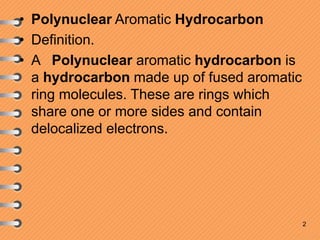
• Polynuclear Aromatic Hydrocarbon
• Definition.
• A Polynuclear aromatic hydrocarbon is
a hydrocarbon made up of fused aromatic
ring molecules. These are rings which
share one or more sides and contain
delocalized electrons.
2
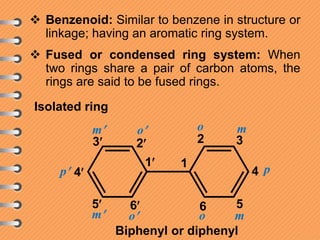
 Benzenoid: Similar to benzene in structure or
linkage; having an aromatic ring system.
 Fused or condensed ring system: When
two rings share a pair of carbon atoms, the
rings are said to be fused rings.
2
1
3
4
665
4
2
1
5
3
Isolated ring
Biphenyl or diphenyl
o m
mo
p
o
m o
m
p
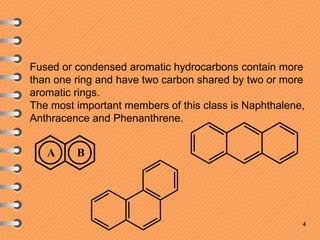
Fused or condensed aromatic hydrocarbons contain more
than one ring and have two carbon shared by two or more
aromatic rings.
The most important members of this class is Naphthalene,
Anthracence and Phenanthrene.
4
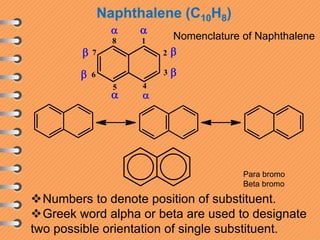
Naphthalene (C10H8)
Numbers to denote position of substituent.
Greek word alpha or beta are used to designate
two possible orientation of single substituent.
Nomenclature of Naphthalene
Para bromo
Beta bromo
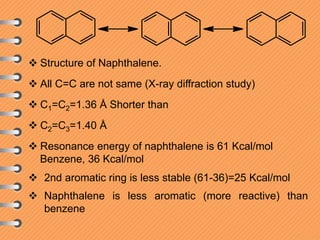
 Structure of Naphthalene.
 All C=C are not same (X-ray diffraction study)
 C1=C2=1.36 Å Shorter than
 C2=C3=1.40 Å
 Resonance energy of naphthalene is 61 Kcal/mol
Benzene, 36 Kcal/mol
 2nd aromatic ring is less stable (61-36)=25 Kcal/mol
 Naphthalene is less aromatic (more reactive) than
benzene
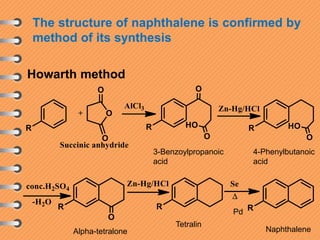
The structure of naphthalene is confirmed by
method of its synthesis
Howarth method
Tetralin
NaphthaleneAlpha-tetralone
3-Benzoylpropanoic
acid
4-Phenylbutanoic
acid
Pd
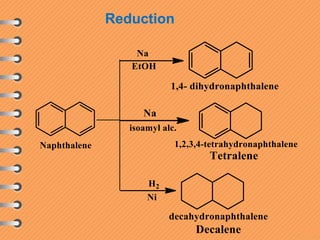
Reduction
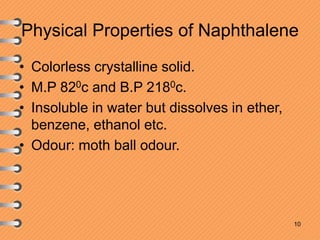
Physical Properties of Naphthalene
• Colorless crystalline solid.
• M.P 820c and B.P 2180c.
• Insoluble in water but dissolves in ether,
benzene, ethanol etc.
• Odour: moth ball odour.
10
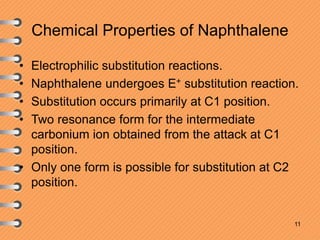
Chemical Properties of Naphthalene
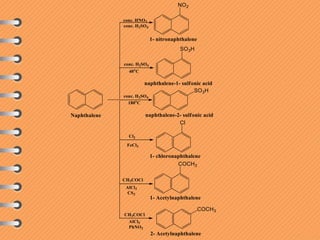
• Electrophilic substitution reactions.
• Naphthalene undergoes E+ substitution reaction.
• Substitution occurs primarily at C1 position.
• Two resonance form for the intermediate
carbonium ion obtained from the attack at C1
position.
• Only one form is possible for substitution at C2
position.
11
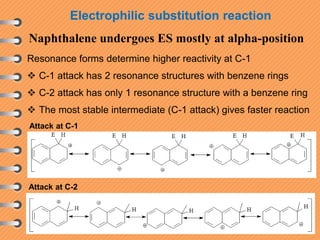
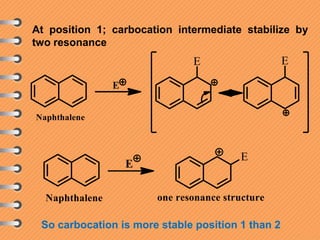
Naphthalene undergoes ES mostly at alpha-position
Resonance forms determine higher reactivity at C-1
 C-1 attack has 2 resonance structures with benzene rings
 C-2 attack has only 1 resonance structure with a benzene ring
 The most stable intermediate (C-1 attack) gives faster reaction
Attack at C-2
Attack at C-1
Electrophilic substitution reaction
At position 1; carbocation intermediate stabilize by
two resonance
So carbocation is more stable position 1 than 2
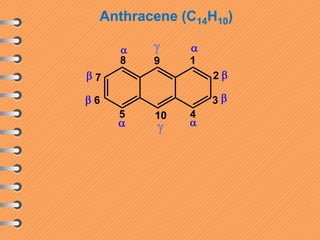
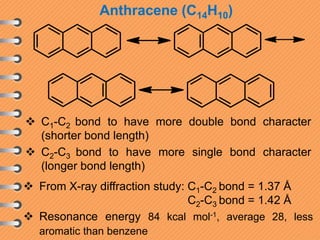
Anthracene (C14H10)
2
1
3
4
7
5
6
8 9
10


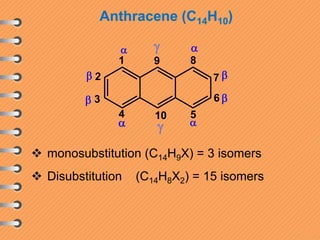
Anthracene (C14H10)
2
1
3
4
7
5
6
89
10


 monosubstitution (C14H9X) = 3 isomers
 Disubstitution (C14H8X2) = 15 isomers
Anthracene (C14H10)
 C1-C2 bond to have more double bond character
(shorter bond length)
 C2-C3 bond to have more single bond character
(longer bond length)
 From X-ray diffraction study: C1-C2 bond = 1.37 Å
C2-C3 bond = 1.42 Å
 Resonance energy 84 kcal mol-1, average 28, less
aromatic than benzene
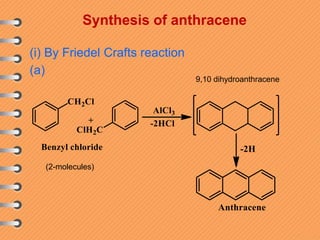
Synthesis of anthracene
(i) By Friedel Crafts reaction
(a)
9,10 dihydroanthracene
(2-molecules)
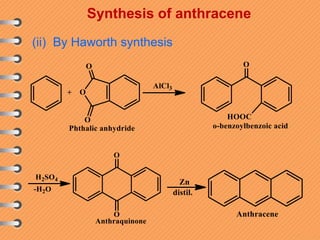
(ii) By Haworth synthesis
Synthesis of anthracene
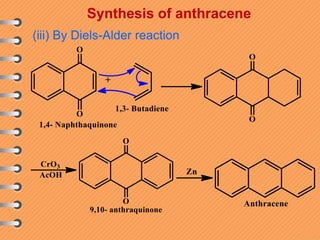
(iii) By Diels-Alder reaction
Synthesis of anthracene
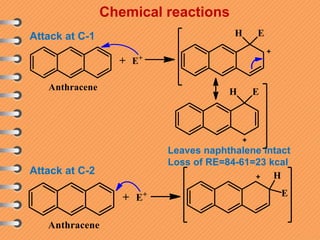
Chemical reactions
Leaves naphthalene intact
Loss of RE=84-61=23 kcal
Attack at C-1
Attack at C-2
Chemical Reactions
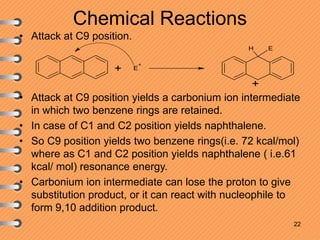
• Attack at C9 position.
• Attack at C9 position yields a carbonium ion intermediate
in which two benzene rings are retained.
• In case of C1 and C2 position yields naphthalene.
• So C9 position yields two benzene rings(i.e. 72 kcal/mol)
where as C1 and C2 position yields naphthalene ( i.e.61
kcal/ mol) resonance energy.
• Carbonium ion intermediate can lose the proton to give
substitution product, or it can react with nucleophile to
form 9,10 addition product.
22
E
+
EH
+
+
Physical Properties of Anthracene
• Colourless solid
• MP-218 0C and BP- 340 0C.
• Insoluble in water, dissolves in benzene.
• It shows strong blue fluorescence when
exposed to UV light.
23
[HNO3+H2SO4 is not used, leads formation
of 9,10 anthraqunone by oxidation]
Reduction
Friedel-crafts acylation
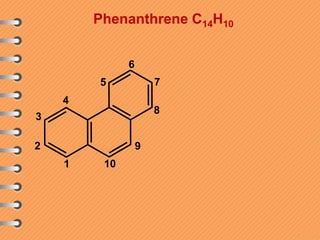
Phenanthrene C14H10
2
1
3
4
75
6
8
9
10
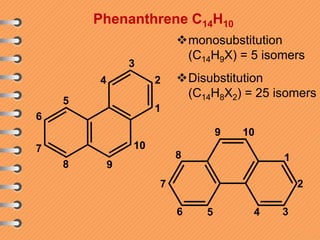
Phenanthrene C14H10
2
1
3
4
7
5
6
8 9
10
2
1
34
7
56
10
8
9
monosubstitution
(C14H9X) = 5 isomers
Disubstitution
(C14H8X2) = 25 isomers
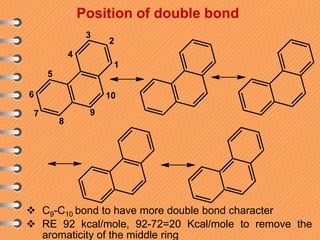
Position of double bond
2
1
3
4
7
5
6
8
9
10
 C9-C10 bond to have more double bond character
 RE 92 kcal/mole, 92-72=20 Kcal/mole to remove the
aromaticity of the middle ring
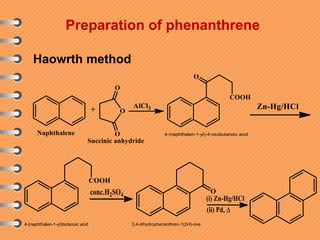
Preparation of phenanthrene
Haowrth method
4-(naphthalen-1-yl)-4-oxobutanoic acid
4-(naphthalen-1-yl)butanoic acid 3,4-dihydrophenanthren-1(2H)-one
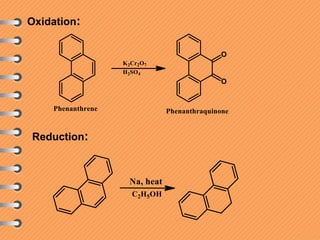
Oxidation:
Reduction:
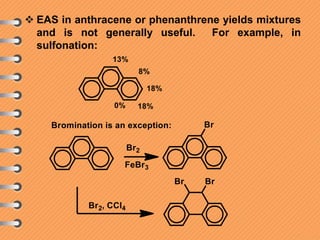
 EAS in anthracene or phenanthrene yields mixtures
and is not generally useful. For example, in
sulfonation:
2
1
3
4
665
4
2
1
5
3
Biphenyl methane or diphenyl methane
o m
mo
p
o
m o
m
p
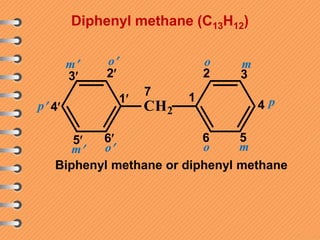
Diphenyl methane (C13H12)
7
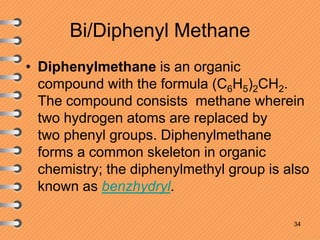
Bi/Diphenyl Methane
• Diphenylmethane is an organic
compound with the formula (C6H5)2CH2.
The compound consists methane wherein
two hydrogen atoms are replaced by
two phenyl groups. Diphenylmethane
forms a common skeleton in organic
chemistry; the diphenylmethyl group is also
known as benzhydryl.
34
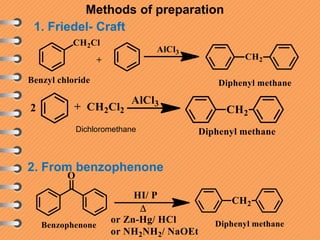
1. Friedel- Craft
Methods of preparation
2. From benzophenone
Dichloromethane
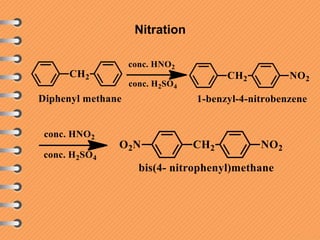
Nitration
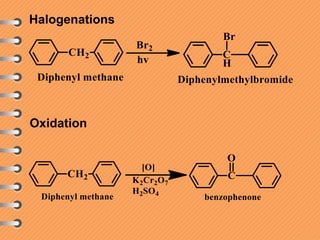
Halogenations
Oxidation
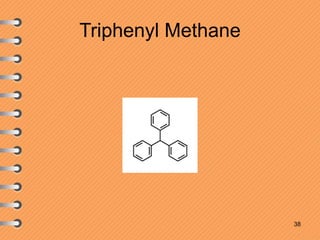
Triphenyl Methane
38
39

Fused polynuclear compounds

  • 1.
    Mr.P.S.Kore Assistant Professor(Research Scholar) Departmentof Pharmaceutical Chemistry RCP, Kasegaon.
  • 2.
    • Polynuclear AromaticHydrocarbon • Definition. • A Polynuclear aromatic hydrocarbon is a hydrocarbon made up of fused aromatic ring molecules. These are rings which share one or more sides and contain delocalized electrons. 2
  • 3.
     Benzenoid: Similarto benzene in structure or linkage; having an aromatic ring system.  Fused or condensed ring system: When two rings share a pair of carbon atoms, the rings are said to be fused rings. 2 1 3 4 665 4 2 1 5 3 Isolated ring Biphenyl or diphenyl o m mo p o m o m p
  • 4.
    Fused or condensedaromatic hydrocarbons contain more than one ring and have two carbon shared by two or more aromatic rings. The most important members of this class is Naphthalene, Anthracence and Phenanthrene. 4
  • 5.
    Naphthalene (C10H8) Numbers todenote position of substituent. Greek word alpha or beta are used to designate two possible orientation of single substituent. Nomenclature of Naphthalene Para bromo Beta bromo
  • 6.
     Structure ofNaphthalene.  All C=C are not same (X-ray diffraction study)  C1=C2=1.36 Å Shorter than  C2=C3=1.40 Å  Resonance energy of naphthalene is 61 Kcal/mol Benzene, 36 Kcal/mol  2nd aromatic ring is less stable (61-36)=25 Kcal/mol  Naphthalene is less aromatic (more reactive) than benzene
  • 8.
    The structure ofnaphthalene is confirmed by method of its synthesis Howarth method Tetralin NaphthaleneAlpha-tetralone 3-Benzoylpropanoic acid 4-Phenylbutanoic acid Pd
  • 9.
  • 10.
    Physical Properties ofNaphthalene • Colorless crystalline solid. • M.P 820c and B.P 2180c. • Insoluble in water but dissolves in ether, benzene, ethanol etc. • Odour: moth ball odour. 10
  • 11.
    Chemical Properties ofNaphthalene • Electrophilic substitution reactions. • Naphthalene undergoes E+ substitution reaction. • Substitution occurs primarily at C1 position. • Two resonance form for the intermediate carbonium ion obtained from the attack at C1 position. • Only one form is possible for substitution at C2 position. 11
  • 12.
    Naphthalene undergoes ESmostly at alpha-position Resonance forms determine higher reactivity at C-1  C-1 attack has 2 resonance structures with benzene rings  C-2 attack has only 1 resonance structure with a benzene ring  The most stable intermediate (C-1 attack) gives faster reaction Attack at C-2 Attack at C-1 Electrophilic substitution reaction
  • 13.
    At position 1;carbocation intermediate stabilize by two resonance So carbocation is more stable position 1 than 2
  • 15.
  • 16.
    Anthracene (C14H10) 2 1 3 4 7 5 6 89 10    monosubstitution(C14H9X) = 3 isomers  Disubstitution (C14H8X2) = 15 isomers
  • 17.
    Anthracene (C14H10)  C1-C2bond to have more double bond character (shorter bond length)  C2-C3 bond to have more single bond character (longer bond length)  From X-ray diffraction study: C1-C2 bond = 1.37 Å C2-C3 bond = 1.42 Å  Resonance energy 84 kcal mol-1, average 28, less aromatic than benzene
  • 18.
    Synthesis of anthracene (i)By Friedel Crafts reaction (a) 9,10 dihydroanthracene (2-molecules)
  • 19.
    (ii) By Haworthsynthesis Synthesis of anthracene
  • 20.
    (iii) By Diels-Alderreaction Synthesis of anthracene
  • 21.
    Chemical reactions Leaves naphthaleneintact Loss of RE=84-61=23 kcal Attack at C-1 Attack at C-2
  • 22.
    Chemical Reactions • Attackat C9 position. • Attack at C9 position yields a carbonium ion intermediate in which two benzene rings are retained. • In case of C1 and C2 position yields naphthalene. • So C9 position yields two benzene rings(i.e. 72 kcal/mol) where as C1 and C2 position yields naphthalene ( i.e.61 kcal/ mol) resonance energy. • Carbonium ion intermediate can lose the proton to give substitution product, or it can react with nucleophile to form 9,10 addition product. 22 E + EH + +
  • 23.
    Physical Properties ofAnthracene • Colourless solid • MP-218 0C and BP- 340 0C. • Insoluble in water, dissolves in benzene. • It shows strong blue fluorescence when exposed to UV light. 23
  • 24.
    [HNO3+H2SO4 is notused, leads formation of 9,10 anthraqunone by oxidation] Reduction Friedel-crafts acylation
  • 25.
  • 26.
  • 27.
    Position of doublebond 2 1 3 4 7 5 6 8 9 10  C9-C10 bond to have more double bond character  RE 92 kcal/mole, 92-72=20 Kcal/mole to remove the aromaticity of the middle ring
  • 28.
    Preparation of phenanthrene Haowrthmethod 4-(naphthalen-1-yl)-4-oxobutanoic acid 4-(naphthalen-1-yl)butanoic acid 3,4-dihydrophenanthren-1(2H)-one
  • 29.
  • 31.
     EAS inanthracene or phenanthrene yields mixtures and is not generally useful. For example, in sulfonation:
  • 32.
    2 1 3 4 665 4 2 1 5 3 Biphenyl methane ordiphenyl methane o m mo p o m o m p Diphenyl methane (C13H12) 7
  • 33.
    Bi/Diphenyl Methane • Diphenylmethaneis an organic compound with the formula (C6H5)2CH2. The compound consists methane wherein two hydrogen atoms are replaced by two phenyl groups. Diphenylmethane forms a common skeleton in organic chemistry; the diphenylmethyl group is also known as benzhydryl. 34
  • 34.
    1. Friedel- Craft Methodsof preparation 2. From benzophenone Dichloromethane
  • 35.
  • 36.
  • 37.
  • 38.