KOTA COLLEGE
OF PHARMACY
Mr. Pradeep Swarnkar
Associate Professor
METHODS OF EXPRESSING
CONCENTRATION
METHODS OF EXPRESSING CONCENTRATION
Solutions may be described as single phase systems composed of two or more
chemical substances representing homogeneous molecular dispersion.
The properties of a solution are uniform throughout the mixture because the
dispersion of the solute molecules in the solvent is on a molecular scale,
making the molecules indistinguishable by usual observation procedures.
Concentration of solution is the amount of solute dissolved in a known
amount of the solvent or solution.
EXPRESSION OF STRENGTHS
PERCENT CONCENTRATION
a) Percent w/w (%w/w) –
(Percentage weight in weight) expresses the number of grams of
solute in 100 gm of product. The concentrations of strong acids, as
available commercially, are expressed in this way.
e.g. H2SO4 98.0% w/w; CH3COOH 33% w/w etc. Also expressing
the percentage purity of the solid dosage forms such as tablets,
capsules etc. as percent weight/weight (%w/w).
b) Percent w/v (%w/v) –
(Percentage weight in volume) It expresses the number of grams
of solute in 100 ml of product. (i.e. 100 ml of solution). This is a
common way of specifying solution composition of mixtures of
miscible liquids, or solids in liquids.
e.g. H2O2 solution 5-7% w/v; BaCl2 solution 10% w/v etc.
c) Percent v/v (%v/v) –
(Percentage volume in volume) It expresses the number of millilitres
of solute in 100 ml of product.
e.g. Alcohol 95% v/v.
d) Percent v/w (%v/w) –
(Percentage volume in weight) It expresses the number of millilitres of
solute in 100 gm of product.
e) Parts per million (ppm) –
When the concentration of a solution is expressed as parts per million
(ppm), it means weight in weight , unless otherwise specified. ppm- the
number of grams of solute contained in 106 gm of solution.
e.g. In the limit test of chloride 25 ppm of Cl.
CHEMICAL METHODS OF EXPRESSING CONCENTRATION
1. Molarity (M) :
The molarity of a solution expresses the number of moles (gram-
molecular weights) of solute contained in1000 ml (1 Litre) of
solution. A solution containing 1 mole of solute in each litre of total
solution is said to be a one molar (M) solution.
2. Molality (m) :
The molality of a solution expresses as the number of moles of a solute
contained in 1000 gm of a solvent. This method of denoting
concentration is used in many equations to express thermodynamic
properties of solutions.
3. Normality (N) :
The normality of a solution expresses the number of equivalents
(gramequivalent weight) of the solute in one litre of solution. This is
generally a much more useful expression since it is directly related to
reactive concentrations of various species in solution.
4. Equivalent weight of Acid
Equivalent weight of the substance is that weight which contains 1 gm
of replaceable hydrogen ion (1.008 gm).
5. Equivalent weight of Base
Equivalent weight of base is that weight which contains one gram of
replaceable hydroxyl groups i.e., 17.008 gm of hydroxyl ion.
6. Saturated solution :
A saturated solution is one which has dissolved all the solute it is
capable of holding at a given temperature. The temperature is a very
crucial aspect of saturated solutions, and unless otherwise specified, the
temperature is assumed to be 25˚C.
An example of a saturated solution is Boric acid solution used as an Eye
wash. The concentration of this solution is near enough to saturation
(4.5 – 5 %) that a drop to below usual temperature will cause the boric
acid to crystallize from the solution. This represents a caution to its use
in the eye. If crystals are present, the solution should be warmed to
dissolve them.
7. Formality (F) :
Formality may be defined as the number of gram formula weight
(GFW) of the solute dissolved per litre of solution.
Formality (F) = GFW/Litres of solution
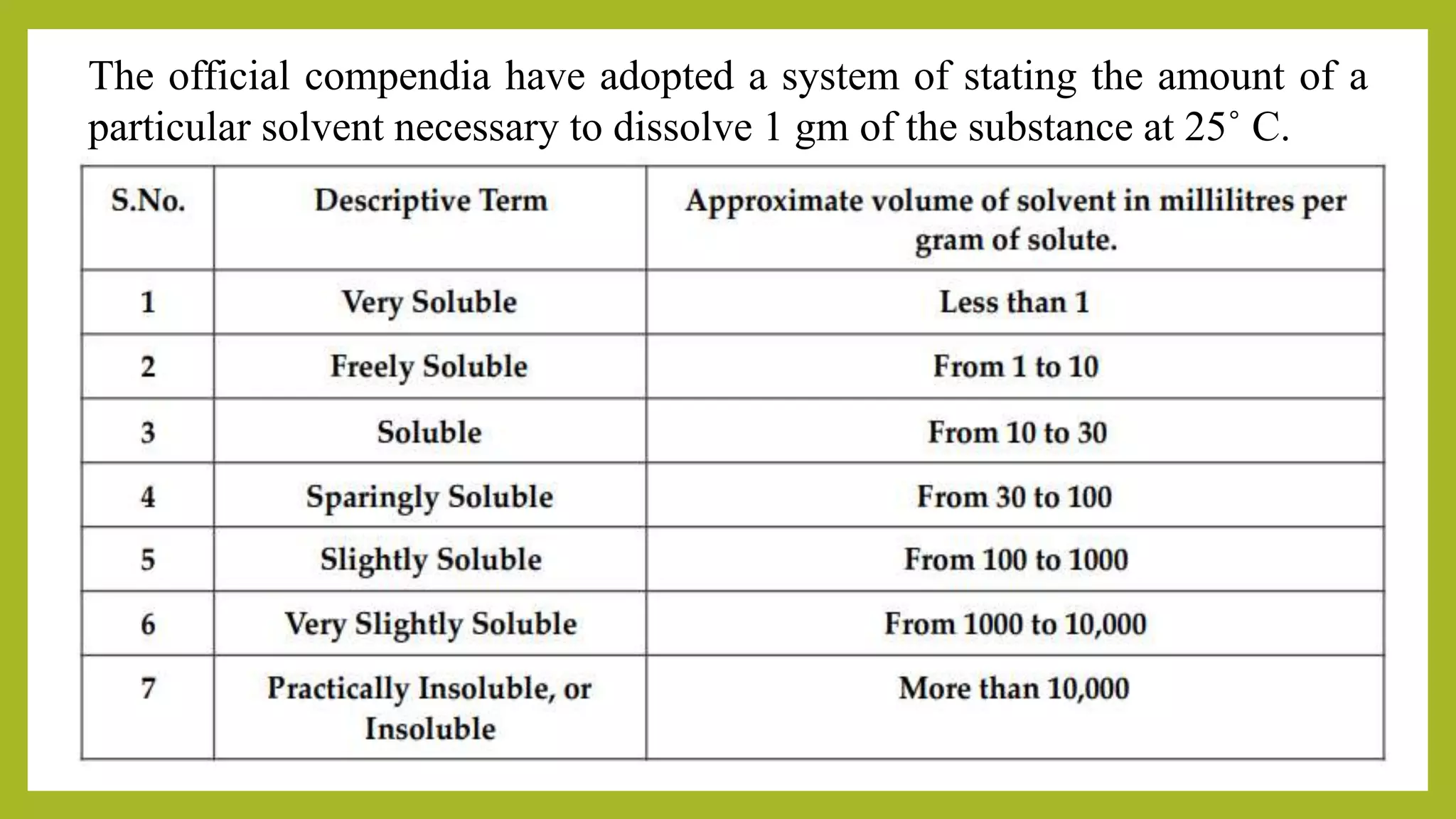
The official compendia have adopted a system of stating the amount of a
particular solvent necessary to dissolve 1 gm of the substance at 25˚ C.
Methods of expressing concentration

Methods of expressing concentration

  • 1.
    KOTA COLLEGE OF PHARMACY Mr.Pradeep Swarnkar Associate Professor METHODS OF EXPRESSING CONCENTRATION
  • 2.
    METHODS OF EXPRESSINGCONCENTRATION
  • 3.
    Solutions may bedescribed as single phase systems composed of two or more chemical substances representing homogeneous molecular dispersion. The properties of a solution are uniform throughout the mixture because the dispersion of the solute molecules in the solvent is on a molecular scale, making the molecules indistinguishable by usual observation procedures. Concentration of solution is the amount of solute dissolved in a known amount of the solvent or solution.
  • 4.
  • 5.
  • 6.
    a) Percent w/w(%w/w) – (Percentage weight in weight) expresses the number of grams of solute in 100 gm of product. The concentrations of strong acids, as available commercially, are expressed in this way. e.g. H2SO4 98.0% w/w; CH3COOH 33% w/w etc. Also expressing the percentage purity of the solid dosage forms such as tablets, capsules etc. as percent weight/weight (%w/w).
  • 7.
    b) Percent w/v(%w/v) – (Percentage weight in volume) It expresses the number of grams of solute in 100 ml of product. (i.e. 100 ml of solution). This is a common way of specifying solution composition of mixtures of miscible liquids, or solids in liquids. e.g. H2O2 solution 5-7% w/v; BaCl2 solution 10% w/v etc.
  • 8.
    c) Percent v/v(%v/v) – (Percentage volume in volume) It expresses the number of millilitres of solute in 100 ml of product. e.g. Alcohol 95% v/v.
  • 9.
    d) Percent v/w(%v/w) – (Percentage volume in weight) It expresses the number of millilitres of solute in 100 gm of product.
  • 10.
    e) Parts permillion (ppm) – When the concentration of a solution is expressed as parts per million (ppm), it means weight in weight , unless otherwise specified. ppm- the number of grams of solute contained in 106 gm of solution. e.g. In the limit test of chloride 25 ppm of Cl.
  • 11.
    CHEMICAL METHODS OFEXPRESSING CONCENTRATION
  • 12.
    1. Molarity (M): The molarity of a solution expresses the number of moles (gram- molecular weights) of solute contained in1000 ml (1 Litre) of solution. A solution containing 1 mole of solute in each litre of total solution is said to be a one molar (M) solution.
  • 13.
    2. Molality (m): The molality of a solution expresses as the number of moles of a solute contained in 1000 gm of a solvent. This method of denoting concentration is used in many equations to express thermodynamic properties of solutions.
  • 14.
    3. Normality (N): The normality of a solution expresses the number of equivalents (gramequivalent weight) of the solute in one litre of solution. This is generally a much more useful expression since it is directly related to reactive concentrations of various species in solution.
  • 15.
    4. Equivalent weightof Acid Equivalent weight of the substance is that weight which contains 1 gm of replaceable hydrogen ion (1.008 gm).
  • 16.
    5. Equivalent weightof Base Equivalent weight of base is that weight which contains one gram of replaceable hydroxyl groups i.e., 17.008 gm of hydroxyl ion.
  • 17.
    6. Saturated solution: A saturated solution is one which has dissolved all the solute it is capable of holding at a given temperature. The temperature is a very crucial aspect of saturated solutions, and unless otherwise specified, the temperature is assumed to be 25˚C. An example of a saturated solution is Boric acid solution used as an Eye wash. The concentration of this solution is near enough to saturation (4.5 – 5 %) that a drop to below usual temperature will cause the boric acid to crystallize from the solution. This represents a caution to its use in the eye. If crystals are present, the solution should be warmed to dissolve them.
  • 18.
    7. Formality (F): Formality may be defined as the number of gram formula weight (GFW) of the solute dissolved per litre of solution. Formality (F) = GFW/Litres of solution
  • 19.
    The official compendiahave adopted a system of stating the amount of a particular solvent necessary to dissolve 1 gm of the substance at 25˚ C.