1
Digital Modulation
Various Forms:
A. Amplitude Shift Keying (ASK) / On-Off Keying (OOK): BASK, MASK
B. Frequency Shift Keying (FSK): BFSK, MSK, MFSK
C. Phase Shift Keying (PSK): BPSK, MPSK, DPSK, QPSK, OQPSK
D. Quadrature Amplitude Modulation (QAM) = ASK+PSK: MQAM
Can also be categorized as:
1. Binary modulation: BASK, BFSK, BPSK
2. M-ary modulation: MASK, MFSK, MPSK, MQAM
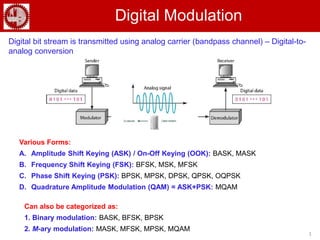
Digital bit stream is transmitted using analog carrier (bandpass channel) – Digital-to-
analog conversion
2
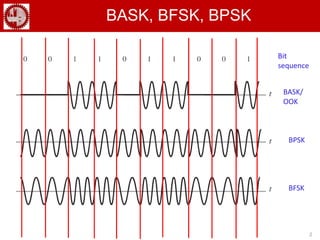
BASK, BFSK, BPSK
BASK/
OOK
BPSK
BFSK
Bit
sequence
3
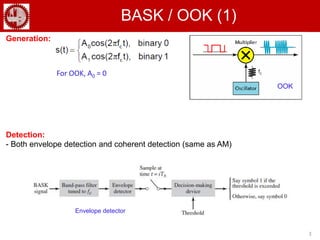
BASK / OOK (1)
Generation:
Detection:
- Both envelope detection and coherent detection (same as AM)
For OOK, A0 = 0
OOK
Envelope detector
s(t)
4
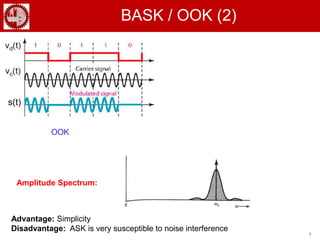
BASK / OOK (2)
Advantage: Simplicity
Disadvantage: ASK is very susceptible to noise interference
Amplitude Spectrum:
OOK
5
BFSK (1)
Advantage: FSK is less susceptible to noise than ASK
Disadvantage: Bandwidth twice that of ASK
Generation:
Amplitude Spectrum:
 
 
 



0for,2cos
1for,2cos
0
1
tfA
tfA
ts
C
C


s(t)
s(t)
6
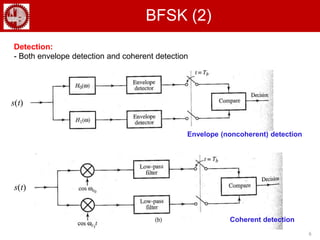
BFSK (2)
Envelope (noncoherent) detection
Detection:
- Both envelope detection and coherent detection
Coherent detection
7
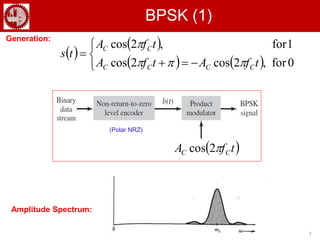
BPSK (1)
Generation:
Amplitude Spectrum:
 
 
   




0for,2cos2cos
1for,2cos
tfAtfA
tfA
ts
CCCC
CC


(Polar NRZ)
 tfA CC 2cos
8
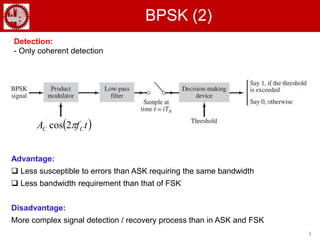
BPSK (2)
Detection:
- Only coherent detection
Advantage:
 Less susceptible to errors than ASK requiring the same bandwidth
 Less bandwidth requirement than that of FSK
Disadvantage:
More complex signal detection / recovery process than in ASK and FSK
 tfA CC 2cos
9
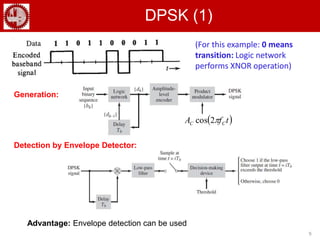
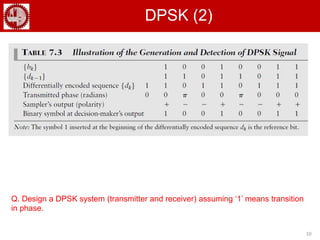
DPSK (1)
Generation:
(For this example: 0 means
transition: Logic network
performs XNOR operation)
Detection by Envelope Detector:
Advantage: Envelope detection can be used
 tfA CC 2cos
10
DPSK (2)
Q. Design a DPSK system (transmitter and receiver) assuming ‘1’ means transition
in phase.
11
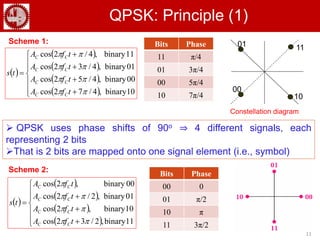
QPSK: Principle (1)
 
 
 
 
 










11binary,2/32cos
10binary,2cos
01binary,2/2cos
00binary,2cos




tfA
tfA
tfA
tfA
ts
CC
CC
CC
CC
Bits Phase
00 0
01 π/2
10 π
11 3π/2
 
 
 
 
 











10binary,4/72cos
00binary,4/52cos
10binary,4/32cos
11binary,4/2cos




tfA
tfA
tfA
tfA
ts
CC
CC
CC
CC
Bits Phase
11 π/4
01 3π/4
00 5π/4
10 7π/4
11
00
10
01
 QPSK uses phase shifts of 90o ⇒ 4 different signals, each
representing 2 bits
That is 2 bits are mapped onto one signal element (i.e., symbol)
Scheme 1:
Scheme 2:
Constellation diagram
12
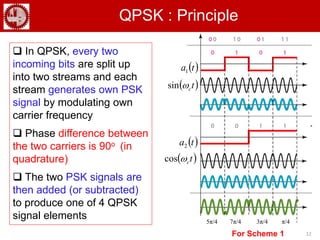
QPSK : Principle
 In QPSK, every two
incoming bits are split up
into two streams and each
stream generates own PSK
signal by modulating own
carrier frequency
 Phase difference between
the two carriers is 90o (in
quadrature)
 The two PSK signals are
then added (or subtracted)
to produce one of 4 QPSK
signal elements
 ta2
 ta1
 tcsin
 tccos
5π/4 7π/4 3π/4 π/4
For Scheme 1
13
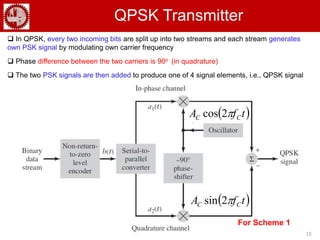
QPSK Transmitter
 In QPSK, every two incoming bits are split up into two streams and each stream generates
own PSK signal by modulating own carrier frequency
 Phase difference between the two carriers is 90o (in quadrature)
 The two PSK signals are then added to produce one of 4 signal elements, i.e., QPSK signal
 tfA CC 2cos
 tfA CC 2sin

For Scheme 1
14
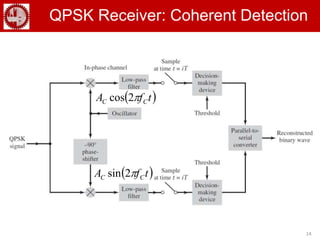
QPSK Receiver: Coherent Detection
 tfA CC 2cos
 tfA CC 2sin
15
QPSK
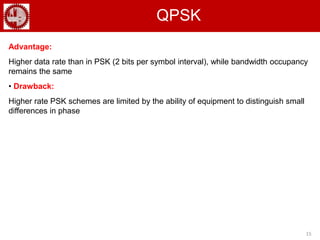
Advantage:
Higher data rate than in PSK (2 bits per symbol interval), while bandwidth occupancy
remains the same
• Drawback:
Higher rate PSK schemes are limited by the ability of equipment to distinguish small
differences in phase
16
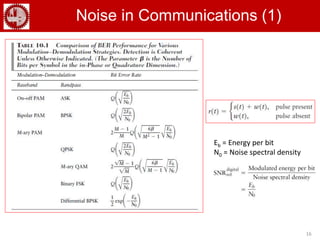
Noise in Communications (1)
Eb = Energy per bit
N0 = Noise spectral density
17
Noise in Communications (2)
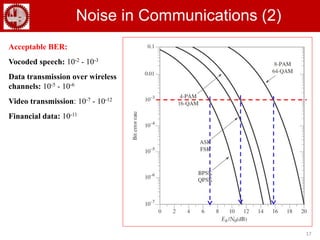
Acceptable BER:
Vocoded speech: 10-2 - 10-3
Data transmission over wireless
channels: 10-5 - 10-6
Video transmission: 10-7 - 10-12
Financial data: 10-11
18
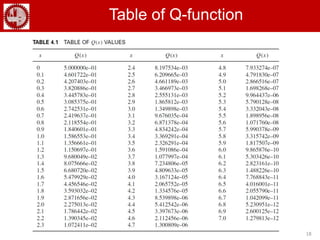
Table of Q-function

Digital Modulation

  • 1.
    1 Digital Modulation Various Forms: A.Amplitude Shift Keying (ASK) / On-Off Keying (OOK): BASK, MASK B. Frequency Shift Keying (FSK): BFSK, MSK, MFSK C. Phase Shift Keying (PSK): BPSK, MPSK, DPSK, QPSK, OQPSK D. Quadrature Amplitude Modulation (QAM) = ASK+PSK: MQAM Can also be categorized as: 1. Binary modulation: BASK, BFSK, BPSK 2. M-ary modulation: MASK, MFSK, MPSK, MQAM Digital bit stream is transmitted using analog carrier (bandpass channel) – Digital-to- analog conversion
  • 2.
  • 3.
    3 BASK / OOK(1) Generation: Detection: - Both envelope detection and coherent detection (same as AM) For OOK, A0 = 0 OOK Envelope detector
  • 4.
    s(t) 4 BASK / OOK(2) Advantage: Simplicity Disadvantage: ASK is very susceptible to noise interference Amplitude Spectrum: OOK
  • 5.
    5 BFSK (1) Advantage: FSKis less susceptible to noise than ASK Disadvantage: Bandwidth twice that of ASK Generation: Amplitude Spectrum:          0for,2cos 1for,2cos 0 1 tfA tfA ts C C  
  • 6.
    s(t) s(t) 6 BFSK (2) Envelope (noncoherent)detection Detection: - Both envelope detection and coherent detection Coherent detection
  • 7.
    7 BPSK (1) Generation: Amplitude Spectrum:            0for,2cos2cos 1for,2cos tfAtfA tfA ts CCCC CC   (Polar NRZ)  tfA CC 2cos
  • 8.
    8 BPSK (2) Detection: - Onlycoherent detection Advantage:  Less susceptible to errors than ASK requiring the same bandwidth  Less bandwidth requirement than that of FSK Disadvantage: More complex signal detection / recovery process than in ASK and FSK  tfA CC 2cos
  • 9.
    9 DPSK (1) Generation: (For thisexample: 0 means transition: Logic network performs XNOR operation) Detection by Envelope Detector: Advantage: Envelope detection can be used  tfA CC 2cos
  • 10.
    10 DPSK (2) Q. Designa DPSK system (transmitter and receiver) assuming ‘1’ means transition in phase.
  • 11.
    11 QPSK: Principle (1)                    11binary,2/32cos 10binary,2cos 01binary,2/2cos 00binary,2cos     tfA tfA tfA tfA ts CC CC CC CC Bits Phase 00 0 01 π/2 10 π 11 3π/2                      10binary,4/72cos 00binary,4/52cos 10binary,4/32cos 11binary,4/2cos     tfA tfA tfA tfA ts CC CC CC CC Bits Phase 11 π/4 01 3π/4 00 5π/4 10 7π/4 11 00 10 01  QPSK uses phase shifts of 90o ⇒ 4 different signals, each representing 2 bits That is 2 bits are mapped onto one signal element (i.e., symbol) Scheme 1: Scheme 2: Constellation diagram
  • 12.
    12 QPSK : Principle In QPSK, every two incoming bits are split up into two streams and each stream generates own PSK signal by modulating own carrier frequency  Phase difference between the two carriers is 90o (in quadrature)  The two PSK signals are then added (or subtracted) to produce one of 4 QPSK signal elements  ta2  ta1  tcsin  tccos 5π/4 7π/4 3π/4 π/4 For Scheme 1
  • 13.
    13 QPSK Transmitter  InQPSK, every two incoming bits are split up into two streams and each stream generates own PSK signal by modulating own carrier frequency  Phase difference between the two carriers is 90o (in quadrature)  The two PSK signals are then added to produce one of 4 signal elements, i.e., QPSK signal  tfA CC 2cos  tfA CC 2sin  For Scheme 1
  • 14.
    14 QPSK Receiver: CoherentDetection  tfA CC 2cos  tfA CC 2sin
  • 15.
    15 QPSK Advantage: Higher data ratethan in PSK (2 bits per symbol interval), while bandwidth occupancy remains the same • Drawback: Higher rate PSK schemes are limited by the ability of equipment to distinguish small differences in phase
  • 16.
    16 Noise in Communications(1) Eb = Energy per bit N0 = Noise spectral density
  • 17.
    17 Noise in Communications(2) Acceptable BER: Vocoded speech: 10-2 - 10-3 Data transmission over wireless channels: 10-5 - 10-6 Video transmission: 10-7 - 10-12 Financial data: 10-11
  • 18.