

PHARMACOVIGILANCE (PV)
SANDEEP MEWADA
B.PHARMACY
PATEL COLLEGE OF
PHARMACY BHOPAL
PHARMACOVIGILANCE (PV)
1
2
3
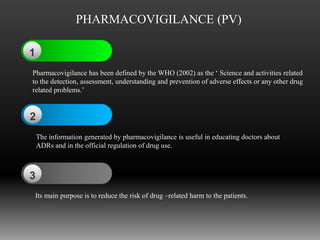
Pharmacovigilance has been defined by the WHO (2002) as the ‘ Science and activities related
to the detection, assessment, understanding and prevention of adverse effects or any other drug
related problems.’
The information generated by pharmacovigilance is useful in educating doctors about
ADRs and in the official regulation of drug use.
Its main purpose is to reduce the risk of drug –related harm to the patients.
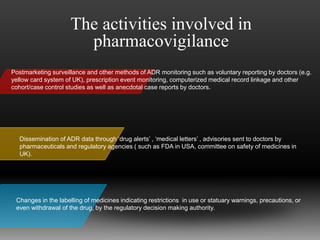
Postmarketing surveillance and other methods of ADR monitoring such as voluntary reporting by doctors (e.g.
yellow card system of UK), prescription event monitoring, computerized medical record linkage and other
cohort/case control studies as well as anecdotal case reports by doctors.
Dissemination of ADR data through ‘drug alerts’ , ‘medical letters’ , advisories sent to doctors by
pharmaceuticals and regulatory agencies ( such as FDA in USA, committee on safety of medicines in
UK).
Changes in the labelling of medicines indicating restrictions in use or statuary warnings, precautions, or
even withdrawal of the drug, by the regulatory decision making authority.
The activities involved in
pharmacovigilance
1
2
3
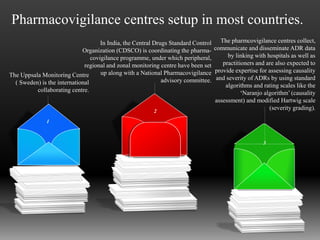
Pharmacovigilance centres setup in most countries.
The Uppsala Monitoring Centre
( Sweden) is the international
collaborating centre.
In India, the Central Drugs Standard Control
Organization (CDSCO) is coordinating the pharma-
covigilance programme, under which peripheral,
regional and zonal monitoring centre have been set
up along with a National Pharmacovigilance
advisory committee.
The pharmcovigilance centres collect,
communicate and disseminate ADR data
by linking with hospitals as well as
practitioners and are also expected to
provide expertise for assessing causality
and severity of ADRs by using standard
algorithms and rating scales like the
‘Naranjo algorithm’ (causality
assessment) and modified Hartwig scale
(severity grading).
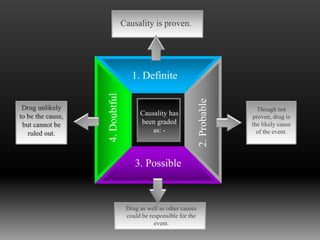
Causality has
been graded
as: -
Drug unlikely
to be the cause,
but cannot be
ruled out.
Though not
proven, drug is
the likely cause
of the event.
Causality is proven.
Drug as well as other causes
could be responsible for the
event.
3. Possible
1. Definite
4.
Doubtful
2.
Probable
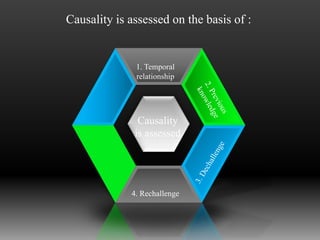
Causality is assessed on the basis of :
Causality
is assessed
4. Rechallenge
1. Temporal
relationship
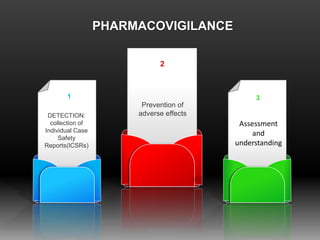
PHARMACOVIGILANCE
1
DETECTION:
collection of
Individual Case
Safety
Reports(ICSRs)
3
Assessment
and
understanding
2
Prevention of
adverse effects
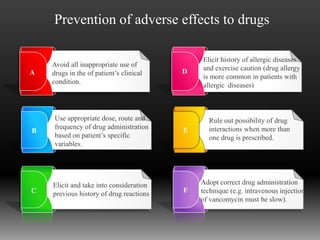
Prevention of adverse effects to drugs
Avoid all inappropriate use of
drugs in the of patient’s clinical
condition.
A
Use appropriate dose, route and
frequency of drug administration
based on patient’s specific
variables.
Elicit and take into consideration
previous history of drug reactions
Elicit history of allergic diseases
and exercise caution (drug allergy
is more common in patients with
allergic diseases)
Rule out possibility of drug
interactions when more than
one drug is prescribed.
Adopt correct drug administration
technique (e.g. intravenous injection
of vancomycin must be slow).
B
C
D
E
F
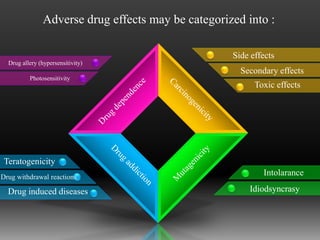
Adverse drug effects may be categorized into :
Drug allery (hypersensitivity)
Photosensitivity
Intolarance
Idiodsyncrasy
Teratogenicity
Drug withdrawal reactions
Drug induced diseases
Side effects
Secondary effects
Toxic effects
REFERENCE
Tripathi, K. D. 2019. Essentials of Medical Pharmacology. 8th ed. New
Delhi, India: Jaypee Brothers Medical. Page No. 93 -101
https://globalpharmacovigilance.com/free-online-pharmacovigilance-
courses/
Pharmacovigilance (PV)

Pharmacovigilance (PV)

  • 1.
  • 2.
    PHARMACOVIGILANCE (PV) 1 2 3 Pharmacovigilance hasbeen defined by the WHO (2002) as the ‘ Science and activities related to the detection, assessment, understanding and prevention of adverse effects or any other drug related problems.’ The information generated by pharmacovigilance is useful in educating doctors about ADRs and in the official regulation of drug use. Its main purpose is to reduce the risk of drug –related harm to the patients.
  • 3.
    Postmarketing surveillance andother methods of ADR monitoring such as voluntary reporting by doctors (e.g. yellow card system of UK), prescription event monitoring, computerized medical record linkage and other cohort/case control studies as well as anecdotal case reports by doctors. Dissemination of ADR data through ‘drug alerts’ , ‘medical letters’ , advisories sent to doctors by pharmaceuticals and regulatory agencies ( such as FDA in USA, committee on safety of medicines in UK). Changes in the labelling of medicines indicating restrictions in use or statuary warnings, precautions, or even withdrawal of the drug, by the regulatory decision making authority. The activities involved in pharmacovigilance
  • 4.
    1 2 3 Pharmacovigilance centres setupin most countries. The Uppsala Monitoring Centre ( Sweden) is the international collaborating centre. In India, the Central Drugs Standard Control Organization (CDSCO) is coordinating the pharma- covigilance programme, under which peripheral, regional and zonal monitoring centre have been set up along with a National Pharmacovigilance advisory committee. The pharmcovigilance centres collect, communicate and disseminate ADR data by linking with hospitals as well as practitioners and are also expected to provide expertise for assessing causality and severity of ADRs by using standard algorithms and rating scales like the ‘Naranjo algorithm’ (causality assessment) and modified Hartwig scale (severity grading).
  • 5.
    Causality has been graded as:- Drug unlikely to be the cause, but cannot be ruled out. Though not proven, drug is the likely cause of the event. Causality is proven. Drug as well as other causes could be responsible for the event. 3. Possible 1. Definite 4. Doubtful 2. Probable
  • 6.
    Causality is assessedon the basis of : Causality is assessed 4. Rechallenge 1. Temporal relationship
  • 7.
  • 8.
    Prevention of adverseeffects to drugs Avoid all inappropriate use of drugs in the of patient’s clinical condition. A Use appropriate dose, route and frequency of drug administration based on patient’s specific variables. Elicit and take into consideration previous history of drug reactions Elicit history of allergic diseases and exercise caution (drug allergy is more common in patients with allergic diseases) Rule out possibility of drug interactions when more than one drug is prescribed. Adopt correct drug administration technique (e.g. intravenous injection of vancomycin must be slow). B C D E F
  • 9.
    Adverse drug effectsmay be categorized into : Drug allery (hypersensitivity) Photosensitivity Intolarance Idiodsyncrasy Teratogenicity Drug withdrawal reactions Drug induced diseases Side effects Secondary effects Toxic effects
  • 10.
    REFERENCE Tripathi, K. D.2019. Essentials of Medical Pharmacology. 8th ed. New Delhi, India: Jaypee Brothers Medical. Page No. 93 -101 https://globalpharmacovigilance.com/free-online-pharmacovigilance- courses/