UNDERSTANDING OF CHEMICAL
CARCINOGENESIS:
CURRENTAND FUTURE PERSPECTIVES
Chander K Negi
Chandernegi09@gmail.com
1
TABLE OF CONTENTS
• INTRODUCTION
• CLASSIFICATION OF CHEMICAL CARCINOGENS
• MECHANISM OF ACTION
• ROLE OF OXIDATIVE STRESS
• CURRENT AND FUTURE PERSPECTIVES
• REGULATORY BACKGROUND
• CONCLUSION
2
INTRODUCTION
Carcinogenesis refers to the process by which a normal
cell is transformed into a malignant cell and repeatedly
divides to become a cancer
Chemicals which initiate this process is called chemical
carcinogens
Chemicals which increase the effectiveness of
carcinogens is called co-carcinogens 3
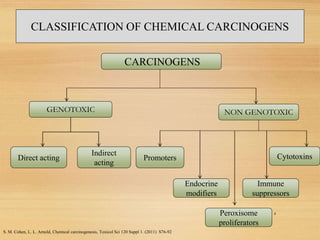
CLASSIFICATION OF CHEMICAL CARCINOGENS
4
CARCINOGENS
NON GENOTOXICGENOTOXIC
Direct acting
Indirect
acting
Promoters Cytotoxins
Endocrine
modifiers
Peroxisome
proliferators
Immune
suppressors
S. M. Cohen, L. L. Arnold, Chemical carcinogenesis, Toxicol Sci 120 Suppl 1. (2011) S76-92
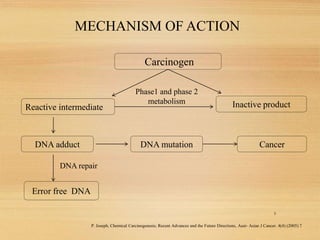
MECHANISM OF ACTION
5
Carcinogen
Inactive productReactive intermediate
DNA adduct DNA mutation Cancer
Error free DNA
DNA repair
Phase1 and phase 2
metabolism
P. Joseph, Chemical Carcinogenesis; Recent Advances and the Future Directions, Aust- Asian J Cancer. 4(4) (2005) 7
STAGES OF CARCINOGENESIS
6
Chemicals
Normal cells
Initiated cells
INITIATION PROMOTION
DNA repair Cellular
proliferation
PROGRESSION
CANCER
MULTISTEP PROCESS
L. A. Loeb, Harris C C, Advances in chemical carcinogenesis: a historical review and prospective, Cancer Res.
68(17) (2008) 6863-6872.
ROLE OF PROTO-ONCOGENES AND TUMOR
SUPPRESSOR GENES
Two classes of genes are mainly involved in carcinogenesis
1. Proto oncogenes
 Involved in growth and differentiation
 Activated in cancers
2. Tumor suppressor genes
 Negative regulators of growth
 Inactivated in cancers
7
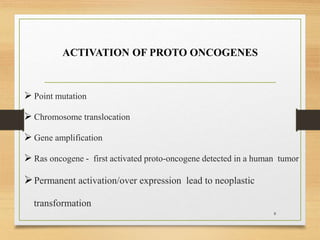
ACTIVATION OF PROTO ONCOGENES
 Point mutation
 Chromosome translocation
 Gene amplification
 Ras oncogene - first activated proto-oncogene detected in a human tumor
Permanent activation/over expression lead to neoplastic
transformation
8
 Mutations of the Ras gene lower the GTPase activity of the protein .
 locks Ras in the permanently active GTP-bound form
 eventually lead to uncontrolled proliferation and transformation.
9A. Luch, Nature and nurture - lessons from chemical carcinogenesis, Nat Rev Cancer .5(2) (2005) 113-125
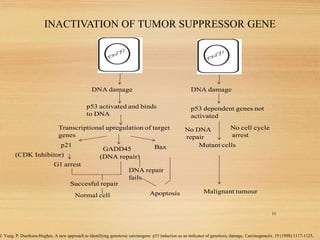
INACTIVATION OF TUMOR SUPPRESSOR GENE
DNA damage DNA damage
p53 activated and binds
to DNA
p53 dependent genes not
activated
Transcriptional upregulation of target
genes
p21
(CDK Inhibitor)
GADD45
(DNA repair)
Bax Mutant cells
G1 arrest
Succesful repair
Apoptosis
No cell cycle
arrest
No DNA
repair
Malignant tumour
Normal cell
DNA repair
fails
10
J. Yang, P. Duerksen-Hughes, A new approach to identifying genotoxic carcinogens: p53 induction as an indicator of genotoxic damage, Carcinogenesis. 19 (1998) 1117-1125.
OXIDATIVE STRESS IN CARCINOGENESIS
• ROS can be produced from both endogenous and exogenous sources
• Attack both purine and pyrimidine bases, as well as the deoxyribose
backbone
• Induces DNA damage which includes single or double-strand
breakage, deoxyribose modification, and DNA cross-link
• If DNA damage is not properly repaired it may result in mutation
which leads to cancer
11
CURRENT PERSPECTIVES
12
NEW
TECHNO-
LOGIES
Micro
array
DD
SSH
SAGE
Ι. IMPACT OF TECHNOLOGIES
P. Joseph, Chemical Carcinogenesis; Recent Advances and the Future Directions, Aust- Asian J Cancer. 4(4) (2005) 7
ΙΙ. BIOMARKERS
ΙΙΙ. BIOSENSORS
• Device that contains two main components including a sensing
receptor and a detector
• Improve the sensitivity and specificity of the biomarker
• Effective early detection without pain with a noninvasive technique.
13
• Carcinoembryonic antigen (CEA) - breast cancer
• Neuron specific enolase (NSE) - lung cancer
• α-fetoprotein (AFP) - liver cancer
• Prostate specific antigen (PSA) - prostate cancer
Z. Altintas, I. Tothill, Biomarkers and biosensors for the early diagnosis of lung cancer, Sensors
and Actuators B: Chemical. 188(0) (2013) 988-998
FUTURE DIRECTIONS
Development of new preclinical models for carcinogenesis
 Future challenge is to develop and validate biomarkers for non
genotoxic chemical carcinogens
Understanding chemical carcinogenesis with
Inter-individual variation
Alteration in gene expression
14
REGULATORY BACKGROUND
OECD guidelines
 451- Carcinogenecity studies
 453- Combined chronic toxicity/carcinogenecity
ICH guidelines
 S1A- Guideline on the need for carcinogenicity studies of
pharmaceuticals
 S1B- Testing for carcinogenicity of pharmaceuticals
 S1C- Dose selection for carcinogenicity studies of
pharmaceuticals
15
CONCLUSION
• Though remarkable progress has been achieved in understanding
chemical carcinogenesis, still it remain leading cause for death in
world
• Currently the development in genomics, proteomics and
informatics for identification and validation of biomarkers enable
us to determine chemical basis of carcinogenesis
• Understanding at molecular level is perhaps most important step
in developing strategies to prevent incidence of chemical
carcinogenesis 16
17

Carcinogenesis

  • 1.
    UNDERSTANDING OF CHEMICAL CARCINOGENESIS: CURRENTANDFUTURE PERSPECTIVES Chander K Negi Chandernegi09@gmail.com 1
  • 2.
    TABLE OF CONTENTS •INTRODUCTION • CLASSIFICATION OF CHEMICAL CARCINOGENS • MECHANISM OF ACTION • ROLE OF OXIDATIVE STRESS • CURRENT AND FUTURE PERSPECTIVES • REGULATORY BACKGROUND • CONCLUSION 2
  • 3.
    INTRODUCTION Carcinogenesis refers tothe process by which a normal cell is transformed into a malignant cell and repeatedly divides to become a cancer Chemicals which initiate this process is called chemical carcinogens Chemicals which increase the effectiveness of carcinogens is called co-carcinogens 3
  • 4.
    CLASSIFICATION OF CHEMICALCARCINOGENS 4 CARCINOGENS NON GENOTOXICGENOTOXIC Direct acting Indirect acting Promoters Cytotoxins Endocrine modifiers Peroxisome proliferators Immune suppressors S. M. Cohen, L. L. Arnold, Chemical carcinogenesis, Toxicol Sci 120 Suppl 1. (2011) S76-92
  • 5.
    MECHANISM OF ACTION 5 Carcinogen InactiveproductReactive intermediate DNA adduct DNA mutation Cancer Error free DNA DNA repair Phase1 and phase 2 metabolism P. Joseph, Chemical Carcinogenesis; Recent Advances and the Future Directions, Aust- Asian J Cancer. 4(4) (2005) 7
  • 6.
    STAGES OF CARCINOGENESIS 6 Chemicals Normalcells Initiated cells INITIATION PROMOTION DNA repair Cellular proliferation PROGRESSION CANCER MULTISTEP PROCESS L. A. Loeb, Harris C C, Advances in chemical carcinogenesis: a historical review and prospective, Cancer Res. 68(17) (2008) 6863-6872.
  • 7.
    ROLE OF PROTO-ONCOGENESAND TUMOR SUPPRESSOR GENES Two classes of genes are mainly involved in carcinogenesis 1. Proto oncogenes  Involved in growth and differentiation  Activated in cancers 2. Tumor suppressor genes  Negative regulators of growth  Inactivated in cancers 7
  • 8.
    ACTIVATION OF PROTOONCOGENES  Point mutation  Chromosome translocation  Gene amplification  Ras oncogene - first activated proto-oncogene detected in a human tumor Permanent activation/over expression lead to neoplastic transformation 8
  • 9.
     Mutations ofthe Ras gene lower the GTPase activity of the protein .  locks Ras in the permanently active GTP-bound form  eventually lead to uncontrolled proliferation and transformation. 9A. Luch, Nature and nurture - lessons from chemical carcinogenesis, Nat Rev Cancer .5(2) (2005) 113-125
  • 10.
    INACTIVATION OF TUMORSUPPRESSOR GENE DNA damage DNA damage p53 activated and binds to DNA p53 dependent genes not activated Transcriptional upregulation of target genes p21 (CDK Inhibitor) GADD45 (DNA repair) Bax Mutant cells G1 arrest Succesful repair Apoptosis No cell cycle arrest No DNA repair Malignant tumour Normal cell DNA repair fails 10 J. Yang, P. Duerksen-Hughes, A new approach to identifying genotoxic carcinogens: p53 induction as an indicator of genotoxic damage, Carcinogenesis. 19 (1998) 1117-1125.
  • 11.
    OXIDATIVE STRESS INCARCINOGENESIS • ROS can be produced from both endogenous and exogenous sources • Attack both purine and pyrimidine bases, as well as the deoxyribose backbone • Induces DNA damage which includes single or double-strand breakage, deoxyribose modification, and DNA cross-link • If DNA damage is not properly repaired it may result in mutation which leads to cancer 11
  • 12.
    CURRENT PERSPECTIVES 12 NEW TECHNO- LOGIES Micro array DD SSH SAGE Ι. IMPACTOF TECHNOLOGIES P. Joseph, Chemical Carcinogenesis; Recent Advances and the Future Directions, Aust- Asian J Cancer. 4(4) (2005) 7
  • 13.
    ΙΙ. BIOMARKERS ΙΙΙ. BIOSENSORS •Device that contains two main components including a sensing receptor and a detector • Improve the sensitivity and specificity of the biomarker • Effective early detection without pain with a noninvasive technique. 13 • Carcinoembryonic antigen (CEA) - breast cancer • Neuron specific enolase (NSE) - lung cancer • α-fetoprotein (AFP) - liver cancer • Prostate specific antigen (PSA) - prostate cancer Z. Altintas, I. Tothill, Biomarkers and biosensors for the early diagnosis of lung cancer, Sensors and Actuators B: Chemical. 188(0) (2013) 988-998
  • 14.
    FUTURE DIRECTIONS Development ofnew preclinical models for carcinogenesis  Future challenge is to develop and validate biomarkers for non genotoxic chemical carcinogens Understanding chemical carcinogenesis with Inter-individual variation Alteration in gene expression 14
  • 15.
    REGULATORY BACKGROUND OECD guidelines 451- Carcinogenecity studies  453- Combined chronic toxicity/carcinogenecity ICH guidelines  S1A- Guideline on the need for carcinogenicity studies of pharmaceuticals  S1B- Testing for carcinogenicity of pharmaceuticals  S1C- Dose selection for carcinogenicity studies of pharmaceuticals 15
  • 16.
    CONCLUSION • Though remarkableprogress has been achieved in understanding chemical carcinogenesis, still it remain leading cause for death in world • Currently the development in genomics, proteomics and informatics for identification and validation of biomarkers enable us to determine chemical basis of carcinogenesis • Understanding at molecular level is perhaps most important step in developing strategies to prevent incidence of chemical carcinogenesis 16
  • 17.