By,
Prof. Prashant B. Patil
Assistant Professor,
H R Patel Institute of Pharmaceutical Education and
Research, Shirpur
 Introduction:
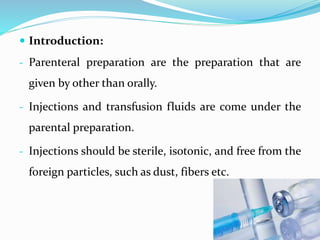
- Parenteral preparation are the preparation that are
given by other than orally.
- Injections and transfusion fluids are come under the
parental preparation.
- Injections should be sterile, isotonic, and free from the
foreign particles, such as dust, fibers etc.
- Injections are the sterile solution and suspension of
drug in aqueous or oily vehicle meant for introduction
in to the body by means of an injectable needle under
or through one or more layer of skin or mucous
membrane.
 Advantages of Parenteral Preparation:
- The drug which are can not be administered by oral route,
can administered by this route.
- The patient who are vomiting or suffering form
unconscious condition, can not able to take the drugs by
orally, can administered by this route.
- The drug action is quick and rapid
- Drug action can be prolonged by modifying the
formulation
- Transfusion fluid are also contain nutritive like glucose and
electrolytes.
 Disadvantages:
- The trained person is required to administer the drug
- Injection causes the pain at the side of injection
- The administration of drug from wrong route of
injection may very dangerous.
- The chances of sensitivity reaction or allergic reaction
of the drug by an individual.
 Route of Administration:
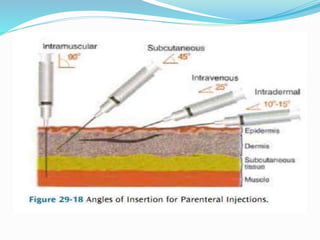
- Intradermal Injection (IC)
- Hypodermis Injection (SC)
- Intramuscular Injection (IM)
- Intravenous Injection (IV)
- Intra Arterial Injection
- Intracardiac Injection
- Intrathecal Injection (surrounding to spinal cord)
- Intracisternal Injection (between first & second
cervical vertebrae) for withdrawing cerebrospinal fluid
- Peridural Injection (inner aspect of vertebra)
- Intra-articular Injection (in bones joint)
- Intracerebral Injection (Cerebrum)
 General Requirement for Parenteral Preparation:
PP required careful consideration of the following
requirement:
- Stability
- Sterility
- Free from Pyrogen
- Free from foreign particles
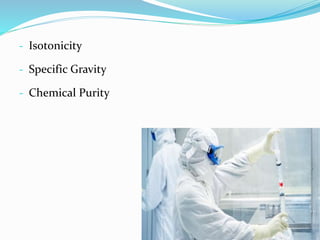
- Isotonicity
- Specific Gravity
- Chemical Purity
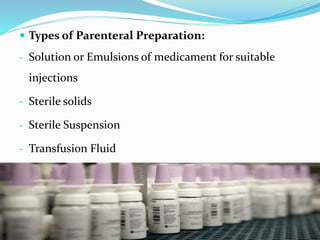
 Types of Parenteral Preparation:
- Solution or Emulsions of medicament for suitable
injections
- Sterile solids
- Sterile Suspension
- Transfusion Fluid
 Formulation of Parenteral Preparation:
- The formulation of parental preparation is the careful
need of planning, through knowledge of the
medicament and adjuvant to be used.
- Following formulating agents are used in the
preparation of parental such as
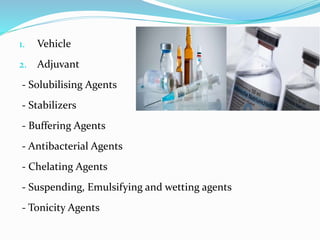
1. Vehicle
2. Adjuvant
- Solubilising Agents
- Stabilizers
- Buffering Agents
- Antibacterial Agents
- Chelating Agents
- Suspending, Emulsifying and wetting agents
- Tonicity Agents
 Units of Concentration:
- Weight per unit volume: Prednisolone 25 mg/ml,
Atropine sulphate injection 60 mg/ml
- Percentage weight per volume: Dextrose Intravenous
Infusion 5 % w/v, Sodium Chloride Intravenous
Infusion 0.9 % w/v
- Millimoles per unit volume: Sodium bicarbonate iv
infusion 150 m.mol each of Na+ and HCO3/liter
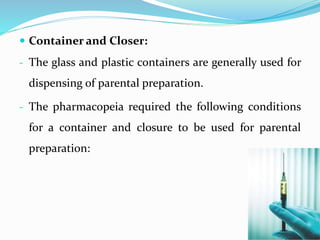
 Container and Closer:
- The glass and plastic containers are generally used for
dispensing of parental preparation.
- The pharmacopeia required the following conditions
for a container and closure to be used for parental
preparation:
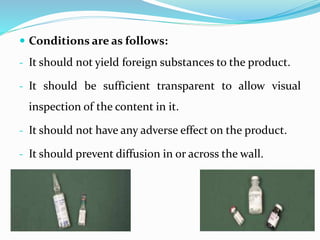
 Conditions are as follows:
- It should not yield foreign substances to the product.
- It should be sufficient transparent to allow visual
inspection of the content in it.
- It should not have any adverse effect on the product.
- It should prevent diffusion in or across the wall.
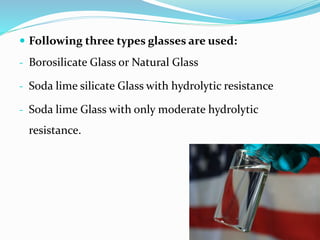
 Following three types glasses are used:
- Borosilicate Glass or Natural Glass
- Soda lime silicate Glass with hydrolytic resistance
- Soda lime Glass with only moderate hydrolytic
resistance.
 Container of type II and III glass should be used once
only. Containers for human blood and blood
components must not be reused.
 Plastics are synthetic polymers are used as containers
for injectables.
 The standard plastic container for parental product are
given in IP
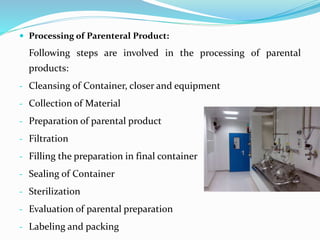
 Processing of Parenteral Product:
Following steps are involved in the processing of parental
products:
- Cleansing of Container, closer and equipment
- Collection of Material
- Preparation of parental product
- Filtration
- Filling the preparation in final container
- Sealing of Container
- Sterilization
- Evaluation of parental preparation
- Labeling and packing
 Evaluation of Parenteral Preparation:
- Sterility Test
- Clarity Test
- Leakage Test
- Pyrogen Test
- Assay
 Sterility Test:
- All the Parenteral preparation are supplied in sterile form.
- The sterility test is strictly carried out under the aseptic
condition in order to avoid accidental contamination.
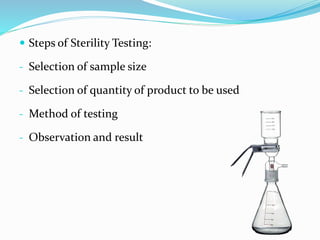
- The Sterility test is must be carried out either by,
i. Membrane Filtration Method
ii. Direct Inoculation Method
 Steps of Sterility Testing:
- Selection of sample size
- Selection of quantity of product to be used
- Method of testing
- Observation and result
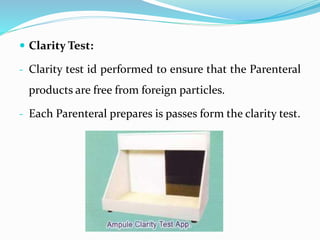
 Clarity Test:
- Clarity test id performed to ensure that the Parenteral
products are free from foreign particles.
- Each Parenteral prepares is passes form the clarity test.
 Leakage Test:
- This test is performed only for the ampoules which have
been sealed by the fusion.
- Leak test is performed in the vacuum chamber, the
ampoules are dipped in methylene blue in vacuum
chamber i.e. Leak test apparatus.
- Then vacuum is applied.
- When vacuum is released the color solution will entered
with defective sealing
- The presence of dyes in the ampoule, confirm the leakage
and hence rejected.
 Pyrogen Test:
- These test is perform for the check the presence or
absence of pyrogen in the Parenteral Preparation.
- These test is involves the measurement of the rise in
body temperature of rabbits following intravenous
injection in marginal ear vein of a sterile solution of
Parenteral preparation is examined.
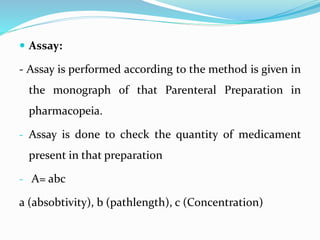
 Assay:
- Assay is performed according to the method is given in
the monograph of that Parenteral Preparation in
pharmacopeia.
- Assay is done to check the quantity of medicament
present in that preparation
- A= abc
a (absobtivity), b (pathlength), c (Concentration)
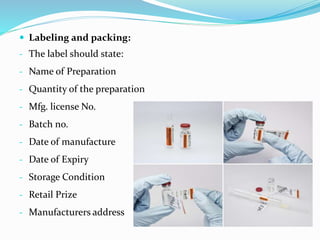
 Labeling and packing:
- The label should state:
- Name of Preparation
- Quantity of the preparation
- Mfg. license No.
- Batch no.
- Date of manufacture
- Date of Expiry
- Storage Condition
- Retail Prize
- Manufacturers address
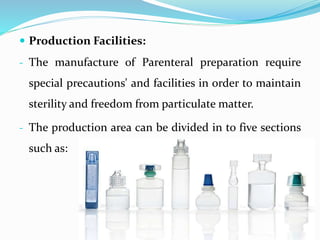
 Production Facilities:
- The manufacture of Parenteral preparation require
special precautions' and facilities in order to maintain
sterility and freedom from particulate matter.
- The production area can be divided in to five sections
such as:
 Clean Up area
 Preparation area
 Aseptic area
 Quarantine area
 Finishing and packing area
 Preparation of Intravenous Fluids:
- Dextrose Injection IP – These are available in conc. of
5, 10, 25 and 50 % w/v/ solution.
- Nacl and Dextrose Injection IP: It contain Nacl from
0.11 to 0.9 % and dextrose from 2.5 to 25 %
- Nacl Injection IP: It contain 0.9 % Nacl, is also called
as normal saline solution.
- Sodium Lactose Injection: It contain 1.75 % to 1.95 %
w/v of sodium lactose. Used as electrolyte replenisher.
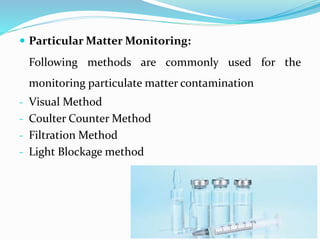
 Particular Matter Monitoring:
Following methods are commonly used for the
monitoring particulate matter contamination
- Visual Method
- Coulter Counter Method
- Filtration Method
- Light Blockage method
Thank You….

Sterile Products

  • 1.
    By, Prof. Prashant B.Patil Assistant Professor, H R Patel Institute of Pharmaceutical Education and Research, Shirpur
  • 2.
     Introduction: - Parenteralpreparation are the preparation that are given by other than orally. - Injections and transfusion fluids are come under the parental preparation. - Injections should be sterile, isotonic, and free from the foreign particles, such as dust, fibers etc.
  • 3.
    - Injections arethe sterile solution and suspension of drug in aqueous or oily vehicle meant for introduction in to the body by means of an injectable needle under or through one or more layer of skin or mucous membrane.
  • 4.
     Advantages ofParenteral Preparation: - The drug which are can not be administered by oral route, can administered by this route. - The patient who are vomiting or suffering form unconscious condition, can not able to take the drugs by orally, can administered by this route. - The drug action is quick and rapid - Drug action can be prolonged by modifying the formulation - Transfusion fluid are also contain nutritive like glucose and electrolytes.
  • 5.
     Disadvantages: - Thetrained person is required to administer the drug - Injection causes the pain at the side of injection - The administration of drug from wrong route of injection may very dangerous. - The chances of sensitivity reaction or allergic reaction of the drug by an individual.
  • 6.
     Route ofAdministration: - Intradermal Injection (IC) - Hypodermis Injection (SC) - Intramuscular Injection (IM) - Intravenous Injection (IV) - Intra Arterial Injection - Intracardiac Injection - Intrathecal Injection (surrounding to spinal cord)
  • 7.
    - Intracisternal Injection(between first & second cervical vertebrae) for withdrawing cerebrospinal fluid - Peridural Injection (inner aspect of vertebra) - Intra-articular Injection (in bones joint) - Intracerebral Injection (Cerebrum)
  • 9.
     General Requirementfor Parenteral Preparation: PP required careful consideration of the following requirement: - Stability - Sterility - Free from Pyrogen - Free from foreign particles
  • 10.
    - Isotonicity - SpecificGravity - Chemical Purity
  • 11.
     Types ofParenteral Preparation: - Solution or Emulsions of medicament for suitable injections - Sterile solids - Sterile Suspension - Transfusion Fluid
  • 12.
     Formulation ofParenteral Preparation: - The formulation of parental preparation is the careful need of planning, through knowledge of the medicament and adjuvant to be used. - Following formulating agents are used in the preparation of parental such as
  • 13.
    1. Vehicle 2. Adjuvant -Solubilising Agents - Stabilizers - Buffering Agents - Antibacterial Agents - Chelating Agents - Suspending, Emulsifying and wetting agents - Tonicity Agents
  • 14.
     Units ofConcentration: - Weight per unit volume: Prednisolone 25 mg/ml, Atropine sulphate injection 60 mg/ml - Percentage weight per volume: Dextrose Intravenous Infusion 5 % w/v, Sodium Chloride Intravenous Infusion 0.9 % w/v - Millimoles per unit volume: Sodium bicarbonate iv infusion 150 m.mol each of Na+ and HCO3/liter
  • 15.
     Container andCloser: - The glass and plastic containers are generally used for dispensing of parental preparation. - The pharmacopeia required the following conditions for a container and closure to be used for parental preparation:
  • 16.
     Conditions areas follows: - It should not yield foreign substances to the product. - It should be sufficient transparent to allow visual inspection of the content in it. - It should not have any adverse effect on the product. - It should prevent diffusion in or across the wall.
  • 17.
     Following threetypes glasses are used: - Borosilicate Glass or Natural Glass - Soda lime silicate Glass with hydrolytic resistance - Soda lime Glass with only moderate hydrolytic resistance.
  • 18.
     Container oftype II and III glass should be used once only. Containers for human blood and blood components must not be reused.  Plastics are synthetic polymers are used as containers for injectables.  The standard plastic container for parental product are given in IP
  • 19.
     Processing ofParenteral Product: Following steps are involved in the processing of parental products: - Cleansing of Container, closer and equipment - Collection of Material - Preparation of parental product - Filtration - Filling the preparation in final container - Sealing of Container - Sterilization - Evaluation of parental preparation - Labeling and packing
  • 20.
     Evaluation ofParenteral Preparation: - Sterility Test - Clarity Test - Leakage Test - Pyrogen Test - Assay
  • 21.
     Sterility Test: -All the Parenteral preparation are supplied in sterile form. - The sterility test is strictly carried out under the aseptic condition in order to avoid accidental contamination. - The Sterility test is must be carried out either by, i. Membrane Filtration Method ii. Direct Inoculation Method
  • 22.
     Steps ofSterility Testing: - Selection of sample size - Selection of quantity of product to be used - Method of testing - Observation and result
  • 23.
     Clarity Test: -Clarity test id performed to ensure that the Parenteral products are free from foreign particles. - Each Parenteral prepares is passes form the clarity test.
  • 24.
     Leakage Test: -This test is performed only for the ampoules which have been sealed by the fusion. - Leak test is performed in the vacuum chamber, the ampoules are dipped in methylene blue in vacuum chamber i.e. Leak test apparatus. - Then vacuum is applied. - When vacuum is released the color solution will entered with defective sealing - The presence of dyes in the ampoule, confirm the leakage and hence rejected.
  • 25.
     Pyrogen Test: -These test is perform for the check the presence or absence of pyrogen in the Parenteral Preparation. - These test is involves the measurement of the rise in body temperature of rabbits following intravenous injection in marginal ear vein of a sterile solution of Parenteral preparation is examined.
  • 26.
     Assay: - Assayis performed according to the method is given in the monograph of that Parenteral Preparation in pharmacopeia. - Assay is done to check the quantity of medicament present in that preparation - A= abc a (absobtivity), b (pathlength), c (Concentration)
  • 27.
     Labeling andpacking: - The label should state: - Name of Preparation - Quantity of the preparation - Mfg. license No. - Batch no. - Date of manufacture - Date of Expiry - Storage Condition - Retail Prize - Manufacturers address
  • 28.
     Production Facilities: -The manufacture of Parenteral preparation require special precautions' and facilities in order to maintain sterility and freedom from particulate matter. - The production area can be divided in to five sections such as:
  • 29.
     Clean Uparea  Preparation area  Aseptic area  Quarantine area  Finishing and packing area
  • 30.
     Preparation ofIntravenous Fluids: - Dextrose Injection IP – These are available in conc. of 5, 10, 25 and 50 % w/v/ solution. - Nacl and Dextrose Injection IP: It contain Nacl from 0.11 to 0.9 % and dextrose from 2.5 to 25 % - Nacl Injection IP: It contain 0.9 % Nacl, is also called as normal saline solution. - Sodium Lactose Injection: It contain 1.75 % to 1.95 % w/v of sodium lactose. Used as electrolyte replenisher.
  • 31.
     Particular MatterMonitoring: Following methods are commonly used for the monitoring particulate matter contamination - Visual Method - Coulter Counter Method - Filtration Method - Light Blockage method
  • 32.