Presented by:
Rohit Kumar
A10647016017
M.Pharm(Pharmaceutics) IVth semester
Department of Pharmaceutics, Amity Institute of Pharmacy,
Amity University, Noida
Table of contents
• Introduction
• Functions of label
• Objective of labeling
• Types of labeling
• Packaging Insert
• Machinery employed
• New developments in labeling technology
• References
• Label means a display of written, printed or
graphic matter upon immediate container or
the wrapper of a drug package
• The term “labeling” designates all labels and
other written, printed, or graphic matter upon
an immediate container of an article or upon,
or in, any package or wrapper in which it is
enclosed, except any outer shipping
container[1].
• Labeling in India
– All labels of a drug should conform as per the
specifications under the Drugs and Cosmetics
Rules 1945.
– That no person sell or distribute any drug unless it
is labeIed in accordance with the Rules (Rule 95 of
D&C Act).
• it includes information regarding
– indications, effects, dosage form, frequency and
duration of administration, warnings, hazards,
contraindications, side effects, precautions and
other relevant information.
• For identification of the product
• Provide ingredients
• Purpose /use of the product
• Child safety
• Other information like maximum retail
price(MRP), Batch No., Shelf-life etc
[2]
The Food and Drug Administration (FDA) requires that drug labeling
be balanced and not misleading. The label must be scientifically
accurate and provide clear instruction to health care
practitioners for prescription drugs and to consumers for over-
the-counter drugs and supplements. Labeling regulations
require that the statement of ingredients must include all
ingredients, in the order in which they are used in the drug.
1. Brand identification
Labeling helps in the identification and principal place of
business of the person by or for whom the prepackaged
product was manufactured, processed, produced or packaged
for resale.
2. Description
Labels provide the information regarding the pharmaceuticals.
It describes the composition, batch no., cost, manufacturing date,
expiry date etc.
3. Promotion
Finally labels helps in promoting the product through
attractive and bright graphics replacing paper labels glued on
bottles.
4. To differentiate Standard and Counterfeit drugs
A counterfeit drug bears an unauthorized representation of a
registered trademark on a product identical or similar to one for
which the trademark is registered.
The use of scratch off label containing a unique code can be
done which if texted to a free no. provides a response from
company server, which will assure the authenticity of product.
The use of unique holograms and designs in labels, which can
not be easily copied.
• The safe use of all medicines depends on
users reading the labeling and packaging
carefully and accurately and being able to
assimilate and act on the information
presented.
• All labels must be clear and concise and must
bear all necessary information regarding the
safe use of a product.
[2]
• Manufacturer label • Dispensing label
• A label which contain drug information for the use of medical
practitioners, pharmacists, or nurses supplied by the
manufacturer, packer, or distributor of the drug.
• Rule 96 of the Drug and Cosmetic Rules (manner of labelling)
mandates the minimum information which needs to be put on the
label of all medicines.
• Legal Requirements:
1. Proprietary name and established name
2. Strength and dosage form.
3. Quantity.
4. Instructions for the use.
5. Precautions & warnings.
6. Manufacturing license no.
7. Batch number.
8. Manufacturing & Expiry date .
9. The name and address of pharmaceutical industry
 Proprietary name/Generic name, Established name and
Compendia name
 Proprietary Name: The exclusive name of a drug substance or
drug product owned by a company under trademark law.
 Established Name: The designated FDA Official name or the
Compendial name.
 Compendial Name: The name of an article for which a
monograph is provided in an official
compendia/pharmacopoeia.
 for drugs included in the India Pharmacopoeia or the official
pharmacopoeia and official compendia of drug standards
prescribed in the rule 124, the name or synonym specified in
the respective followed by letters ‘I.P.’
 Brand name which is used to market the drug.
 Strength and dosage form
 It is amount of active drug per unit dose.
Brand Name
Generic
Name
StrengthDosage
Form
 Manufacturing license no.
 In India, to manufacture any drug, it is required to
get a Mfg. Lic. No. as per Drug and Cosmetic Act,
1945.
 Manufacturing Licences are issued By State Drug
Authorities.
 And it is legally required to mention that no. on the
label.
Quantity
Quantity/volume present per packaging unit.
The container hold 20 tablets and each tablet
has a dosage strength of 500 mg.
Instructions, Precautions and warnings for their Use:
Storage conditions
 Store in cool place: store under 0°c to 8°c
 Protect from light: necessary for light sensitive
formulations.
 Keep out of the reach of children: All dispensed
medicines should carry this information on label
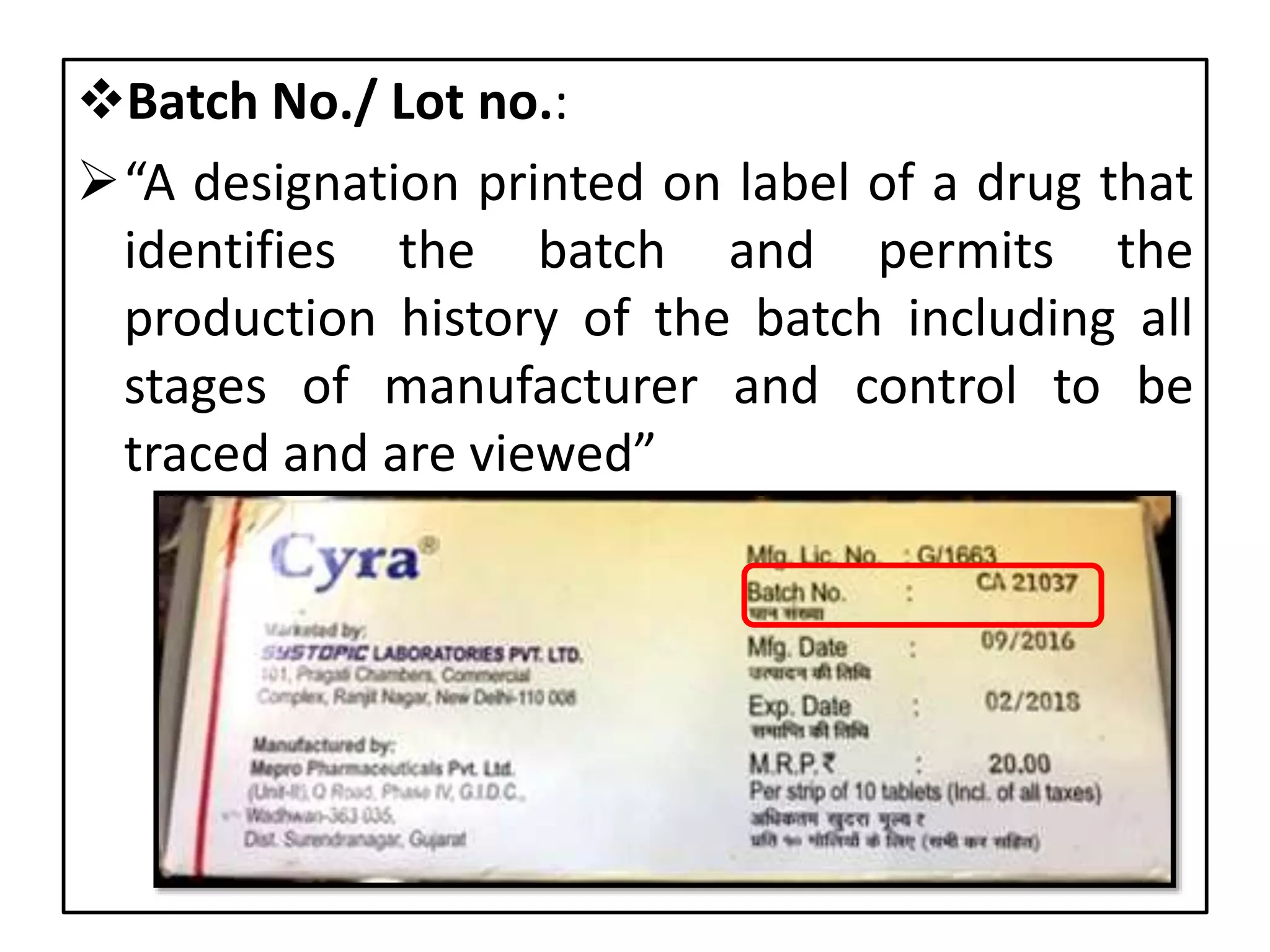
Batch No./ Lot no.:
“A designation printed on label of a drug that
identifies the batch and permits the
production history of the batch including all
stages of manufacturer and control to be
traced and are viewed”
 Manufacturing & Expiry date
 In compliance with Good Manufacturing Practices (GMP)
regulations, the manufacture date printed on the label
represents the date the product was produced.
 Date stated on the label of a drug after which a drug is not
expected to retain its claimed efficacy, safety, quantity, or
potency or after which it is no permissible to sell the drug is
called Expiry Date.
Name and address of pharmaceutical industry
All dispensed medicines should ideally be
provided with a label, which clearly states:
(i) Name of the patient
(ii) Name, strength, batch number and expiry of the
medicine, in case the medicine has been
repacked or cut out from a larger pack
(iii) Dosage and usage instructions
(iv) Date of delivery
(v) Storage instructions
(vi) Name and address of the pharmacy
• The Package insert is considered “adequate
direction for use”. [1]
• The main aim of the package inserts or leaflets is
to provide information essential for the safe and
effective use of the drugs, and hence reducing
the number of adverse reactions resulting from
medication errors.
• In India, regulations for package insert are
provided under 'Section 6.2' and 'Section 6.3' of
'Drugs and Cosmetics Act (1940) and Rules
(1945).
1. Kalam A, Anwar S, Fatima A, “Drug Package Inserts In India: Current Scenario”, World
Journal Of Pharmacy And Pharmaceutical Sciences, Mar 2014, 3(4), 385-392
• Content of Packaging Insert [5]:
Sec 6.2 Therapeutic Information Sec 6.3 Pharmaceutical Information
Posology and method of
administration
 Contra-indications.
Special warnings and special
precautions for use, if any.
Interaction with other medicaments
and other forms of interaction.
Pregnancy and lactation, if contra-
indicated.
Effects on ability to drive and use
machines, if contra-indicated.
Undesirable effects/side effects.
Antidote for overdosing
List of excipients
Incompatibilities
Shelf life in the medical product as
packaged for sale.
Shelf life after dilution or
reconstitution according to direction.
Shelf life after first opening the
container.
Special precautions for storage.
Nature and specification of the
container.
[6]
• Labeling machines are machines that dispense, apply or print-
and-apply labels to various items, products, containers, or
packages
• Labeling equipment are various machines, including label
printers, label applicators, printer-applicators, and labeling
systems, that apply labels to various products and packages.
Semi Automatic Labeling Machine Fully Automatic Labeling Machine
• Types of Labeling machinery
1. Semi Automatic Labeling Machine
2. Fully Automatic Labeling Machine
• Fully Automatic Single Side Sticker Labeling
Machine
• Fully Automatic Double Side (front & back) Sticker
Labeling Machines
• Fully Automatic High Speed Sticker Labeling
Machine
• Semi Automatic Labelling Machine are suitable
for labelling on Round Vials, Bottles.
• No change of parts is required for change in size
of containers & labels suitable for Glass, Plastic,
Composite Containers can be prepared.
• Grooved and Brut Shaped Bottles can also be
labeled.
• The Semi Automatic Labelling Machine
incorporates latest sophisticated.
• Microprocessor Controlled Stepper Motor Drive,
Fiber Optic Label and Container sensing system.
• Fully Automatic Labelling machine is useful to
place label accurately on round shape of product.
• Full or partial wrap labeling can be possible.
• A unique feature of machine is if the body
diameters changes, than also machine operates
without change in part.
• Products of different diameter like small size of
vials and bottles upto containers can be
accommodated in the same machine & Speed is
depend on the length of label.
• Different types such as Alluminium, Glass,
Plastic products can be accommodated on the
machine.
• Labeling speed is automatically synchronized
with conveyor speed to ensure quality.
• Push and press optional attachment is used to
ensure smooth labeling without wrinkles or
bubble.
[7] [8]
• Pharmaceutical labelling is more complex than ever, with
increasing pressure from consumers and regulatory bodies
to prevent counterfeiting and improve safety.
Manufacturers and packaging companies need to ensure
products can be recognized and verified quickly and easily
throughout the supply chain, communicating vital
information to retailers and distributors.
• Today's drug manufacturers can choose from a wide
selection of :
– Automatic Identification and Data Capture (AIDC) technologies
– Radio Frequency Identification (RFID) tags
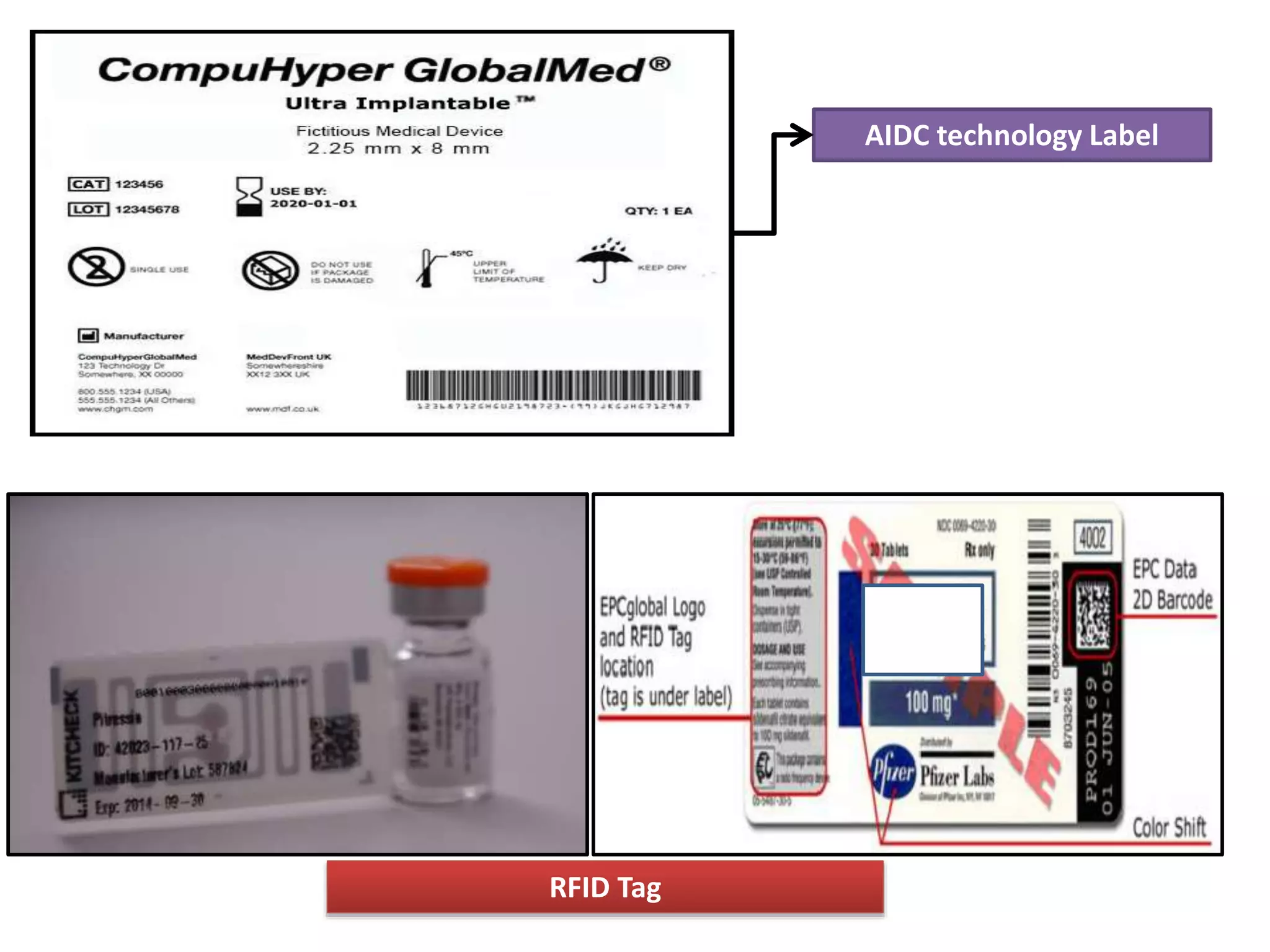
• For instance, using AIDC technologies, manufacturers
can include product or batch specific data in individual
product labels. In the pharma industry, this could
enable suppliers and retailers to verify a product quickly
and accurately — in most cases using standard
technology.
• RFID tags can be read without the need for close
contact or a direct line of sight, and offer read/write
functionality, which makes them ideal for tracking
products and monitoring processes. However, relatively
high cost and complexity of implementing the
technology has prevented its progress in many areas,
including the pharma industry.
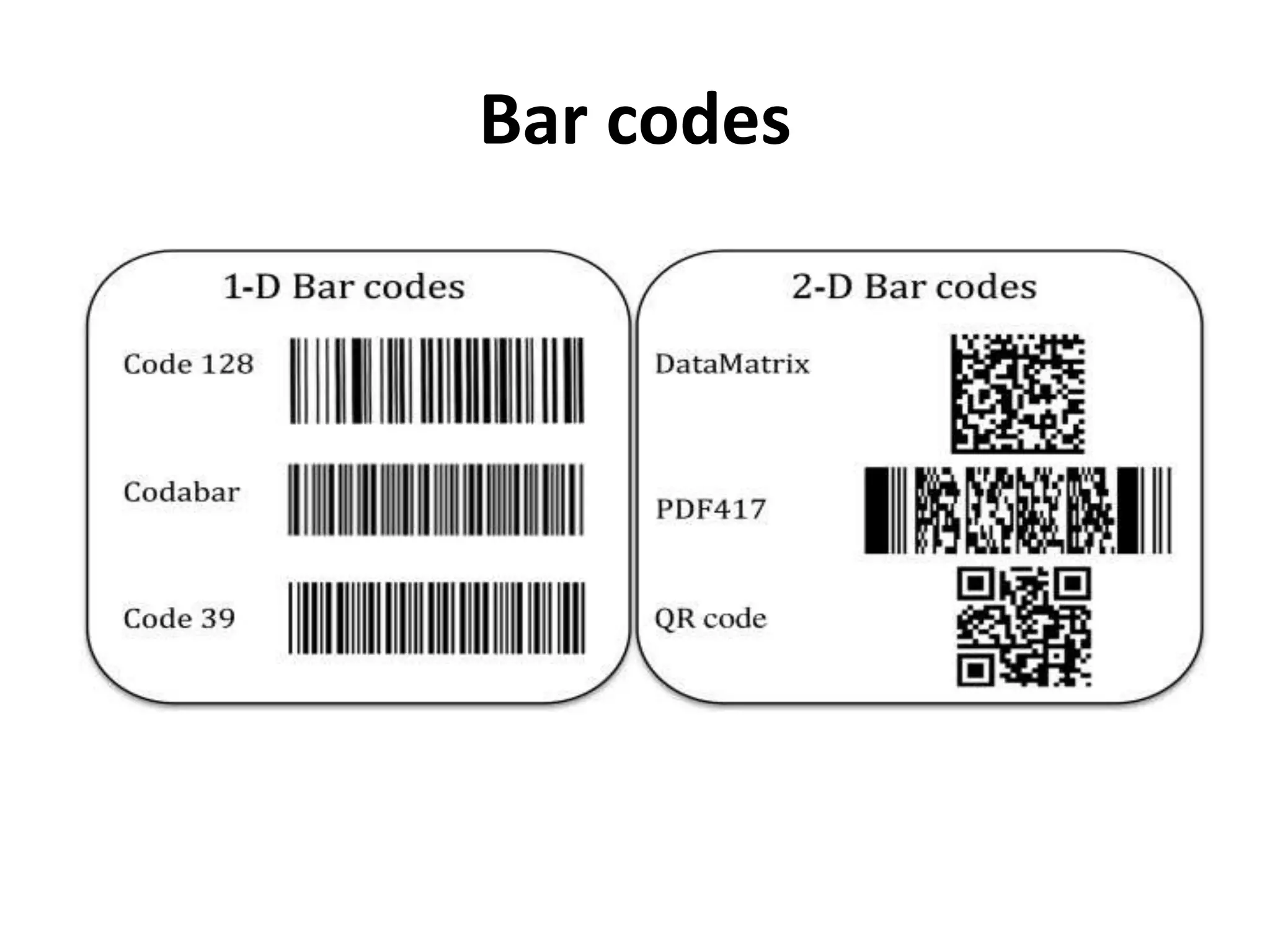
• 2D Barcodes:
 2D barcodes can hold considerably more information
than standard barcodes (usually up to approximately
1000 characters of information on a single label)
making them better suited to meet the requirements
of today's manufacturers.
 This increased level of information can be held on a
label the same size or smaller than a conventional
barcode label, and the codes can, in most cases, be
printed using the same technology, helping to minimize
the cost of upgrading.
 Furthermore, 2D barcodes can also function as a
database themselves, providing a portable information
source on the labelled product.
AIDC technology Label
RFID Tag
Bar codes
1. Thompson JE, Davidow LW. Chapter 2, Labeling Prescriptions and
Medications. In: Davidow LW, editor. A Practical Guide to Contemporary
Pharmacy Practice. Baltimore, MD: Williams & Wilkins, A Waverly Company;
1998. pp. 2.1–2.4.
2. Carter, SJ; Cooper And Gunn's Dispensing For Pharmaceutical Students; 6th
edition; Delhi: CBS Publishers & Distributors; 2008; 865-869
3. Labels and labeling, Dr.MCR HRD Institute
(http://www.mcrhrdi.gov.in/drugs/week2/Labels%20&%20labelling2.pdf)
4. Guidelines for delivery of Pharmaceutical Services and Care In Community
Pharmacy Settings in India, Indian Pharmaceutical Association, 2002, Page
no. 19-21.
5. Kalam A, Anwar S, Fatima A, “Drug Package Inserts In India: Current
Scenario”, World Journal Of Pharmacy And Pharmaceutical Sciences, Mar
2014, 3(4), 385-392.
6. http://www.pharmaceuticalmachinery.in
(http://www.pharmaceuticalmachinery.in/labeling_
machineries.htm#labeling_machine)
7. www.pharmtech.com
(http://images.pharmtech.com/trends-
labelling?id=&sk=&date=&&pageID=1)
[Updated 2009 Nov]
8. Zadbuke N, Shahi S, Gulecha B, Padalkar A,
Thube M, “Recent Trends and Future of
Pharmaceutical packaging Technology”, J
Pharm Bioallied Sci., 2013 Apr; 5(2); 98-110
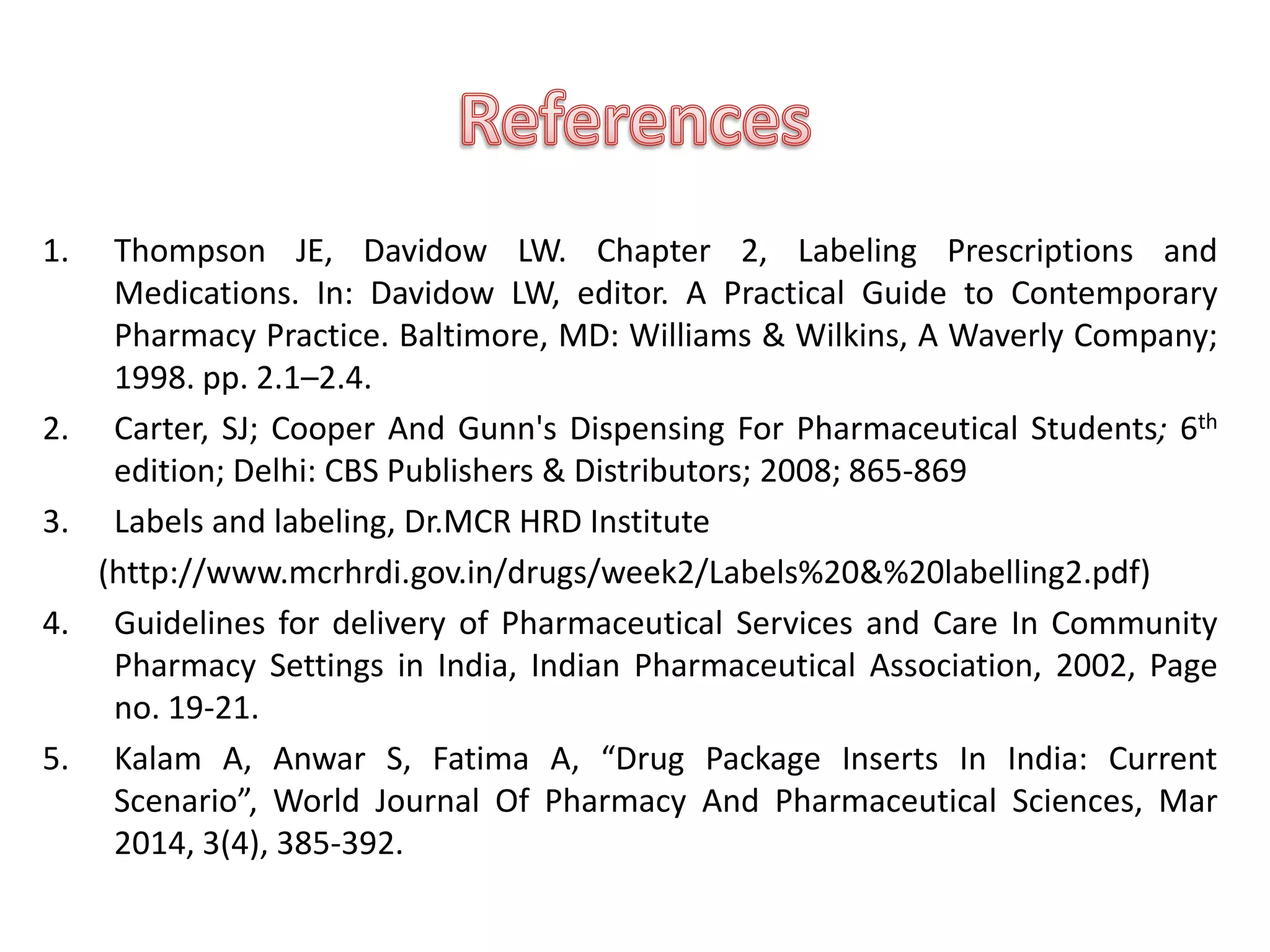
Labeling in pharmaceutical packaging

Labeling in pharmaceutical packaging

  • 1.
    Presented by: Rohit Kumar A10647016017 M.Pharm(Pharmaceutics)IVth semester Department of Pharmaceutics, Amity Institute of Pharmacy, Amity University, Noida
  • 2.
    Table of contents •Introduction • Functions of label • Objective of labeling • Types of labeling • Packaging Insert • Machinery employed • New developments in labeling technology • References
  • 3.
    • Label meansa display of written, printed or graphic matter upon immediate container or the wrapper of a drug package • The term “labeling” designates all labels and other written, printed, or graphic matter upon an immediate container of an article or upon, or in, any package or wrapper in which it is enclosed, except any outer shipping container[1].
  • 4.
    • Labeling inIndia – All labels of a drug should conform as per the specifications under the Drugs and Cosmetics Rules 1945. – That no person sell or distribute any drug unless it is labeIed in accordance with the Rules (Rule 95 of D&C Act). • it includes information regarding – indications, effects, dosage form, frequency and duration of administration, warnings, hazards, contraindications, side effects, precautions and other relevant information.
  • 5.
    • For identificationof the product • Provide ingredients • Purpose /use of the product • Child safety • Other information like maximum retail price(MRP), Batch No., Shelf-life etc
  • 6.
    [2] The Food andDrug Administration (FDA) requires that drug labeling be balanced and not misleading. The label must be scientifically accurate and provide clear instruction to health care practitioners for prescription drugs and to consumers for over- the-counter drugs and supplements. Labeling regulations require that the statement of ingredients must include all ingredients, in the order in which they are used in the drug. 1. Brand identification Labeling helps in the identification and principal place of business of the person by or for whom the prepackaged product was manufactured, processed, produced or packaged for resale.
  • 7.
    2. Description Labels providethe information regarding the pharmaceuticals. It describes the composition, batch no., cost, manufacturing date, expiry date etc. 3. Promotion Finally labels helps in promoting the product through attractive and bright graphics replacing paper labels glued on bottles. 4. To differentiate Standard and Counterfeit drugs A counterfeit drug bears an unauthorized representation of a registered trademark on a product identical or similar to one for which the trademark is registered. The use of scratch off label containing a unique code can be done which if texted to a free no. provides a response from company server, which will assure the authenticity of product. The use of unique holograms and designs in labels, which can not be easily copied.
  • 8.
    • The safeuse of all medicines depends on users reading the labeling and packaging carefully and accurately and being able to assimilate and act on the information presented. • All labels must be clear and concise and must bear all necessary information regarding the safe use of a product.
  • 9.
    [2] • Manufacturer label• Dispensing label
  • 10.
    • A labelwhich contain drug information for the use of medical practitioners, pharmacists, or nurses supplied by the manufacturer, packer, or distributor of the drug. • Rule 96 of the Drug and Cosmetic Rules (manner of labelling) mandates the minimum information which needs to be put on the label of all medicines. • Legal Requirements: 1. Proprietary name and established name 2. Strength and dosage form. 3. Quantity. 4. Instructions for the use. 5. Precautions & warnings. 6. Manufacturing license no. 7. Batch number. 8. Manufacturing & Expiry date . 9. The name and address of pharmaceutical industry
  • 11.
     Proprietary name/Genericname, Established name and Compendia name  Proprietary Name: The exclusive name of a drug substance or drug product owned by a company under trademark law.  Established Name: The designated FDA Official name or the Compendial name.  Compendial Name: The name of an article for which a monograph is provided in an official compendia/pharmacopoeia.  for drugs included in the India Pharmacopoeia or the official pharmacopoeia and official compendia of drug standards prescribed in the rule 124, the name or synonym specified in the respective followed by letters ‘I.P.’  Brand name which is used to market the drug.  Strength and dosage form  It is amount of active drug per unit dose.
  • 12.
  • 13.
     Manufacturing licenseno.  In India, to manufacture any drug, it is required to get a Mfg. Lic. No. as per Drug and Cosmetic Act, 1945.  Manufacturing Licences are issued By State Drug Authorities.  And it is legally required to mention that no. on the label.
  • 14.
    Quantity Quantity/volume present perpackaging unit. The container hold 20 tablets and each tablet has a dosage strength of 500 mg.
  • 15.
    Instructions, Precautions andwarnings for their Use:
  • 16.
    Storage conditions  Storein cool place: store under 0°c to 8°c  Protect from light: necessary for light sensitive formulations.  Keep out of the reach of children: All dispensed medicines should carry this information on label
  • 17.
    Batch No./ Lotno.: “A designation printed on label of a drug that identifies the batch and permits the production history of the batch including all stages of manufacturer and control to be traced and are viewed”
  • 18.
     Manufacturing &Expiry date  In compliance with Good Manufacturing Practices (GMP) regulations, the manufacture date printed on the label represents the date the product was produced.  Date stated on the label of a drug after which a drug is not expected to retain its claimed efficacy, safety, quantity, or potency or after which it is no permissible to sell the drug is called Expiry Date.
  • 19.
    Name and addressof pharmaceutical industry
  • 20.
    All dispensed medicinesshould ideally be provided with a label, which clearly states: (i) Name of the patient (ii) Name, strength, batch number and expiry of the medicine, in case the medicine has been repacked or cut out from a larger pack (iii) Dosage and usage instructions (iv) Date of delivery (v) Storage instructions (vi) Name and address of the pharmacy
  • 22.
    • The Packageinsert is considered “adequate direction for use”. [1] • The main aim of the package inserts or leaflets is to provide information essential for the safe and effective use of the drugs, and hence reducing the number of adverse reactions resulting from medication errors. • In India, regulations for package insert are provided under 'Section 6.2' and 'Section 6.3' of 'Drugs and Cosmetics Act (1940) and Rules (1945). 1. Kalam A, Anwar S, Fatima A, “Drug Package Inserts In India: Current Scenario”, World Journal Of Pharmacy And Pharmaceutical Sciences, Mar 2014, 3(4), 385-392
  • 23.
    • Content ofPackaging Insert [5]: Sec 6.2 Therapeutic Information Sec 6.3 Pharmaceutical Information Posology and method of administration  Contra-indications. Special warnings and special precautions for use, if any. Interaction with other medicaments and other forms of interaction. Pregnancy and lactation, if contra- indicated. Effects on ability to drive and use machines, if contra-indicated. Undesirable effects/side effects. Antidote for overdosing List of excipients Incompatibilities Shelf life in the medical product as packaged for sale. Shelf life after dilution or reconstitution according to direction. Shelf life after first opening the container. Special precautions for storage. Nature and specification of the container.
  • 24.
    [6] • Labeling machinesare machines that dispense, apply or print- and-apply labels to various items, products, containers, or packages • Labeling equipment are various machines, including label printers, label applicators, printer-applicators, and labeling systems, that apply labels to various products and packages. Semi Automatic Labeling Machine Fully Automatic Labeling Machine
  • 25.
    • Types ofLabeling machinery 1. Semi Automatic Labeling Machine 2. Fully Automatic Labeling Machine • Fully Automatic Single Side Sticker Labeling Machine • Fully Automatic Double Side (front & back) Sticker Labeling Machines • Fully Automatic High Speed Sticker Labeling Machine
  • 26.
    • Semi AutomaticLabelling Machine are suitable for labelling on Round Vials, Bottles. • No change of parts is required for change in size of containers & labels suitable for Glass, Plastic, Composite Containers can be prepared. • Grooved and Brut Shaped Bottles can also be labeled. • The Semi Automatic Labelling Machine incorporates latest sophisticated. • Microprocessor Controlled Stepper Motor Drive, Fiber Optic Label and Container sensing system.
  • 27.
    • Fully AutomaticLabelling machine is useful to place label accurately on round shape of product. • Full or partial wrap labeling can be possible. • A unique feature of machine is if the body diameters changes, than also machine operates without change in part. • Products of different diameter like small size of vials and bottles upto containers can be accommodated in the same machine & Speed is depend on the length of label.
  • 28.
    • Different typessuch as Alluminium, Glass, Plastic products can be accommodated on the machine. • Labeling speed is automatically synchronized with conveyor speed to ensure quality. • Push and press optional attachment is used to ensure smooth labeling without wrinkles or bubble.
  • 29.
    [7] [8] • Pharmaceuticallabelling is more complex than ever, with increasing pressure from consumers and regulatory bodies to prevent counterfeiting and improve safety. Manufacturers and packaging companies need to ensure products can be recognized and verified quickly and easily throughout the supply chain, communicating vital information to retailers and distributors. • Today's drug manufacturers can choose from a wide selection of : – Automatic Identification and Data Capture (AIDC) technologies – Radio Frequency Identification (RFID) tags
  • 30.
    • For instance,using AIDC technologies, manufacturers can include product or batch specific data in individual product labels. In the pharma industry, this could enable suppliers and retailers to verify a product quickly and accurately — in most cases using standard technology. • RFID tags can be read without the need for close contact or a direct line of sight, and offer read/write functionality, which makes them ideal for tracking products and monitoring processes. However, relatively high cost and complexity of implementing the technology has prevented its progress in many areas, including the pharma industry.
  • 31.
    • 2D Barcodes: 2D barcodes can hold considerably more information than standard barcodes (usually up to approximately 1000 characters of information on a single label) making them better suited to meet the requirements of today's manufacturers.  This increased level of information can be held on a label the same size or smaller than a conventional barcode label, and the codes can, in most cases, be printed using the same technology, helping to minimize the cost of upgrading.  Furthermore, 2D barcodes can also function as a database themselves, providing a portable information source on the labelled product.
  • 32.
  • 33.
  • 34.
    1. Thompson JE,Davidow LW. Chapter 2, Labeling Prescriptions and Medications. In: Davidow LW, editor. A Practical Guide to Contemporary Pharmacy Practice. Baltimore, MD: Williams & Wilkins, A Waverly Company; 1998. pp. 2.1–2.4. 2. Carter, SJ; Cooper And Gunn's Dispensing For Pharmaceutical Students; 6th edition; Delhi: CBS Publishers & Distributors; 2008; 865-869 3. Labels and labeling, Dr.MCR HRD Institute (http://www.mcrhrdi.gov.in/drugs/week2/Labels%20&%20labelling2.pdf) 4. Guidelines for delivery of Pharmaceutical Services and Care In Community Pharmacy Settings in India, Indian Pharmaceutical Association, 2002, Page no. 19-21. 5. Kalam A, Anwar S, Fatima A, “Drug Package Inserts In India: Current Scenario”, World Journal Of Pharmacy And Pharmaceutical Sciences, Mar 2014, 3(4), 385-392.
  • 35.
    6. http://www.pharmaceuticalmachinery.in (http://www.pharmaceuticalmachinery.in/labeling_ machineries.htm#labeling_machine) 7. www.pharmtech.com (http://images.pharmtech.com/trends- labelling?id=&sk=&date=&&pageID=1) [Updated2009 Nov] 8. Zadbuke N, Shahi S, Gulecha B, Padalkar A, Thube M, “Recent Trends and Future of Pharmaceutical packaging Technology”, J Pharm Bioallied Sci., 2013 Apr; 5(2); 98-110