
Pharmacovigilance
- An overview
Tulasi Raman P.
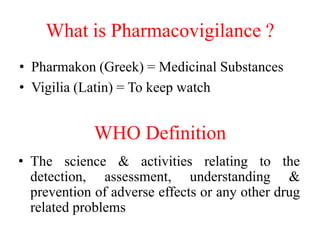
What is Pharmacovigilance ?
• Pharmakon (Greek) = Medicinal Substances
• Vigilia (Latin) = To keep watch
WHO Definition
• The science & activities relating to the
detection, assessment, understanding &
prevention of adverse effects or any other drug
related problems
Need for Pharmacovigilance ?
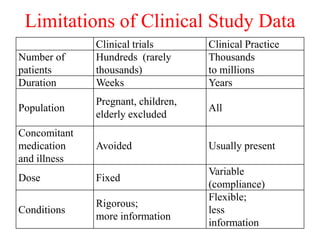
Limitations of Clinical Study Data
Clinical trials Clinical Practice
Number of
patients
Hundreds (rarely
thousands)
Thousands
to millions
Duration Weeks Years
Population
Pregnant, children,
elderly excluded
All
Concomitant
medication
and illness
Avoided Usually present
Dose Fixed
Variable
(compliance)
Conditions
Rigorous;
more information
Flexible;
less
information
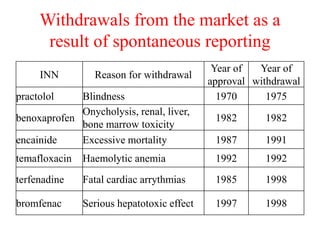
Withdrawals from the market as a
result of spontaneous reporting
INN Reason for withdrawal
Year of
approval
Year of
withdrawal
practolol Blindness 1970 1975
benoxaprofen
Onycholysis, renal, liver,
bone marrow toxicity
1982 1982
encainide Excessive mortality 1987 1991
temafloxacin Haemolytic anemia 1992 1992
terfenadine Fatal cardiac arrythmias 1985 1998
bromfenac Serious hepatotoxic effect 1997 1998
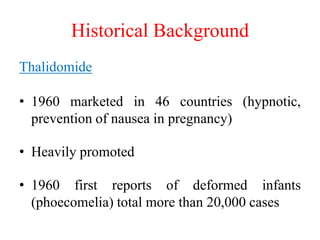
Historical Background
Thalidomide
• 1960 marketed in 46 countries (hypnotic,
prevention of nausea in pregnancy)
• Heavily promoted
• 1960 first reports of deformed infants
(phoecomelia) total more than 20,000 cases
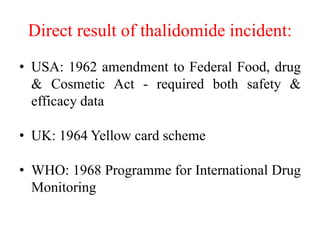
Direct result of thalidomide incident:
• USA: 1962 amendment to Federal Food, drug
& Cosmetic Act - required both safety &
efficacy data
• UK: 1964 Yellow card scheme
• WHO: 1968 Programme for International Drug
Monitoring
Aims
• To improve patient care and safety in relation
to the use of medicines, and all medical and
paramedical interventions
• To improve public health and safety in relation
to the use of medicines
• To contribute to the assessment of benefit,
harm, effectiveness and risk of medicines,
encouraging their safe, rational and more
effective use
• To promote understanding, education and
clinical training in pharmacovigilance and its
effective communication to health
professionals and the public
Terminology
• Adverse Drug Reaction (ADR)
• An unintended reaction to a drug taken at doses normally
used in man
When an association between an AE and a drug is established
it becomes an ADR
• Adverse Event (AE)
– A negative experience encountered by an
individual during the course of a clinical
trail, which may or may not be associated with a
drug
• Serious Adverse Event (SAE)
– Any adverse event which is fatal, life-
threatening, permanently disabling or which results
in hospitalilsation
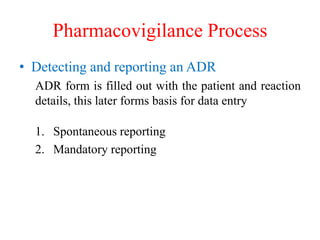
Pharmacovigilance Process
• Detecting and reporting an ADR
ADR form is filled out with the patient and reaction
details, this later forms basis for data entry
1. Spontaneous reporting
2. Mandatory reporting
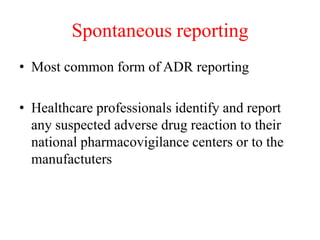
Spontaneous reporting
• Most common form of ADR reporting
• Healthcare professionals identify and report
any suspected adverse drug reaction to their
national pharmacovigilance centers or to the
manufactuters
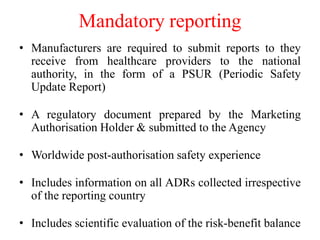
Mandatory reporting
• Manufacturers are required to submit reports to they
receive from healthcare providers to the national
authority, in the form of a PSUR (Periodic Safety
Update Report)
• A regulatory document prepared by the Marketing
Authorisation Holder & submitted to the Agency
• Worldwide post-authorisation safety experience
• Includes information on all ADRs collected irrespective
of the reporting country
• Includes scientific evaluation of the risk-benefit balance
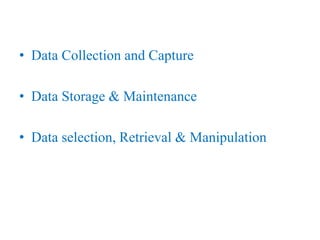
• Data Collection and Capture
• Data Storage & Maintenance
• Data selection, Retrieval & Manipulation
Signal Detection
Signal:
New, previously unknown safety information
(WHO Definition)
• Reported information on a possible causal
association between an Adverse Event and a
drug, the relationship being unclear or
incompletely documented previously
Regulatory actions on the basis of
ADR reports
• Summary of Product Characteristics (SPC)
– basis of information for Healthcare Professionals
on how to use the medicinal product safely and
effectively
• Patient Information Leaflets (PIL)
– drawn up in accordance with the SPC
• Changes in classification:
– From Over the counter to Prescription only
Medicine
– From renewable prescription to non-renewable
– Special medical prescription
– Restricted prescription
• Marketing Authorization withdrawal
• Batch recall based on clustering of ADRs
WHO & UMC
• Uppsala Monitoring Centre (UMC) is a field
name of the WHO collaborating Centre for
International Drug Monitoring.
• It is responsible for the management of the
WHO program for International Drug
Monitoring.
Functions of WHO Program for
international drug monitoring include:
• Identification and analysis of new adverse reaction
signal from the case report information submitted to
the National Centers and from them to the database
• Information exchange between WHO and National
Centers, mainly through ‘Vigimed’ an e-mail
information exchange system
• Publication of periodical newsletters, guidelines and
books in the pharmacovigilance and risk management
area
• Supply of tools for management of clinical
information including adverse drug reaction case
reports
– WHO Drug Dictionary
– WHO Adverse Reaction Terminology
• Provision of training and consultancy support to
National Centers and countries establishing
pharmacovigilance systems
• Computer software for case report management
designed to suit the needs of National Centers
(Vigiflow)
• Annual meetings for representatives of
National Centers at which Scientific and
Organizational matters are discussed
• Methodological research for the development
of pharmacovigilance as a science
Functions of UMC
• To co-ordinate the WHO program for international drug
monitoring and its more than eighty member countries
• To collect, assess and communicate information from
member countries about the benefits, harms and risks of
drugs and other substances used in medicine to improve
patient therapy and public health worldwide
• To collaborate with member countries in the
development and practice of the science of
pharmacovigilance
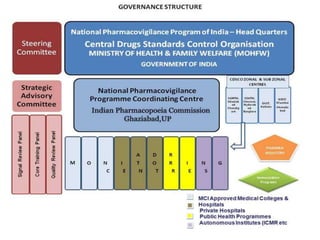
Pharmacovigilance in India
• Central Drugs Standard Control Association
– DGHS, Ministry of Health & Family Welfare
• Legislative requirements of PV in India
– Schedule Y of the drugs & cosmetic act 1945
Timeline of reporting an ADR
• By sponsor to Licensing Authority – 14
calendar days
• Investigation to sponsor within 24 hours
• Investigation to Ethic Committee within 7
working days
Pharmacovigilance in UK
• Yellow Card Scheme
• ADROIT – Adverse Drug Reactions Online
Information Tracking system.
• Eudra Vigilance
– Data processing network and management for
reporting and evaluating suspected adverse reactions
during the development and following market
authorization of medicinal products in the EEA.
Pharmacovigilance in USA
• MEDWATCH
• Medwatch 3500 form / FDA form 3500
Pharmacovigilance
Programme of India
(PvPI)
Goal
• To ensure that the benefits of use of medicine
outweighs the risks and thus safeguard the
health of the Indian population.
Objectives
• To monitor Adverse Drug Reactions (ADRs) in Indian population
• To create awareness amongst health care professionals about the
importance of ADR reporting in India
• To monitor benefit-risk profile of medicines
• Generate independent, evidence based recommendations on the
safety of medicines
• Support the CDSCO for formulating safety related regulatory
decisions for medicines
• Communicate findings with all key stakeholders
• Create a national centre of excellence at par with global drug safety
monitoring standards
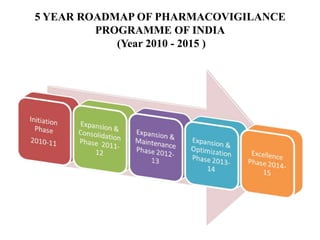
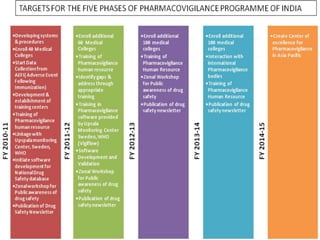
5 YEAR ROADMAP OF PHARMACOVIGILANCE
PROGRAMME OF INDIA
(Year 2010 - 2015 )
Thank You

Pharmacovigilance

  • 1.
  • 2.
    What is Pharmacovigilance? • Pharmakon (Greek) = Medicinal Substances • Vigilia (Latin) = To keep watch WHO Definition • The science & activities relating to the detection, assessment, understanding & prevention of adverse effects or any other drug related problems
  • 3.
  • 4.
    Limitations of ClinicalStudy Data Clinical trials Clinical Practice Number of patients Hundreds (rarely thousands) Thousands to millions Duration Weeks Years Population Pregnant, children, elderly excluded All Concomitant medication and illness Avoided Usually present Dose Fixed Variable (compliance) Conditions Rigorous; more information Flexible; less information
  • 5.
    Withdrawals from themarket as a result of spontaneous reporting INN Reason for withdrawal Year of approval Year of withdrawal practolol Blindness 1970 1975 benoxaprofen Onycholysis, renal, liver, bone marrow toxicity 1982 1982 encainide Excessive mortality 1987 1991 temafloxacin Haemolytic anemia 1992 1992 terfenadine Fatal cardiac arrythmias 1985 1998 bromfenac Serious hepatotoxic effect 1997 1998
  • 6.
    Historical Background Thalidomide • 1960marketed in 46 countries (hypnotic, prevention of nausea in pregnancy) • Heavily promoted • 1960 first reports of deformed infants (phoecomelia) total more than 20,000 cases
  • 7.
    Direct result ofthalidomide incident: • USA: 1962 amendment to Federal Food, drug & Cosmetic Act - required both safety & efficacy data • UK: 1964 Yellow card scheme • WHO: 1968 Programme for International Drug Monitoring
  • 8.
    Aims • To improvepatient care and safety in relation to the use of medicines, and all medical and paramedical interventions • To improve public health and safety in relation to the use of medicines
  • 9.
    • To contributeto the assessment of benefit, harm, effectiveness and risk of medicines, encouraging their safe, rational and more effective use • To promote understanding, education and clinical training in pharmacovigilance and its effective communication to health professionals and the public
  • 10.
    Terminology • Adverse DrugReaction (ADR) • An unintended reaction to a drug taken at doses normally used in man When an association between an AE and a drug is established it becomes an ADR
  • 11.
    • Adverse Event(AE) – A negative experience encountered by an individual during the course of a clinical trail, which may or may not be associated with a drug • Serious Adverse Event (SAE) – Any adverse event which is fatal, life- threatening, permanently disabling or which results in hospitalilsation
  • 12.
    Pharmacovigilance Process • Detectingand reporting an ADR ADR form is filled out with the patient and reaction details, this later forms basis for data entry 1. Spontaneous reporting 2. Mandatory reporting
  • 13.
    Spontaneous reporting • Mostcommon form of ADR reporting • Healthcare professionals identify and report any suspected adverse drug reaction to their national pharmacovigilance centers or to the manufactuters
  • 14.
    Mandatory reporting • Manufacturersare required to submit reports to they receive from healthcare providers to the national authority, in the form of a PSUR (Periodic Safety Update Report) • A regulatory document prepared by the Marketing Authorisation Holder & submitted to the Agency • Worldwide post-authorisation safety experience • Includes information on all ADRs collected irrespective of the reporting country • Includes scientific evaluation of the risk-benefit balance
  • 15.
    • Data Collectionand Capture • Data Storage & Maintenance • Data selection, Retrieval & Manipulation
  • 16.
    Signal Detection Signal: New, previouslyunknown safety information (WHO Definition) • Reported information on a possible causal association between an Adverse Event and a drug, the relationship being unclear or incompletely documented previously
  • 17.
    Regulatory actions onthe basis of ADR reports • Summary of Product Characteristics (SPC) – basis of information for Healthcare Professionals on how to use the medicinal product safely and effectively • Patient Information Leaflets (PIL) – drawn up in accordance with the SPC
  • 18.
    • Changes inclassification: – From Over the counter to Prescription only Medicine – From renewable prescription to non-renewable – Special medical prescription – Restricted prescription • Marketing Authorization withdrawal • Batch recall based on clustering of ADRs
  • 19.
    WHO & UMC •Uppsala Monitoring Centre (UMC) is a field name of the WHO collaborating Centre for International Drug Monitoring. • It is responsible for the management of the WHO program for International Drug Monitoring.
  • 20.
    Functions of WHOProgram for international drug monitoring include: • Identification and analysis of new adverse reaction signal from the case report information submitted to the National Centers and from them to the database • Information exchange between WHO and National Centers, mainly through ‘Vigimed’ an e-mail information exchange system • Publication of periodical newsletters, guidelines and books in the pharmacovigilance and risk management area
  • 21.
    • Supply oftools for management of clinical information including adverse drug reaction case reports – WHO Drug Dictionary – WHO Adverse Reaction Terminology • Provision of training and consultancy support to National Centers and countries establishing pharmacovigilance systems • Computer software for case report management designed to suit the needs of National Centers (Vigiflow)
  • 22.
    • Annual meetingsfor representatives of National Centers at which Scientific and Organizational matters are discussed • Methodological research for the development of pharmacovigilance as a science
  • 23.
    Functions of UMC •To co-ordinate the WHO program for international drug monitoring and its more than eighty member countries • To collect, assess and communicate information from member countries about the benefits, harms and risks of drugs and other substances used in medicine to improve patient therapy and public health worldwide • To collaborate with member countries in the development and practice of the science of pharmacovigilance
  • 24.
    Pharmacovigilance in India •Central Drugs Standard Control Association – DGHS, Ministry of Health & Family Welfare • Legislative requirements of PV in India – Schedule Y of the drugs & cosmetic act 1945
  • 25.
    Timeline of reportingan ADR • By sponsor to Licensing Authority – 14 calendar days • Investigation to sponsor within 24 hours • Investigation to Ethic Committee within 7 working days
  • 26.
    Pharmacovigilance in UK •Yellow Card Scheme • ADROIT – Adverse Drug Reactions Online Information Tracking system. • Eudra Vigilance – Data processing network and management for reporting and evaluating suspected adverse reactions during the development and following market authorization of medicinal products in the EEA.
  • 27.
    Pharmacovigilance in USA •MEDWATCH • Medwatch 3500 form / FDA form 3500
  • 28.
  • 30.
    Goal • To ensurethat the benefits of use of medicine outweighs the risks and thus safeguard the health of the Indian population.
  • 31.
    Objectives • To monitorAdverse Drug Reactions (ADRs) in Indian population • To create awareness amongst health care professionals about the importance of ADR reporting in India • To monitor benefit-risk profile of medicines • Generate independent, evidence based recommendations on the safety of medicines • Support the CDSCO for formulating safety related regulatory decisions for medicines • Communicate findings with all key stakeholders • Create a national centre of excellence at par with global drug safety monitoring standards
  • 32.
    5 YEAR ROADMAPOF PHARMACOVIGILANCE PROGRAMME OF INDIA (Year 2010 - 2015 )
  • 35.