Pharmacovigilance
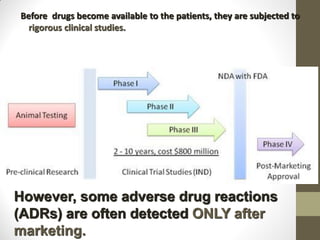
Before drugs become available to the patients, they are subjected to
rigorous clinical studies.
However, some adverse drug reactions
(ADRs) are often detected ONLY after
marketing.
The study of ADRs is
the concern of the
field known as
pharmacovigilance
Adverse drug reactions
• ADR is defined as any harm associated with the use of
given drugs at a normal dosage during normal use.
• ADRs may occur following a single dose or prolonged
administration of a drug or result from the
combination of two or more drugs.
• The meaning of ADR differs from the meaning of "side
effect ", as this last expression might also imply that
the effects can be beneficial.
Types of ADRs
1. Type A: Augmented pharmacologic
effects (dose dependent and
predictable)
2. Type B: Bizarre effects (dose independent
& unpredictable)
3. Type C: Chronic effects
4. Type D: Delayed effects
5. Type E: End-of-treatment effects
6. Type F: Failure of therapy
7. Type G: Genetic reactions
Serious and severe
Serious (FDA): when the patient outcome:
1. Death
2. Life-threatening
3. Hospitalization
4. Disability - or permanent change, impairment, damage or
disruption in the patient's body function/structure, physical
activities or quality of life
5. Congenital abnormalities
6. Requires intervention to prevent permanent damage
Severity: intensity of the adverse effect
Possible causes of ADRS
1. Intrinsic
Idiosyncrasy Mutagenicity Carcinogenicity
Teratogenicity
2. Extrinsic
Adulterations, contamination
3. Underlying medical conditions
4. Interactions
5. Wrong use
Economic impact of ADRs
• In the USA, the cost of drug-related morbidity and mortality
exceeded 177.4 billion dollars in 2000
(Ernst FR & Grizzle AJ, 2001: J American Pharm Assoc)
• The cost to the country of ADRs may exceed the cost of the
medications themselves
• 30-60 % of ADRs may be preventable
Definition of Pharmacovigilance
PV is the science and activities dealing with the detection,
assessment, understanding and prevention of adverse effects
of drugs.
It has been widened to include biological products, herbals,
traditional and complementary medicines.
Pharmaco - Vigilance
Pharmaco (Greek): drug
Vigilance (Latin):
• to keep awake or alert
• to keep watch
• the process of paying close and
continuousattention
Why do we need
pharmacovigilance?
Reason 1: Insufficient evidence of safety
• Animal experiments
• Clinical trials prior to marketing
Reason 2: Dying from a disease may be inevitable, dying from a
medicine is unacceptable (WHO,2005)
Reason 3: ADR are expensive
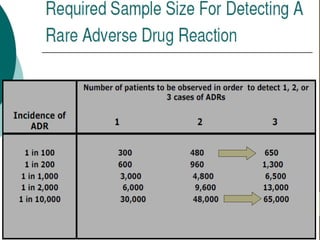
Limitations of clinical trials
1. Number of patients is limited: ~ 5000
2. Narrow population: Specific age and sex
3. Narrow indications: only those having the specific disease
studied
4. Short duration: often no longer than a few weeks
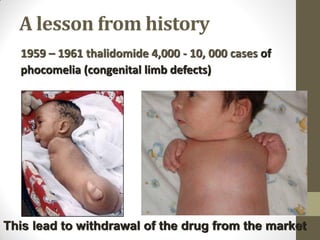
A lesson from history
1959 – 1961 thalidomide 4,000 - 10, 000 cases of
phocomelia (congenital limb defects)
This lead to withdrawal of the drug from the market
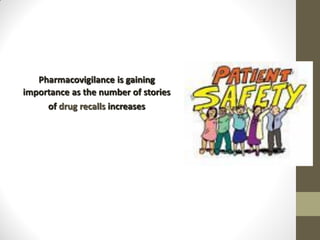
Pharmacovigilance is gaining
importance as the number of stories
of drug recalls increases
Examples of product recalls due
to toxicity
1. Thalidomide (1965) Phocomelia
2. Practolol (1975) Sclerosing
peritonitis
3. Phenformin (1982) Lactic acidosis
4. Rofecoxib (2004) cardiovascular
effects
5. Veralipride (2007) Anxiety,
depression,
movement disorders
6. Rosiglitazone (2010( Increased risk of
MI and death
from CV causes
Pharmacovigilance
 Aims of Pharmacovigilance
 Pharmacovigilance cycle
 Regulatory actions to minimize risk
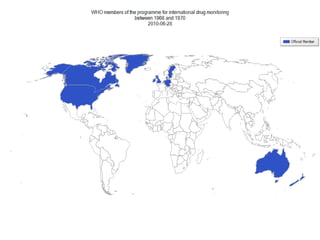
 WHO members of the drug monitoring programme
 The Egyptian Pharmacovigilance Center
 Middle East Members
 Top 10 contributors to the WHO database
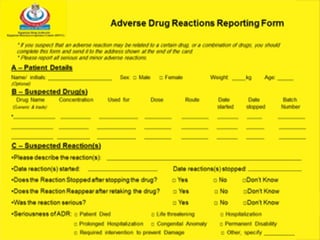
 Yellow Card Scheme
 What should be reported?
 Who can report?
 Report to whom?
 Causality assessment
Aims of pharmacovigilance
1. Identify previously unrecognized adverse effects or
changes in the patterns of adverse effects
2. Assess the risks and benefits of medicines in order to
determine what action, if any, is necessary to
improve their safe use
3. Provide information to healthcare professionals and
patients to optimize safe and effective use of
medicines
• Thus, the ultimate purpose of ADR reporting and monitoring is to
reduce risks associated with drug prescribing and administration
• Improve patient care and patient safety
• Communication with international institutions working in
pharmacovigilance
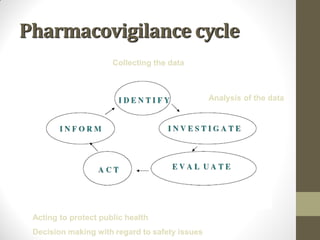
Pharmacovigilance cycle
Acting to protect public health
Decision making with regard to safety issues
Collecting the data
Analysis of the data
Changes that occur from the PV findings
include
1. Restriction in use
2. Changes in the specified dose of the medicine
3. Introduction of specific warnings in the product
information
4. Changing the legal status of a medicine, e.g., from
over-the-counter to prescription only
5. In rare cases, removal of the medicine from the
market, if the risks of a medicine are found to
outweigh the benefits
International collaboration
in the field of pharmacovigilance
• WHO runs the Uppsala Monitoring Centre (Started in 1968,
Located in Uppsala Sweden)
• European Union runs the European Medicines Evaluation Agency
(EMEA)
• United States, the FDA is responsible for monitoring post-
marketing studies.
• Egyptian PV center
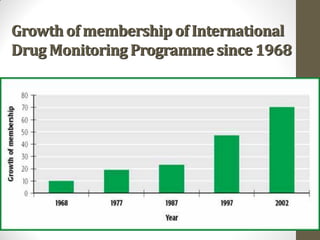
Growth of membership of International
Drug Monitoring Programme since 1968
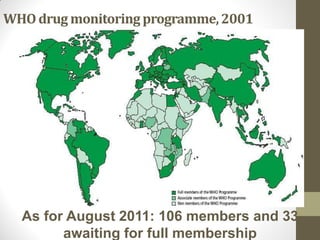
WHOdrug monitoring programme,2001
As for August 2011: 106 members and 33
awaiting for full membership
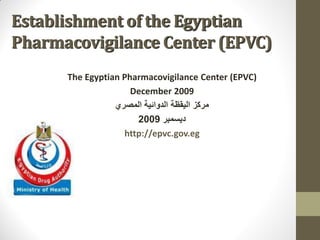
Establishment of the Egyptian
Pharmacovigilance Center (EPVC)
The Egyptian Pharmacovigilance Center (EPVC)
December 2009
‫المصري‬ ‫الدوائية‬ ‫اليقظة‬ ‫مركز‬
‫ديسمبر‬2009
http://epvc.gov.eg
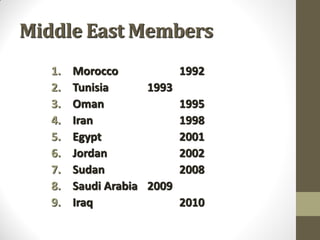
Middle East Members
1. Morocco 1992
2. Tunisia 1993
3. Oman 1995
4. Iran 1998
5. Egypt 2001
6. Jordan 2002
7. Sudan 2008
8. Saudi Arabia 2009
9. Iraq 2010
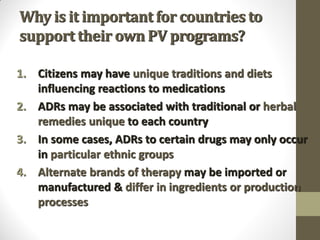
Why is it important for countries to
support their own PV programs?
1. Citizens may have unique traditions and diets
influencing reactions to medications
2. ADRs may be associated with traditional or herbal
remedies unique to each country
3. In some cases, ADRs to certain drugs may only occur
in particular ethnic groups
4. Alternate brands of therapy may be imported or
manufactured & differ in ingredients or production
processes
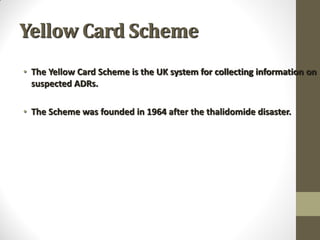
Yellow Card Scheme
• The Yellow Card Scheme is the UK system for collecting information on
suspected ADRs.
• The Scheme was founded in 1964 after the thalidomide disaster.
Essential information to include
on a yellow card
1. Patient details
2. Suspected drug
3. Suspected reaction
4. Reporter details
Why is the yellow card scheme
important?
1. The scheme acts as an early warning system for the
identification of previously unrecognised reactions
1. It enables to identify risk factors, outcomes of the ADR and
other factors that may affect clinical management
What should be reported?
1. All suspected reactions including minor ones
2. All serious, unexpected, unusual ADRs
3. Change in frequency of a given reaction
4. All suspected drug-drug, drug-food, drug food
supplements interactions
5. ADRs associated with drug withdrawal
6. ADRs due to medication errors
7. ADRs due to lack of efficacy or suspected
pharmaceutical defect
Who can report?
• Patients, patients relatives or patients carers
• Health care professionals (physicians, dentists, pharmacists,
radiographers, nurses)
• Manufacturers
• Authorities
Report to whom?
► Regulatory Authority
► Industry, manufacturers
► Health professionals
► Patient organizations
► General public
► Social security
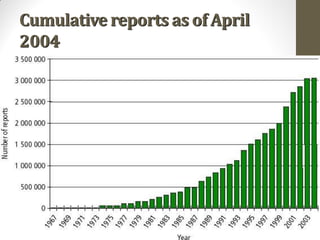
Cumulative reports as of April
2004
Causality assessment
How likely is this medication the cause of this problem in this
particular patient?
Naranjo’s algorithm
Questionnaire
1. Are there previous conclusive reports on this
reaction?
2. Did the adverse event appear after the suspected
drug was given?
3. Did the adverse reaction improve when the drug was
discontinued or a specific antagonist was given?
4. Did the adverse reaction appear when the drug was
readministered?
5. Are there alternative causes that could have caused
the reaction?
Questionnaire (cont)
6. Did the reaction reappear when a placebo was given?
7. Was the drug detected in any body fluid in toxic
concentrations?
8. Was the reaction more severe when the dose was
increased, or less severe when the dose was
decreased?
9. Did the patient have a similar reaction to the same or
similar drugs in any previous exposure?
10. Was the adverse event confirmed by any objective
evidence?
Scoring
Definite ADR > 9
Probable ADR 5-8
Possible ADR 1-4
Doubtful ADR 0
Take home message
• Pharmacovigilance is a dynamic clinical and scientific discipline
• ADR reporting is the cornerstone pharmacovigilance activity
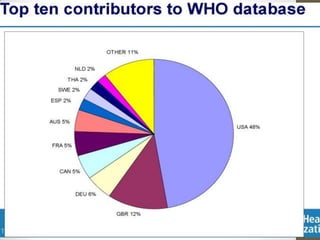
• The majority of global information related to ADRs arises from
Western countries
• Each country should support its own PV program
A successfully implemented pharmacovigilance centre can
minimize, prevent and improve the use of drugs by discovering
ADRs at the level of general public use.
Pharmacovigilance STUDY

Pharmacovigilance STUDY

  • 1.
  • 2.
    Before drugs becomeavailable to the patients, they are subjected to rigorous clinical studies. However, some adverse drug reactions (ADRs) are often detected ONLY after marketing.
  • 3.
    The study ofADRs is the concern of the field known as pharmacovigilance
  • 5.
    Adverse drug reactions •ADR is defined as any harm associated with the use of given drugs at a normal dosage during normal use. • ADRs may occur following a single dose or prolonged administration of a drug or result from the combination of two or more drugs. • The meaning of ADR differs from the meaning of "side effect ", as this last expression might also imply that the effects can be beneficial.

  • 6.
    Types of ADRs 1.Type A: Augmented pharmacologic effects (dose dependent and predictable) 2. Type B: Bizarre effects (dose independent & unpredictable) 3. Type C: Chronic effects 4. Type D: Delayed effects 5. Type E: End-of-treatment effects 6. Type F: Failure of therapy 7. Type G: Genetic reactions
  • 7.
    Serious and severe Serious(FDA): when the patient outcome: 1. Death 2. Life-threatening 3. Hospitalization 4. Disability - or permanent change, impairment, damage or disruption in the patient's body function/structure, physical activities or quality of life 5. Congenital abnormalities 6. Requires intervention to prevent permanent damage Severity: intensity of the adverse effect
  • 8.
    Possible causes ofADRS 1. Intrinsic Idiosyncrasy Mutagenicity Carcinogenicity Teratogenicity 2. Extrinsic Adulterations, contamination 3. Underlying medical conditions 4. Interactions 5. Wrong use
  • 9.
    Economic impact ofADRs • In the USA, the cost of drug-related morbidity and mortality exceeded 177.4 billion dollars in 2000 (Ernst FR & Grizzle AJ, 2001: J American Pharm Assoc) • The cost to the country of ADRs may exceed the cost of the medications themselves • 30-60 % of ADRs may be preventable
  • 10.
    Definition of Pharmacovigilance PVis the science and activities dealing with the detection, assessment, understanding and prevention of adverse effects of drugs. It has been widened to include biological products, herbals, traditional and complementary medicines.
  • 11.
    Pharmaco - Vigilance Pharmaco(Greek): drug Vigilance (Latin): • to keep awake or alert • to keep watch • the process of paying close and continuousattention
  • 12.
    Why do weneed pharmacovigilance? Reason 1: Insufficient evidence of safety • Animal experiments • Clinical trials prior to marketing Reason 2: Dying from a disease may be inevitable, dying from a medicine is unacceptable (WHO,2005) Reason 3: ADR are expensive
  • 13.
    Limitations of clinicaltrials 1. Number of patients is limited: ~ 5000 2. Narrow population: Specific age and sex 3. Narrow indications: only those having the specific disease studied 4. Short duration: often no longer than a few weeks
  • 15.
    A lesson fromhistory 1959 – 1961 thalidomide 4,000 - 10, 000 cases of phocomelia (congenital limb defects) This lead to withdrawal of the drug from the market
  • 16.
    Pharmacovigilance is gaining importanceas the number of stories of drug recalls increases
  • 17.
    Examples of productrecalls due to toxicity 1. Thalidomide (1965) Phocomelia 2. Practolol (1975) Sclerosing peritonitis 3. Phenformin (1982) Lactic acidosis 4. Rofecoxib (2004) cardiovascular effects 5. Veralipride (2007) Anxiety, depression, movement disorders 6. Rosiglitazone (2010( Increased risk of MI and death from CV causes
  • 18.
    Pharmacovigilance  Aims ofPharmacovigilance  Pharmacovigilance cycle  Regulatory actions to minimize risk  WHO members of the drug monitoring programme  The Egyptian Pharmacovigilance Center  Middle East Members  Top 10 contributors to the WHO database  Yellow Card Scheme  What should be reported?  Who can report?  Report to whom?  Causality assessment
  • 19.
    Aims of pharmacovigilance 1.Identify previously unrecognized adverse effects or changes in the patterns of adverse effects 2. Assess the risks and benefits of medicines in order to determine what action, if any, is necessary to improve their safe use 3. Provide information to healthcare professionals and patients to optimize safe and effective use of medicines
  • 20.
    • Thus, theultimate purpose of ADR reporting and monitoring is to reduce risks associated with drug prescribing and administration • Improve patient care and patient safety • Communication with international institutions working in pharmacovigilance
  • 21.
    Pharmacovigilance cycle Acting toprotect public health Decision making with regard to safety issues Collecting the data Analysis of the data
  • 22.
    Changes that occurfrom the PV findings include 1. Restriction in use 2. Changes in the specified dose of the medicine 3. Introduction of specific warnings in the product information 4. Changing the legal status of a medicine, e.g., from over-the-counter to prescription only 5. In rare cases, removal of the medicine from the market, if the risks of a medicine are found to outweigh the benefits
  • 23.
    International collaboration in thefield of pharmacovigilance • WHO runs the Uppsala Monitoring Centre (Started in 1968, Located in Uppsala Sweden) • European Union runs the European Medicines Evaluation Agency (EMEA) • United States, the FDA is responsible for monitoring post- marketing studies. • Egyptian PV center
  • 24.
    Growth of membershipof International Drug Monitoring Programme since 1968
  • 26.
    WHOdrug monitoring programme,2001 Asfor August 2011: 106 members and 33 awaiting for full membership
  • 27.
    Establishment of theEgyptian Pharmacovigilance Center (EPVC) The Egyptian Pharmacovigilance Center (EPVC) December 2009 ‫المصري‬ ‫الدوائية‬ ‫اليقظة‬ ‫مركز‬ ‫ديسمبر‬2009 http://epvc.gov.eg
  • 28.
    Middle East Members 1.Morocco 1992 2. Tunisia 1993 3. Oman 1995 4. Iran 1998 5. Egypt 2001 6. Jordan 2002 7. Sudan 2008 8. Saudi Arabia 2009 9. Iraq 2010
  • 30.
    Why is itimportant for countries to support their own PV programs? 1. Citizens may have unique traditions and diets influencing reactions to medications 2. ADRs may be associated with traditional or herbal remedies unique to each country 3. In some cases, ADRs to certain drugs may only occur in particular ethnic groups 4. Alternate brands of therapy may be imported or manufactured & differ in ingredients or production processes
  • 31.
    Yellow Card Scheme •The Yellow Card Scheme is the UK system for collecting information on suspected ADRs. • The Scheme was founded in 1964 after the thalidomide disaster.
  • 32.
    Essential information toinclude on a yellow card 1. Patient details 2. Suspected drug 3. Suspected reaction 4. Reporter details
  • 34.
    Why is theyellow card scheme important? 1. The scheme acts as an early warning system for the identification of previously unrecognised reactions 1. It enables to identify risk factors, outcomes of the ADR and other factors that may affect clinical management
  • 35.
    What should bereported? 1. All suspected reactions including minor ones 2. All serious, unexpected, unusual ADRs 3. Change in frequency of a given reaction 4. All suspected drug-drug, drug-food, drug food supplements interactions 5. ADRs associated with drug withdrawal 6. ADRs due to medication errors 7. ADRs due to lack of efficacy or suspected pharmaceutical defect
  • 36.
    Who can report? •Patients, patients relatives or patients carers • Health care professionals (physicians, dentists, pharmacists, radiographers, nurses) • Manufacturers • Authorities
  • 37.
    Report to whom? ►Regulatory Authority ► Industry, manufacturers ► Health professionals ► Patient organizations ► General public ► Social security
  • 38.
    Cumulative reports asof April 2004
  • 39.
    Causality assessment How likelyis this medication the cause of this problem in this particular patient?
  • 40.
  • 41.
    Questionnaire 1. Are thereprevious conclusive reports on this reaction? 2. Did the adverse event appear after the suspected drug was given? 3. Did the adverse reaction improve when the drug was discontinued or a specific antagonist was given? 4. Did the adverse reaction appear when the drug was readministered? 5. Are there alternative causes that could have caused the reaction?
  • 42.
    Questionnaire (cont) 6. Didthe reaction reappear when a placebo was given? 7. Was the drug detected in any body fluid in toxic concentrations? 8. Was the reaction more severe when the dose was increased, or less severe when the dose was decreased? 9. Did the patient have a similar reaction to the same or similar drugs in any previous exposure? 10. Was the adverse event confirmed by any objective evidence?
  • 43.
    Scoring Definite ADR >9 Probable ADR 5-8 Possible ADR 1-4 Doubtful ADR 0
  • 44.
    Take home message •Pharmacovigilance is a dynamic clinical and scientific discipline • ADR reporting is the cornerstone pharmacovigilance activity • The majority of global information related to ADRs arises from Western countries • Each country should support its own PV program
  • 45.
    A successfully implementedpharmacovigilance centre can minimize, prevent and improve the use of drugs by discovering ADRs at the level of general public use.