Dr Merlin M
Assistant Professor
DRUG INDUCED LIVER
DISORDER
PROTOCOL
 DEFINITION
 EPIDEMIOLOGY
 AETIOLOGY
 RISK FACTORS
 VARIOUS DRUG INDUCED LIVER DISORDERS
 PATHOPHYSIOLOGY
 CLINICAL MANIFESTATIONS
 INVESTIGATIONS
 TREATMENT
 REFERENCES
DEFINITION
 Drug induced liver diseases (DILD) is
defined as Injury to liver that is associated
with impaired liver function caused by
exposure to a drug or another
noninfectious agent.
EPIDEMIOLOGY
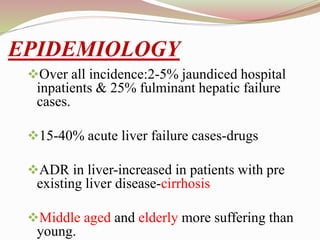
Over all incidence:2-5% jaundiced hospital
inpatients & 25% fulminant hepatic failure
cases.
15-40% acute liver failure cases-drugs
ADR in liver-increased in patients with pre
existing liver disease-cirrhosis
Middle aged and elderly more suffering than
young.
AETIOLOGY
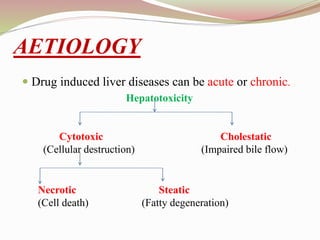
 Drug induced liver diseases can be acute or chronic.
Hepatotoxicity
Cytotoxic Cholestatic
(Cellular destruction) (Impaired bile flow)
Necrotic Steatic
(Cell death) (Fatty degeneration)
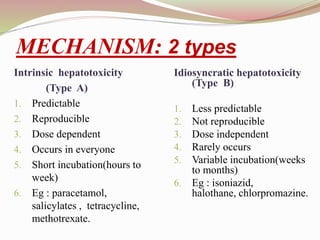
MECHANISM: 2 types
Intrinsic hepatotoxicity
(Type A)
1. Predictable
2. Reproducible
3. Dose dependent
4. Occurs in everyone
5. Short incubation(hours to
week)
6. Eg : paracetamol,
salicylates , tetracycline,
methotrexate.
Idiosyncratic hepatotoxicity
(Type B)
1. Less predictable
2. Not reproducible
3. Dose independent
4. Rarely occurs
5. Variable incubation(weeks
to months)
6. Eg : isoniazid,
halothane, chlorpromazine.
RISK FACTORS
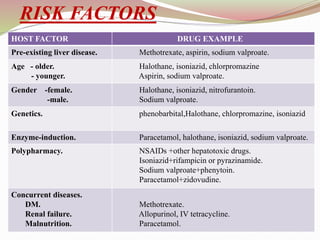
HOST FACTOR DRUG EXAMPLE
Pre-existing liver disease. Methotrexate, aspirin, sodium valproate.
Age - older.
- younger.
Halothane, isoniazid, chlorpromazine
Aspirin, sodium valproate.
Gender -female.
-male.
Halothane, isoniazid, nitrofurantoin.
Sodium valproate.
Genetics. phenobarbital,Halothane, chlorpromazine, isoniazid
Enzyme-induction. Paracetamol, halothane, isoniazid, sodium valproate.
Polypharmacy. NSAIDs +other hepatotoxic drugs.
Isoniazid+rifampicin or pyrazinamide.
Sodium valproate+phenytoin.
Paracetamol+zidovudine.
Concurrent diseases.
DM.
Renal failure.
Malnutrition.
Methotrexate.
Allopurinol, IV tetracycline.
Paracetamol.
Various drug induced liver disorders
 Hepatocellular necrosis.
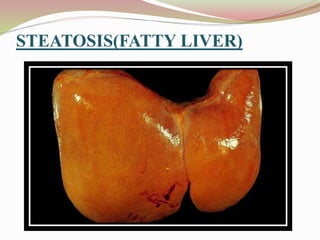
 Steatosis(Fatty liver).
 Cholestasis.
 Cholestasis with hepatitis.
 Granulomatous hepatitis.
 Acute hepatitis.
 Chronic active hepatitis.
 Fibrosis and cirrhosis.
 Vascular disorders.
 Hepatic Tumours.
PATHOPHYSIOLOGY
HEPATOCELLULAR NECROSIS
CHANGES
Presents with jaundice.
Modestly increased alkaline
phosphatase.
Increased alanine amino transferase.
Prolonged prothrombin time.
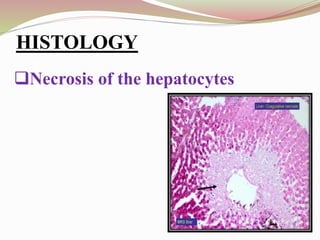
HISTOLOGY:
Necrosis of the hepatocytes
HISTOLOGY
:DRUGS
Paracetamol.
Propylthiouracil.
Salicylates.
Iron salts.
Allopurinol.
Dantrolene.
Halothane.
Ketoconazole.
Isoniazid.
Mithramycin.
Cocaine.
STEATOSIS(FATTY LIVER)
CHANGES
Abnormal LFTs.
Increased blood levels of ALT & AST
Hyperammonia
Hypoglycemia
Acidosis
Clotting factor deficiency
Tetracyclines +synthesis of
lipoproteins ------ STEATOSIS
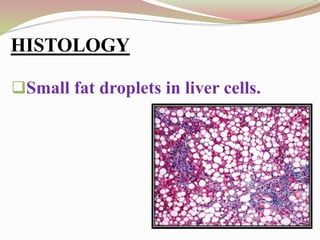
HISTOLOGY
Small fat droplets in liver cells.
DRUGS
Tetracycline
Sodium valproate
Methotrexate.
Steroids.
 Alcohol
Amiodarone
Macrovesicular
Microvesicular
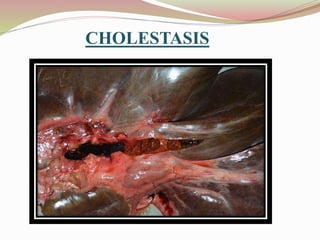
CHOLESTASIS
Increased bilirubin
Normal or minimally raised alanine amino
transferase
No inflammation or hapatocellular necrosis
CHANGES
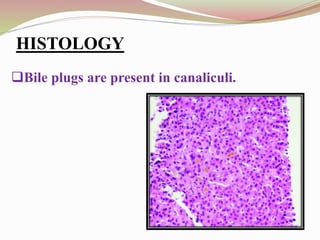
HISTOLOGY
Bile plugs are present in canaliculi.
Oral contraceptives.
Carbimazole.
Anabolic steroids.
Cyclosporin.
DRUGS
CHOLESTASIS WITH HEPATITIS
Increased bilirubin.
Increased alanine amino transferase.
Increased alkaline phosphatase.
Certain liver damage.
CHANGES
DRUGS
• Chlorpromazine.
• Tricyclics.
• Erythromycin.
• ACE inhibitors.
• Ranitidine.
•Sulphonamides.
•Sulphonylureas.
•Phenytoin.
•NSAIDS.
•Cimetidine.
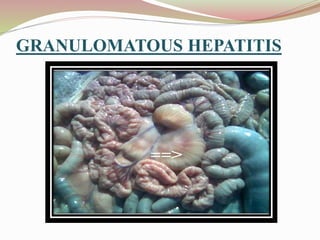
GRANULOMATOUS HEPATITIS
CHANGES
Modestly elevated LFTs.
Phenytoin.
Allopurinol.
Carbamazepine.
Clofibrate.
Hydralazine.
Sulphonamides.
Sulphonylureas.
HISTOLOGY
Granulomas and tissue eosinophilia.
DRUGS
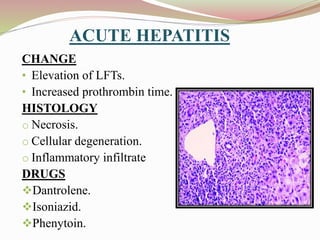
ACUTE HEPATITIS
CHANGES:
• Elevation of LFTs.
• Increased prothrombin time.
HISTOLOGY
o Necrosis.
o Cellular degeneration.
o Inflammatory infiltrate
DRUGS
Dantrolene.
Isoniazid.
Phenytoin.
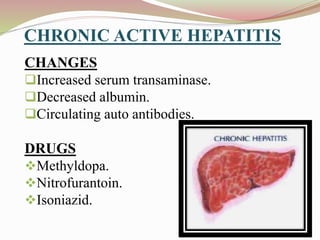
CHRONIC ACTIVE HEPATITIS
CHANGES
Increased serum transaminase.
Decreased albumin.
Circulating auto antibodies.
DRUGS
Methyldopa.
Nitrofurantoin.
Isoniazid.
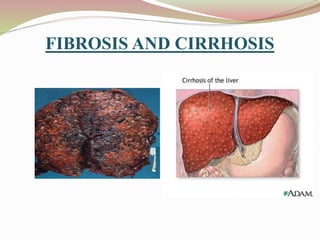
FIBROSIS AND CIRRHOSIS
CHANGES
Slightly raised serum transaminase.
Fibrosis may proceed to cirrhosis.
Deposition of fibrous tissue.
Methotrexate (chronic use).
Vitamin A (dose dependent).
Methyldopa.
HISTOLOGY
DRUGS
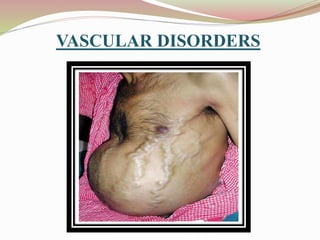
VASCULAR DISORDERS
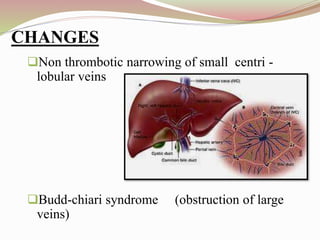
Non thrombotic narrowing of small centri -
lobular veins
Budd-chiari syndrome (obstruction of large
veins)
CHANGES
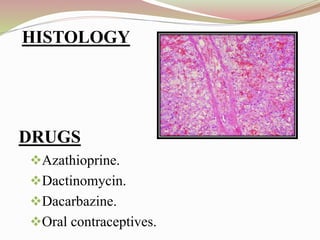
DRUGS
Azathioprine.
Dactinomycin.
Dacarbazine.
Oral contraceptives.
HISTOLOGY
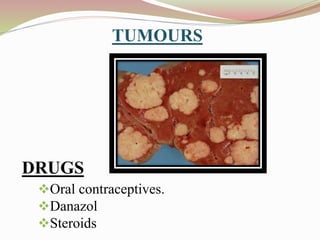
TUMOURS
Oral contraceptives.
Danazol
Steroids
DRUGS
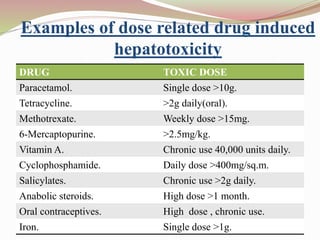
Examples of dose related drug induced
hepatotoxicity
DRUG TOXIC DOSE
Paracetamol. Single dose >10g.
Tetracycline. >2g daily(oral).
Methotrexate. Weekly dose >15mg.
6-Mercaptopurine. >2.5mg/kg.
Vitamin A. Chronic use 40,000 units daily.
Cyclophosphamide. Daily dose >400mg/sq.m.
Salicylates. Chronic use >2g daily.
Anabolic steroids. High dose >1 month.
Oral contraceptives. High dose , chronic use.
Iron. Single dose >1g.
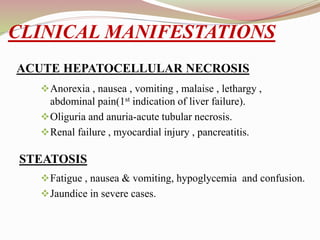
CLINICAL MANIFESTATIONS
Anorexia , nausea , vomiting , malaise , lethargy ,
abdominal pain(1st indication of liver failure).
Oliguria and anuria-acute tubular necrosis.
Renal failure , myocardial injury , pancreatitis.
Fatigue , nausea & vomiting, hypoglycemia and confusion.
Jaundice in severe cases.
ACUTE HEPATOCELLULAR NECROSIS
STEATOSIS
:
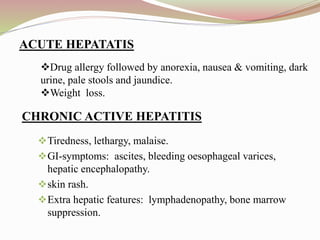
Tiredness, lethargy, malaise.
GI-symptoms: ascites, bleeding oesophageal varices,
hepatic encephalopathy.
skin rash.
Extra hepatic features: lymphadenopathy, bone marrow
suppression.
ACUTE HEPATATIS
Drug allergy followed by anorexia, nausea & vomiting, dark
urine, pale stools and jaundice.
Weight loss.
CHRONIC ACTIVE HEPATITIS
Severe Pruritus with or without dark urine,pale stools and jaundice.
Abdominal pain , influenza- like illness.
Painful hepatomegaly, ascites and jaundice.
Abdominal pain, feeling of fullness after eating , weight loss,
fatigue, anorexia, nausea and vomiting.
CHOLESTASIS
CHOLESTATIC HEPATITIS:
VENO-OCCLUSIVE DISEASE
HEPATIC TUMOURS
INVESTIGATIONS
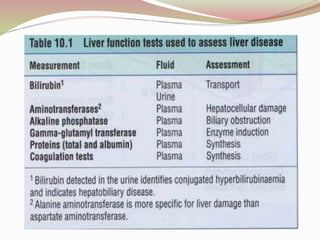
Liver function tests (LFTs).
Radiological investigations.
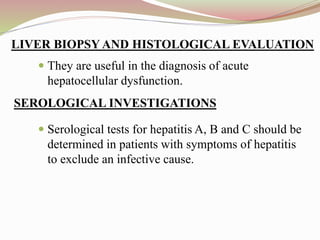
Liver biopsy and histological evaluation.
Serological markers for Hepatitis A , B & C.
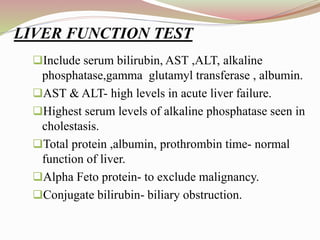
Include serum bilirubin, AST ,ALT, alkaline
phosphatase,gamma glutamyl transferase , albumin.
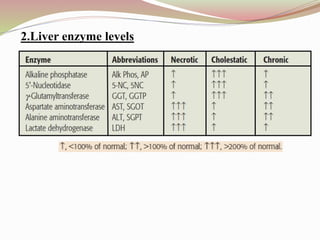
AST & ALT- high levels in acute liver failure.
Highest serum levels of alkaline phosphatase seen in
cholestasis.
Total protein ,albumin, prothrombin time- normal
function of liver.
Alpha Feto protein- to exclude malignancy.
Conjugate bilirubin- biliary obstruction.
LIVER FUNCTION TEST
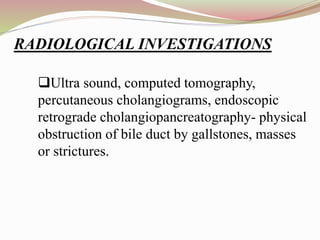
Ultra sound, computed tomography,
percutaneous cholangiograms, endoscopic
retrograde cholangiopancreatography- physical
obstruction of bile duct by gallstones, masses
or strictures.
RADIOLOGICAL INVESTIGATIONS
 They are useful in the diagnosis of acute
hepatocellular dysfunction.
 Serological tests for hepatitis A, B and C should be
determined in patients with symptoms of hepatitis
to exclude an infective cause.
LIVER BIOPSY AND HISTOLOGICAL EVALUATION
SEROLOGICAL INVESTIGATIONS
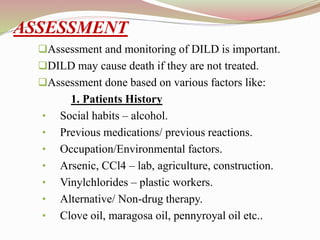
ASSESSMENT
Assessment and monitoring of DILD is important.
DILD may cause death if they are not treated.
Assessment done based on various factors like:
1. Patients History
• Social habits – alcohol.
• Previous medications/ previous reactions.
• Occupation/Environmental factors.
• Arsenic, CCl4 – lab, agriculture, construction.
• Vinylchlorides – plastic workers.
• Alternative/ Non-drug therapy.
• Clove oil, maragosa oil, pennyroyal oil etc..
2.Liver enzyme levels
3.Liver Biopsy
4.Nutritional status
o Low serum levels of vitamins E and C are
associated with asymptomatic elevations in
transaminases.
o High serum iron, transferrin, and selenium
levels are also associated with asymptomatic
elevations of transaminases.
TREATMENT
I. Diagnosis.
II. Withdrawal of the causative drug.
III.Supportive therapy.
DIAGNOSIS
 Detailed drug history including the use of oral
contraceptives,OTC medicines, vitamins, herbs and illicit
drugs should be obtained.
 Predisposing factors should be noted.
WITHDRAWL
 Once drug induced hepatotoxicity has been recognized,
therapy should be stopped.
1. ANTIDOTES
 N-acetyl cysteine & methionine for paracetamol
over dose.
 Desferrioxamine (5 to 10g in 100 ml water orally)
for iron overdose.
2.CORTICOSTEROIDS
 For immuno suppression.
MANAGEMENT
3.SUPPORTIVE TREATMENT
 Fluid & electrolyte balance.
 Nutritional support-high carbohydrate , low fat diet-
relief from anorexia, nausea and diarrhoea.
4. PRURITIS
Light clothing (avoid wool).
Cooling the skin with tepid bath or calamine
lotion
5. COAGULATION DISORDERS
Can be treated by correcting vitamin K deficiency
with iv phytomenadione injection.
Infusion of fresh frozen plasma or clotting factor
concentrates are indicated if profused bleeding occurs.
6.LIVER PROTECTIVES
LIV52.
Livna.
Liv Atharva liq.
 Clinical Pharmacy and Therapeutics- Fourth Edition-
Roger Walker, Page NO: 199-214.
 Pharmacotherapy. A Pathophysiologic Approach-
Joseph. T. Dipiro 6th Edition, Page NO:713-720.
REFERENCES
Drug Induced Liver Disorder

Drug Induced Liver Disorder