HYPERTENSION
Non Pharmacologic Management
Mohammad Ilyas, M.D.
Assistant Clinical Professor
University of Florida / Health Sciences Center
Jacksonville, Florida USA
6/24/2014
1
Outline
1. Definition, Regulation and Pathophysiology
2. Measurement of Blood Pressure, Staging of Hypertension and Ambulatory
Blood Pressure Monitoring
3. Evaluation of Primary Versus Secondary
4. Sequel of Hypertension and Hypertension Emergencies
5. Management of Hypertension (Non-Pharmacology versus Drug Therapy)
6. The Relation Between Hypertension: Obesity, Drugs, Stress and Sleep
Disorders.
7. Hypertension in Renal diseases and Pregnancies
8. Pediatric, Neonatal and Genetic Hypertension
6/24/2014
2
0
10
20
30
40
50
60
70
80
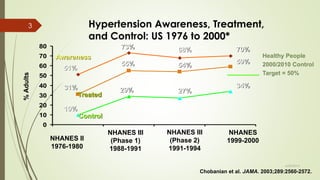
Hypertension Awareness, Treatment,
and Control: US 1976 to 2000*
NHANES III
(Phase 2)
1991-1994
NHANES III
(Phase 1)
1988-1991
51%
73% 68%
31%
55% 54%
10%
29% 27%
%Adults
NHANES II
1976-1980
NHANES
1999-2000
70%
59%
34%
Healthy People
2000/2010 Control
Target = 50%
Control
Awareness
Treated
Chobanian et al. JAMA. 2003;289:2560-2572.
6/24/2014
3
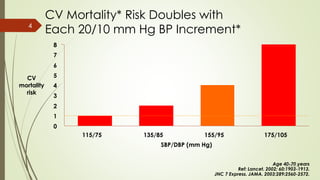
CV Mortality* Risk Doubles with
Each 20/10 mm Hg BP Increment*
Age 40-70 years
Ref: Lancet. 2002; 60:1903-1913.
JNC 7 Express. JAMA. 2003;289:2560-2572.
CV
mortality
risk
SBP/DBP (mm Hg)
0
1
2
3
4
5
6
7
8
115/75 135/85 155/95 175/105
6/24/2014
4
0
1
2
3
4
5
6
7
8
9
120/80 140/90 160/100 180/110
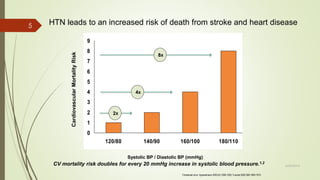
HTN leads to an increased risk of death from stroke and heart disease
Systolic BP / Diastolic BP (mmHg)
8x
4x
2x
CV mortality risk doubles for every 20 mmHg increase in systolic blood pressure.1,2
CardiovascularMortalityRisk
Chobanian et al. Hypertension 2003;42:1206-1252; 2Lancet 2002;360:1903-1913
6/24/2014
5
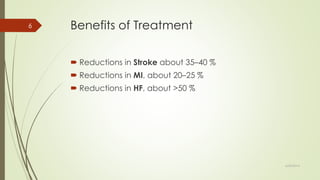
Benefits of Treatment
 Reductions in Stroke about 35–40 %
 Reductions in MI, about 20–25 %
 Reductions in HF, about >50 %
6/24/2014
6
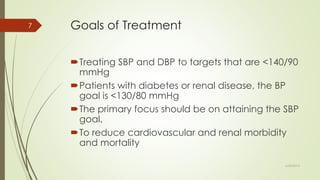
Goals of Treatment
Treating SBP and DBP to targets that are <140/90
mmHg
Patients with diabetes or renal disease, the BP
goal is <130/80 mmHg
The primary focus should be on attaining the SBP
goal.
To reduce cardiovascular and renal morbidity
and mortality
6/24/2014
7
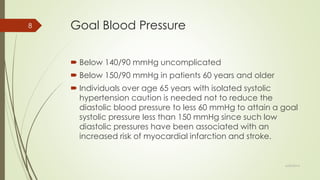
Goal Blood Pressure
 Below 140/90 mmHg uncomplicated
 Below 150/90 mmHg in patients 60 years and older
 Individuals over age 65 years with isolated systolic
hypertension caution is needed not to reduce the
diastolic blood pressure to less 60 mmHg to attain a goal
systolic pressure less than 150 mmHg since such low
diastolic pressures have been associated with an
increased risk of myocardial infarction and stroke.
6/24/2014
8
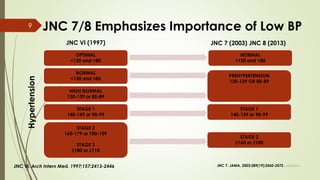
JNC 7/8 Emphasizes Importance of Low BP
OPTIMAL
<120 and <80
HIGH NORMAL
130-139 or 85-89
STAGE 1
140-159 or 90-99
STAGE 2
160-179 or 100-109
STAGE 3
≥180 or ≥110
NORMAL
<130 and <85
NORMAL
<120 and <80
PREHYPERTENSION
120-139 OR 80-89
STAGE 2
≥160 or ≥100
STAGE 1
140-159 or 90-99
JNC 7 (2003) JNC 8 (2013)JNC VI (1997)
Hypertension
JNC VI. Arch Intern Med. 1997;157:2413-2446 JNC 7. JAMA. 2003;289(19):2560-2572. 6/24/2014
9
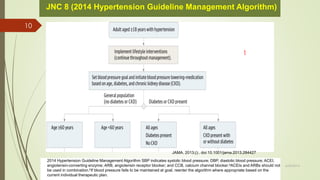
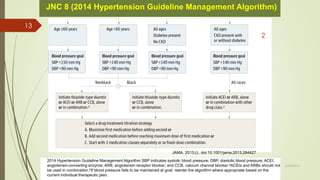
2014 Hypertension Guideline Management Algorithm SBP indicates systolic blood pressure; DBP, diastolic blood pressure; ACEI,
angiotensin-converting enzyme; ARB, angiotensin receptor blocker; and CCB, calcium channel blocker.aACEIs and ARBs should not
be used in combination.bIf blood pressure fails to be maintained at goal, reenter the algorithm where appropriate based on the
current individual therapeutic plan.
JNC 8 (2014 Hypertension Guideline Management Algorithm)
JAMA. 2013;():. doi:10.1001/jama.2013.284427
1
6/24/2014
10
Adapted from the JNC 7 Slide Deck. Available at: http://www.nhlbi.nih.gov.
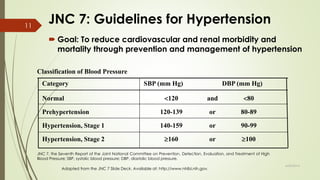
JNC 7: Guidelines for Hypertension
 Goal: To reduce cardiovascular and renal morbidity and
mortality through prevention and management of hypertension
Classification of Blood Pressure
DBP (mm Hg)SBP (mm Hg)Category
80
80-89
90-99
100
120
120-139
140-159
160
Normal
Prehypertension
Hypertension, Stage 1
Hypertension, Stage 2
and
or
or
or
JNC 7, the Seventh Report of the Joint National Committee on Prevention, Detection, Evaluation, and Treatment of High
Blood Pressure; SBP, systolic blood pressure; DBP, diastolic blood pressure.
6/24/2014
11
6/24/2014
12
JAMA. 2013;():. doi:10.1001/jama.2013.284427
2014 Hypertension Guideline Management Algorithm SBP indicates systolic blood pressure; DBP, diastolic blood pressure; ACEI,
angiotensin-converting enzyme; ARB, angiotensin receptor blocker; and CCB, calcium channel blocker.aACEIs and ARBs should not
be used in combination.bIf blood pressure fails to be maintained at goal, reenter the algorithm where appropriate based on the
current individual therapeutic plan.
JNC 8 (2014 Hypertension Guideline Management Algorithm)
2
6/24/2014
13
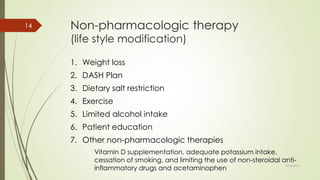
Non-pharmacologic therapy
(life style modification)
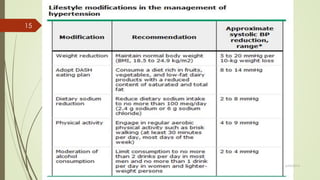
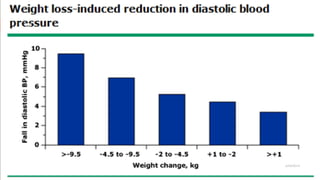
1. Weight loss
2. DASH Plan
3. Dietary salt restriction
4. Exercise
5. Limited alcohol intake
6. Patient education
7. Other non-pharmacologic therapies
Vitamin D supplementation, adequate potassium intake,
cessation of smoking, and limiting the use of non-steroidal anti-
inflammatory drugs and acetaminophen
6/24/2014
14
6/24/2014
15
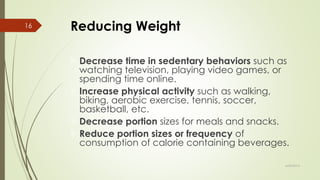
Reducing Weight
Decrease time in sedentary behaviors such as
watching television, playing video games, or
spending time online.
Increase physical activity such as walking,
biking, aerobic exercise, tennis, soccer,
basketball, etc.
Decrease portion sizes for meals and snacks.
Reduce portion sizes or frequency of
consumption of calorie containing beverages.
6/24/2014
16
6/24/2014
17
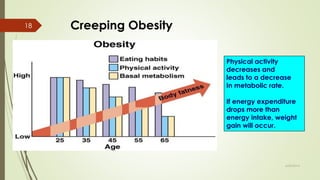
Creeping Obesity
Physical activity
decreases and
leads to a decrease
In metabolic rate.
If energy expenditure
drops more than
energy intake, weight
gain will occur.
6/24/2014
18
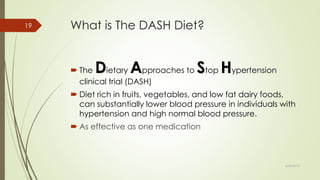
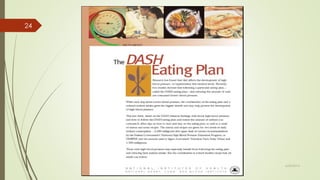
What is The DASH Diet?
 The Dietary Approaches to Stop Hypertension
clinical trial (DASH)
 Diet rich in fruits, vegetables, and low fat dairy foods,
can substantially lower blood pressure in individuals with
hypertension and high normal blood pressure.
 As effective as one medication
6/24/2014
19
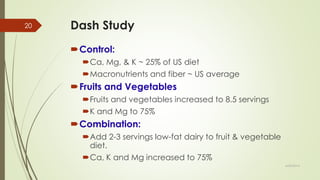
Dash Study
Control:
Ca, Mg, & K ~ 25% of US diet
Macronutrients and fiber ~ US average
Fruits and Vegetables
Fruits and vegetables increased to 8.5 servings
K and Mg to 75%
Combination:
Add 2-3 servings low-fat dairy to fruit & vegetable
diet.
Ca, K and Mg increased to 75%
6/24/2014
20
Dash Study Outcomes
Fruit and Vegetable Diet:
Decrease in systolic and diastolic blood pressure in
entire study group and in the hypertensive subgroup.
Combination Diet:
Significant decrease in both systolic and diastolic
blood pressure in both groups.
Greatest drop was in systolic BP in hypertensive group
(11.4 mmHg)
6/24/2014
21
Dash Diet Implications
Combination diet affects comparable to
pharmacological trails in mild hypertension.
Population wide reductions in blood pressure
similar to DASH results would reduce CHD by ~
15% and stroke by ~27%
Great potential in susceptible groups: African
Americans and elderly.
6/24/2014
22
The DASH Diet
The DASH Diet includes:
7-8 servings of grains and grain products
4-5 servings of vegetables
4-5 servings of fruits
2-3 servings of low fat dairy products
2 or less servings of meat, poultry and fish
2-3 servings of fats and oils
Nuts, seeds and dry beans 4-5 times /week
Limited ‘sweets’ low in fat. 6/24/2014
23
6/24/2014
24
Effects of increasing Calcium-Rich Dairy
Food in Black Hypertensives
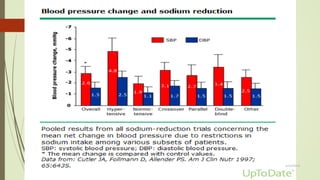
 Increases urinary sodium excretion
 Decreases volume
 Decreases peripheral vascular resistance
 Decrease blood pressure
 Reduces left ventricular mass and risk of left ventricular
hypertrophy
Effects sustained for one-year period of study
6/24/2014
25
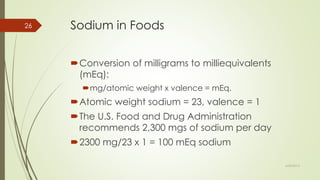
Sodium in Foods
Conversion of milligrams to milliequivalents
(mEq):
mg/atomic weight x valence = mEq.
Atomic weight sodium = 23, valence = 1
The U.S. Food and Drug Administration
recommends 2,300 mgs of sodium per day
2300 mg/23 x 1 = 100 mEq sodium
6/24/2014
26
Reducing Sodium in the Diet
Use fresh poultry, fish and lean meat, rather than
canned or processed.
Buy fresh, plain frozen or canned with “no salt
added” vegetables.
Use herbs, spices and salt-free seasoning blends
in cooking and at the table; decrease or
eliminate use of table salt.
Choose ‘convenience’ foods that are lower in
sodium.
6/24/2014
27
Reducing Sodium in the Diet
When available, buy low- or reduced-sodium or
‘no-salt-added’ versions of foods like:
Canned soup, canned vegetables, vegetable juices
cheeses, lower in fat
condiments like soy sauce
crackers and snack foods like nuts
processed lean meats
6/24/2014
28
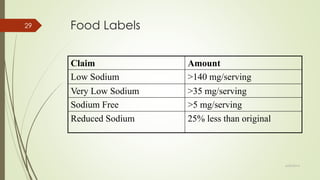
Food Labels
Claim Amount
Low Sodium >140 mg/serving
Very Low Sodium >35 mg/serving
Sodium Free >5 mg/serving
Reduced Sodium 25% less than original
6/24/2014
29
6/24/2014
30
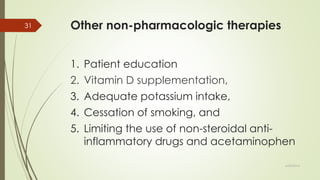
Other non-pharmacologic therapies
1. Patient education
2. Vitamin D supplementation,
3. Adequate potassium intake,
4. Cessation of smoking, and
5. Limiting the use of non-steroidal anti-
inflammatory drugs and acetaminophen
6/24/2014
31

Hypertension non pharmcolical management

  • 1.
    HYPERTENSION Non Pharmacologic Management MohammadIlyas, M.D. Assistant Clinical Professor University of Florida / Health Sciences Center Jacksonville, Florida USA 6/24/2014 1
  • 2.
    Outline 1. Definition, Regulationand Pathophysiology 2. Measurement of Blood Pressure, Staging of Hypertension and Ambulatory Blood Pressure Monitoring 3. Evaluation of Primary Versus Secondary 4. Sequel of Hypertension and Hypertension Emergencies 5. Management of Hypertension (Non-Pharmacology versus Drug Therapy) 6. The Relation Between Hypertension: Obesity, Drugs, Stress and Sleep Disorders. 7. Hypertension in Renal diseases and Pregnancies 8. Pediatric, Neonatal and Genetic Hypertension 6/24/2014 2
  • 3.
    0 10 20 30 40 50 60 70 80 Hypertension Awareness, Treatment, andControl: US 1976 to 2000* NHANES III (Phase 2) 1991-1994 NHANES III (Phase 1) 1988-1991 51% 73% 68% 31% 55% 54% 10% 29% 27% %Adults NHANES II 1976-1980 NHANES 1999-2000 70% 59% 34% Healthy People 2000/2010 Control Target = 50% Control Awareness Treated Chobanian et al. JAMA. 2003;289:2560-2572. 6/24/2014 3
  • 4.
    CV Mortality* RiskDoubles with Each 20/10 mm Hg BP Increment* Age 40-70 years Ref: Lancet. 2002; 60:1903-1913. JNC 7 Express. JAMA. 2003;289:2560-2572. CV mortality risk SBP/DBP (mm Hg) 0 1 2 3 4 5 6 7 8 115/75 135/85 155/95 175/105 6/24/2014 4
  • 5.
    0 1 2 3 4 5 6 7 8 9 120/80 140/90 160/100180/110 HTN leads to an increased risk of death from stroke and heart disease Systolic BP / Diastolic BP (mmHg) 8x 4x 2x CV mortality risk doubles for every 20 mmHg increase in systolic blood pressure.1,2 CardiovascularMortalityRisk Chobanian et al. Hypertension 2003;42:1206-1252; 2Lancet 2002;360:1903-1913 6/24/2014 5
  • 6.
    Benefits of Treatment Reductions in Stroke about 35–40 %  Reductions in MI, about 20–25 %  Reductions in HF, about >50 % 6/24/2014 6
  • 7.
    Goals of Treatment TreatingSBP and DBP to targets that are <140/90 mmHg Patients with diabetes or renal disease, the BP goal is <130/80 mmHg The primary focus should be on attaining the SBP goal. To reduce cardiovascular and renal morbidity and mortality 6/24/2014 7
  • 8.
    Goal Blood Pressure Below 140/90 mmHg uncomplicated  Below 150/90 mmHg in patients 60 years and older  Individuals over age 65 years with isolated systolic hypertension caution is needed not to reduce the diastolic blood pressure to less 60 mmHg to attain a goal systolic pressure less than 150 mmHg since such low diastolic pressures have been associated with an increased risk of myocardial infarction and stroke. 6/24/2014 8
  • 9.
    JNC 7/8 EmphasizesImportance of Low BP OPTIMAL <120 and <80 HIGH NORMAL 130-139 or 85-89 STAGE 1 140-159 or 90-99 STAGE 2 160-179 or 100-109 STAGE 3 ≥180 or ≥110 NORMAL <130 and <85 NORMAL <120 and <80 PREHYPERTENSION 120-139 OR 80-89 STAGE 2 ≥160 or ≥100 STAGE 1 140-159 or 90-99 JNC 7 (2003) JNC 8 (2013)JNC VI (1997) Hypertension JNC VI. Arch Intern Med. 1997;157:2413-2446 JNC 7. JAMA. 2003;289(19):2560-2572. 6/24/2014 9
  • 10.
    2014 Hypertension GuidelineManagement Algorithm SBP indicates systolic blood pressure; DBP, diastolic blood pressure; ACEI, angiotensin-converting enzyme; ARB, angiotensin receptor blocker; and CCB, calcium channel blocker.aACEIs and ARBs should not be used in combination.bIf blood pressure fails to be maintained at goal, reenter the algorithm where appropriate based on the current individual therapeutic plan. JNC 8 (2014 Hypertension Guideline Management Algorithm) JAMA. 2013;():. doi:10.1001/jama.2013.284427 1 6/24/2014 10
  • 11.
    Adapted from theJNC 7 Slide Deck. Available at: http://www.nhlbi.nih.gov. JNC 7: Guidelines for Hypertension  Goal: To reduce cardiovascular and renal morbidity and mortality through prevention and management of hypertension Classification of Blood Pressure DBP (mm Hg)SBP (mm Hg)Category 80 80-89 90-99 100 120 120-139 140-159 160 Normal Prehypertension Hypertension, Stage 1 Hypertension, Stage 2 and or or or JNC 7, the Seventh Report of the Joint National Committee on Prevention, Detection, Evaluation, and Treatment of High Blood Pressure; SBP, systolic blood pressure; DBP, diastolic blood pressure. 6/24/2014 11
  • 12.
  • 13.
    JAMA. 2013;():. doi:10.1001/jama.2013.284427 2014Hypertension Guideline Management Algorithm SBP indicates systolic blood pressure; DBP, diastolic blood pressure; ACEI, angiotensin-converting enzyme; ARB, angiotensin receptor blocker; and CCB, calcium channel blocker.aACEIs and ARBs should not be used in combination.bIf blood pressure fails to be maintained at goal, reenter the algorithm where appropriate based on the current individual therapeutic plan. JNC 8 (2014 Hypertension Guideline Management Algorithm) 2 6/24/2014 13
  • 14.
    Non-pharmacologic therapy (life stylemodification) 1. Weight loss 2. DASH Plan 3. Dietary salt restriction 4. Exercise 5. Limited alcohol intake 6. Patient education 7. Other non-pharmacologic therapies Vitamin D supplementation, adequate potassium intake, cessation of smoking, and limiting the use of non-steroidal anti- inflammatory drugs and acetaminophen 6/24/2014 14
  • 15.
  • 16.
    Reducing Weight Decrease timein sedentary behaviors such as watching television, playing video games, or spending time online. Increase physical activity such as walking, biking, aerobic exercise, tennis, soccer, basketball, etc. Decrease portion sizes for meals and snacks. Reduce portion sizes or frequency of consumption of calorie containing beverages. 6/24/2014 16
  • 17.
  • 18.
    Creeping Obesity Physical activity decreasesand leads to a decrease In metabolic rate. If energy expenditure drops more than energy intake, weight gain will occur. 6/24/2014 18
  • 19.
    What is TheDASH Diet?  The Dietary Approaches to Stop Hypertension clinical trial (DASH)  Diet rich in fruits, vegetables, and low fat dairy foods, can substantially lower blood pressure in individuals with hypertension and high normal blood pressure.  As effective as one medication 6/24/2014 19
  • 20.
    Dash Study Control: Ca, Mg,& K ~ 25% of US diet Macronutrients and fiber ~ US average Fruits and Vegetables Fruits and vegetables increased to 8.5 servings K and Mg to 75% Combination: Add 2-3 servings low-fat dairy to fruit & vegetable diet. Ca, K and Mg increased to 75% 6/24/2014 20
  • 21.
    Dash Study Outcomes Fruitand Vegetable Diet: Decrease in systolic and diastolic blood pressure in entire study group and in the hypertensive subgroup. Combination Diet: Significant decrease in both systolic and diastolic blood pressure in both groups. Greatest drop was in systolic BP in hypertensive group (11.4 mmHg) 6/24/2014 21
  • 22.
    Dash Diet Implications Combinationdiet affects comparable to pharmacological trails in mild hypertension. Population wide reductions in blood pressure similar to DASH results would reduce CHD by ~ 15% and stroke by ~27% Great potential in susceptible groups: African Americans and elderly. 6/24/2014 22
  • 23.
    The DASH Diet TheDASH Diet includes: 7-8 servings of grains and grain products 4-5 servings of vegetables 4-5 servings of fruits 2-3 servings of low fat dairy products 2 or less servings of meat, poultry and fish 2-3 servings of fats and oils Nuts, seeds and dry beans 4-5 times /week Limited ‘sweets’ low in fat. 6/24/2014 23
  • 24.
  • 25.
    Effects of increasingCalcium-Rich Dairy Food in Black Hypertensives  Increases urinary sodium excretion  Decreases volume  Decreases peripheral vascular resistance  Decrease blood pressure  Reduces left ventricular mass and risk of left ventricular hypertrophy Effects sustained for one-year period of study 6/24/2014 25
  • 26.
    Sodium in Foods Conversionof milligrams to milliequivalents (mEq): mg/atomic weight x valence = mEq. Atomic weight sodium = 23, valence = 1 The U.S. Food and Drug Administration recommends 2,300 mgs of sodium per day 2300 mg/23 x 1 = 100 mEq sodium 6/24/2014 26
  • 27.
    Reducing Sodium inthe Diet Use fresh poultry, fish and lean meat, rather than canned or processed. Buy fresh, plain frozen or canned with “no salt added” vegetables. Use herbs, spices and salt-free seasoning blends in cooking and at the table; decrease or eliminate use of table salt. Choose ‘convenience’ foods that are lower in sodium. 6/24/2014 27
  • 28.
    Reducing Sodium inthe Diet When available, buy low- or reduced-sodium or ‘no-salt-added’ versions of foods like: Canned soup, canned vegetables, vegetable juices cheeses, lower in fat condiments like soy sauce crackers and snack foods like nuts processed lean meats 6/24/2014 28
  • 29.
    Food Labels Claim Amount LowSodium >140 mg/serving Very Low Sodium >35 mg/serving Sodium Free >5 mg/serving Reduced Sodium 25% less than original 6/24/2014 29
  • 30.
  • 31.
    Other non-pharmacologic therapies 1.Patient education 2. Vitamin D supplementation, 3. Adequate potassium intake, 4. Cessation of smoking, and 5. Limiting the use of non-steroidal anti- inflammatory drugs and acetaminophen 6/24/2014 31