Antiviral agents-I
Dr. Pravin Prasad
M.B.B.S., MD Clinical Pharmacology
Lecturer, Lumbini Medical College
22 July, 2018 (6 Shrawan, 2075), Sunday
By the end of the class, MBBS Sem IV
students will be able to:
 Identify the targets of anti-viral agents
 Classify anti-viral agents
 Describe the pharmacology of acyclovir
 Compare the different anti-herpes agents
Anti-viral agents: Introduction
 Virus uses host cell metabolic machinery for its
replication
 Selective toxicity difficult to achieve
 Antivirals required for:
 Immunocompromised individuals
 Infection with high morbidity/mortality
 Targets of anti-viral agents:
 Viral enzymes, virus directed enzymes
 Virus specific steps
Virus specific steps: Possible Targets
Attachment
and entry
Penetration
Uncoating Nucleic acid
synthesis
Integration
and/or
transcription
Viral Protein
synthesis
Packaging and
assembly
Virus
release
Mammalian cell
1
2
3 4
56
7
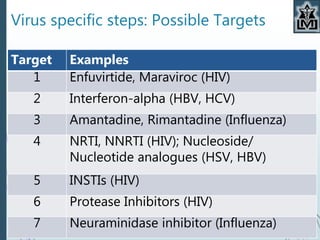
Virus specific steps: Possible Targets
Target Examples
1 Enfuvirtide, Maraviroc (HIV)
2 Interferon-alpha (HBV, HCV)
3 Amantadine, Rimantadine (Influenza)
4 NRTI, NNRTI (HIV); Nucleoside/
Nucleotide analogues (HSV, HBV)
5 INSTIs (HIV)
6 Protease Inhibitors (HIV)
7 Neuraminidase inhibitor (Influenza)
Anti-viral agents: Classification
 Anti-herpes drugs
 Idoxuridine, Trifluridine
 Acyclovir, Valacyclovir
 Ganciclovir, Valganciclovir
 Famciclovir
 Cidofovir
 Foscarnet
Anti-viral agents: Classification
 Anti-influenza drugs
 Amantadine, Rimantadine
 Oseltamivir
 Zanamivir
Anti-viral agents: Classification
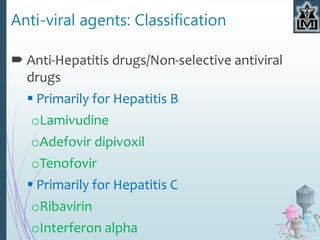
 Anti-Hepatitis drugs/Non-selective antiviral
drugs
 Primarily for Hepatitis B
oLamivudine
oAdefovir dipivoxil
oTenofovir
 Primarily for Hepatitis C
oRibavirin
oInterferon alpha
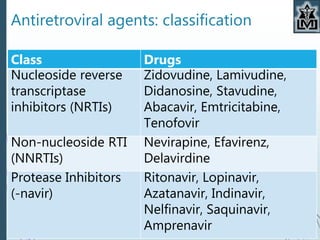
Antiretroviral agents: classification
Class Drugs
Nucleoside reverse
transcriptase
inhibitors (NRTIs)
Zidovudine, Lamivudine,
Didanosine, Stavudine,
Abacavir, Emtricitabine,
Tenofovir
Non-nucleoside RTI
(NNRTIs)
Nevirapine, Efavirenz,
Delavirdine
Protease Inhibitors
(-navir)
Ritonavir, Lopinavir,
Azatanavir, Indinavir,
Nelfinavir, Saquinavir,
Amprenavir
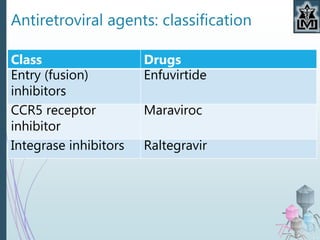
Antiretroviral agents: classification
Class Drugs
Entry (fusion)
inhibitors
Enfuvirtide
CCR5 receptor
inhibitor
Maraviroc
Integrase inhibitors Raltegravir
Anti-herpes drugs
Idoxuridine, Trifluridine
 Thymidine analogue
 Competes with thymidine
 Gets incorporated into DNA
 Faulty DNA formed, that breaks easily
 Trifluridine: fluorinated nucleoside
 Problems:
 Low virus selectivity
 Rapid development of viral resistance
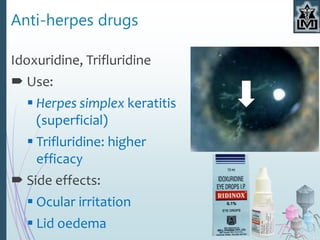
Anti-herpes drugs
Idoxuridine, Trifluridine
 Use:
 Herpes simplex keratitis
(superficial)
 Trifluridine: higher
efficacy
 Side effects:
 Ocular irritation
 Lid oedema
Anti-herpes agents
 Acyclovir
 Deoxyguanosine analogue
 Selective toxicity:
oPreferentially taken up by virus infected cells
oHerpes virus specific thymidine kinase
required for its action
oActs by inhibiting viral DNA polymerase
reversibly as well as irreversibly
Acyclovir: Mechanism of Action
Acyclovir
Acyclovir
Mono-
phosphate
Acyclovir
Triphosphate
1. Herpes virus specific
thymidine kinase
2.Cellular kinases
1
2
• Inhibits herpes virus DNA
polymerase competitively
• Gets incorporated into viral DNA
• Early termination of lengthening
of viral DNA
• DNA polymerase inhibited
irreversibly
Interesting fact….
George Hitchings and Gertrude Elion
Discovered and developed Acyclovir
Nobel Prize in 1988
 Active against only herpes group of viruses
 Herpes simplex Virus (HSV)-1
 HSV-2
 Varicella zoster virus (VZV), Ebstein Barr
virus
 Resistance to acyclovir:
 HSV- mutant thymidine kinase (TK)
 VZV- increased substrate specificity of TK
Anti-herpes agents: Acyclovir
IncreasedSensitivity
CMV
Anti-herpes agents: Acyclovir
 Pharmacokinetics:
 Oral bioavailability: 10-30%
o Decreases with increasing dose
oValacyclovir: 55-70%
 Low percutaneous absorption
 Widely distributed
 Eliminated unmetabolized by glomerular
filtration and tubular secretion
 Elimination t½ 2.5 hrs
Anti-herpes agents: Acyclovir
 Uses:
 Herpes simplex infections:
oGenital (Primary, Recurrent)
oMucocutaneous
oEncephalitis
oKeratitis
 Varicella zoster infections:
oHerpes zoster
oChickenpox
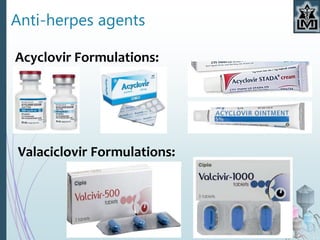
Anti-herpes agents
Acyclovir Formulations:
Valaciclovir Formulations:
Anti-herpes agents: Acyclovir
 Adverse effects:
 Dose dependent decrease in GFR
 Reversible neurological manifestation (lethargy,
disorientation, hallucinations, convulsions,
coma) at higher doses
 Topical: Stinging and burning sensation after
each application
 Oral: Headache, nausea, malaise
 Intravenous: Rashes, sweating, fall in BP
Anti-herpes agents: Ganciclovir
 Analogue of acyclovir
 Active against:
 H. simplex, H. zoster, EBV
 Cytomegalovirus (CMV, most sensitive)
oHigher concentration
oEliminated slowly ( >24 hours)
Anti-herpes agents: Ganciclovir
 Mechanism of action: Similar to acyclovir
 Mechanism of resistance:
 Mutation of viral phosphokinase and/or viral
DNA polymerase
 Pharmacokinetics:
 Oral bioavailability <10%
oValganciclovir higher oral bioavailability
 Excreted in urine
 Plasma half life 2-4 hrs
Anti-herpes agents: Ganciclovir
Side effects:
 Bone marrow toxicity
 Precursor cells quite sensitive to ganciclovir
 Rash, fever, vomiting, neuropsychiatric
disturbances
Uses:
 Prophylaxis and treatment of severe CMV
infections in immunocompromised
 CMV retinitis in AIDS patients
Anti-herpes agents: Famciclovir
 Guanine nucloeside
 Prodrug of penciclovir
 Good oral bioavailability
 Prolonged intracellular t½ of the active
triphosphate metabolite
 Penciclovir available in some countries for
intravenous use
Anti-herpes agents: Famciclovir
 Mechanism of action:
 Requires viral TK for activation
 Inhibits viral DNA polymerase
 Inhibits:
 Acyclovir sensitive H. simplex, H. zoster
oAs alternative
oReduces duration of illness
 Hepatitis B virus
oChronic hepatitis B
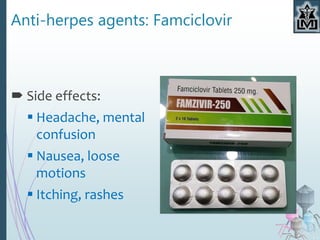
Anti-herpes agents: Famciclovir
 Side effects:
 Headache, mental
confusion
 Nausea, loose
motions
 Itching, rashes
Anti-herpes agents: Cidofovir
 Monophosphate nucleotide analogue of
cytidine
 Inhibits:
 HSV, CMV, pox and adenoviruses
 Acyclovir resistant HSV
 Ganciclovir resistant CMV
Anti-herpes agents: Cidofovir
 Mechanism of Action:
 Does not require viral phosphokinase
 Converted into diphosphate by cellular kinase
oRemains intracellularly for long time
oActs as alternative substrate for viral DNA
polymerase
oInhibits viral DNA polymerase
 Mechanism of resistance: mutation of DNA
polymerase (CMV)
Anti-herpes agents: Cidofovir
Pharmacokinetics:
 Given as intravenous infusion
 Along with pre and post dose oral
probenecid: decreases tubular secretion of
cidofovir
oAvailable to enter cells for longer duration
oReduces nephrotoxicity
Anti-herpes agents: Cidofovir
 Uses:
 CMV retinitis (who have failed on ganciclovir
therapy)
 Acyclovir resistant mucocutaneous HSV
infection in immunocompromised
 Anogenital warts: topical
 Side effects:
 Dose related kidney damage
 Neutropenia, uveitis, hypersensitivity reaction
Anti-herpes agents: Foscarnet
 Unrelated to any nucleic acid
 Inhibits viral DNA polymerase and reverse
transcriptase
 Resistance to foscarnet- minimal
 Acts on:
 H. simplex (acyclovir sensitive / resistance)
 CMV (ganciclovir sensitive / resistant)
 HIV
Anti-herpes agents: Foscarnet
 Pharmacokinetics:
 Poorly absorbed orally
 Not metabolised
 t½ 4-8 hrs
 Uses:
 CMV retinitis/ infections in AIDS patients
 Acyclovir resistance cases in AIDS patients
Anti-herpes agents: Foscarnet
 Side effects:
 Renal diabetes like condition
 Acute renal failure
 Anaemia, phlebitis, tremor, convulsions
 Due to hypocalcaemia:
oNumbness and tingling sensation
oMuscle cramps
oIrritability, seizures
Conclusion
 Selective toxicity for antiviral agents is achieved
by targeting viral enzymes and virus specific
steps
 Anti-viral agents are broadly classified into four
groups depending upon their activity on viruses
 Idoxuridine and trifluridine are used only
topically
 Variation in the sensitivity of anti-herpes agents
to herpes family viruses is well recognised
Questions??
 Thank you..

Antiviral agents-1

  • 1.
    Antiviral agents-I Dr. PravinPrasad M.B.B.S., MD Clinical Pharmacology Lecturer, Lumbini Medical College 22 July, 2018 (6 Shrawan, 2075), Sunday
  • 2.
    By the endof the class, MBBS Sem IV students will be able to:  Identify the targets of anti-viral agents  Classify anti-viral agents  Describe the pharmacology of acyclovir  Compare the different anti-herpes agents
  • 3.
    Anti-viral agents: Introduction Virus uses host cell metabolic machinery for its replication  Selective toxicity difficult to achieve  Antivirals required for:  Immunocompromised individuals  Infection with high morbidity/mortality  Targets of anti-viral agents:  Viral enzymes, virus directed enzymes  Virus specific steps
  • 4.
    Virus specific steps:Possible Targets Attachment and entry Penetration Uncoating Nucleic acid synthesis Integration and/or transcription Viral Protein synthesis Packaging and assembly Virus release Mammalian cell 1 2 3 4 56 7
  • 5.
    Virus specific steps:Possible Targets Target Examples 1 Enfuvirtide, Maraviroc (HIV) 2 Interferon-alpha (HBV, HCV) 3 Amantadine, Rimantadine (Influenza) 4 NRTI, NNRTI (HIV); Nucleoside/ Nucleotide analogues (HSV, HBV) 5 INSTIs (HIV) 6 Protease Inhibitors (HIV) 7 Neuraminidase inhibitor (Influenza)
  • 6.
    Anti-viral agents: Classification Anti-herpes drugs  Idoxuridine, Trifluridine  Acyclovir, Valacyclovir  Ganciclovir, Valganciclovir  Famciclovir  Cidofovir  Foscarnet
  • 7.
    Anti-viral agents: Classification Anti-influenza drugs  Amantadine, Rimantadine  Oseltamivir  Zanamivir
  • 8.
    Anti-viral agents: Classification Anti-Hepatitis drugs/Non-selective antiviral drugs  Primarily for Hepatitis B oLamivudine oAdefovir dipivoxil oTenofovir  Primarily for Hepatitis C oRibavirin oInterferon alpha
  • 9.
    Antiretroviral agents: classification ClassDrugs Nucleoside reverse transcriptase inhibitors (NRTIs) Zidovudine, Lamivudine, Didanosine, Stavudine, Abacavir, Emtricitabine, Tenofovir Non-nucleoside RTI (NNRTIs) Nevirapine, Efavirenz, Delavirdine Protease Inhibitors (-navir) Ritonavir, Lopinavir, Azatanavir, Indinavir, Nelfinavir, Saquinavir, Amprenavir
  • 10.
    Antiretroviral agents: classification ClassDrugs Entry (fusion) inhibitors Enfuvirtide CCR5 receptor inhibitor Maraviroc Integrase inhibitors Raltegravir
  • 11.
    Anti-herpes drugs Idoxuridine, Trifluridine Thymidine analogue  Competes with thymidine  Gets incorporated into DNA  Faulty DNA formed, that breaks easily  Trifluridine: fluorinated nucleoside  Problems:  Low virus selectivity  Rapid development of viral resistance
  • 12.
    Anti-herpes drugs Idoxuridine, Trifluridine Use:  Herpes simplex keratitis (superficial)  Trifluridine: higher efficacy  Side effects:  Ocular irritation  Lid oedema
  • 13.
    Anti-herpes agents  Acyclovir Deoxyguanosine analogue  Selective toxicity: oPreferentially taken up by virus infected cells oHerpes virus specific thymidine kinase required for its action oActs by inhibiting viral DNA polymerase reversibly as well as irreversibly
  • 14.
    Acyclovir: Mechanism ofAction Acyclovir Acyclovir Mono- phosphate Acyclovir Triphosphate 1. Herpes virus specific thymidine kinase 2.Cellular kinases 1 2 • Inhibits herpes virus DNA polymerase competitively • Gets incorporated into viral DNA • Early termination of lengthening of viral DNA • DNA polymerase inhibited irreversibly
  • 15.
    Interesting fact…. George Hitchingsand Gertrude Elion Discovered and developed Acyclovir Nobel Prize in 1988
  • 16.
     Active againstonly herpes group of viruses  Herpes simplex Virus (HSV)-1  HSV-2  Varicella zoster virus (VZV), Ebstein Barr virus  Resistance to acyclovir:  HSV- mutant thymidine kinase (TK)  VZV- increased substrate specificity of TK Anti-herpes agents: Acyclovir IncreasedSensitivity CMV
  • 17.
    Anti-herpes agents: Acyclovir Pharmacokinetics:  Oral bioavailability: 10-30% o Decreases with increasing dose oValacyclovir: 55-70%  Low percutaneous absorption  Widely distributed  Eliminated unmetabolized by glomerular filtration and tubular secretion  Elimination t½ 2.5 hrs
  • 18.
    Anti-herpes agents: Acyclovir Uses:  Herpes simplex infections: oGenital (Primary, Recurrent) oMucocutaneous oEncephalitis oKeratitis  Varicella zoster infections: oHerpes zoster oChickenpox
  • 19.
  • 20.
    Anti-herpes agents: Acyclovir Adverse effects:  Dose dependent decrease in GFR  Reversible neurological manifestation (lethargy, disorientation, hallucinations, convulsions, coma) at higher doses  Topical: Stinging and burning sensation after each application  Oral: Headache, nausea, malaise  Intravenous: Rashes, sweating, fall in BP
  • 21.
    Anti-herpes agents: Ganciclovir Analogue of acyclovir  Active against:  H. simplex, H. zoster, EBV  Cytomegalovirus (CMV, most sensitive) oHigher concentration oEliminated slowly ( >24 hours)
  • 22.
    Anti-herpes agents: Ganciclovir Mechanism of action: Similar to acyclovir  Mechanism of resistance:  Mutation of viral phosphokinase and/or viral DNA polymerase  Pharmacokinetics:  Oral bioavailability <10% oValganciclovir higher oral bioavailability  Excreted in urine  Plasma half life 2-4 hrs
  • 23.
    Anti-herpes agents: Ganciclovir Sideeffects:  Bone marrow toxicity  Precursor cells quite sensitive to ganciclovir  Rash, fever, vomiting, neuropsychiatric disturbances Uses:  Prophylaxis and treatment of severe CMV infections in immunocompromised  CMV retinitis in AIDS patients
  • 24.
    Anti-herpes agents: Famciclovir Guanine nucloeside  Prodrug of penciclovir  Good oral bioavailability  Prolonged intracellular t½ of the active triphosphate metabolite  Penciclovir available in some countries for intravenous use
  • 25.
    Anti-herpes agents: Famciclovir Mechanism of action:  Requires viral TK for activation  Inhibits viral DNA polymerase  Inhibits:  Acyclovir sensitive H. simplex, H. zoster oAs alternative oReduces duration of illness  Hepatitis B virus oChronic hepatitis B
  • 26.
    Anti-herpes agents: Famciclovir Side effects:  Headache, mental confusion  Nausea, loose motions  Itching, rashes
  • 27.
    Anti-herpes agents: Cidofovir Monophosphate nucleotide analogue of cytidine  Inhibits:  HSV, CMV, pox and adenoviruses  Acyclovir resistant HSV  Ganciclovir resistant CMV
  • 28.
    Anti-herpes agents: Cidofovir Mechanism of Action:  Does not require viral phosphokinase  Converted into diphosphate by cellular kinase oRemains intracellularly for long time oActs as alternative substrate for viral DNA polymerase oInhibits viral DNA polymerase  Mechanism of resistance: mutation of DNA polymerase (CMV)
  • 29.
    Anti-herpes agents: Cidofovir Pharmacokinetics: Given as intravenous infusion  Along with pre and post dose oral probenecid: decreases tubular secretion of cidofovir oAvailable to enter cells for longer duration oReduces nephrotoxicity
  • 30.
    Anti-herpes agents: Cidofovir Uses:  CMV retinitis (who have failed on ganciclovir therapy)  Acyclovir resistant mucocutaneous HSV infection in immunocompromised  Anogenital warts: topical  Side effects:  Dose related kidney damage  Neutropenia, uveitis, hypersensitivity reaction
  • 31.
    Anti-herpes agents: Foscarnet Unrelated to any nucleic acid  Inhibits viral DNA polymerase and reverse transcriptase  Resistance to foscarnet- minimal  Acts on:  H. simplex (acyclovir sensitive / resistance)  CMV (ganciclovir sensitive / resistant)  HIV
  • 32.
    Anti-herpes agents: Foscarnet Pharmacokinetics:  Poorly absorbed orally  Not metabolised  t½ 4-8 hrs  Uses:  CMV retinitis/ infections in AIDS patients  Acyclovir resistance cases in AIDS patients
  • 33.
    Anti-herpes agents: Foscarnet Side effects:  Renal diabetes like condition  Acute renal failure  Anaemia, phlebitis, tremor, convulsions  Due to hypocalcaemia: oNumbness and tingling sensation oMuscle cramps oIrritability, seizures
  • 34.
    Conclusion  Selective toxicityfor antiviral agents is achieved by targeting viral enzymes and virus specific steps  Anti-viral agents are broadly classified into four groups depending upon their activity on viruses  Idoxuridine and trifluridine are used only topically  Variation in the sensitivity of anti-herpes agents to herpes family viruses is well recognised
  • 35.

Editor's Notes

  • #18 Widely distributed (vesicular fluids, placenta, amniotic fluid, CSF, breast milk) Teratogenic potential not seen (USFDA pregnancy category B)