Presentor
Muhammad Naveed
Date:16-11-2016
o Introduction
oHelminths
oTypes of Helminths
oHelminths infection
o Anthelmintics drugs /anti helminths
o Classification of Anthelmintic Drugs
o Description
 Helminth is a general term meaning “worm”
 macroscopic, multicellular, eukaryotic invertebrates
 characterized by elongated, flat or round bodies
 Life cycles are complex
 Intermediate hosts are often needed to support larval stages
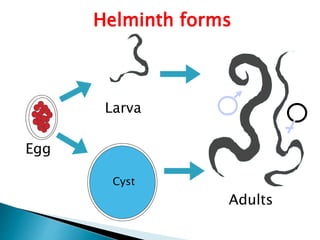
Cyst
Helminth forms
Larva
Egg
Adults
 Based on the external and internal morphology of egg, larval, and
adult stages.
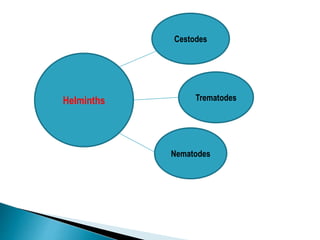
 Three groups of helminthes
◦ Cestodes (tapeworm)
◦ Trematodes (fluke)
◦ Nematodes (roundworm)………… (STHs or Geohelminths)
Helminths
Cestodes
Trematodes
Nematodes
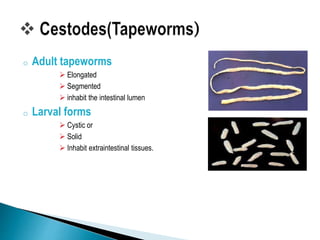
o Adult tapeworms
 Elongated
 Segmented
 inhabit the intestinal lumen
o Larval forms
 Cystic or
 Solid
 Inhabit extraintestinal tissues.
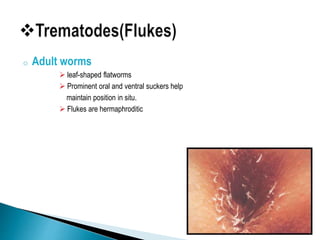
o Adult worms
 leaf-shaped flatworms
 Prominent oral and ventral suckers help
maintain position in situ.
 Flukes are hermaphroditic
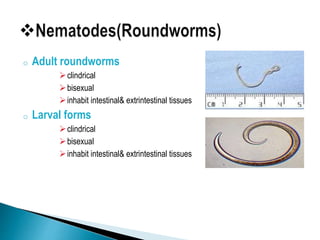
o Adult roundworms
clindrical
bisexual
inhabit intestinal& extrintestinal tissues
o Larval forms
clindrical
bisexual
inhabit intestinal& extrintestinal tissues
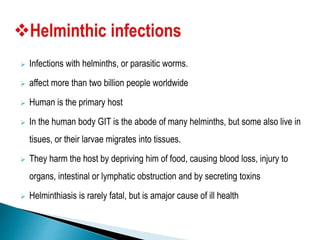
 Infections with helminths, or parasitic worms.
 affect more than two billion people worldwide
 Human is the primary host
 In the human body GIT is the abode of many helminths, but some also live in
tisues, or their larvae migrates into tissues.
 They harm the host by depriving him of food, causing blood loss, injury to
organs, intestinal or lymphatic obstruction and by secreting toxins
 Helminthiasis is rarely fatal, but is amajor cause of ill health
oTapeworms (cestodes)
• Echinococcus granulosus………………………Hydatid Disease
•T. solium………………………………………..…. Cysticercosis
o Flukes (trematodes)
• Schistzoma (Schistozomes)………………….. Schistosomiasis
oRoundworms (nematodes)
• Enterobius vermicularis(pinworm)………..…Enterobiasis
• Ascaris lumbricoid(Roundworm)….………......Ascariasis
• Trichuris trichiura (whipworm)………….…..Trichuriasis
• Necator americanus (hookworm)……………Nectariasis
• Wuchereria bancrofti ……......………………..(Elephantiasis)
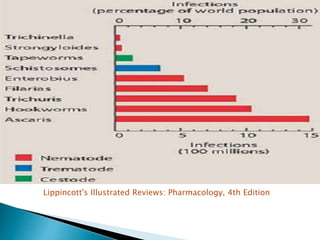
Lippincott's Illustrated Reviews: Pharmacology, 4th Edition
 Anthelmintics are a group of antiparasitic drugs that
• Expel parasitic worms (helminths)
&
• Other internal parasites from the body
by
• Either stunning Or killing them
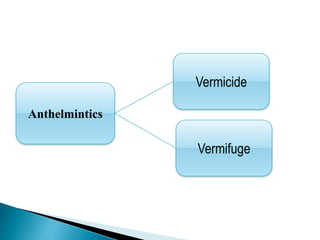
Anthelmintics
Vermicide
Vermifuge
Affect metabolic processes
either different in worms than human hosts
are not found in humans
 Cause death of the worm by interfering with normal
functioning
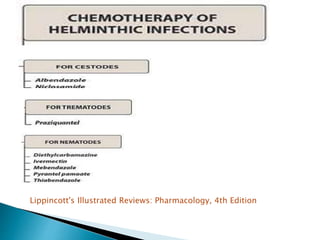
Lippincott's Illustrated Reviews: Pharmacology, 4th Edition
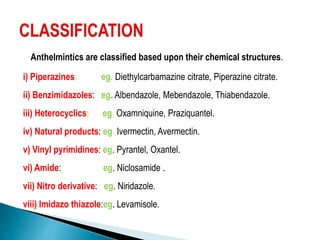
Anthelmintics are classified based upon their chemical structures.
i) Piperazines: eg. Diethylcarbamazine citrate, Piperazine citrate.
ii) Benzimidazoles: eg. Albendazole, Mebendazole, Thiabendazole.
iii) Heterocyclics: eg. Oxamniquine, Praziquantel.
iv) Natural products: eg. Ivermectin, Avermectin.
v) Vinyl pyrimidines: eg. Pyrantel, Oxantel.
vi) Amide: eg. Niclosamide .
vii) Nitro derivative: eg. Niridazole.
viii) Imidazo thiazole:eg. Levamisole.
Piperazine citrate
https://www.google.com.pk/search?q=piperazine
Piperazine citrate
 The discovery of the anthelmintic properties of piperazine usually is
credited to Fayard (1949),
 Piperazine was first introduced as an anthelmintic in 1953.
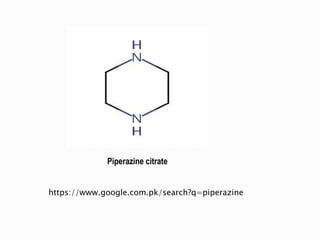
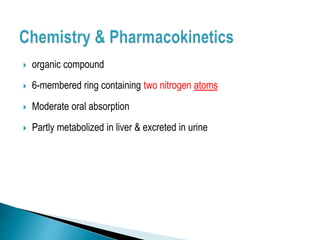
 organic compound
 6-membered ring containing two nitrogen atoms
 Moderate oral absorption
 Partly metabolized in liver & excreted in urine
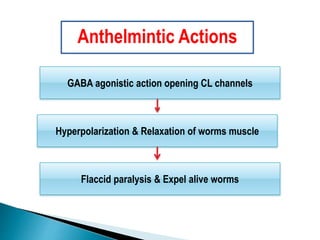
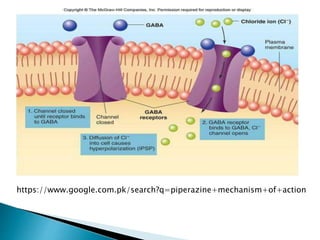
GABA agonistic action opening CL channels
Flaccid paralysis & Expel alive worms
Hyperpolarization & Relaxation of worms muscle
Anthelmintic Actions
https://www.google.com.pk/search?q=piperazine+mechanism+of+action
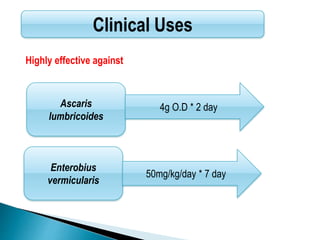
Highly effective against
Ascaris
lumbricoides
Enterobius
vermicularis
4g O.D * 2 day
50mg/kg/day * 7 day
Clinical Uses
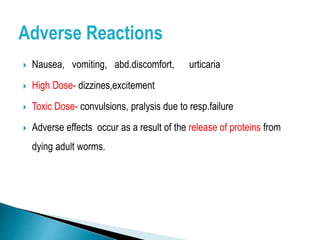
 Nausea, vomiting, abd.discomfort, urticaria
 High Dose- dizzines,excitement
 Toxic Dose- convulsions, pralysis due to resp.failure
 Adverse effects occur as a result of the release of proteins from
dying adult worms.
Adverse Reactions
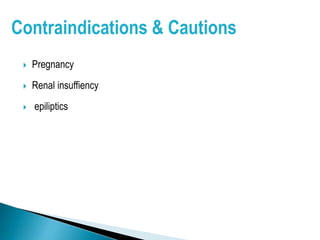
 Pregnancy
 Renal insuffiency
 epiliptics
Contraindications & Cautions
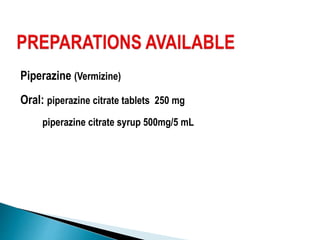
Piperazine (Vermizine)
Oral: piperazine citrate tablets 250 mg
piperazine citrate syrup 500mg/5 mL
Mebendazole
 The discovery by Brown and coworkers(1962) that thiabendazole
possessed potent activity against gastrointestinal nematodes
sparked Development of the BZAs as broad-spectrum anthelmintic
agent
 Of the hundreds of derivatives tested, those most therapeutically
useful have modifications at the 2 and/or 5 positions of the
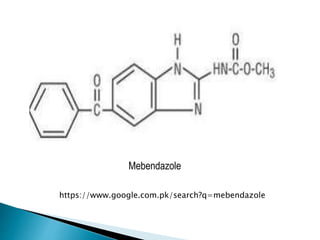
benzimidazole ring system
 Three compounds, thiabendazole, mebendazole, and albendazole,
have been used extensively for the treatment of human helminth
infections
 Mebendazole is the prototype, synthetic benzimidazole that has a
wide spectrum of anthelmintic activity and a low incidence of adverse
effects.
 Highly effective against gastrointestinal nematode infections
 Mebendazole came into use in 1971
Mebendazole
https://www.google.com.pk/search?q=mebendazole
 BZAs have only limited solubility in water
 Less than 10% of orally administered mebendazole is absorbed
 Rapidly converted to inactive metabolites(1st pass metabolism)
 The absorbed drug is protein-bound (> 90%)
 Abs. With fatty meal & co-adm. With Cimitidine
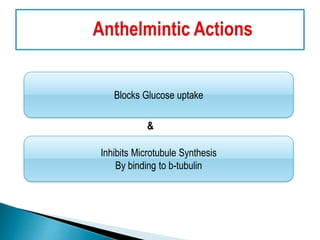
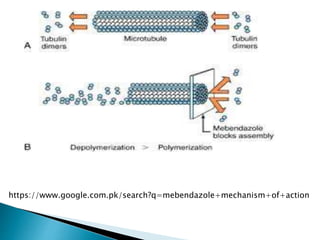
Blocks Glucose uptake
Inhibits Microtubule Synthesis
By binding to b-tubulin
&
https://www.google.com.pk/search?q=mebendazole+mechanism+of+action
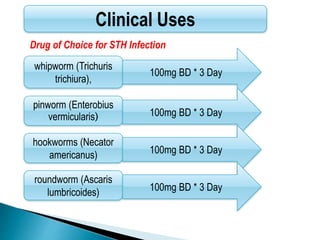
whipworm (Trichuris
trichiura),
pinworm (Enterobius
vermicularis)
100mg BD * 3 Day
Clinical Uses
hookworms (Necator
americanus)
roundworm (Ascaris
lumbricoides)
100mg BD * 3 Day
100mg BD * 3 Day
100mg BD * 3 Day
Drug of Choice for STH Infection
 Overall, the BZAs have excellent safety profiles
 Overall, the incidence of side effects, primarily mild GI symptoms,
occurs in only 1% of treated children
 Rare side effects, usually with high-dose therapy, are
 hypersensitivity reactions (rash, urticaria),
 abdominal pain
 distention and
 Diarrhea (in cases of massive infestation and expulsion of gastrointestinal worms)
Adverse Reactions
 Not given during pregnancy
( potent embryotoxin and teratogen in laboratory animals; effects
may occur in pregnant rats at single oral doses as low as 10 mg/kg.)
 hypersensitive peoples
 children under 2 years (No safety data)
 free-living nematode Caenorhabditis elegans and
 the sheep nematode Haemonchus contortus, displays
 reduced high-affinity drug binding to b-tubulin
 alterations in b-tubulin isotype gene expression
 correlate with drug resistance
Mebendazole (Vermox)
Oral: 100 mg chewable tablets,
100 mg/5 mL suspension
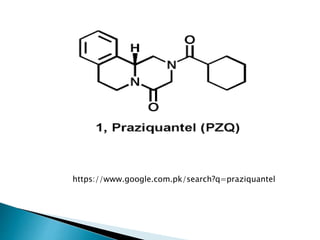
Praziquantel
https://www.google.com.pk/search?q=praziquantel
 Pyrazin isoquinoline derivative
 Praziquantel developed after this class of compounds was
discovered to have anthelmintic activity in 1972
 In animals and humans, infections with many different cestodes and
trematodes respond favorably to this agent, whereas nematodes
generally are unaffected
 rapidly absorbed
 bioavailability 80% after oral administration
 serum conc. are reached in 1-3h
 About 80% of the drug is protein bound
 Excretion is mainly via the kidneys (60-80%) and bile (15-35%).
 Abs. With fatty meal & co-adm. With Cimitidine
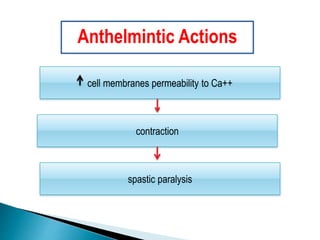
cell membranes permeability to Ca++
spastic paralysis
contraction
Anthelmintic Actions
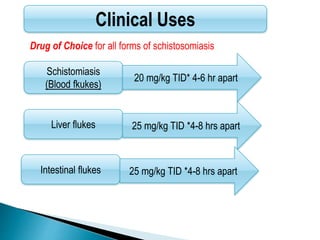
Schistomiasis
(Blood fkukes)
Liver flukes
20 mg/kg TID* 4-6 hr apart
Clinical Uses
Intestinal flukes
25 mg/kg TID *4-8 hrs apart
Drug of Choice for all forms of schistosomiasis
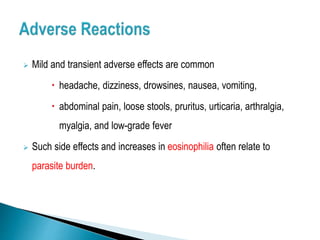
 Mild and transient adverse effects are common
 headache, dizziness, drowsines, nausea, vomiting,
 abdominal pain, loose stools, pruritus, urticaria, arthralgia,
myalgia, and low-grade fever
 Such side effects and increases in eosinophilia often relate to
parasite burden.
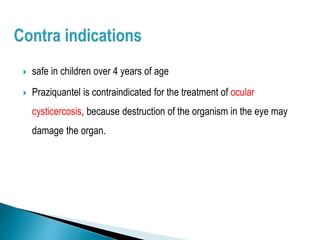
 safe in children over 4 years of age
 Praziquantel is contraindicated for the treatment of ocular
cysticercosis, because destruction of the organism in the eye may
damage the organ.
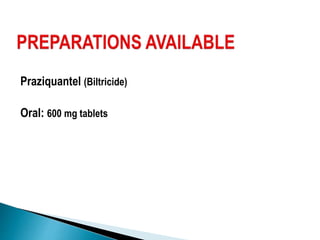
Praziquantel (Biltricide)
Oral: 600 mg tablets
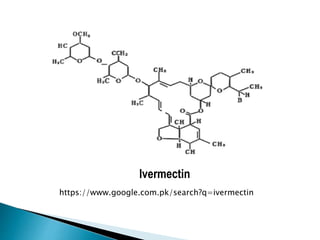
Ivermectin
https://www.google.com.pk/search?q=ivermectin
Ivermectin
 In the mid-1970s Isolation of the anthelmintic components from soil
actinomycete Streptomyces avermitilis led to discovery of the
avermectins, a novel class of 16-membered lactones
 Ivermectin is a semisynthetic analog of avermectin (macrocyclic
lactone)
 In 1996, the FDA approved the use of ivermectin in humans for
treatment of onchocerciasis, the filarial infection responsible for river
blindness, and for therapy of intestinal strongyloidiasis.
 Ivermectin is used only orally in humans
 Rapidly absorbed following oral administration with meals
 Reaching maximum plasma concentrations in 4 hours
 Excretion of the drug and its metabolites is almost exclusively in the
feces.
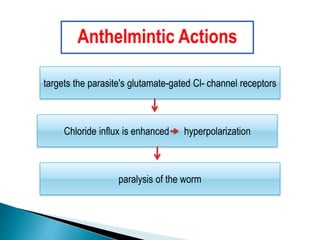
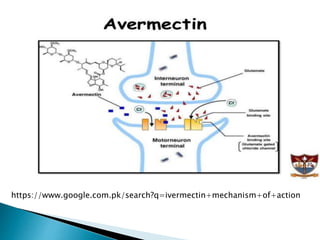
targets the parasite's glutamate-gated Cl- channel receptors
paralysis of the worm
Chloride influx is enhanced hyperpolarization
Anthelmintic Actions
https://www.google.com.pk/search?q=ivermectin+mechanism+of+action
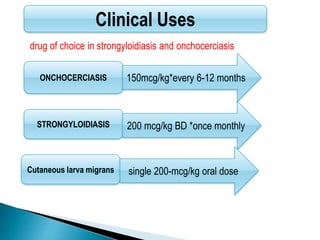
ONCHOCERCIASIS
STRONGYLOIDIASIS
150mcg/kg*every 6-12 months
Clinical Uses
Cutaneous larva migrans
200 mcg/kg BD *once monthly
single 200-mcg/kg oral dose
drug of choice in strongyloidiasis and onchocerciasis
 Ivermectin toxicity nearly always results from Mazzotti-like reactions
to dying Helminths (fever, headache, dizziness, somnolence, and
hypotension).
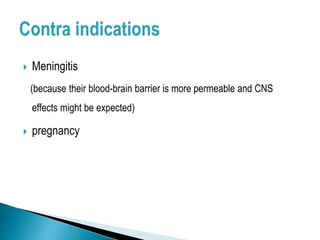
 Meningitis
(because their blood-brain barrier is more permeable and CNS
effects might be expected)
 pregnancy
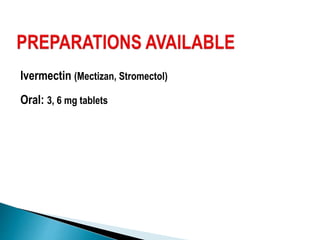
Ivermectin (Mectizan, Stromectol)
Oral: 3, 6 mg tablets
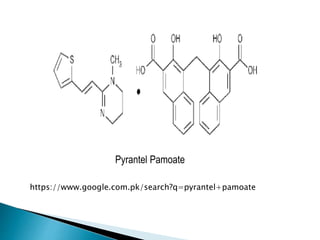
Pyrantel Pamoate
https://www.google.com.pk/search?q=pyrantel+pamoate
Pyrantel Pamoate
 First introduced into veterinary practice as a broad-spectrum
anthelmintic directed against pinworm, roundworm, and hookworm
infections
 Its effectiveness and lack of toxicity led to its trial against related
intestinal helminths in humans
 Pyrantel pamoate is a tetrahydropyrimidine derivative
 Poorly absorbed orally
 Exerts its effects in the intestinal tract
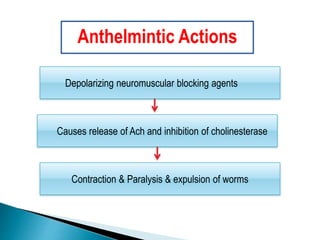
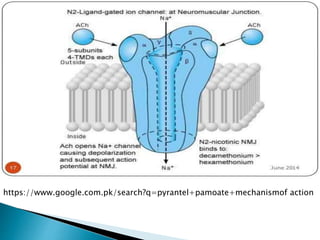
Depolarizing neuromuscular blocking agents
Contraction & Paralysis & expulsion of worms
Causes release of Ach and inhibition of cholinesterase
Anthelmintic Actions
https://www.google.com.pk/search?q=pyrantel+pamoate+mechanismof action
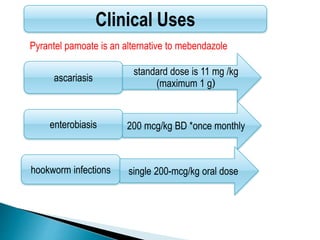
ascariasis
enterobiasis
standard dose is 11 mg /kg
(maximum 1 g)
Clinical Uses
hookworm infections
200 mcg/kg BD *once monthly
single 200-mcg/kg oral dose
Pyrantel pamoate is an alternative to mebendazole
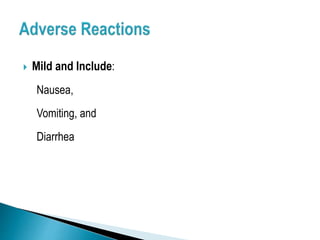
 Mild and Include:
Nausea,
Vomiting, and
Diarrhea
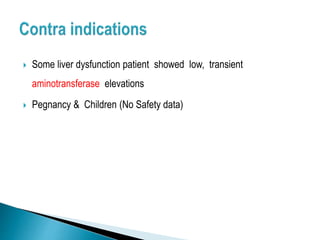
 Some liver dysfunction patient showed low, transient
aminotransferase elevations
 Pegnancy & Children (No Safety data)
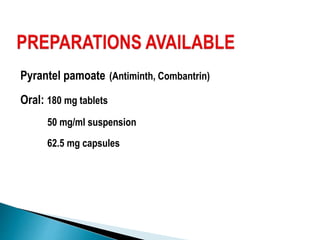
Pyrantel pamoate (Antiminth, Combantrin)
Oral: 180 mg tablets
50 mg/ml suspension
62.5 mg capsules
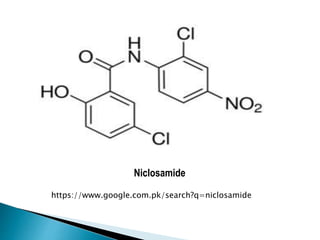
Niclosamide
https://www.google.com.pk/search?q=niclosamide
Niclosamide
 Niclosamide is a salicylamide derivative
 A second-choice drug to praziquantel for treating human intestinal
infections with Taenia saginata and most other Cestodes
 Introduced in the 1960s for human use as a taeniacide
 Minimally absorbed from the gastrointestinal tract
 Neither the drug nor its metabolites have been recovered from the
blood or urine.
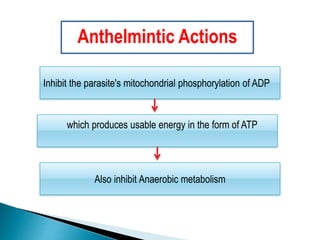
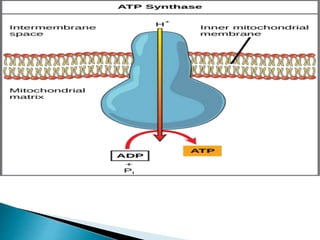
Inhibit the parasite's mitochondrial phosphorylation of ADP
Also inhibit Anaerobic metabolism
which produces usable energy in the form of ATP
Anthelmintic Actions
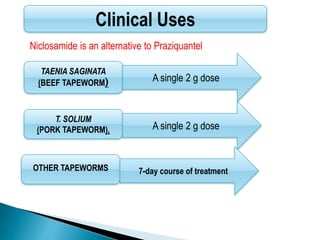
TAENIA SAGINATA
(BEEF TAPEWORM)
T. SOLIUM
(PORK TAPEWORM),
A single 2 g dose
Clinical Uses
OTHER TAPEWORMS
A single 2 g dose
7-day course of treatment
Niclosamide is an alternative to Praziquantel
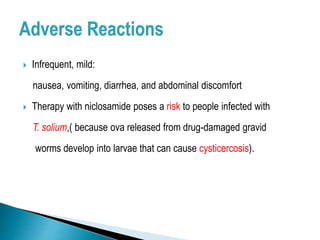
 Infrequent, mild:
nausea, vomiting, diarrhea, and abdominal discomfort
 Therapy with niclosamide poses a risk to people infected with
T. solium,( because ova released from drug-damaged gravid
worms develop into larvae that can cause cysticercosis).
 Niclosamide, along with oxyclozanide, another anti-tapeworm drug,
was found in a 2015 study to display "strong in vivo and in
vitro activity against methicillin-resistant Staphylococcus
aureus (MRSA)".
 A 2016 drug repurposing screening study suggested that
niclosamide may inhibit Zika virus replication in vitro.
Niclosamide (Niclocide)
Oral: 500 mg chewable tablets
1)Goodman & Gilman The Pharmacological Basis of Therapeutics 11th
Edition
2)Katzung Pharmacology 10th Edition
3)Lippincott's Illustrated Reviews: Pharmacology, 4th Edition
4)www.google.com

Anthelmintic drugs presentation

  • 1.
  • 2.
    o Introduction oHelminths oTypes ofHelminths oHelminths infection o Anthelmintics drugs /anti helminths o Classification of Anthelmintic Drugs o Description
  • 3.
     Helminth isa general term meaning “worm”  macroscopic, multicellular, eukaryotic invertebrates  characterized by elongated, flat or round bodies  Life cycles are complex  Intermediate hosts are often needed to support larval stages
  • 4.
  • 5.
     Based onthe external and internal morphology of egg, larval, and adult stages.  Three groups of helminthes ◦ Cestodes (tapeworm) ◦ Trematodes (fluke) ◦ Nematodes (roundworm)………… (STHs or Geohelminths)
  • 6.
  • 7.
    o Adult tapeworms Elongated  Segmented  inhabit the intestinal lumen o Larval forms  Cystic or  Solid  Inhabit extraintestinal tissues.
  • 8.
    o Adult worms leaf-shaped flatworms  Prominent oral and ventral suckers help maintain position in situ.  Flukes are hermaphroditic
  • 9.
    o Adult roundworms clindrical bisexual inhabitintestinal& extrintestinal tissues o Larval forms clindrical bisexual inhabit intestinal& extrintestinal tissues
  • 10.
     Infections withhelminths, or parasitic worms.  affect more than two billion people worldwide  Human is the primary host  In the human body GIT is the abode of many helminths, but some also live in tisues, or their larvae migrates into tissues.  They harm the host by depriving him of food, causing blood loss, injury to organs, intestinal or lymphatic obstruction and by secreting toxins  Helminthiasis is rarely fatal, but is amajor cause of ill health
  • 11.
    oTapeworms (cestodes) • Echinococcusgranulosus………………………Hydatid Disease •T. solium………………………………………..…. Cysticercosis o Flukes (trematodes) • Schistzoma (Schistozomes)………………….. Schistosomiasis oRoundworms (nematodes) • Enterobius vermicularis(pinworm)………..…Enterobiasis • Ascaris lumbricoid(Roundworm)….………......Ascariasis • Trichuris trichiura (whipworm)………….…..Trichuriasis • Necator americanus (hookworm)……………Nectariasis • Wuchereria bancrofti ……......………………..(Elephantiasis)
  • 12.
    Lippincott's Illustrated Reviews:Pharmacology, 4th Edition
  • 13.
     Anthelmintics area group of antiparasitic drugs that • Expel parasitic worms (helminths) & • Other internal parasites from the body by • Either stunning Or killing them
  • 14.
  • 15.
    Affect metabolic processes eitherdifferent in worms than human hosts are not found in humans  Cause death of the worm by interfering with normal functioning
  • 16.
    Lippincott's Illustrated Reviews:Pharmacology, 4th Edition
  • 17.
    Anthelmintics are classifiedbased upon their chemical structures. i) Piperazines: eg. Diethylcarbamazine citrate, Piperazine citrate. ii) Benzimidazoles: eg. Albendazole, Mebendazole, Thiabendazole. iii) Heterocyclics: eg. Oxamniquine, Praziquantel. iv) Natural products: eg. Ivermectin, Avermectin. v) Vinyl pyrimidines: eg. Pyrantel, Oxantel. vi) Amide: eg. Niclosamide . vii) Nitro derivative: eg. Niridazole. viii) Imidazo thiazole:eg. Levamisole.
  • 18.
  • 19.
  • 20.
     The discoveryof the anthelmintic properties of piperazine usually is credited to Fayard (1949),  Piperazine was first introduced as an anthelmintic in 1953.
  • 21.
     organic compound 6-membered ring containing two nitrogen atoms  Moderate oral absorption  Partly metabolized in liver & excreted in urine
  • 22.
    GABA agonistic actionopening CL channels Flaccid paralysis & Expel alive worms Hyperpolarization & Relaxation of worms muscle Anthelmintic Actions
  • 23.
  • 24.
  • 25.
     Nausea, vomiting,abd.discomfort, urticaria  High Dose- dizzines,excitement  Toxic Dose- convulsions, pralysis due to resp.failure  Adverse effects occur as a result of the release of proteins from dying adult worms. Adverse Reactions
  • 26.
     Pregnancy  Renalinsuffiency  epiliptics Contraindications & Cautions
  • 27.
    Piperazine (Vermizine) Oral: piperazinecitrate tablets 250 mg piperazine citrate syrup 500mg/5 mL
  • 28.
  • 29.
     The discoveryby Brown and coworkers(1962) that thiabendazole possessed potent activity against gastrointestinal nematodes sparked Development of the BZAs as broad-spectrum anthelmintic agent  Of the hundreds of derivatives tested, those most therapeutically useful have modifications at the 2 and/or 5 positions of the benzimidazole ring system  Three compounds, thiabendazole, mebendazole, and albendazole, have been used extensively for the treatment of human helminth infections
  • 30.
     Mebendazole isthe prototype, synthetic benzimidazole that has a wide spectrum of anthelmintic activity and a low incidence of adverse effects.  Highly effective against gastrointestinal nematode infections  Mebendazole came into use in 1971
  • 31.
  • 32.
     BZAs haveonly limited solubility in water  Less than 10% of orally administered mebendazole is absorbed  Rapidly converted to inactive metabolites(1st pass metabolism)  The absorbed drug is protein-bound (> 90%)  Abs. With fatty meal & co-adm. With Cimitidine
  • 33.
    Blocks Glucose uptake InhibitsMicrotubule Synthesis By binding to b-tubulin &
  • 34.
  • 35.
    whipworm (Trichuris trichiura), pinworm (Enterobius vermicularis) 100mgBD * 3 Day Clinical Uses hookworms (Necator americanus) roundworm (Ascaris lumbricoides) 100mg BD * 3 Day 100mg BD * 3 Day 100mg BD * 3 Day Drug of Choice for STH Infection
  • 36.
     Overall, theBZAs have excellent safety profiles  Overall, the incidence of side effects, primarily mild GI symptoms, occurs in only 1% of treated children  Rare side effects, usually with high-dose therapy, are  hypersensitivity reactions (rash, urticaria),  abdominal pain  distention and  Diarrhea (in cases of massive infestation and expulsion of gastrointestinal worms) Adverse Reactions
  • 37.
     Not givenduring pregnancy ( potent embryotoxin and teratogen in laboratory animals; effects may occur in pregnant rats at single oral doses as low as 10 mg/kg.)  hypersensitive peoples  children under 2 years (No safety data)
  • 38.
     free-living nematodeCaenorhabditis elegans and  the sheep nematode Haemonchus contortus, displays  reduced high-affinity drug binding to b-tubulin  alterations in b-tubulin isotype gene expression  correlate with drug resistance
  • 39.
    Mebendazole (Vermox) Oral: 100mg chewable tablets, 100 mg/5 mL suspension
  • 40.
  • 41.
  • 42.
     Pyrazin isoquinolinederivative  Praziquantel developed after this class of compounds was discovered to have anthelmintic activity in 1972  In animals and humans, infections with many different cestodes and trematodes respond favorably to this agent, whereas nematodes generally are unaffected
  • 43.
     rapidly absorbed bioavailability 80% after oral administration  serum conc. are reached in 1-3h  About 80% of the drug is protein bound  Excretion is mainly via the kidneys (60-80%) and bile (15-35%).  Abs. With fatty meal & co-adm. With Cimitidine
  • 44.
    cell membranes permeabilityto Ca++ spastic paralysis contraction Anthelmintic Actions
  • 45.
    Schistomiasis (Blood fkukes) Liver flukes 20mg/kg TID* 4-6 hr apart Clinical Uses Intestinal flukes 25 mg/kg TID *4-8 hrs apart 25 mg/kg TID *4-8 hrs apart Drug of Choice for all forms of schistosomiasis
  • 46.
     Mild andtransient adverse effects are common  headache, dizziness, drowsines, nausea, vomiting,  abdominal pain, loose stools, pruritus, urticaria, arthralgia, myalgia, and low-grade fever  Such side effects and increases in eosinophilia often relate to parasite burden.
  • 47.
     safe inchildren over 4 years of age  Praziquantel is contraindicated for the treatment of ocular cysticercosis, because destruction of the organism in the eye may damage the organ.
  • 48.
  • 49.
  • 50.
  • 51.
     In themid-1970s Isolation of the anthelmintic components from soil actinomycete Streptomyces avermitilis led to discovery of the avermectins, a novel class of 16-membered lactones  Ivermectin is a semisynthetic analog of avermectin (macrocyclic lactone)  In 1996, the FDA approved the use of ivermectin in humans for treatment of onchocerciasis, the filarial infection responsible for river blindness, and for therapy of intestinal strongyloidiasis.
  • 52.
     Ivermectin isused only orally in humans  Rapidly absorbed following oral administration with meals  Reaching maximum plasma concentrations in 4 hours  Excretion of the drug and its metabolites is almost exclusively in the feces.
  • 53.
    targets the parasite'sglutamate-gated Cl- channel receptors paralysis of the worm Chloride influx is enhanced hyperpolarization Anthelmintic Actions
  • 54.
  • 55.
    ONCHOCERCIASIS STRONGYLOIDIASIS 150mcg/kg*every 6-12 months ClinicalUses Cutaneous larva migrans 200 mcg/kg BD *once monthly single 200-mcg/kg oral dose drug of choice in strongyloidiasis and onchocerciasis
  • 56.
     Ivermectin toxicitynearly always results from Mazzotti-like reactions to dying Helminths (fever, headache, dizziness, somnolence, and hypotension).
  • 57.
     Meningitis (because theirblood-brain barrier is more permeable and CNS effects might be expected)  pregnancy
  • 58.
  • 59.
  • 60.
  • 61.
     First introducedinto veterinary practice as a broad-spectrum anthelmintic directed against pinworm, roundworm, and hookworm infections  Its effectiveness and lack of toxicity led to its trial against related intestinal helminths in humans
  • 62.
     Pyrantel pamoateis a tetrahydropyrimidine derivative  Poorly absorbed orally  Exerts its effects in the intestinal tract
  • 63.
    Depolarizing neuromuscular blockingagents Contraction & Paralysis & expulsion of worms Causes release of Ach and inhibition of cholinesterase Anthelmintic Actions
  • 64.
  • 65.
    ascariasis enterobiasis standard dose is11 mg /kg (maximum 1 g) Clinical Uses hookworm infections 200 mcg/kg BD *once monthly single 200-mcg/kg oral dose Pyrantel pamoate is an alternative to mebendazole
  • 66.
     Mild andInclude: Nausea, Vomiting, and Diarrhea
  • 67.
     Some liverdysfunction patient showed low, transient aminotransferase elevations  Pegnancy & Children (No Safety data)
  • 68.
    Pyrantel pamoate (Antiminth,Combantrin) Oral: 180 mg tablets 50 mg/ml suspension 62.5 mg capsules
  • 69.
  • 70.
  • 71.
     Niclosamide isa salicylamide derivative  A second-choice drug to praziquantel for treating human intestinal infections with Taenia saginata and most other Cestodes  Introduced in the 1960s for human use as a taeniacide
  • 72.
     Minimally absorbedfrom the gastrointestinal tract  Neither the drug nor its metabolites have been recovered from the blood or urine.
  • 73.
    Inhibit the parasite'smitochondrial phosphorylation of ADP Also inhibit Anaerobic metabolism which produces usable energy in the form of ATP Anthelmintic Actions
  • 75.
    TAENIA SAGINATA (BEEF TAPEWORM) T.SOLIUM (PORK TAPEWORM), A single 2 g dose Clinical Uses OTHER TAPEWORMS A single 2 g dose 7-day course of treatment Niclosamide is an alternative to Praziquantel
  • 76.
     Infrequent, mild: nausea,vomiting, diarrhea, and abdominal discomfort  Therapy with niclosamide poses a risk to people infected with T. solium,( because ova released from drug-damaged gravid worms develop into larvae that can cause cysticercosis).
  • 77.
     Niclosamide, alongwith oxyclozanide, another anti-tapeworm drug, was found in a 2015 study to display "strong in vivo and in vitro activity against methicillin-resistant Staphylococcus aureus (MRSA)".  A 2016 drug repurposing screening study suggested that niclosamide may inhibit Zika virus replication in vitro.
  • 78.
  • 79.
    1)Goodman & GilmanThe Pharmacological Basis of Therapeutics 11th Edition 2)Katzung Pharmacology 10th Edition 3)Lippincott's Illustrated Reviews: Pharmacology, 4th Edition 4)www.google.com