2004-2005
Module 2
                             #1
                Pharmacodynamics

               Kash Desai
                966-2723
                HSc A120
            k.desai@usask.ca


2004-2005
Drug Receptors and Pharmacodynamics
                    (how drugs work on the body)


The action of a drug on the body,
 including receptor interactions, dose-
 response phenomena, and mechanisms
 of therapeutic and toxic action.


2004-2005
2
                           Pharmacodynamics
                           (how drugs work on the body)

            many drugs inhibit enzymes
           Enzymes control a number of metabolic processes
           A very common mode of action of many drugs
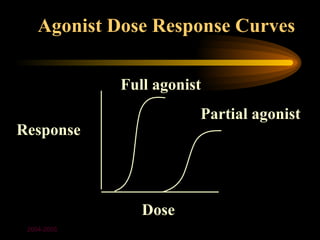
                in the patient (ACE inhibitors)
                in microbes (sulfas, penicillins)
                in cancer cells (5-FU, 6-MP)

            some drugs bind to:
               proteins (in patient, or microbes)
               the genome (cyclophosphamide)
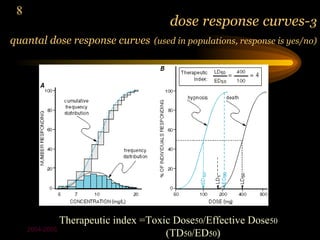
               microtubules (vincristine)
    2004-2005
3
                           Pharmacodynamics
     most drugs act (bind) on receptors
         in or on cells
         form tight bonds with the ligand
         exacting requirements (size, shape,
              stereospecificity)
         can be agonists (salbutamol), or
        antagonists (propranolol)
     receptors have signal transduction
         methods
2004-2005
Drug Receptor

• A macromolecular component of a cell
  with which a drug interacts to produce
  a response
• Usually a protein


2004-2005
Types of Protein Receptors

• Regulatory – change the activity of
  cellular enzymes
• Enzymes – may be inhibited or
  activated
• Transport – e.g. Na+ /K+ ATP’ase
• Structural – these form cell parts


2004-2005
5
                                 dose response curves
                    k1             α
        [D] + [R]          [DR]         effect
                    k -1

        at equilibrium:                k1/k-1 = affinity const.

        [D] x [R] x k1 = [DR] x k-1    k-1/k1 = dissociation
                                              const.(kd)
        so that: [DR] = k1
              [D] [R]      k-1     the lower the kd the
                                   more potent the drug

2004-2005
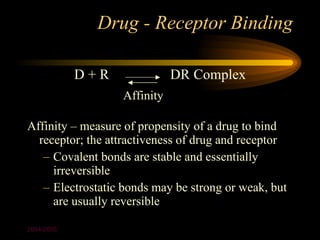
Drug - Receptor Binding

            D+R              DR Complex
                  Affinity

Affinity – measure of propensity of a drug to bind
  receptor; the attractiveness of drug and receptor
   – Covalent bonds are stable and essentially
     irreversible
   – Electrostatic bonds may be strong or weak, but
     are usually reversible

2004-2005
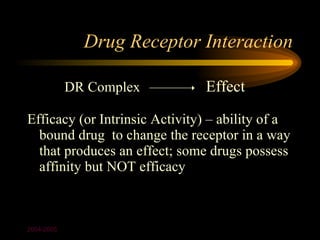
Drug Receptor Interaction

            DR Complex         Effect

Efficacy (or Intrinsic Activity) – ability of a
  bound drug to change the receptor in a way
  that produces an effect; some drugs possess
  affinity but NOT efficacy


2004-2005
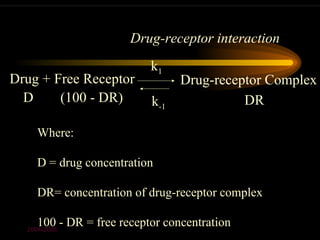
Drug-receptor interaction
                           k1
Drug + Free Receptor             Drug-receptor Complex
  D     (100 - DR)         k-1             DR

     Where:

     D = drug concentration

     DR= concentration of drug-receptor complex

     100 - DR = free receptor concentration
  2004-2005
Drug-receptor interaction

• At equilibrium:
[D] x [R] x k1 = [DR] x k-1
so that:    [DR]      =   k1
            [D] [R]       k-1


k-1/k1 = dissociation constant (kd)

2004-2005
•    At equilibrium:
[D] x [R] x k1 = [DR] x k-1
so that:   [DR] = k1
           [D] [R]    k-1
                                      What can we learn?
k-1/k1 = dissociation constant (kd)


      • Ke (k1/k-1) is called the affinity constant
      • DR is the response; D is concentration of drug
      • when DR = 50 percent (effect is half
        maximal), D (or EC50) is equal to kd or the
        reciprocal of the affinity constant
      • response is a measure of efficacy
      • drugs that have parallel dose-response curves
        often have the same mechanism of action
      2004-2005
6
                   dose response curves-2

    effect = α [DR] = Emax * [D]/([D]+EC50)       % occupancy
                                              α


                                       Concept: spare
2004-2005
                                       receptors
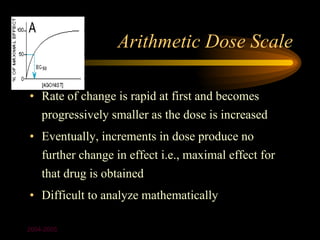
Arithmetic Dose Scale

• Rate of change is rapid at first and becomes
  progressively smaller as the dose is increased
• Eventually, increments in dose produce no
  further change in effect i.e., maximal effect for
  that drug is obtained
• Difficult to analyze mathematically

2004-2005
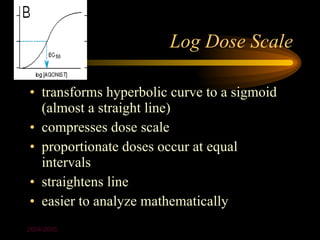
Log Dose Scale

• transforms hyperbolic curve to a sigmoid
  (almost a straight line)
• compresses dose scale
• proportionate doses occur at equal
  intervals
• straightens line
• easier to analyze mathematically
2004-2005
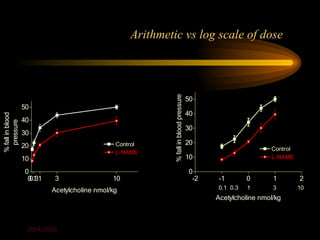
Arithmetic vs log scale of dose


                                                            % fall in blood pressure
                                                                                       50
                  50
                                                                                       40
% fall in blood


                  40
  pressure


                                                                                       30
                  30
                  20                           Control                                 20
                                                                                                              Control
                                               L-NAME
                  10                                                                   10                     L-NAME

                  0                                                                    0
                   0.1
                    0.31    3                 10                                        -2    -1       0       1        2
                           Acetylcholine nmol/kg                                             0.1 0.3   1       3        10
                                                                                             Acetylcholine nmol/kg


                   2004-2005
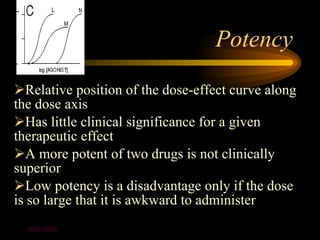
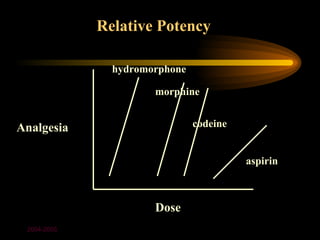
Potency
Relative position of the dose-effect curve along
the dose axis
Has little clinical significance for a given
therapeutic effect
A more potent of two drugs is not clinically
superior
Low potency is a disadvantage only if the dose
is so large that it is awkward to administer
  2004-2005
Relative Potency

               hydromorphone

                      morphine


Analgesia                      codeine


                                         aspirin


                      Dose
 2004-2005
7

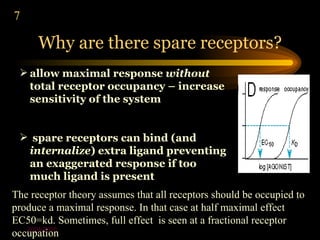
      Why are there spare receptors?
  allow maximal response without
   total receptor occupancy – increase
   sensitivity of the system


  spare receptors can bind (and
  internalize) extra ligand preventing
  an exaggerated response if too
  much ligand is present
The receptor theory assumes that all receptors should be occupied to
produce a maximal response. In that case at half maximal effect
EC50=kd. Sometimes, full effect is seen at a fractional receptor
   2004-2005
occupation
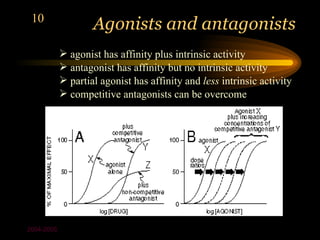
10
                    Agonists and antagonists
             agonist has affinity plus intrinsic activity
             antagonist has affinity but no intrinsic activity
             partial agonist has affinity and less intrinsic activity
             competitive antagonists can be overcome


2004-2005
Agonist Drugs
• drugs that interact with and activate
  receptors; they possess both affinity and
  efficacy
• two types
   – Full – an agonist with maximal efficacy
   – Partial – an agonist with less then
     maximal efficacy

  2004-2005
Agonist Dose Response Curves

             Full agonist
                        Partial agonist
Response


                Dose
 2004-2005
Antagonist Drug
• Antagonists interact with the receptor
  but do NOT change the receptor
• they have affinity but NO efficacy
• two types
    – Competitive
    – Noncompetitive


2004-2005
Competitive Antagonist
• competes with agonist for receptor
• surmountable with increasing agonist
  concentration
• displaces agonist dose response curve
  to the right (dextral shift)
• reduces the apparent affinity of the
  agonist i.e., increases 1/Ke

2004-2005
Noncompetitive Antagonist
• drug binds to receptor and stays bound
• irreversible – does not let go of receptor
• produces slight dextral shift in the agonist
  DR curve in the low concentration range
• this looks like competitive antagonist
• but, as more and more receptors are bound
  (and essentially destroyed), the agonist drug
  becomes incapable of eliciting a maximal
  effect
2004-2005
11
                                  Desensitization

      agonists tend to desensitize receptors
             homologous (decreased receptor
            number)
             heterologous (decreased signal
                  transduction)

      antagonists tend to up regulate
     receptors


2004-2005
8
                                      dose response curves-3
quantal dose response curves (used in populations, response is yes/no)


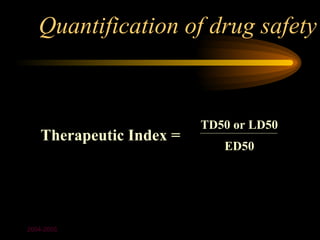
               Therapeutic index =Toxic Dose50/Effective Dose50
     2004-2005
                                      (TD50/ED50)
DR Curve: Whole Animal
• Graded – response measured on a
  continuous scale
• Quantal – response is an either/or event
    – relates dose and frequency of response in
      a population of individuals
    – often derived from frequency distribution
      of doses required to produce a specified
      effect
2004-2005
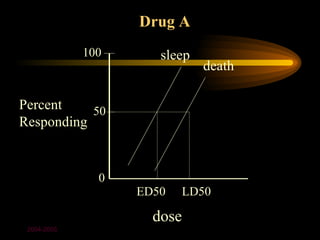
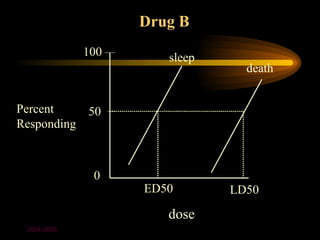
Effectiveness, toxicity, lethality
• ED50 - Median Effective Dose 50; the dose
  at which 50 percent of the population or
  sample manifests a given effect; used with
  quantal dr curves
• TD50 - Median Toxic Dose 50 - dose at
  which 50 percent of the population
  manifests a given toxic effect
• LD50 - Median Toxic Dose 50 - dose which
  kills 50 percent of the subjects
2004-2005
Quantification of drug safety


                          TD50 or LD50
    Therapeutic Index =
                             ED50


2004-2005
Drug A
             100      sleep
                              death

Percent    50
Responding


               0
                   ED50     LD50

                     dose
 2004-2005
Drug B
             100      sleep
                                death


Percent      50
Responding


              0
                   ED50       LD50

                      dose
 2004-2005
9
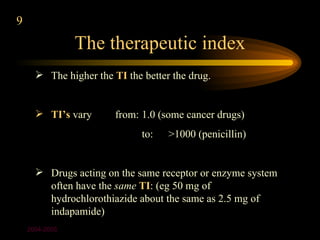
                The therapeutic index
       The higher the TI the better the drug.


       TI’s vary       from: 1.0 (some cancer drugs)
                              to:   >1000 (penicillin)


       Drugs acting on the same receptor or enzyme system
        often have the same TI: (eg 50 mg of
        hydrochlorothiazide about the same as 2.5 mg of
        indapamide)
    2004-2005
4
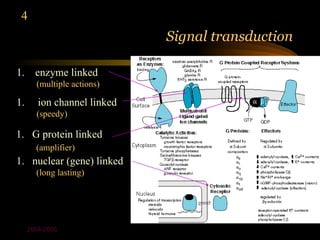
                             Signal transduction

1.     enzyme linked
       (multiple actions)

1.      ion channel linked
       (speedy)

1. G protein linked
       (amplifier)
1. nuclear (gene) linked
       (long lasting)


     2004-2005
Structure:
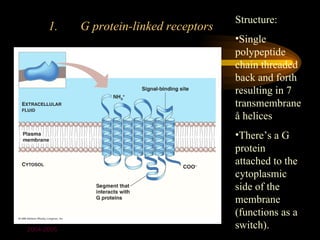
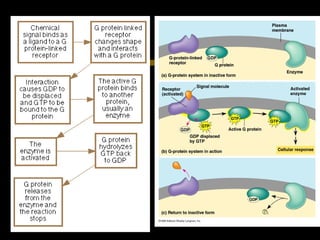
      1.    G protein-linked receptors
                                         •Single
                                         polypeptide
                                         chain threaded
                                         back and forth
                                         resulting in 7
                                         transmembrane
                                         å helices
                                         •There’s a G
                                         protein
                                         attached to the
                                         cytoplasmic
                                         side of the
                                         membrane
                                         (functions as a
2004-2005
                                         switch).
2004-2005
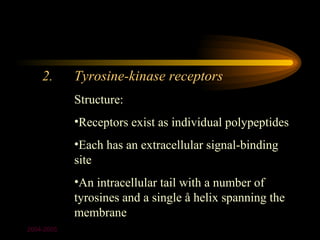
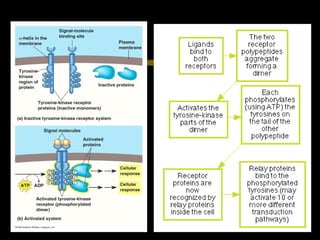
2.      Tyrosine-kinase receptors
            Structure:
            •Receptors exist as individual polypeptides
            •Each has an extracellular signal-binding
            site
            •An intracellular tail with a number of
            tyrosines and a single å helix spanning the
            membrane
2004-2005
2004-2005
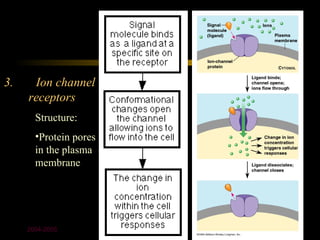
3.    Ion channel
     receptors
       Structure:
       •Protein pores
       in the plasma
       membrane


     2004-2005
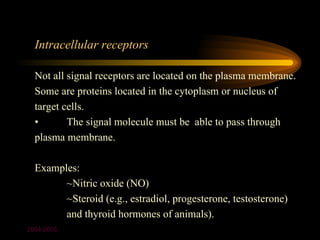
Intracellular receptors

  Not all signal receptors are located on the plasma membrane.
  Some are proteins located in the cytoplasm or nucleus of
  target cells.
  •       The signal molecule must be able to pass through
  plasma membrane.

  Examples:
        ~Nitric oxide (NO)
        ~Steroid (e.g., estradiol, progesterone, testosterone)
        and thyroid hormones of animals).
2004-2005
B.       Second Messengers
            •Small, nonprotein, water-soluble
            molecules or ions
            •Readily spread throughout the cell by
            diffusion
            •Two most widely used second messengers
            are:
               1. Cycle AMP

2004-2005
               2. Calcium ions Ca2+
2.    Calcium Ions (Ca2+) and Inositol
  Trisphosphate
            •Calcium more widely used than cAMP
               •used in neurotransmitters, growth
               factors, some hormones
            •Increases in Ca2+ causes many possible
            responses:
               •Muscle cell contraction
               •Secretion of certain substance
               •Cell division
2004-2005
Two benefits of a signal-transduction pathway
            1.    Signal amplification
            2.    Signal specificity


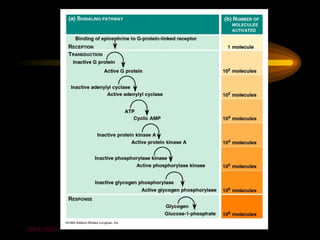
     A.     Signal amplification
            •Proteins persist in active form long
            enough to process numerous molecules
            of substrate
            •Each catalytic step activates more
            products then in the proceeding steps
2004-2005
2004-2005
12
                                            Summary
  most drugs act through receptors
  there are 4 common signal transduction methods
  the interaction between drug and receptor can be described
       mathematically and graphically
  agonists have both affinity (kd) and intrinsic activity (α)
  antagonists have affinity only
  antagonists can be competitive (change kd) or
  non-competitive (change α) when mixed with agonists
  agonists desensitize receptors.
  antagonists sensitize receptors.


     2004-2005

Pharmacodynamics

  • 1.
  • 2.
    Module 2 #1 Pharmacodynamics Kash Desai 966-2723 HSc A120 k.desai@usask.ca 2004-2005
  • 3.
    Drug Receptors andPharmacodynamics (how drugs work on the body) The action of a drug on the body, including receptor interactions, dose- response phenomena, and mechanisms of therapeutic and toxic action. 2004-2005
  • 4.
    2 Pharmacodynamics (how drugs work on the body)  many drugs inhibit enzymes Enzymes control a number of metabolic processes A very common mode of action of many drugs  in the patient (ACE inhibitors)  in microbes (sulfas, penicillins)  in cancer cells (5-FU, 6-MP)  some drugs bind to:  proteins (in patient, or microbes)  the genome (cyclophosphamide)  microtubules (vincristine) 2004-2005
  • 5.
    3 Pharmacodynamics  most drugs act (bind) on receptors  in or on cells  form tight bonds with the ligand  exacting requirements (size, shape, stereospecificity)  can be agonists (salbutamol), or antagonists (propranolol)  receptors have signal transduction methods 2004-2005
  • 6.
    Drug Receptor • Amacromolecular component of a cell with which a drug interacts to produce a response • Usually a protein 2004-2005
  • 7.
    Types of ProteinReceptors • Regulatory – change the activity of cellular enzymes • Enzymes – may be inhibited or activated • Transport – e.g. Na+ /K+ ATP’ase • Structural – these form cell parts 2004-2005
  • 8.
    5 dose response curves k1 α [D] + [R] [DR] effect k -1 at equilibrium: k1/k-1 = affinity const. [D] x [R] x k1 = [DR] x k-1 k-1/k1 = dissociation const.(kd) so that: [DR] = k1 [D] [R] k-1 the lower the kd the more potent the drug 2004-2005
  • 9.
    Drug - ReceptorBinding D+R DR Complex Affinity Affinity – measure of propensity of a drug to bind receptor; the attractiveness of drug and receptor – Covalent bonds are stable and essentially irreversible – Electrostatic bonds may be strong or weak, but are usually reversible 2004-2005
  • 10.
    Drug Receptor Interaction DR Complex Effect Efficacy (or Intrinsic Activity) – ability of a bound drug to change the receptor in a way that produces an effect; some drugs possess affinity but NOT efficacy 2004-2005
  • 11.
    Drug-receptor interaction k1 Drug + Free Receptor Drug-receptor Complex D (100 - DR) k-1 DR Where: D = drug concentration DR= concentration of drug-receptor complex 100 - DR = free receptor concentration 2004-2005
  • 12.
    Drug-receptor interaction • Atequilibrium: [D] x [R] x k1 = [DR] x k-1 so that: [DR] = k1 [D] [R] k-1 k-1/k1 = dissociation constant (kd) 2004-2005
  • 13.
    At equilibrium: [D] x [R] x k1 = [DR] x k-1 so that: [DR] = k1 [D] [R] k-1 What can we learn? k-1/k1 = dissociation constant (kd) • Ke (k1/k-1) is called the affinity constant • DR is the response; D is concentration of drug • when DR = 50 percent (effect is half maximal), D (or EC50) is equal to kd or the reciprocal of the affinity constant • response is a measure of efficacy • drugs that have parallel dose-response curves often have the same mechanism of action 2004-2005
  • 14.
    6 dose response curves-2 effect = α [DR] = Emax * [D]/([D]+EC50) % occupancy α Concept: spare 2004-2005 receptors
  • 15.
    Arithmetic Dose Scale •Rate of change is rapid at first and becomes progressively smaller as the dose is increased • Eventually, increments in dose produce no further change in effect i.e., maximal effect for that drug is obtained • Difficult to analyze mathematically 2004-2005
  • 16.
    Log Dose Scale •transforms hyperbolic curve to a sigmoid (almost a straight line) • compresses dose scale • proportionate doses occur at equal intervals • straightens line • easier to analyze mathematically 2004-2005
  • 17.
    Arithmetic vs logscale of dose % fall in blood pressure 50 50 40 % fall in blood 40 pressure 30 30 20 Control 20 Control L-NAME 10 10 L-NAME 0 0 0.1 0.31 3 10 -2 -1 0 1 2 Acetylcholine nmol/kg 0.1 0.3 1 3 10 Acetylcholine nmol/kg 2004-2005
  • 18.
    Potency Relative position ofthe dose-effect curve along the dose axis Has little clinical significance for a given therapeutic effect A more potent of two drugs is not clinically superior Low potency is a disadvantage only if the dose is so large that it is awkward to administer 2004-2005
  • 19.
    Relative Potency hydromorphone morphine Analgesia codeine aspirin Dose 2004-2005
  • 20.
    7 Why are there spare receptors?  allow maximal response without total receptor occupancy – increase sensitivity of the system  spare receptors can bind (and internalize) extra ligand preventing an exaggerated response if too much ligand is present The receptor theory assumes that all receptors should be occupied to produce a maximal response. In that case at half maximal effect EC50=kd. Sometimes, full effect is seen at a fractional receptor 2004-2005 occupation
  • 21.
    10 Agonists and antagonists  agonist has affinity plus intrinsic activity  antagonist has affinity but no intrinsic activity  partial agonist has affinity and less intrinsic activity  competitive antagonists can be overcome 2004-2005
  • 22.
    Agonist Drugs • drugsthat interact with and activate receptors; they possess both affinity and efficacy • two types – Full – an agonist with maximal efficacy – Partial – an agonist with less then maximal efficacy 2004-2005
  • 23.
    Agonist Dose ResponseCurves Full agonist Partial agonist Response Dose 2004-2005
  • 24.
    Antagonist Drug • Antagonistsinteract with the receptor but do NOT change the receptor • they have affinity but NO efficacy • two types – Competitive – Noncompetitive 2004-2005
  • 25.
    Competitive Antagonist • competeswith agonist for receptor • surmountable with increasing agonist concentration • displaces agonist dose response curve to the right (dextral shift) • reduces the apparent affinity of the agonist i.e., increases 1/Ke 2004-2005
  • 26.
    Noncompetitive Antagonist • drugbinds to receptor and stays bound • irreversible – does not let go of receptor • produces slight dextral shift in the agonist DR curve in the low concentration range • this looks like competitive antagonist • but, as more and more receptors are bound (and essentially destroyed), the agonist drug becomes incapable of eliciting a maximal effect 2004-2005
  • 27.
    11 Desensitization  agonists tend to desensitize receptors  homologous (decreased receptor number)  heterologous (decreased signal transduction)  antagonists tend to up regulate receptors 2004-2005
  • 28.
    8 dose response curves-3 quantal dose response curves (used in populations, response is yes/no) Therapeutic index =Toxic Dose50/Effective Dose50 2004-2005 (TD50/ED50)
  • 29.
    DR Curve: WholeAnimal • Graded – response measured on a continuous scale • Quantal – response is an either/or event – relates dose and frequency of response in a population of individuals – often derived from frequency distribution of doses required to produce a specified effect 2004-2005
  • 30.
    Effectiveness, toxicity, lethality •ED50 - Median Effective Dose 50; the dose at which 50 percent of the population or sample manifests a given effect; used with quantal dr curves • TD50 - Median Toxic Dose 50 - dose at which 50 percent of the population manifests a given toxic effect • LD50 - Median Toxic Dose 50 - dose which kills 50 percent of the subjects 2004-2005
  • 31.
    Quantification of drugsafety TD50 or LD50 Therapeutic Index = ED50 2004-2005
  • 32.
    Drug A 100 sleep death Percent 50 Responding 0 ED50 LD50 dose 2004-2005
  • 33.
    Drug B 100 sleep death Percent 50 Responding 0 ED50 LD50 dose 2004-2005
  • 34.
    9 The therapeutic index  The higher the TI the better the drug.  TI’s vary from: 1.0 (some cancer drugs) to: >1000 (penicillin)  Drugs acting on the same receptor or enzyme system often have the same TI: (eg 50 mg of hydrochlorothiazide about the same as 2.5 mg of indapamide) 2004-2005
  • 35.
    4 Signal transduction 1. enzyme linked (multiple actions) 1. ion channel linked (speedy) 1. G protein linked (amplifier) 1. nuclear (gene) linked (long lasting) 2004-2005
  • 36.
    Structure: 1. G protein-linked receptors •Single polypeptide chain threaded back and forth resulting in 7 transmembrane å helices •There’s a G protein attached to the cytoplasmic side of the membrane (functions as a 2004-2005 switch).
  • 37.
  • 38.
    2. Tyrosine-kinase receptors Structure: •Receptors exist as individual polypeptides •Each has an extracellular signal-binding site •An intracellular tail with a number of tyrosines and a single å helix spanning the membrane 2004-2005
  • 39.
  • 40.
    3. Ion channel receptors Structure: •Protein pores in the plasma membrane 2004-2005
  • 41.
    Intracellular receptors Not all signal receptors are located on the plasma membrane. Some are proteins located in the cytoplasm or nucleus of target cells. • The signal molecule must be able to pass through plasma membrane. Examples: ~Nitric oxide (NO) ~Steroid (e.g., estradiol, progesterone, testosterone) and thyroid hormones of animals). 2004-2005
  • 42.
    B. Second Messengers •Small, nonprotein, water-soluble molecules or ions •Readily spread throughout the cell by diffusion •Two most widely used second messengers are: 1. Cycle AMP 2004-2005 2. Calcium ions Ca2+
  • 43.
    2. Calcium Ions (Ca2+) and Inositol Trisphosphate •Calcium more widely used than cAMP •used in neurotransmitters, growth factors, some hormones •Increases in Ca2+ causes many possible responses: •Muscle cell contraction •Secretion of certain substance •Cell division 2004-2005
  • 44.
    Two benefits ofa signal-transduction pathway 1. Signal amplification 2. Signal specificity A. Signal amplification •Proteins persist in active form long enough to process numerous molecules of substrate •Each catalytic step activates more products then in the proceeding steps 2004-2005
  • 45.
  • 46.
    12 Summary  most drugs act through receptors  there are 4 common signal transduction methods  the interaction between drug and receptor can be described mathematically and graphically  agonists have both affinity (kd) and intrinsic activity (α)  antagonists have affinity only  antagonists can be competitive (change kd) or  non-competitive (change α) when mixed with agonists  agonists desensitize receptors.  antagonists sensitize receptors. 2004-2005