SUSPENSION
Submitted by
C.Sangavi M.Pharm.,
Assistant Professor
Department of Pharmaceutics
Acharya and BM Reddy College of Pharmacy
1
Definition
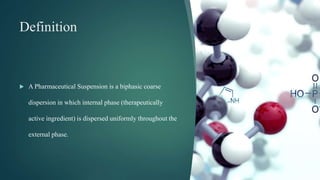
 A Pharmaceutical Suspension is a biphasic coarse
dispersion in which internal phase (therapeutically
active ingredient) is dispersed uniformly throughout the
external phase.
2
INTERNAL PHASE
 The internal phase consists of insoluble solid
particles having a range of size (0.5 to 5 microns)
which is maintained uniformly throughout the
suspending vehicle with aid of single or combination
of suspending agents
3
EXTERNAL
PHASE
The external phase (suspending medium) is generally
aqueous in some instance, may be organic or oily liquid for
non oral use.
4
Reasons for the
formulation of
pharmaceutical
suspensions
When the drug is insoluble in the
delivery vehicle
To mask the bitter taste of the drug.
To increase the drug stability.
To achieve controlled/sustained drug
release
5
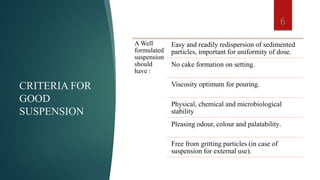
CRITERIA FOR
GOOD
SUSPENSION
A Well
formulated
suspension
should
have :
Easy and readily redispersion of sedimented
particles, important for uniformity of dose.
No cake formation on setting.
Viscosity optimum for pouring.
Physical, chemical and microbiological
stability
Pleasing odour, colour and palatability.
Free from gritting particles (in case of
suspension for external use).
6
Some phramaceutical Suspension
Antacid Oral suspension
Antibacterial oral suspension
Dry powders for oral suspensions (antibiotic)
Analgesic oral suspension
Anthelmintic oral suspension
Anticonvulsant oral suspension
Antifungal oral suspension
7
CLASSIFICATION OF SUSPENSION
Route of administration
• Oral Suspension
• External application
• Parenteral Suspension
Solid Particle proportion
• Dilute Suspension
• Concentrated Suspension
Solid Particle Size
• Colloidal Suspension
• Coarse Suspension
• Nano Suspension
8
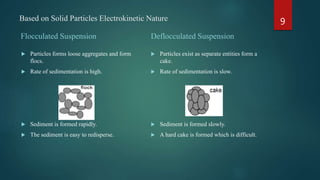
Based on Solid Particles Electrokinetic Nature
Flocculated Suspension
 Particles forms loose aggregates and form
flocs.
 Rate of sedimentation is high.
 Sediment is formed rapidly.
 The sediment is easy to redisperse.
Deflocculated Suspension
 Particles exist as separate entities form a
cake.
 Rate of sedimentation is slow.
 Sediment is formed slowly.
 A hard cake is formed which is difficult.
9
SUSPENDING
AGENTS
It increase the Viscosity of the
continuous phase
Minimize the sedimentation
Reduce the Surface tension of the
Solid particles
10
WETTING AGENTS
Reduce the surface tension between the
solid particles and the liquid medium
Improve the wetting power of the
insoluble substances
11
FLOCCULATING AGENT
To improve the
dispersibility of
insoluble solid particles.
Example : Sodium lauryl
sulphate, Tween, Span,
Carbowaxes.
12
PRESERVATIVES
 To preserve the suspension from the
bacterial growth.
 Example : Benzoic acid, Sodium
benzoate, Methyl paraben, Propyl
paraben
ORGANOLEPTIC ADDITIVES
 To enhance the patient acceptability.
 To mask the unpleasant taste.
 To enhance the appearance of the
preparation.
13
Preparation of the
Suspension
 Two main methods for the formulation of
suspension:
 PRECIPITATION METHODS
 DISPERSION METHODS
14
PRECIPITATION METHODS
 Three main methods are
• Organic solvent preparation
• Precipitation effected by the change pH of the medium
• Double decomposition
15
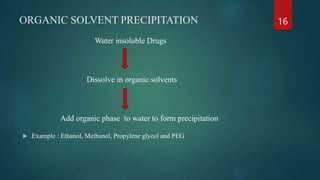
ORGANIC SOLVENT PRECIPITATION
Water insoluble Drugs
Dissolve in organic solvents
Add organic phase to water to form precipitation
 Example : Ethanol, Methanol, Propylene glycol and PEG
16
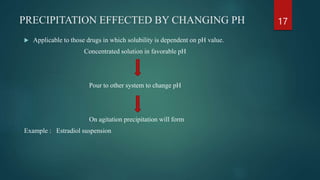
PRECIPITATION EFFECTED BY CHANGING PH
 Applicable to those drugs in which solubility is dependent on pH value.
Concentrated solution in favorable pH
Pour to other system to change pH
On agitation precipitation will form
Example : Estradiol suspension
17
BY DOUBLE DECOMPOSITION
 Two water soluble reagent forms a water insoluble product.
 Example : White lotion NF
Zinc sulphate solution
Solution of sulphurated potash
Precipitate of zinc polysulphide
18
DISPERSION METHOD
Vehicle is formulated
Solid phase is wetted and dispersed
Use of surfactant to ensure wetting of hydrophobic solids
19
EVALUATION OF SUSPENSION 20
Sedimentation
Method
Rheological
Method
Electrokinetic
Method
SEDIMENTATION
METHOD
 Sedimentation Volume(Sv) is defined as the ratio of the
ultimate height of the sediment(Hu) after settling the
suspension to the full height of suspension(Ho) before
settling.
Sv = Hu / Ho
Where,
Hu = Ultimate height of the sediment
Ho = Full height of the suspension before settling
21
RHEOLOGICAL METHOD
 It provide information about settling behaviour.
 Brookfield Viscometer is used to study the viscosity of the suspension.
 If the rate of settling of the particles is less, the stability of the suspension is more.
22
23
ELECTROKINETIC
METHOD
 Measurement of zeta potential using Micro
electrophoresis apparatus & Zeta Plus.
 It shows the stability of the disperse system
 Two types of electrical potential contribute to
electrokinetic properties.
• Zeta Potential
• Nernst Potential
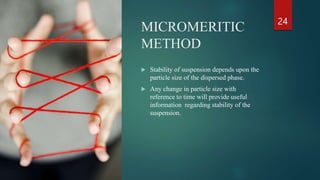
MICROMERITIC
METHOD
24
 Stability of suspension depends upon the
particle size of the dispersed phase.
 Any change in particle size with
reference to time will provide useful
information regarding stability of the
suspension.
THANK YOU
25

SUSPENSION.pptx

  • 1.
    SUSPENSION Submitted by C.Sangavi M.Pharm., AssistantProfessor Department of Pharmaceutics Acharya and BM Reddy College of Pharmacy 1
  • 2.
    Definition  A PharmaceuticalSuspension is a biphasic coarse dispersion in which internal phase (therapeutically active ingredient) is dispersed uniformly throughout the external phase. 2
  • 3.
    INTERNAL PHASE  Theinternal phase consists of insoluble solid particles having a range of size (0.5 to 5 microns) which is maintained uniformly throughout the suspending vehicle with aid of single or combination of suspending agents 3
  • 4.
    EXTERNAL PHASE The external phase(suspending medium) is generally aqueous in some instance, may be organic or oily liquid for non oral use. 4
  • 5.
    Reasons for the formulationof pharmaceutical suspensions When the drug is insoluble in the delivery vehicle To mask the bitter taste of the drug. To increase the drug stability. To achieve controlled/sustained drug release 5
  • 6.
    CRITERIA FOR GOOD SUSPENSION A Well formulated suspension should have: Easy and readily redispersion of sedimented particles, important for uniformity of dose. No cake formation on setting. Viscosity optimum for pouring. Physical, chemical and microbiological stability Pleasing odour, colour and palatability. Free from gritting particles (in case of suspension for external use). 6
  • 7.
    Some phramaceutical Suspension AntacidOral suspension Antibacterial oral suspension Dry powders for oral suspensions (antibiotic) Analgesic oral suspension Anthelmintic oral suspension Anticonvulsant oral suspension Antifungal oral suspension 7
  • 8.
    CLASSIFICATION OF SUSPENSION Routeof administration • Oral Suspension • External application • Parenteral Suspension Solid Particle proportion • Dilute Suspension • Concentrated Suspension Solid Particle Size • Colloidal Suspension • Coarse Suspension • Nano Suspension 8
  • 9.
    Based on SolidParticles Electrokinetic Nature Flocculated Suspension  Particles forms loose aggregates and form flocs.  Rate of sedimentation is high.  Sediment is formed rapidly.  The sediment is easy to redisperse. Deflocculated Suspension  Particles exist as separate entities form a cake.  Rate of sedimentation is slow.  Sediment is formed slowly.  A hard cake is formed which is difficult. 9
  • 10.
    SUSPENDING AGENTS It increase theViscosity of the continuous phase Minimize the sedimentation Reduce the Surface tension of the Solid particles 10
  • 11.
    WETTING AGENTS Reduce thesurface tension between the solid particles and the liquid medium Improve the wetting power of the insoluble substances 11
  • 12.
    FLOCCULATING AGENT To improvethe dispersibility of insoluble solid particles. Example : Sodium lauryl sulphate, Tween, Span, Carbowaxes. 12
  • 13.
    PRESERVATIVES  To preservethe suspension from the bacterial growth.  Example : Benzoic acid, Sodium benzoate, Methyl paraben, Propyl paraben ORGANOLEPTIC ADDITIVES  To enhance the patient acceptability.  To mask the unpleasant taste.  To enhance the appearance of the preparation. 13
  • 14.
    Preparation of the Suspension Two main methods for the formulation of suspension:  PRECIPITATION METHODS  DISPERSION METHODS 14
  • 15.
    PRECIPITATION METHODS  Threemain methods are • Organic solvent preparation • Precipitation effected by the change pH of the medium • Double decomposition 15
  • 16.
    ORGANIC SOLVENT PRECIPITATION Waterinsoluble Drugs Dissolve in organic solvents Add organic phase to water to form precipitation  Example : Ethanol, Methanol, Propylene glycol and PEG 16
  • 17.
    PRECIPITATION EFFECTED BYCHANGING PH  Applicable to those drugs in which solubility is dependent on pH value. Concentrated solution in favorable pH Pour to other system to change pH On agitation precipitation will form Example : Estradiol suspension 17
  • 18.
    BY DOUBLE DECOMPOSITION Two water soluble reagent forms a water insoluble product.  Example : White lotion NF Zinc sulphate solution Solution of sulphurated potash Precipitate of zinc polysulphide 18
  • 19.
    DISPERSION METHOD Vehicle isformulated Solid phase is wetted and dispersed Use of surfactant to ensure wetting of hydrophobic solids 19
  • 20.
    EVALUATION OF SUSPENSION20 Sedimentation Method Rheological Method Electrokinetic Method
  • 21.
    SEDIMENTATION METHOD  Sedimentation Volume(Sv)is defined as the ratio of the ultimate height of the sediment(Hu) after settling the suspension to the full height of suspension(Ho) before settling. Sv = Hu / Ho Where, Hu = Ultimate height of the sediment Ho = Full height of the suspension before settling 21
  • 22.
    RHEOLOGICAL METHOD  Itprovide information about settling behaviour.  Brookfield Viscometer is used to study the viscosity of the suspension.  If the rate of settling of the particles is less, the stability of the suspension is more. 22
  • 23.
    23 ELECTROKINETIC METHOD  Measurement ofzeta potential using Micro electrophoresis apparatus & Zeta Plus.  It shows the stability of the disperse system  Two types of electrical potential contribute to electrokinetic properties. • Zeta Potential • Nernst Potential
  • 24.
    MICROMERITIC METHOD 24  Stability ofsuspension depends upon the particle size of the dispersed phase.  Any change in particle size with reference to time will provide useful information regarding stability of the suspension.
  • 25.