International Conference on Harmonisation of Technical
Requirements for Registration of Pharmaceuticals for Human Use
ICH Q10
Pharmaceutical
Quality System (PQS)
2
ICH Q10 PQS Guideline
Background
Objectives
Scope
Content
Implementation
Conclusion
3
Background
high level
more visionary
less prescriptive
flexible regulatory
approaches
ICH Q8 Pharmaceutical Development
ICH Q9 Quality Risk Management
ICH Q10 Pharmaceutical Quality System
Vision
Move from regulatory guidance to scientific guidance
A harmonized pharmaceutical quality system applicable across
the lifecycle of the product emphasizing an integrated approach
to quality risk management and science
Companion guidelines
4
Background (continued)
ICH Q8 Finalized November 2005
ICH Q8(R1) (Step 2) November 2007
ICH Q9 Finalized November 2005
ICH Q10 (Step 2) May 2007
Public comments were received from the various Regions and
consolidated
Comments were considered and incorporated
Major issues and revisions discussed
Final resolution in in Portland
ICH Q10 - Finalized June 2008
5
Objectives of the Guideline
To meet the objectives, ICH Q10 augments Good
Manufacturing Practices which are generally not
repeated within the Guideline
1. Achieve product realisation
2. Establish and maintain a state of control
3. Facilitate continual improvement
6
Scope of Guideline
applies…throughout the product lifecycle
(§3.1)
Pharmaceutical Development
Technology Transfer
Commercial Manufacturing
Product Discontinuation
7
Scope of Guideline (continued)
…applies to the systems supporting the
development and manufacture of
pharmaceutical drug substances (i.e., API) and
drug products, including biotechnology and biological
products
…application is appropriate and proportionate to
lifecycle stage
…includes…new and existing products.
8
Content
1. Pharmaceutical Quality System
2. Management Responsibility
3. Continual Improvement of
Process Performance and Product Quality
4. Continual Improvement of the
Pharmaceutical Quality System
5. Glossary
Annex 1 - Potential Opportunities to Enhance Science and Risk Based
Regulatory Approaches
Annex 2 - Diagram of the ICH Q10 Pharmaceutical Quality System Model
9
Content: §1 – PQS
Introduction / Scope / Objectives
Relationship of ICH Q10 to
Regional GMP Requirements, ISO Standards and ICH Q7
Regulatory Approaches
Enablers
Knowledge Management
Quality Risk Management
Design and Content Considerations
Quality Manual
10
Content: §2 – Management
Responsibility
Management Commitment
Quality Policy, Quality Planning
Resource Management
Internal Communication
Management Review
Management of
Outsourced Activities and Purchased Materials
Change in Product Ownership
11
Content: §3 – Continual Improvement
of Process Performance
& Product Quality
Two major sections:
§3.1 Lifecycle Stage Goals – 4 stages
§3.2 PQS Elements – 4 elements
12
Content: §3.1 Lifecycle Stage Goals
1 Pharmaceutical Development
design product and process to consistently deliver the
intended performance and meet the needs of [parties]
exploratory and clinical development studies are inputs
2 Technology Transfer
transfer product/process knowledge between
development and manufacturing, and within or between
sites
13
Content: §3.1 Lifecycle Stage Goals
(continued)
3 Commercial Manufacturing
achieving product realisation, establishing and
maintaining a state of control, and facilitating
continual improvement
4 Product Discontinuation
manage the terminal stage of the product lifecycle
effectively
14
Content: §3.2 PQS Elements
1 Process Performance and Product Quality Monitoring
System
A monitoring system to ensure a state of control is maintained
The process performance and product quality monitoring system
should:
Use quality risk management (ICH Q9 for example) to establish the control
strategy.
Provide the tools for measurement and analysis of parameters and attributes
Analyse parameters and attributes
Identify sources of variation for potential continual improvement activities
Include feedback on product quality from both internal and external sources
Provide knowledge to enhance process understanding, enrich the design space
(where established), and enable innovative approaches to process validation.
15
Content: §3.2 PQS Elements(continued)
2 Corrective Action and Preventive Action (CAPA) System
A system for implementing
corrective actions resulting from the investigation of complaints, product
rejections, non-conformances, recalls, deviations, audits, regulatory
inspections and findings
preventive actions resulting from trends from process performance and
product quality monitoring
CAPA methodology should result in product and process
improvements and enhanced product and process understanding
16
Content: §3.2 PQS Elements(continued)
3 Change Management System
A change management system ensures continual improvement is
undertaken in a timely and effective manner.
It should provide a high degree of assurance there are no unintended
consequences of the change
Change Management should, as appropriate for the lifecycle stage:
Use Quality risk management (Q9) to evaluate proposed changes
Evaluate proposed changes relative to the marketing authorisation and need for
a change to the regulatory filing
Evaluate proposed changes using expert teams
Evaluate the change after implementation to confirm the change objectives were
achieved and that there was no deleterious impact on product quality.
17
Content: §3.2 PQS Elements(continued)
4 Management Review of Process Performance and
Product Quality
Management reviews provide assurance that process performance
and product quality are managed over the lifecycle
Includes data from a wide range of external and internal sources
Results in appropriate actions, such as:
Improvements to manufacturing processes and products
Training and/or realignment of resources
Capture and dissemination of knowledge
18
Content: §4 – Continual
Improvement of the PQS
Management Review of the
Pharmaceutical Quality System
Monitoring of Internal and External Factors
Impacting the Pharmaceutical Quality
System
Outcomes of Management Review and
Monitoring
19
Content: ..in addition
§5 – Glossary
Annex 1 – Potential Opportunities to
Enhance Science and Risk Based
Regulatory Approaches
Annex 2 – Diagram of the ICH Q10
Pharmaceutical Quality System Model
20
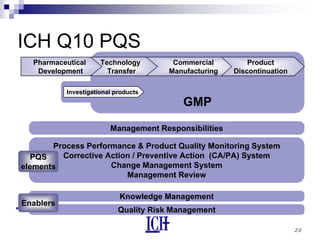
GMP
ICH Q10 PQS
Pharmaceutical
Development
Commercial
Manufacturing
Product
Discontinuation
Technology
Transfer
Investigational products
Management Responsibilities
Process Performance & Product Quality Monitoring System
Corrective Action / Preventive Action (CA/PA) System
Change Management System
Management Review
PQS
elements
Knowledge Management
Quality Risk Management
Enablers
21
Integration of Q8, Q9, & Q10
An integrated set of guidelines:
Q8 Pharmaceutical Development
Q9 Quality Risk Management
Q10 Pharmaceutical Quality Systems
Q8, 9, & 10:
Quality by Design, Risk Management, and PQS
provide greater product assurance of quality
22
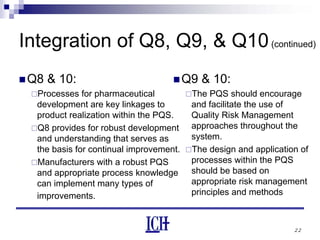
Integration of Q8, Q9, & Q10(continued)
Q8 & 10:
Processes for pharmaceutical
development are key linkages to
product realization within the PQS.
Q8 provides for robust development
and understanding that serves as
the basis for continual improvement.
Manufacturers with a robust PQS
and appropriate process knowledge
can implement many types of
improvements.
Q9 & 10:
The PQS should encourage
and facilitate the use of
Quality Risk Management
approaches throughout the
system.
The design and application of
processes within the PQS
should be based on
appropriate risk management
principles and methods
23
Implementation of Q10
Annex 1 - Potential Opportunities to
Enhance Science and Risk Based
Regulatory Approaches
Annex reflects potential opportunities to
enhance regulatory approaches.
The actual regulatory process will be
determined by region.
24
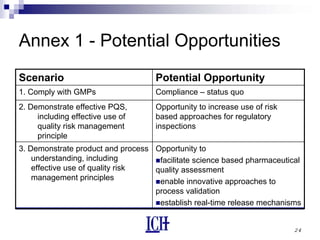
Annex 1 - Potential Opportunities
Scenario Potential Opportunity
1. Comply with GMPs Compliance – status quo
2. Demonstrate effective PQS,
including effective use of
quality risk management
principle
Opportunity to increase use of risk
based approaches for regulatory
inspections
3. Demonstrate product and process
understanding, including
effective use of quality risk
management principles
Opportunity to
facilitate science based pharmaceutical
quality assessment
enable innovative approaches to
process validation
establish real-time release mechanisms
25
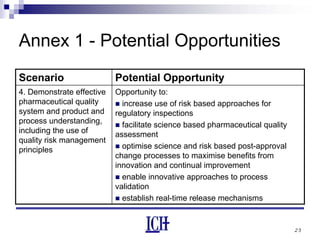
Annex 1 - Potential Opportunities
Scenario Potential Opportunity
4. Demonstrate effective
pharmaceutical quality
system and product and
process understanding,
including the use of
quality risk management
principles
Opportunity to:
increase use of risk based approaches for
regulatory inspections
facilitate science based pharmaceutical quality
assessment
optimise science and risk based post-approval
change processes to maximise benefits from
innovation and continual improvement
enable innovative approaches to process
validation
establish real-time release mechanisms
26
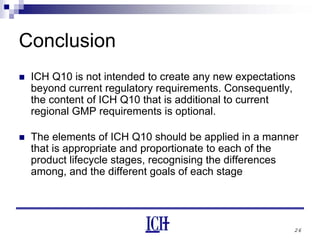
Conclusion
ICH Q10 is not intended to create any new expectations
beyond current regulatory requirements. Consequently,
the content of ICH Q10 that is additional to current
regional GMP requirements is optional.
The elements of ICH Q10 should be applied in a manner
that is appropriate and proportionate to each of the
product lifecycle stages, recognising the differences
among, and the different goals of each stage

Q10 general presentation

  • 1.
    International Conference onHarmonisation of Technical Requirements for Registration of Pharmaceuticals for Human Use ICH Q10 Pharmaceutical Quality System (PQS)
  • 2.
    2 ICH Q10 PQSGuideline Background Objectives Scope Content Implementation Conclusion
  • 3.
    3 Background high level more visionary lessprescriptive flexible regulatory approaches ICH Q8 Pharmaceutical Development ICH Q9 Quality Risk Management ICH Q10 Pharmaceutical Quality System Vision Move from regulatory guidance to scientific guidance A harmonized pharmaceutical quality system applicable across the lifecycle of the product emphasizing an integrated approach to quality risk management and science Companion guidelines
  • 4.
    4 Background (continued) ICH Q8Finalized November 2005 ICH Q8(R1) (Step 2) November 2007 ICH Q9 Finalized November 2005 ICH Q10 (Step 2) May 2007 Public comments were received from the various Regions and consolidated Comments were considered and incorporated Major issues and revisions discussed Final resolution in in Portland ICH Q10 - Finalized June 2008
  • 5.
    5 Objectives of theGuideline To meet the objectives, ICH Q10 augments Good Manufacturing Practices which are generally not repeated within the Guideline 1. Achieve product realisation 2. Establish and maintain a state of control 3. Facilitate continual improvement
  • 6.
    6 Scope of Guideline applies…throughoutthe product lifecycle (§3.1) Pharmaceutical Development Technology Transfer Commercial Manufacturing Product Discontinuation
  • 7.
    7 Scope of Guideline(continued) …applies to the systems supporting the development and manufacture of pharmaceutical drug substances (i.e., API) and drug products, including biotechnology and biological products …application is appropriate and proportionate to lifecycle stage …includes…new and existing products.
  • 8.
    8 Content 1. Pharmaceutical QualitySystem 2. Management Responsibility 3. Continual Improvement of Process Performance and Product Quality 4. Continual Improvement of the Pharmaceutical Quality System 5. Glossary Annex 1 - Potential Opportunities to Enhance Science and Risk Based Regulatory Approaches Annex 2 - Diagram of the ICH Q10 Pharmaceutical Quality System Model
  • 9.
    9 Content: §1 –PQS Introduction / Scope / Objectives Relationship of ICH Q10 to Regional GMP Requirements, ISO Standards and ICH Q7 Regulatory Approaches Enablers Knowledge Management Quality Risk Management Design and Content Considerations Quality Manual
  • 10.
    10 Content: §2 –Management Responsibility Management Commitment Quality Policy, Quality Planning Resource Management Internal Communication Management Review Management of Outsourced Activities and Purchased Materials Change in Product Ownership
  • 11.
    11 Content: §3 –Continual Improvement of Process Performance & Product Quality Two major sections: §3.1 Lifecycle Stage Goals – 4 stages §3.2 PQS Elements – 4 elements
  • 12.
    12 Content: §3.1 LifecycleStage Goals 1 Pharmaceutical Development design product and process to consistently deliver the intended performance and meet the needs of [parties] exploratory and clinical development studies are inputs 2 Technology Transfer transfer product/process knowledge between development and manufacturing, and within or between sites
  • 13.
    13 Content: §3.1 LifecycleStage Goals (continued) 3 Commercial Manufacturing achieving product realisation, establishing and maintaining a state of control, and facilitating continual improvement 4 Product Discontinuation manage the terminal stage of the product lifecycle effectively
  • 14.
    14 Content: §3.2 PQSElements 1 Process Performance and Product Quality Monitoring System A monitoring system to ensure a state of control is maintained The process performance and product quality monitoring system should: Use quality risk management (ICH Q9 for example) to establish the control strategy. Provide the tools for measurement and analysis of parameters and attributes Analyse parameters and attributes Identify sources of variation for potential continual improvement activities Include feedback on product quality from both internal and external sources Provide knowledge to enhance process understanding, enrich the design space (where established), and enable innovative approaches to process validation.
  • 15.
    15 Content: §3.2 PQSElements(continued) 2 Corrective Action and Preventive Action (CAPA) System A system for implementing corrective actions resulting from the investigation of complaints, product rejections, non-conformances, recalls, deviations, audits, regulatory inspections and findings preventive actions resulting from trends from process performance and product quality monitoring CAPA methodology should result in product and process improvements and enhanced product and process understanding
  • 16.
    16 Content: §3.2 PQSElements(continued) 3 Change Management System A change management system ensures continual improvement is undertaken in a timely and effective manner. It should provide a high degree of assurance there are no unintended consequences of the change Change Management should, as appropriate for the lifecycle stage: Use Quality risk management (Q9) to evaluate proposed changes Evaluate proposed changes relative to the marketing authorisation and need for a change to the regulatory filing Evaluate proposed changes using expert teams Evaluate the change after implementation to confirm the change objectives were achieved and that there was no deleterious impact on product quality.
  • 17.
    17 Content: §3.2 PQSElements(continued) 4 Management Review of Process Performance and Product Quality Management reviews provide assurance that process performance and product quality are managed over the lifecycle Includes data from a wide range of external and internal sources Results in appropriate actions, such as: Improvements to manufacturing processes and products Training and/or realignment of resources Capture and dissemination of knowledge
  • 18.
    18 Content: §4 –Continual Improvement of the PQS Management Review of the Pharmaceutical Quality System Monitoring of Internal and External Factors Impacting the Pharmaceutical Quality System Outcomes of Management Review and Monitoring
  • 19.
    19 Content: ..in addition §5– Glossary Annex 1 – Potential Opportunities to Enhance Science and Risk Based Regulatory Approaches Annex 2 – Diagram of the ICH Q10 Pharmaceutical Quality System Model
  • 20.
    20 GMP ICH Q10 PQS Pharmaceutical Development Commercial Manufacturing Product Discontinuation Technology Transfer Investigationalproducts Management Responsibilities Process Performance & Product Quality Monitoring System Corrective Action / Preventive Action (CA/PA) System Change Management System Management Review PQS elements Knowledge Management Quality Risk Management Enablers
  • 21.
    21 Integration of Q8,Q9, & Q10 An integrated set of guidelines: Q8 Pharmaceutical Development Q9 Quality Risk Management Q10 Pharmaceutical Quality Systems Q8, 9, & 10: Quality by Design, Risk Management, and PQS provide greater product assurance of quality
  • 22.
    22 Integration of Q8,Q9, & Q10(continued) Q8 & 10: Processes for pharmaceutical development are key linkages to product realization within the PQS. Q8 provides for robust development and understanding that serves as the basis for continual improvement. Manufacturers with a robust PQS and appropriate process knowledge can implement many types of improvements. Q9 & 10: The PQS should encourage and facilitate the use of Quality Risk Management approaches throughout the system. The design and application of processes within the PQS should be based on appropriate risk management principles and methods
  • 23.
    23 Implementation of Q10 Annex1 - Potential Opportunities to Enhance Science and Risk Based Regulatory Approaches Annex reflects potential opportunities to enhance regulatory approaches. The actual regulatory process will be determined by region.
  • 24.
    24 Annex 1 -Potential Opportunities Scenario Potential Opportunity 1. Comply with GMPs Compliance – status quo 2. Demonstrate effective PQS, including effective use of quality risk management principle Opportunity to increase use of risk based approaches for regulatory inspections 3. Demonstrate product and process understanding, including effective use of quality risk management principles Opportunity to facilitate science based pharmaceutical quality assessment enable innovative approaches to process validation establish real-time release mechanisms
  • 25.
    25 Annex 1 -Potential Opportunities Scenario Potential Opportunity 4. Demonstrate effective pharmaceutical quality system and product and process understanding, including the use of quality risk management principles Opportunity to: increase use of risk based approaches for regulatory inspections facilitate science based pharmaceutical quality assessment optimise science and risk based post-approval change processes to maximise benefits from innovation and continual improvement enable innovative approaches to process validation establish real-time release mechanisms
  • 26.
    26 Conclusion ICH Q10 isnot intended to create any new expectations beyond current regulatory requirements. Consequently, the content of ICH Q10 that is additional to current regional GMP requirements is optional. The elements of ICH Q10 should be applied in a manner that is appropriate and proportionate to each of the product lifecycle stages, recognising the differences among, and the different goals of each stage