ICH Q10
( PHARMACEUTICAL QUALITY SYSTEM )
SURAJ SHRIHARI PAULKAR
M.PHARMACY(QA)
SCHOOL OF PHARMACY
SRTMU,NANDED.
This Guideline has been developed by the appropriate ICH Expert
Working Group and has been subject to consultation by the
regulatory parties, in accordance with the ICH Process. At Step 4 of
the Process the final draft is recommended for adoption to the
regulatory bodies of the European Union, Japan and USA.
ICH
 ICH is the short form of “International Council for Harmonization” of technical
requirements for registration of pharmaceuticals for human use.
 The objective of ICH is to increase international harmonization of technical
requirements to ensure that safe, effective and high quality medicines are
developed and registered in the most efficient and cost effective manner.
 Members of ICH: Japan, Europe and USA
 Meeting are conducted twice in year.
 Head quarter: Geneva
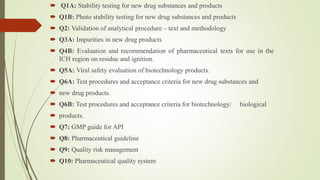
 Q1A: Stability testing for new drug substances and products
 Q1B: Photo stability testing for new drug substances and products
 Q2: Validation of analytical procedure – text and methodology
 Q3A: Impurities in new drug products
 Q4B: Evaluation and recommendation of pharmaceutical texts for use in the
ICH region on residue and ignition.
 Q5A: Viral safety evaluation of biotechnology products.
 Q6A: Test procedures and acceptance criteria for new drug substances and
 new drug products.
 Q6B: Test procedures and acceptance criteria for biotechnology/ biological
 products.
 Q7: GMP guide for API
 Q8: Pharmaceutical guideline
 Q9: Quality risk management
 Q10: Pharmaceutical quality system
PHARMACEUTICAL QUALITY SYSTEM
Introduction
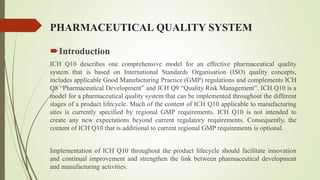
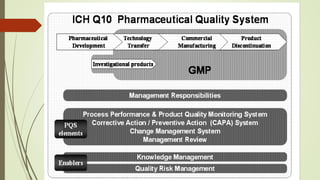
ICH Q10 describes one comprehensive model for an effective pharmaceutical quality
system that is based on International Standards Organisation (ISO) quality concepts,
includes applicable Good Manufacturing Practice (GMP) regulations and complements ICH
Q8 “Pharmaceutical Development” and ICH Q9 “Quality Risk Management”. ICH Q10 is a
model for a pharmaceutical quality system that can be implemented throughout the different
stages of a product lifecycle. Much of the content of ICH Q10 applicable to manufacturing
sites is currently specified by regional GMP requirements. ICH Q10 is not intended to
create any new expectations beyond current regulatory requirements. Consequently, the
content of ICH Q10 that is additional to current regional GMP requirements is optional.
Implementation of ICH Q10 throughout the product lifecycle should facilitate innovation
and continual improvement and strengthen the link between pharmaceutical development
and manufacturing activities.
Scope
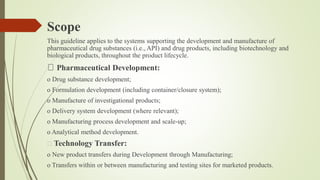
This guideline applies to the systems supporting the development and manufacture of
pharmaceutical drug substances (i.e., API) and drug products, including biotechnology and
biological products, throughout the product lifecycle.
Pharmaceutical Development:
o Drug substance development;
o Formulation development (including container/closure system);
o Manufacture of investigational products;
o Delivery system development (where relevant);
o Manufacturing process development and scale-up;
o Analytical method development.
Technology Transfer:
o New product transfers during Development through Manufacturing;
o Transfers within or between manufacturing and testing sites for marketed products.
Commercial Manufacturing:
o Acquisition and control of materials;
o Provision of facilities, utilities, and equipment;
o Production (including packaging and labelling);
o Quality control and assurance;
o Release;
o Storage;
o Distribution (excluding wholesaler activities).
Product Discontinuation:
o Retention of documentation;
o Sample retention;
o Continued product assessment and reporting.
ICH Q10 OBJECTIVES
o Achieve Product Realisation
o Establish and Maintain a State of Control
o Facilitate Continual Improvement
Relationship of ICH Q10 to Regional GMP Requirements, ISO
Standards and ICH Q7
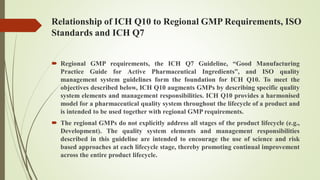
 Regional GMP requirements, the ICH Q7 Guideline, “Good Manufacturing
Practice Guide for Active Pharmaceutical Ingredients”, and ISO quality
management system guidelines form the foundation for ICH Q10. To meet the
objectives described below, ICH Q10 augments GMPs by describing specific quality
system elements and management responsibilities. ICH Q10 provides a harmonised
model for a pharmaceutical quality system throughout the lifecycle of a product and
is intended to be used together with regional GMP requirements.
 The regional GMPs do not explicitly address all stages of the product lifecycle (e.g.,
Development). The quality system elements and management responsibilities
described in this guideline are intended to encourage the use of science and risk
based approaches at each lifecycle stage, thereby promoting continual improvement
across the entire product lifecycle.
Relationship of ICH Q10 to Regulatory Approaches
 Regulatory approaches for a specific product or manufacturing facility should be
commensurate with the level of product and process understanding, the results of
quality risk management, and the effectiveness of the pharmaceutical quality
system. When implemented, the effectiveness of the pharmaceutical quality
system can normally be evaluated during a regulatory inspection at the
manufacturing site. Potential opportunities to enhance science and risk based
regulatory approaches are identified in Annex 1. Regulatory processes will be
determined by region.
MANAGEMENT RESPONSIBILITY
 Management Commitment
 Quality Policy
 Quality Planning 5
 Resource Management
 Internal Communication
 Management Review
 Management of Outsourced Activities and Purchased Materials
 Management of Change in Product Ownership
CONTINUAL IMPROVEMENT OF PROCESS
PERFORMANCE AND PRODUCT QUALITY
 Lifecycle Stage Goals
Pharmaceutical Development
Technology Transfer
Commercial Manufacturing
Product Discontinuation
 Pharmaceutical Quality System Elements
Process Performance and Product Quality Monitoring System
Corrective Action and Preventive Action (CAPA) System
Change Management System
Management Review of Process Performance and Product Quality
CONTINUAL IMPROVEMENT OF THE
PHARMACEUTICAL QUALITY SYSTEM
 Management Review of the Pharmaceutical Quality System
 Monitoring of Internal and External Factors Impacting the Pharmaceutical
Quality System
 Outcomes of Management Review and Monitoring
REFERENCE
 International Conference on Harmonization, ICH Q10:Pharmaceutical Quality
System, May 2007 & June 2008.

Ich q10

  • 1.
    ICH Q10 ( PHARMACEUTICALQUALITY SYSTEM ) SURAJ SHRIHARI PAULKAR M.PHARMACY(QA) SCHOOL OF PHARMACY SRTMU,NANDED.
  • 2.
    This Guideline hasbeen developed by the appropriate ICH Expert Working Group and has been subject to consultation by the regulatory parties, in accordance with the ICH Process. At Step 4 of the Process the final draft is recommended for adoption to the regulatory bodies of the European Union, Japan and USA.
  • 3.
    ICH  ICH isthe short form of “International Council for Harmonization” of technical requirements for registration of pharmaceuticals for human use.  The objective of ICH is to increase international harmonization of technical requirements to ensure that safe, effective and high quality medicines are developed and registered in the most efficient and cost effective manner.  Members of ICH: Japan, Europe and USA  Meeting are conducted twice in year.  Head quarter: Geneva
  • 4.
     Q1A: Stabilitytesting for new drug substances and products  Q1B: Photo stability testing for new drug substances and products  Q2: Validation of analytical procedure – text and methodology  Q3A: Impurities in new drug products  Q4B: Evaluation and recommendation of pharmaceutical texts for use in the ICH region on residue and ignition.  Q5A: Viral safety evaluation of biotechnology products.  Q6A: Test procedures and acceptance criteria for new drug substances and  new drug products.  Q6B: Test procedures and acceptance criteria for biotechnology/ biological  products.  Q7: GMP guide for API  Q8: Pharmaceutical guideline  Q9: Quality risk management  Q10: Pharmaceutical quality system
  • 5.
    PHARMACEUTICAL QUALITY SYSTEM Introduction ICHQ10 describes one comprehensive model for an effective pharmaceutical quality system that is based on International Standards Organisation (ISO) quality concepts, includes applicable Good Manufacturing Practice (GMP) regulations and complements ICH Q8 “Pharmaceutical Development” and ICH Q9 “Quality Risk Management”. ICH Q10 is a model for a pharmaceutical quality system that can be implemented throughout the different stages of a product lifecycle. Much of the content of ICH Q10 applicable to manufacturing sites is currently specified by regional GMP requirements. ICH Q10 is not intended to create any new expectations beyond current regulatory requirements. Consequently, the content of ICH Q10 that is additional to current regional GMP requirements is optional. Implementation of ICH Q10 throughout the product lifecycle should facilitate innovation and continual improvement and strengthen the link between pharmaceutical development and manufacturing activities.
  • 6.
    Scope This guideline appliesto the systems supporting the development and manufacture of pharmaceutical drug substances (i.e., API) and drug products, including biotechnology and biological products, throughout the product lifecycle. Pharmaceutical Development: o Drug substance development; o Formulation development (including container/closure system); o Manufacture of investigational products; o Delivery system development (where relevant); o Manufacturing process development and scale-up; o Analytical method development. Technology Transfer: o New product transfers during Development through Manufacturing; o Transfers within or between manufacturing and testing sites for marketed products.
  • 7.
    Commercial Manufacturing: o Acquisitionand control of materials; o Provision of facilities, utilities, and equipment; o Production (including packaging and labelling); o Quality control and assurance; o Release; o Storage; o Distribution (excluding wholesaler activities). Product Discontinuation: o Retention of documentation; o Sample retention; o Continued product assessment and reporting.
  • 8.
    ICH Q10 OBJECTIVES oAchieve Product Realisation o Establish and Maintain a State of Control o Facilitate Continual Improvement
  • 9.
    Relationship of ICHQ10 to Regional GMP Requirements, ISO Standards and ICH Q7  Regional GMP requirements, the ICH Q7 Guideline, “Good Manufacturing Practice Guide for Active Pharmaceutical Ingredients”, and ISO quality management system guidelines form the foundation for ICH Q10. To meet the objectives described below, ICH Q10 augments GMPs by describing specific quality system elements and management responsibilities. ICH Q10 provides a harmonised model for a pharmaceutical quality system throughout the lifecycle of a product and is intended to be used together with regional GMP requirements.  The regional GMPs do not explicitly address all stages of the product lifecycle (e.g., Development). The quality system elements and management responsibilities described in this guideline are intended to encourage the use of science and risk based approaches at each lifecycle stage, thereby promoting continual improvement across the entire product lifecycle.
  • 10.
    Relationship of ICHQ10 to Regulatory Approaches  Regulatory approaches for a specific product or manufacturing facility should be commensurate with the level of product and process understanding, the results of quality risk management, and the effectiveness of the pharmaceutical quality system. When implemented, the effectiveness of the pharmaceutical quality system can normally be evaluated during a regulatory inspection at the manufacturing site. Potential opportunities to enhance science and risk based regulatory approaches are identified in Annex 1. Regulatory processes will be determined by region.
  • 11.
    MANAGEMENT RESPONSIBILITY  ManagementCommitment  Quality Policy  Quality Planning 5  Resource Management  Internal Communication  Management Review  Management of Outsourced Activities and Purchased Materials  Management of Change in Product Ownership
  • 12.
    CONTINUAL IMPROVEMENT OFPROCESS PERFORMANCE AND PRODUCT QUALITY  Lifecycle Stage Goals Pharmaceutical Development Technology Transfer Commercial Manufacturing Product Discontinuation  Pharmaceutical Quality System Elements Process Performance and Product Quality Monitoring System Corrective Action and Preventive Action (CAPA) System Change Management System Management Review of Process Performance and Product Quality
  • 13.
    CONTINUAL IMPROVEMENT OFTHE PHARMACEUTICAL QUALITY SYSTEM  Management Review of the Pharmaceutical Quality System  Monitoring of Internal and External Factors Impacting the Pharmaceutical Quality System  Outcomes of Management Review and Monitoring
  • 15.
    REFERENCE  International Conferenceon Harmonization, ICH Q10:Pharmaceutical Quality System, May 2007 & June 2008.