PRESENTED BY:-
BHANDARI UMESH M.
1ST YR M- PHARM.
DEPARTMENT OF PHARMACEUTICS.
RCPIPER, SHIRPUR
PHARMACEUTICAL QUALITY SYSTEMS
(ICH Q10)
CONTENTS
• INTRODUCTION
• OBJECTIVE
• DESIGN AND CONTENT CONSIDERATIONS
• RELATIONSHIP OF ICH Q10 TO GMP REQUIREMENTS
• RELATIONSHIP OF ICH Q10 TO REGULATORY APPROACHES
• MANAGEMENT RESPONSIBILITY
• MANAAGEMENT REVIEW
• CHALLENGES
• CONCLUSIONS
• REFERENCES
2
INTRODUCTION
• ICH - International Conference on Harmonization of Technical Requirements for
Registration of Pharmaceuticals for Human Use.
• The objective of ICH is to increase international harmonization of technical
requirements to ensure that safe , effective and high quality medicines are developed
and registered in the most efficient and cost-effective manner.
• Members of ICH
 Japan
 Europe
 USA
• Meeting are conducted twice in year
• Last meeting conducted on 23rd oct 2015 3
Purpose
To increase international harmonization of technical
requirements.
Goal
1. To promote international harmonization
2. To make information available on ICH, ICH activities and
ICH guidelines to any country or company
3. To promote a mutual understanding of regional initiatives
4. To strengthen the capacity of drug regulatory authorities
and industry to utilize them.
 Location
. The ICH Secretariat is based in Geneva
4
PHARMACEUTICAL QUALITY SYSTEMS
(ICH Q10)
• This document establishes a new ICH tripartite guideline describing a model for an
effective quality management system for the pharmaceutical industry
• ICH Q10 was adopted in the year 2008 to establish and implement an effective QA
system in order to comply with GMP.
• This guideline, “pharmaceutical quality systemic on ISO concept.
• ICH Q10 demonstrates industry and regulatory authorities’
• ICH Q10 is not intended to create any new expectations beyond current regulatory
requirements
• Current is Step 4, Version dated 4th June 2008
• Recommended for adoption to the regulatory bodies of the European Union,
Japan and USA
5
OBJECTIVES
(1) Achieve Product Realization:
To establish, implement & maintain a system that allows the delivery of a products
with the quality attributes appropriate to meet the needs of patient & other stake
holders.
(2) Establish & Maintain a State of Control:
To develop & use effective monitoring & control systems for process performance &
product quality, thereby providing assurance of continued suitability and capability
of processes. Quality Risk Management (QRM) can be useful in identifying the
monitoring and control systems
(3) Facilitate Continual Improvement:
To identify and implement appropriate product quality improvements, process
improvements, variability reduction, innovation & quality system enhancements,
thereby increasing the ability to fulfill quality needs consistently. QRM can be useful
for identifying & prioritizing areas for continual improvement 6
DESIGN AND CONTENT CONSIDERATIONS
• The pharmaceutical quality system should be well structured
• Facilitate common understanding and consistent application
• Product lifecycle stages, recognizing the differences among, and the different
goals of each stage
• Manufacturing of procurement of materials, provision of facilities, quality
control and assurance.
7
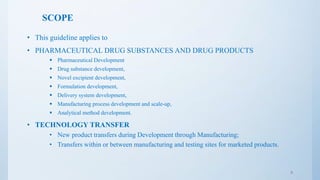
SCOPE
• This guideline applies to
• PHARMACEUTICAL DRUG SUBSTANCES AND DRUG PRODUCTS
 Pharmaceutical Development
 Drug substance development,
 Novel excipient development,
 Formulation development,
 Delivery system development,
 Manufacturing process development and scale-up,
 Analytical method development.
• TECHNOLOGY TRANSFER
• New product transfers during Development through Manufacturing;
• Transfers within or between manufacturing and testing sites for marketed products.
8
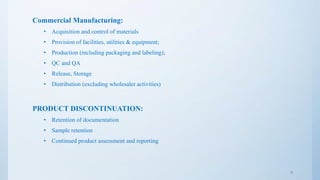
Commercial Manufacturing:
• Acquisition and control of materials
• Provision of facilities, utilities & equipment;
• Production (including packaging and labeling);
• QC and QA
• Release, Storage
• Distribution (excluding wholesaler activities)
PRODUCT DISCONTINUATION:
• Retention of documentation
• Sample retention
• Continued product assessment and reporting
9
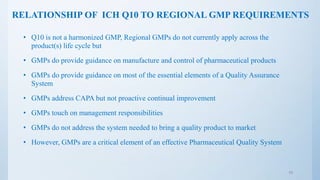
RELATIONSHIP OF ICH Q10 TO REGIONAL GMP REQUIREMENTS
• Q10 is not a harmonized GMP, Regional GMPs do not currently apply across the
product(s) life cycle but
• GMPs do provide guidance on manufacture and control of pharmaceutical products
• GMPs do provide guidance on most of the essential elements of a Quality Assurance
System
• GMPs address CAPA but not proactive continual improvement
• GMPs touch on management responsibilities
• GMPs do not address the system needed to bring a quality product to market
• However, GMPs are a critical element of an effective Pharmaceutical Quality System
10
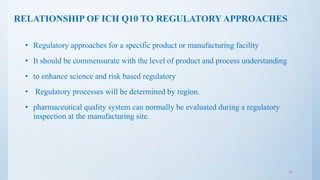
RELATIONSHIP OF ICH Q10 TO REGULATORY APPROACHES
• Regulatory approaches for a specific product or manufacturing facility
• It should be commensurate with the level of product and process understanding
• to enhance science and risk based regulatory
• Regulatory processes will be determined by region.
• pharmaceutical quality system can normally be evaluated during a regulatory
inspection at the manufacturing site.
11
MANAGEMENT RESPONSIBILITY
Management Commitment
Quality Policy
Quality Planning
Resource Management
Internal Communication
12
MANAAGEMENT REVIEW
• Management should have a formal process for reviewing the pharmaceutical
quality system on a periodic basis.
• i) Measurement of achievement of pharmaceutical quality system objectives
• ii) Assessment of Key Performance Indicators that can be used to monitor the
effectiveness of processes within the pharmaceutical quality system such as,
• Complaint, deviation, CAPA and change management processes;
• Self-assessment processes including audits
• External assessments such as regulatory inspections and findings and
customer audits.
13
APPLICABILITY AND KEY MASSAGE
• Pharmaceutical Quality System
• Scale-up and Technology Transfer
• Process Validation
• Change Management and Continual Improvement
• Quality Unit (QA/QC) and Batch Release
14
KEY MASSAGE
• It introduces the involvement and role of senior management
• It introduces a product life cycle perspective
• Quality Risk Management and Knowledge Management are enablers for the
PQS
• Implementation of PQS provides to enhance assurance of product quality
15
QRM-Quality Risk Management
• QRM is integral to an effective pharmaceutical quality system. It can provide
a proactive approach to identifying, scientifically evaluating & controlling
potential risks to quality. It facilitates continual improvement of process
performance & product quality throughout the product life cycle.
• QRM can be applied to different aspects of pharmaceutical quality
(e.g. Design & content consideration)
16
CHALLENGES
• Trust and Culture Change
• Industry-Regulatory Trust & Openness in vision
• Culture change in both for industry & regulatory
• Will the Q10 approach disadvantage small & medium manufacturing units?
• What is the scope of QMS (Site or Enterprise)?
• How many companies will require re-engineering of their QMS?
• How will we eventually adopte
17
CONCLUSIONS
• ICH Q10 requires an understanding of FDA for the 21st Century, ICH Q8 (Design), ICH
Q9 (Risk) as well as ISO 9000 (2005) to maximize benefit
• ICH Q10 is an ISO SYSTEMS approach to GMP
• NOT additional to GMP but integral to GMP
• Covers full life Cycle of a Product
• Objectives: Product Realization, Control & improvement
• Demands Management Team to lead Quality System and which protects public health in
respect of product lifecycle.
• As a management team we firmly believe that effective and robust Quality
• Risk Management underpinned by an effective quality system is key to the successful
implementation of the new concepts described in ICH Q8, Q9 & Q10.
18
REFERENCES
• International Conference on Harmonisation, ICH Q10: Pharmaceutical Quality
System, May 2007 & June 2008. http://www.ich.org/
• Guidance for Industry: Quality Systems Approach to Pharmaceutical GMP
Regulations, September 2006. http://www.fda.gov/
• International Conference on Harmonisation, ICH Q9: Quality Risk
Management, November 2005. http://www.ich.org/
• Kuchekar B.S., Khadatare A.M., Itkar S.C., Forensic Pharmacy, Nirali
Publication, page no.17.16-17.25.
19
THANK U…..
HAVE NICE DAY…..
for more contacts
umesh.m.b143@gmail.com

ICH Q 10 guidline

  • 1.
    PRESENTED BY:- BHANDARI UMESHM. 1ST YR M- PHARM. DEPARTMENT OF PHARMACEUTICS. RCPIPER, SHIRPUR PHARMACEUTICAL QUALITY SYSTEMS (ICH Q10)
  • 2.
    CONTENTS • INTRODUCTION • OBJECTIVE •DESIGN AND CONTENT CONSIDERATIONS • RELATIONSHIP OF ICH Q10 TO GMP REQUIREMENTS • RELATIONSHIP OF ICH Q10 TO REGULATORY APPROACHES • MANAGEMENT RESPONSIBILITY • MANAAGEMENT REVIEW • CHALLENGES • CONCLUSIONS • REFERENCES 2
  • 3.
    INTRODUCTION • ICH -International Conference on Harmonization of Technical Requirements for Registration of Pharmaceuticals for Human Use. • The objective of ICH is to increase international harmonization of technical requirements to ensure that safe , effective and high quality medicines are developed and registered in the most efficient and cost-effective manner. • Members of ICH  Japan  Europe  USA • Meeting are conducted twice in year • Last meeting conducted on 23rd oct 2015 3
  • 4.
    Purpose To increase internationalharmonization of technical requirements. Goal 1. To promote international harmonization 2. To make information available on ICH, ICH activities and ICH guidelines to any country or company 3. To promote a mutual understanding of regional initiatives 4. To strengthen the capacity of drug regulatory authorities and industry to utilize them.  Location . The ICH Secretariat is based in Geneva 4
  • 5.
    PHARMACEUTICAL QUALITY SYSTEMS (ICHQ10) • This document establishes a new ICH tripartite guideline describing a model for an effective quality management system for the pharmaceutical industry • ICH Q10 was adopted in the year 2008 to establish and implement an effective QA system in order to comply with GMP. • This guideline, “pharmaceutical quality systemic on ISO concept. • ICH Q10 demonstrates industry and regulatory authorities’ • ICH Q10 is not intended to create any new expectations beyond current regulatory requirements • Current is Step 4, Version dated 4th June 2008 • Recommended for adoption to the regulatory bodies of the European Union, Japan and USA 5
  • 6.
    OBJECTIVES (1) Achieve ProductRealization: To establish, implement & maintain a system that allows the delivery of a products with the quality attributes appropriate to meet the needs of patient & other stake holders. (2) Establish & Maintain a State of Control: To develop & use effective monitoring & control systems for process performance & product quality, thereby providing assurance of continued suitability and capability of processes. Quality Risk Management (QRM) can be useful in identifying the monitoring and control systems (3) Facilitate Continual Improvement: To identify and implement appropriate product quality improvements, process improvements, variability reduction, innovation & quality system enhancements, thereby increasing the ability to fulfill quality needs consistently. QRM can be useful for identifying & prioritizing areas for continual improvement 6
  • 7.
    DESIGN AND CONTENTCONSIDERATIONS • The pharmaceutical quality system should be well structured • Facilitate common understanding and consistent application • Product lifecycle stages, recognizing the differences among, and the different goals of each stage • Manufacturing of procurement of materials, provision of facilities, quality control and assurance. 7
  • 8.
    SCOPE • This guidelineapplies to • PHARMACEUTICAL DRUG SUBSTANCES AND DRUG PRODUCTS  Pharmaceutical Development  Drug substance development,  Novel excipient development,  Formulation development,  Delivery system development,  Manufacturing process development and scale-up,  Analytical method development. • TECHNOLOGY TRANSFER • New product transfers during Development through Manufacturing; • Transfers within or between manufacturing and testing sites for marketed products. 8
  • 9.
    Commercial Manufacturing: • Acquisitionand control of materials • Provision of facilities, utilities & equipment; • Production (including packaging and labeling); • QC and QA • Release, Storage • Distribution (excluding wholesaler activities) PRODUCT DISCONTINUATION: • Retention of documentation • Sample retention • Continued product assessment and reporting 9
  • 10.
    RELATIONSHIP OF ICHQ10 TO REGIONAL GMP REQUIREMENTS • Q10 is not a harmonized GMP, Regional GMPs do not currently apply across the product(s) life cycle but • GMPs do provide guidance on manufacture and control of pharmaceutical products • GMPs do provide guidance on most of the essential elements of a Quality Assurance System • GMPs address CAPA but not proactive continual improvement • GMPs touch on management responsibilities • GMPs do not address the system needed to bring a quality product to market • However, GMPs are a critical element of an effective Pharmaceutical Quality System 10
  • 11.
    RELATIONSHIP OF ICHQ10 TO REGULATORY APPROACHES • Regulatory approaches for a specific product or manufacturing facility • It should be commensurate with the level of product and process understanding • to enhance science and risk based regulatory • Regulatory processes will be determined by region. • pharmaceutical quality system can normally be evaluated during a regulatory inspection at the manufacturing site. 11
  • 12.
    MANAGEMENT RESPONSIBILITY Management Commitment QualityPolicy Quality Planning Resource Management Internal Communication 12
  • 13.
    MANAAGEMENT REVIEW • Managementshould have a formal process for reviewing the pharmaceutical quality system on a periodic basis. • i) Measurement of achievement of pharmaceutical quality system objectives • ii) Assessment of Key Performance Indicators that can be used to monitor the effectiveness of processes within the pharmaceutical quality system such as, • Complaint, deviation, CAPA and change management processes; • Self-assessment processes including audits • External assessments such as regulatory inspections and findings and customer audits. 13
  • 14.
    APPLICABILITY AND KEYMASSAGE • Pharmaceutical Quality System • Scale-up and Technology Transfer • Process Validation • Change Management and Continual Improvement • Quality Unit (QA/QC) and Batch Release 14
  • 15.
    KEY MASSAGE • Itintroduces the involvement and role of senior management • It introduces a product life cycle perspective • Quality Risk Management and Knowledge Management are enablers for the PQS • Implementation of PQS provides to enhance assurance of product quality 15
  • 16.
    QRM-Quality Risk Management •QRM is integral to an effective pharmaceutical quality system. It can provide a proactive approach to identifying, scientifically evaluating & controlling potential risks to quality. It facilitates continual improvement of process performance & product quality throughout the product life cycle. • QRM can be applied to different aspects of pharmaceutical quality (e.g. Design & content consideration) 16
  • 17.
    CHALLENGES • Trust andCulture Change • Industry-Regulatory Trust & Openness in vision • Culture change in both for industry & regulatory • Will the Q10 approach disadvantage small & medium manufacturing units? • What is the scope of QMS (Site or Enterprise)? • How many companies will require re-engineering of their QMS? • How will we eventually adopte 17
  • 18.
    CONCLUSIONS • ICH Q10requires an understanding of FDA for the 21st Century, ICH Q8 (Design), ICH Q9 (Risk) as well as ISO 9000 (2005) to maximize benefit • ICH Q10 is an ISO SYSTEMS approach to GMP • NOT additional to GMP but integral to GMP • Covers full life Cycle of a Product • Objectives: Product Realization, Control & improvement • Demands Management Team to lead Quality System and which protects public health in respect of product lifecycle. • As a management team we firmly believe that effective and robust Quality • Risk Management underpinned by an effective quality system is key to the successful implementation of the new concepts described in ICH Q8, Q9 & Q10. 18
  • 19.
    REFERENCES • International Conferenceon Harmonisation, ICH Q10: Pharmaceutical Quality System, May 2007 & June 2008. http://www.ich.org/ • Guidance for Industry: Quality Systems Approach to Pharmaceutical GMP Regulations, September 2006. http://www.fda.gov/ • International Conference on Harmonisation, ICH Q9: Quality Risk Management, November 2005. http://www.ich.org/ • Kuchekar B.S., Khadatare A.M., Itkar S.C., Forensic Pharmacy, Nirali Publication, page no.17.16-17.25. 19
  • 20.
    THANK U….. HAVE NICEDAY….. for more contacts umesh.m.b143@gmail.com