Roy Thomas.Principles of Management - Ouchi's Theory Z
Theory Z
• Theory Z has been called a sociological description of the humanistic
organizations
• “Theory Z is an approach to management based upon a combination of
American and Japanese management philosophies”. Proponents of Theory
Z suggest that it leads to improvements in organizational performance.
• The following sections highlights;
1. The definition of Theory Z
2. The Maker – William G. Ouchi
3. The History of Theory Z
4. American Management V/s Japanese Management .
5. Transformation.
6. Features
7. An evaluation of Theory Z.
Principles of Management - Ouchi's Theory Z
1. The Japanese management style popularized in the 1980s that assumes
employees have an interest in good working relationships with
management and other employees. Management generally has high
confidence in employees, who are encouraged to participate in the
management decision making. Employees are viewed as long-term assets
who will stay with the same firm throughout their careers.
2. Japanese consensus management style based on the assumptions
that (1) employees want to build cooperative relationships with
their employers, peers, and other employees in the firms; for this
they (2) require high degree of support in the form of secure
employment and facilities for development of multiple skills
through training and job rotation, (3) they value family life, culture
and traditions, and social institutions as much as material success,
(4) they have well-developed sense of dedication, moral
obligations, and self-discipline, and (5) they can make collective
decisions through consensus.
Principles of Management - Ouchi's Theory Z
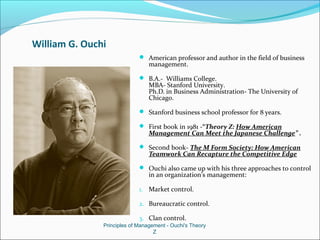
William G. Ouchi
 American professor and author in the field of business
management.
 B.A.- Williams College.
MBA- Stanford University.
Ph.D. in Business Administration- The University of
Chicago.
 Stanford business school professor for 8 years.
 First book in 1981 -“Theory Z: How American
Management Can Meet the Japanese Challenge” .
 Second book- The M Form Society: How American
Teamwork Can Recapture the Competitive Edge
 Ouchi also came up with his three approaches to control
in an organization's management:
1. Market control.
2. Bureaucratic control.
3. Clan control.
Principles of Management - Ouchi's Theory
Z
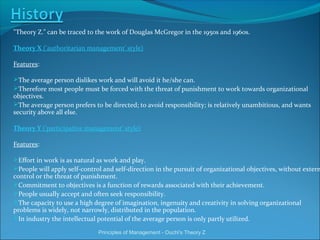
"Theory Z." can be traced to the work of Douglas McGregor in the 1950s and 1960s.
Theory X ('authoritarian management' style)
Features:
The average person dislikes work and will avoid it he/she can.
Therefore most people must be forced with the threat of punishment to work towards organizational
objectives.
The average person prefers to be directed; to avoid responsibility; is relatively unambitious, and wants
security above all else.
Theory Y ('participative management' style)
Features:
Effort in work is as natural as work and play.
People will apply self-control and self-direction in the pursuit of organizational objectives, without extern
control or the threat of punishment.
Commitment to objectives is a function of rewards associated with their achievement.
People usually accept and often seek responsibility.
The capacity to use a high degree of imagination, ingenuity and creativity in solving organizational
problems is widely, not narrowly, distributed in the population.
In industry the intellectual potential of the average person is only partly utilized.
Principles of Management - Ouchi's Theory Z
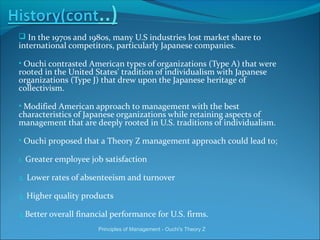
 In the 1970s and 1980s, many U.S industries lost market share to
international competitors, particularly Japanese companies.
• Ouchi contrasted American types of organizations (Type A) that were
rooted in the United States' tradition of individualism with Japanese
organizations (Type J) that drew upon the Japanese heritage of
collectivism.
• Modified American approach to management with the best
characteristics of Japanese organizations while retaining aspects of
management that are deeply rooted in U.S. traditions of individualism.
• Ouchi proposed that a Theory Z management approach could lead to;
1. Greater employee job satisfaction
2. Lower rates of absenteeism and turnover
3. Higher quality products
4.Better overall financial performance for U.S. firms.
Principles of Management - Ouchi's Theory Z
Differences between American and Japanese
Management Practices
American Organizations Japanese Organizations
Short-term employment Lifetime employment
Individual decision making Collective decision making
Individual responsibility Collective responsibility
Rapid evaluation & promotion Slow evaluation & promotion
Explicit control mechanisms Implicit control mechanisms
Specialized career paths Non-specialized career paths
Segmented concern for employee as an
employee
Holistic concern for employee as a person
Principles of Management - Ouchi's Theory Z
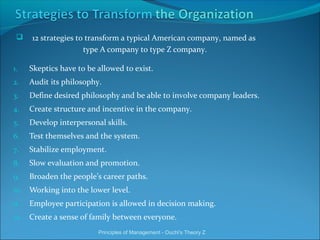
 12 strategies to transform a typical American company, named as
type A company to type Z company.
1. Skeptics have to be allowed to exist.
2. Audit its philosophy.
3. Define desired philosophy and be able to involve company leaders.
4. Create structure and incentive in the company.
5. Develop interpersonal skills.
6. Test themselves and the system.
7. Stabilize employment.
8. Slow evaluation and promotion.
9. Broaden the people’s career paths.
10. Working into the lower level.
11. Employee participation is allowed in decision making.
12. Create a sense of family between everyone.
Principles of Management - Ouchi's Theory Z
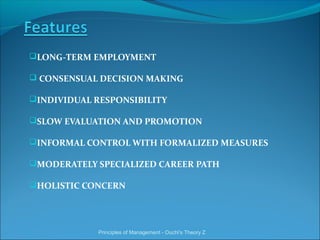
LONG-TERM EMPLOYMENT
 CONSENSUAL DECISION MAKING
INDIVIDUAL RESPONSIBILITY
SLOW EVALUATION AND PROMOTION
INFORMAL CONTROL WITH FORMALIZED MEASURES
MODERATELY SPECIALIZED CAREER PATH
HOLISTIC CONCERN
Principles of Management - Ouchi's Theory Z
LONG-TERM EMPLOYMENT
Type Z organizations generally make life-long commitments to
their employees and expect loyalty in return, but Type Z
organizations set the conditions to encourage this. This promotes
stability in the organization and job security among employees.
Principles of Management - Ouchi's Theory Z
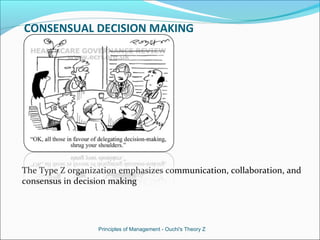
CONSENSUAL DECISION MAKING
The Type Z organization emphasizes communication, collaboration, and
consensus in decision making
Principles of Management - Ouchi's Theory Z
INDIVIDUAL RESPONSIBILITY
Type Z organizations retain the emphasis on individual
contributions that are characteristic of most American firms by
recognizing individual achievements, albeit within the context of
the wider group.
Principles of Management - Ouchi's Theory Z
SLOW EVALUATION AND PROMOTION
The Type Z organization, conversely, adopts the model of slow
evaluation and promotion.
Principles of Management - Ouchi's Theory Z
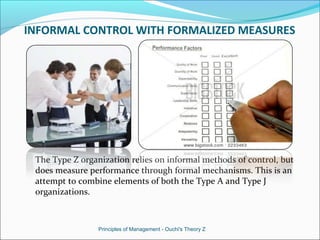
INFORMAL CONTROL WITH FORMALIZED MEASURES
The Type Z organization relies on informal methods of control, but
does measure performance through formal mechanisms. This is an
attempt to combine elements of both the Type A and Type J
organizations.
Principles of Management - Ouchi's Theory Z
MODERATELY SPECIALIZED CAREER
PATH
The Type Z organization adopts a middle-of-the-road posture, with
career paths that are less specialized than the traditional U.S. model but
more specialized than the traditional Japanese model.
Principles of Management - Ouchi's Theory Z
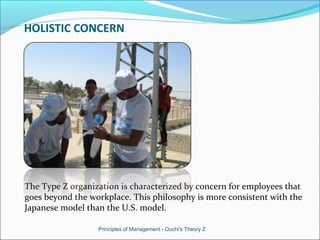
HOLISTIC CONCERN
The Type Z organization is characterized by concern for employees that
goes beyond the workplace. This philosophy is more consistent with the
Japanese model than the U.S. model.
Principles of Management - Ouchi's Theory Z
• IBM
• Procter and Gamble
• Hewlett Packard
• Eastman Kodak
• The US Military
Principles of Management - Ouchi's Theory Z
Mixed results
• +Ve
Employee satisfaction
Motivation
Commitment
Financial performance
• -Ve
do not outperform other organizations
Been misplaced
Considerable criticism.
Principles of Management - Ouchi's Theory Z
Reference:
Encyclopedia of Management
Wikipedia
Business Dictionary
Vector study
Knol
By Narayana Rao K.V.S.S
Principles of Management - Ouchi's Theory Z

Ouchis theory z

  • 1.
    Roy Thomas.Principles ofManagement - Ouchi's Theory Z
  • 2.
    Theory Z • TheoryZ has been called a sociological description of the humanistic organizations • “Theory Z is an approach to management based upon a combination of American and Japanese management philosophies”. Proponents of Theory Z suggest that it leads to improvements in organizational performance. • The following sections highlights; 1. The definition of Theory Z 2. The Maker – William G. Ouchi 3. The History of Theory Z 4. American Management V/s Japanese Management . 5. Transformation. 6. Features 7. An evaluation of Theory Z. Principles of Management - Ouchi's Theory Z
  • 3.
    1. The Japanesemanagement style popularized in the 1980s that assumes employees have an interest in good working relationships with management and other employees. Management generally has high confidence in employees, who are encouraged to participate in the management decision making. Employees are viewed as long-term assets who will stay with the same firm throughout their careers. 2. Japanese consensus management style based on the assumptions that (1) employees want to build cooperative relationships with their employers, peers, and other employees in the firms; for this they (2) require high degree of support in the form of secure employment and facilities for development of multiple skills through training and job rotation, (3) they value family life, culture and traditions, and social institutions as much as material success, (4) they have well-developed sense of dedication, moral obligations, and self-discipline, and (5) they can make collective decisions through consensus. Principles of Management - Ouchi's Theory Z
  • 4.
    William G. Ouchi American professor and author in the field of business management.  B.A.- Williams College. MBA- Stanford University. Ph.D. in Business Administration- The University of Chicago.  Stanford business school professor for 8 years.  First book in 1981 -“Theory Z: How American Management Can Meet the Japanese Challenge” .  Second book- The M Form Society: How American Teamwork Can Recapture the Competitive Edge  Ouchi also came up with his three approaches to control in an organization's management: 1. Market control. 2. Bureaucratic control. 3. Clan control. Principles of Management - Ouchi's Theory Z
  • 5.
    "Theory Z." canbe traced to the work of Douglas McGregor in the 1950s and 1960s. Theory X ('authoritarian management' style) Features: The average person dislikes work and will avoid it he/she can. Therefore most people must be forced with the threat of punishment to work towards organizational objectives. The average person prefers to be directed; to avoid responsibility; is relatively unambitious, and wants security above all else. Theory Y ('participative management' style) Features: Effort in work is as natural as work and play. People will apply self-control and self-direction in the pursuit of organizational objectives, without extern control or the threat of punishment. Commitment to objectives is a function of rewards associated with their achievement. People usually accept and often seek responsibility. The capacity to use a high degree of imagination, ingenuity and creativity in solving organizational problems is widely, not narrowly, distributed in the population. In industry the intellectual potential of the average person is only partly utilized. Principles of Management - Ouchi's Theory Z
  • 6.
     In the1970s and 1980s, many U.S industries lost market share to international competitors, particularly Japanese companies. • Ouchi contrasted American types of organizations (Type A) that were rooted in the United States' tradition of individualism with Japanese organizations (Type J) that drew upon the Japanese heritage of collectivism. • Modified American approach to management with the best characteristics of Japanese organizations while retaining aspects of management that are deeply rooted in U.S. traditions of individualism. • Ouchi proposed that a Theory Z management approach could lead to; 1. Greater employee job satisfaction 2. Lower rates of absenteeism and turnover 3. Higher quality products 4.Better overall financial performance for U.S. firms. Principles of Management - Ouchi's Theory Z
  • 7.
    Differences between Americanand Japanese Management Practices American Organizations Japanese Organizations Short-term employment Lifetime employment Individual decision making Collective decision making Individual responsibility Collective responsibility Rapid evaluation & promotion Slow evaluation & promotion Explicit control mechanisms Implicit control mechanisms Specialized career paths Non-specialized career paths Segmented concern for employee as an employee Holistic concern for employee as a person Principles of Management - Ouchi's Theory Z
  • 8.
     12 strategiesto transform a typical American company, named as type A company to type Z company. 1. Skeptics have to be allowed to exist. 2. Audit its philosophy. 3. Define desired philosophy and be able to involve company leaders. 4. Create structure and incentive in the company. 5. Develop interpersonal skills. 6. Test themselves and the system. 7. Stabilize employment. 8. Slow evaluation and promotion. 9. Broaden the people’s career paths. 10. Working into the lower level. 11. Employee participation is allowed in decision making. 12. Create a sense of family between everyone. Principles of Management - Ouchi's Theory Z
  • 9.
    LONG-TERM EMPLOYMENT  CONSENSUALDECISION MAKING INDIVIDUAL RESPONSIBILITY SLOW EVALUATION AND PROMOTION INFORMAL CONTROL WITH FORMALIZED MEASURES MODERATELY SPECIALIZED CAREER PATH HOLISTIC CONCERN Principles of Management - Ouchi's Theory Z
  • 10.
    LONG-TERM EMPLOYMENT Type Zorganizations generally make life-long commitments to their employees and expect loyalty in return, but Type Z organizations set the conditions to encourage this. This promotes stability in the organization and job security among employees. Principles of Management - Ouchi's Theory Z
  • 11.
    CONSENSUAL DECISION MAKING TheType Z organization emphasizes communication, collaboration, and consensus in decision making Principles of Management - Ouchi's Theory Z
  • 12.
    INDIVIDUAL RESPONSIBILITY Type Zorganizations retain the emphasis on individual contributions that are characteristic of most American firms by recognizing individual achievements, albeit within the context of the wider group. Principles of Management - Ouchi's Theory Z
  • 13.
    SLOW EVALUATION ANDPROMOTION The Type Z organization, conversely, adopts the model of slow evaluation and promotion. Principles of Management - Ouchi's Theory Z
  • 14.
    INFORMAL CONTROL WITHFORMALIZED MEASURES The Type Z organization relies on informal methods of control, but does measure performance through formal mechanisms. This is an attempt to combine elements of both the Type A and Type J organizations. Principles of Management - Ouchi's Theory Z
  • 15.
    MODERATELY SPECIALIZED CAREER PATH TheType Z organization adopts a middle-of-the-road posture, with career paths that are less specialized than the traditional U.S. model but more specialized than the traditional Japanese model. Principles of Management - Ouchi's Theory Z
  • 16.
    HOLISTIC CONCERN The TypeZ organization is characterized by concern for employees that goes beyond the workplace. This philosophy is more consistent with the Japanese model than the U.S. model. Principles of Management - Ouchi's Theory Z
  • 17.
    • IBM • Procterand Gamble • Hewlett Packard • Eastman Kodak • The US Military Principles of Management - Ouchi's Theory Z
  • 18.
    Mixed results • +Ve Employeesatisfaction Motivation Commitment Financial performance • -Ve do not outperform other organizations Been misplaced Considerable criticism. Principles of Management - Ouchi's Theory Z
  • 19.
    Reference: Encyclopedia of Management Wikipedia BusinessDictionary Vector study Knol By Narayana Rao K.V.S.S Principles of Management - Ouchi's Theory Z