
(A perspective explained by the 5 disciplines)
LEARNING ORGANIZATIONS
PETER SANGE
THE FIFTH
DISCIPLINE
Building the learning organization
THE CORE DISCIPLINES
GROUP MEMBERS
• Saad Iqbal Ch
• Salman Mazhar
• Shariq Ejaz
• Junaid Qaiser
• Zia Rao
CONTENTS
 Peter Senge
 Introduction : Learning Organizations
 The 5 Core Disciplines
 Examples
 Personal Remarks
 Conclusion
 Question/Answer session
PETER MICHAEL SENGE
• An American systems scientist (who is a senior lecturer at the MIT), is the founder of the
Society for Organizational Learning.
• He is known as the author of the book The Fifth Discipline: The Art and Practice of the
Learning Organization.
• B.S. in Aerospace engineering from Stanford University.
• Senge also studied philosophy.
• M.S. in social systems modeling from MIT.
• PhD in Management.
• He has had a regular meditation practice.
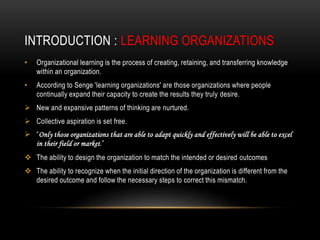
INTRODUCTION : LEARNING ORGANIZATIONS
• Organizational learning is the process of creating, retaining, and transferring knowledge
within an organization.
• According to Senge 'learning organizations' are those organizations where people
continually expand their capacity to create the results they truly desire.
 New and expansive patterns of thinking are nurtured.
 Collective aspiration is set free.
 “Only those organizations that are able to adapt quickly and effectively will be able to excel
in their field or market.”
 The ability to design the organization to match the intended or desired outcomes
 The ability to recognize when the initial direction of the organization is different from the
desired outcome and follow the necessary steps to correct this mismatch.
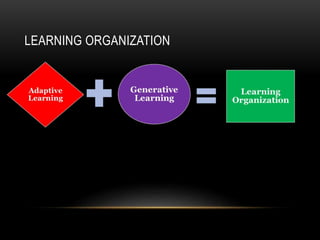
LEARNING ORGANIZATION
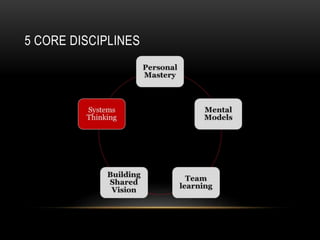
5 CORE DISCIPLINES
SYSTEMS THINKING
 Systems thinking has been referred to as the 'Cornerstone' of
the learning organization.
 Systems thinking focuses on how the individual that is being
studied interacts with the other constituents of the system.
 Rather than focusing on the individuals within an organization it
prefers to look at a larger number of interactions within the
organization and in between organizations as a whole.
SYSTEMS THINKING
• Systems Thinking integrates all other disciplines.
• It focuses on how a system works as a whole.
• To observe that whole system instead of observing a limited area or time.
• The biggest error is that we ignore the bigger picture; rather focus on the individual
actions.
• One has to be curious enough in understanding relations between companies and
interactions between different departments in an organization.
• In simple words, it’s a correlation between action and consequences.
MENTAL MODELS
• Questions :
• How do we think ?
• What is the result of perception ?
• What triggers thinking and reasoning ?
• Answer :
• The answer is simple we rely on MENTAL MODEL
MENTAL MODELS
• What are mental models ?
• “To identify the values of the companies and the perception of
basically what is the business about”
• A persons thought process of understanding the world .It allows
people to make assumption about how things work and
influence our behaviour and decision making.
MENTAL MODELS
• Beliefs, ideas, images, and verbal descriptions that we consciously or
unconsciously form from our experiences and which (when formed)
guide our thoughts and actions within narrow channels.
• These representations of perceived reality lead us to expect certain
results, give meaning to events, and forced us to behave in certain way.
• Everyone has different models (that differ in detail from everyone
else's) of the same concept or subject, no matter how common or
simple
PERSONAL MASTERY
• An individual should have a clear dedication to the truth.
• It means that he/she shouldn’t consider himself/herself less
from anybody. Nobody can stop anyone if he is determined and
motivated.
• Internal motivation is necessary to adopt this skill.
• The biggest enemy of a man is lack of belief in self-worth
because when we believe that we are powerless, then nobody
can help us (not even ourselves).
• So, train and utilize the powers of subconscious for achieving
personal mastery and dedication.
PERSONAL MASTERY (THE SPIRIT OF L-O)
The spirit of learning organizations
Mastery and proficiency
Why we want it?
Resistance.
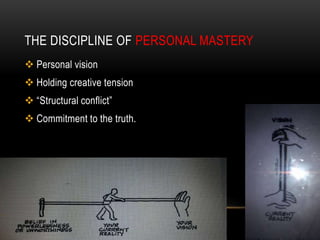
THE DISCIPLINE OF PERSONAL MASTERY
 Personal vision
 Holding creative tension
 “Structural conflict”
 Commitment to the truth.
PERSONAL MASTERY & THE FIFTH DISCIPLINE
• Integrating reason & intuition.
• Seeing our connectedness to the world.
• Compassion.
• Commitment to the whole.
• Fostering Personal Mastery in an organiziation.
SHARED VISION
Sharing.
Vision.
Shared Vision.
General concept of Shared vision.
Shared Vision in an organization.
SHARED VISION
• Shared Vision is a simple concept that an employee considers the vision of
the firm as his own personal vision.
• It’s a challenge of capturing real commitment among employees.
• The vision shouldn’t be restricted only to the top hierarchy but it should be
focusing at all levels.
• So that, the whole organization remains in the same direction having mutual
goals, values and missions.
SHARED VISION
• In simple words, there should be a specified vision of a firm and
that should be same for each employee working in that
particular firm.
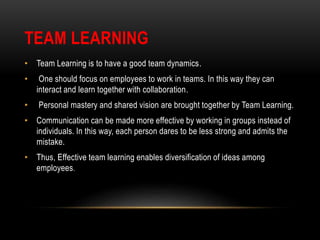
TEAM LEARNING
• Team Learning is to have a good team dynamics.
• One should focus on employees to work in teams. In this way they can
interact and learn together with collaboration.
• Personal mastery and shared vision are brought together by Team Learning.
• Communication can be made more effective by working in groups instead of
individuals. In this way, each person dares to be less strong and admits the
mistake.
• Thus, Effective team learning enables diversification of ideas among
employees.
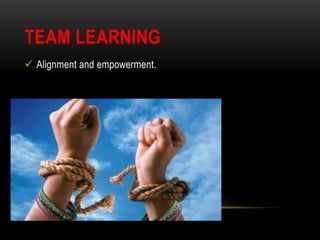
TEAM LEARNING
 Alignment and empowerment.
TEAM LEARNING
• The process of aligning and developing the capacity of a team to create the results its
members truly desire
• It builds on the capacity of shared vision
• It also builds on personal mastery
• Knowing how to play together
• Teams are the key learning unit in organizations
TEAM LEARNING
3 Critical Dimensions:
 First, there is a need to think insightfully about complex issues teams must
learn how to tap the potential for many minds to be more intelligent than one
mind.
 Second, there is a need for innovative, coordinated action.
 Third, there is the role of team members on other teams
A learning team fosters other learning teams through inculcating the practices and skills of
team learning
TEAM LEARNING
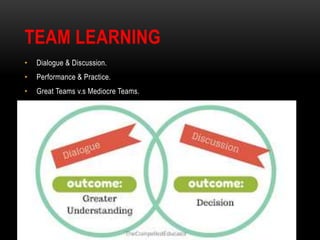
• Dialogue & Discussion.
• Performance & Practice.
• Great Teams v.s Mediocre Teams.
CONCLUSIVE
REMARKS

3 sj fifth-discipline

  • 1.
    (A perspective explainedby the 5 disciplines) LEARNING ORGANIZATIONS
  • 2.
  • 3.
    Building the learningorganization THE CORE DISCIPLINES
  • 4.
    GROUP MEMBERS • SaadIqbal Ch • Salman Mazhar • Shariq Ejaz • Junaid Qaiser • Zia Rao
  • 5.
    CONTENTS  Peter Senge Introduction : Learning Organizations  The 5 Core Disciplines  Examples  Personal Remarks  Conclusion  Question/Answer session
  • 6.
    PETER MICHAEL SENGE •An American systems scientist (who is a senior lecturer at the MIT), is the founder of the Society for Organizational Learning. • He is known as the author of the book The Fifth Discipline: The Art and Practice of the Learning Organization. • B.S. in Aerospace engineering from Stanford University. • Senge also studied philosophy. • M.S. in social systems modeling from MIT. • PhD in Management. • He has had a regular meditation practice.
  • 7.
    INTRODUCTION : LEARNINGORGANIZATIONS • Organizational learning is the process of creating, retaining, and transferring knowledge within an organization. • According to Senge 'learning organizations' are those organizations where people continually expand their capacity to create the results they truly desire.  New and expansive patterns of thinking are nurtured.  Collective aspiration is set free.  “Only those organizations that are able to adapt quickly and effectively will be able to excel in their field or market.”  The ability to design the organization to match the intended or desired outcomes  The ability to recognize when the initial direction of the organization is different from the desired outcome and follow the necessary steps to correct this mismatch.
  • 8.
  • 9.
  • 10.
    SYSTEMS THINKING  Systemsthinking has been referred to as the 'Cornerstone' of the learning organization.  Systems thinking focuses on how the individual that is being studied interacts with the other constituents of the system.  Rather than focusing on the individuals within an organization it prefers to look at a larger number of interactions within the organization and in between organizations as a whole.
  • 11.
    SYSTEMS THINKING • SystemsThinking integrates all other disciplines. • It focuses on how a system works as a whole. • To observe that whole system instead of observing a limited area or time. • The biggest error is that we ignore the bigger picture; rather focus on the individual actions. • One has to be curious enough in understanding relations between companies and interactions between different departments in an organization. • In simple words, it’s a correlation between action and consequences.
  • 12.
    MENTAL MODELS • Questions: • How do we think ? • What is the result of perception ? • What triggers thinking and reasoning ? • Answer : • The answer is simple we rely on MENTAL MODEL
  • 13.
    MENTAL MODELS • Whatare mental models ? • “To identify the values of the companies and the perception of basically what is the business about” • A persons thought process of understanding the world .It allows people to make assumption about how things work and influence our behaviour and decision making.
  • 14.
    MENTAL MODELS • Beliefs,ideas, images, and verbal descriptions that we consciously or unconsciously form from our experiences and which (when formed) guide our thoughts and actions within narrow channels. • These representations of perceived reality lead us to expect certain results, give meaning to events, and forced us to behave in certain way. • Everyone has different models (that differ in detail from everyone else's) of the same concept or subject, no matter how common or simple
  • 15.
    PERSONAL MASTERY • Anindividual should have a clear dedication to the truth. • It means that he/she shouldn’t consider himself/herself less from anybody. Nobody can stop anyone if he is determined and motivated. • Internal motivation is necessary to adopt this skill. • The biggest enemy of a man is lack of belief in self-worth because when we believe that we are powerless, then nobody can help us (not even ourselves). • So, train and utilize the powers of subconscious for achieving personal mastery and dedication.
  • 16.
    PERSONAL MASTERY (THESPIRIT OF L-O) The spirit of learning organizations Mastery and proficiency Why we want it? Resistance.
  • 17.
    THE DISCIPLINE OFPERSONAL MASTERY  Personal vision  Holding creative tension  “Structural conflict”  Commitment to the truth.
  • 18.
    PERSONAL MASTERY &THE FIFTH DISCIPLINE • Integrating reason & intuition. • Seeing our connectedness to the world. • Compassion. • Commitment to the whole. • Fostering Personal Mastery in an organiziation.
  • 19.
    SHARED VISION Sharing. Vision. Shared Vision. Generalconcept of Shared vision. Shared Vision in an organization.
  • 20.
    SHARED VISION • SharedVision is a simple concept that an employee considers the vision of the firm as his own personal vision. • It’s a challenge of capturing real commitment among employees. • The vision shouldn’t be restricted only to the top hierarchy but it should be focusing at all levels. • So that, the whole organization remains in the same direction having mutual goals, values and missions.
  • 21.
    SHARED VISION • Insimple words, there should be a specified vision of a firm and that should be same for each employee working in that particular firm.
  • 22.
    TEAM LEARNING • TeamLearning is to have a good team dynamics. • One should focus on employees to work in teams. In this way they can interact and learn together with collaboration. • Personal mastery and shared vision are brought together by Team Learning. • Communication can be made more effective by working in groups instead of individuals. In this way, each person dares to be less strong and admits the mistake. • Thus, Effective team learning enables diversification of ideas among employees.
  • 23.
  • 24.
    TEAM LEARNING • Theprocess of aligning and developing the capacity of a team to create the results its members truly desire • It builds on the capacity of shared vision • It also builds on personal mastery • Knowing how to play together • Teams are the key learning unit in organizations
  • 25.
    TEAM LEARNING 3 CriticalDimensions:  First, there is a need to think insightfully about complex issues teams must learn how to tap the potential for many minds to be more intelligent than one mind.  Second, there is a need for innovative, coordinated action.  Third, there is the role of team members on other teams A learning team fosters other learning teams through inculcating the practices and skills of team learning
  • 26.
    TEAM LEARNING • Dialogue& Discussion. • Performance & Practice. • Great Teams v.s Mediocre Teams.
  • 27.