aninda shome, july 2012
Scope
•   What is a Learning Organization (LO)?
•   Why bother with LOs?
•   “Old order changes yielding place to new”
•   Examples of Learning Organizations
•   What do they look like?
    – Organizational Structure
• What do they feel like?
    – Organizational culture
• Why are they needed?
What is a Learning Organization?


•   The concept of Learning
    Organizations (LOs) has existed for
    decades.

•   Drucker (1959) called such
    organizations knowledge based
    organizations.
What is a Learning Organization?


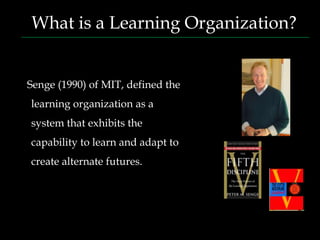
Senge (1990) of MIT, defined the
learning organization as a
system that exhibits the
capability to learn and adapt to
create alternate futures.
Characteristics of LOs
• There are five characteristics of LOs identified by Senge
  (1990):
   – System Thinking, which is the ability to think through problems, while
     considering the enterprise-wide impact.
   – Team Learning,
   – Shared Vision,
   – Mental Models,
   – Personal Mastery,
What is a Learning Organization?
Garvin, of the Harvard
Business School : "an
organization skilled at
creating, acquiring, and
transferring knowledge, and
at modifying its behavior to
reflect new knowledge and
insights” (1993, p 3).

       http://www.youtube.com/watch?v=lUP4WcfNyAA
Learning Organization…why bother?
Analysis
Findings: some indicators for
                                   our future
                             1000
                              900              873
                              800
Total Revenue of top 20


                              700
                              600
                                                                 1972
                              500
                              400                                1992
                                                           339
                              300                                2012
                              200   161
                              100
                                0
                                          Revenue ($ BN)
Findings: some indicators for
                                   our future
                                      16
                                                              14
                                      14
No. of new entrants into the Top 20


                                      12
                                      10
                                                    8              1972
                                       8
                                                                   1992
                                       6
                                                                   2012
                                       4
                                       2
                                       0
                                           New entrant/ drop out
“Old order must
change, yielding place to new”
“Old order must
change, yielding place to new”
“Old order must
change, yielding place to new”
New = ???
Has the time for Learning
 Organizations arrived?
Is it time for the LOs?


Traditional Hierarchical        Traditional Matrix


                           Modern
Why is this happening?
                 How things change (4:22)


      How American workforce is changing (3:40)


                  World in 2020 (5:20)


                  Future of our world (5:40)


http://www.youtube.com/watch?v=A1sPWiywJ5U&feature=related
So why not convert all
Traditional Organizations to
            LOs?
United Kingdom : NHS
USA
Common reasons for failure
•   Top management intervention
•   Existing power structures
•   Internal politics
•   Covert resistance to change
•   Existing “comfort” levels
•   Too much time needed
•   No immediate gains to be seen
                           (Sheaff & Pilgrim, 2006)
Failure rates in Change
management initiatives of large
 organization is close to 70%
        (Senge, 1999)
An exception, did they borrow
         from LOs ?
An exception, did they borrow
         from LOs ?
Question : if all of that is
true, why will investors wait ?
Question : where will you put
       your money?
The story so far…..
• Business world is extremely volatile
• Large companies are losing money and investors
• A different genre of companies are emerging
  and beginning to lead
• These types of companies have not been
  classified as yet
• Their business practices maybe close to those of
  Learning Organization
What do these companies look
            like?
What is the impact of these
            companies?
COMPANY     LISTING           MARKET CAP    INDUSTRY

Intel       1986 (26 years)   134 Billion   IT


GE          1962 (50 years)   222 Billion   Manufacturing/
                                            Services/Finance
Google      2004 (8 years)    210 Billion   Internet/
                                            Information
Amazon      1998 (14 years)   106 Billion   Internet/ Retail


Face book   2012 (< 1 year)   45 Billion    Internet/
                                            Socialization
Fundamental differences
        between these companies?
COMPANY

Intel
               Traditional
GE
                             Organization
Google                        Structure

                             Organization
Amazon                         Culture
                 New
               generation
Face book
Fundamental differences
            between these companies?
                              Organization
COMPANY
                               Structure

Intel


GE


Google


Amazon


Face book
Fundamental differences
            between these companies?
                                              Organization
COMPANY
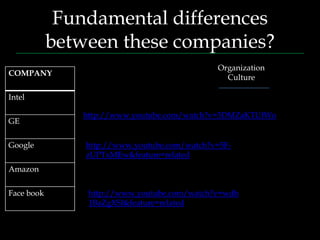
                                                Culture

Intel

               http://www.youtube.com/watch?v=3DMZaKTUfWo
GE


Google          http://www.youtube.com/watch?v=5F-
                zUPTxMEw&feature=related
Amazon


Face book       http://www.youtube.com/watch?v=wdh
                1BaZgXSI&feature=related
Thank you!

Learning organization

  • 1.
  • 2.
    Scope • What is a Learning Organization (LO)? • Why bother with LOs? • “Old order changes yielding place to new” • Examples of Learning Organizations • What do they look like? – Organizational Structure • What do they feel like? – Organizational culture • Why are they needed?
  • 3.
    What is aLearning Organization? • The concept of Learning Organizations (LOs) has existed for decades. • Drucker (1959) called such organizations knowledge based organizations.
  • 4.
    What is aLearning Organization? Senge (1990) of MIT, defined the learning organization as a system that exhibits the capability to learn and adapt to create alternate futures.
  • 5.
    Characteristics of LOs •There are five characteristics of LOs identified by Senge (1990): – System Thinking, which is the ability to think through problems, while considering the enterprise-wide impact. – Team Learning, – Shared Vision, – Mental Models, – Personal Mastery,
  • 6.
    What is aLearning Organization? Garvin, of the Harvard Business School : "an organization skilled at creating, acquiring, and transferring knowledge, and at modifying its behavior to reflect new knowledge and insights” (1993, p 3). http://www.youtube.com/watch?v=lUP4WcfNyAA
  • 7.
  • 8.
  • 9.
  • 10.
    Findings: some indicatorsfor our future 1000 900 873 800 Total Revenue of top 20 700 600 1972 500 400 1992 339 300 2012 200 161 100 0 Revenue ($ BN)
  • 11.
    Findings: some indicatorsfor our future 16 14 14 No. of new entrants into the Top 20 12 10 8 1972 8 1992 6 2012 4 2 0 New entrant/ drop out
  • 12.
    “Old order must change,yielding place to new”
  • 13.
    “Old order must change,yielding place to new”
  • 14.
    “Old order must change,yielding place to new”
  • 15.
    New = ??? Hasthe time for Learning Organizations arrived?
  • 16.
    Is it timefor the LOs? Traditional Hierarchical Traditional Matrix Modern
  • 21.
    Why is thishappening? How things change (4:22) How American workforce is changing (3:40) World in 2020 (5:20) Future of our world (5:40) http://www.youtube.com/watch?v=A1sPWiywJ5U&feature=related
  • 22.
    So why notconvert all Traditional Organizations to LOs?
  • 23.
  • 24.
  • 25.
    Common reasons forfailure • Top management intervention • Existing power structures • Internal politics • Covert resistance to change • Existing “comfort” levels • Too much time needed • No immediate gains to be seen (Sheaff & Pilgrim, 2006)
  • 26.
    Failure rates inChange management initiatives of large organization is close to 70% (Senge, 1999)
  • 27.
    An exception, didthey borrow from LOs ?
  • 28.
    An exception, didthey borrow from LOs ?
  • 29.
    Question : ifall of that is true, why will investors wait ?
  • 30.
    Question : wherewill you put your money?
  • 32.
    The story sofar….. • Business world is extremely volatile • Large companies are losing money and investors • A different genre of companies are emerging and beginning to lead • These types of companies have not been classified as yet • Their business practices maybe close to those of Learning Organization
  • 33.
    What do thesecompanies look like?
  • 34.
    What is theimpact of these companies? COMPANY LISTING MARKET CAP INDUSTRY Intel 1986 (26 years) 134 Billion IT GE 1962 (50 years) 222 Billion Manufacturing/ Services/Finance Google 2004 (8 years) 210 Billion Internet/ Information Amazon 1998 (14 years) 106 Billion Internet/ Retail Face book 2012 (< 1 year) 45 Billion Internet/ Socialization
  • 35.
    Fundamental differences between these companies? COMPANY Intel Traditional GE Organization Google Structure Organization Amazon Culture New generation Face book
  • 36.
    Fundamental differences between these companies? Organization COMPANY Structure Intel GE Google Amazon Face book
  • 37.
    Fundamental differences between these companies? Organization COMPANY Culture Intel http://www.youtube.com/watch?v=3DMZaKTUfWo GE Google http://www.youtube.com/watch?v=5F- zUPTxMEw&feature=related Amazon Face book http://www.youtube.com/watch?v=wdh 1BaZgXSI&feature=related
  • 38.