GROUP BEHAVIOUR
MEANING OF GROUP
• Two or more individuals
• Interacting and interdependent
• come together to achieve organizational goals
FLOW CHART OF TYPES OF GROUPS
TYPES OF GROUPS
FORMAL GROUP INFORMAL GROUP
COMMAND TASK COMMITTEE INTEREST CLIQUEFRIENDSHIP
Formal group : Defined by organisation structure Designated with work
assignments
 Command group: A command group is determined by the organisational chart. It is composed of
the subordinates who report directly to a given manager.
 Task group: Those working together to finish a job or task is known as task group.
 Committee Group: A group of people officially delegated to perform a function, such as
investigating, considering, reporting, or acting on a matter.
 Informal group :Created by mutual consent Not formally structured Not
organizationally determined.
 Friendship: members have one or more common characteristics
 Interest group: A group of individuals that share a common interest in a specific subject
or members.
 Cliques: Groups consist of colleagues or those who commonly associate with each other and
observe certain social norms and standards.
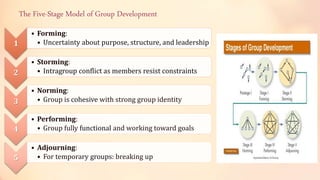
The Five-Stage Model of Group Development
1
• Forming:
• Uncertainty about purpose, structure, and leadership
2
• Storming:
• Intragroup conflict as members resist constraints
3
• Norming:
• Group is cohesive with strong group identity
4
• Performing:
• Group fully functional and working toward goals
5
• Adjourning:
• For temporary groups: breaking up
GROUP PROPERTY
ROLES : A set of expected behaviour
patterns attributed to someone
occupying a given position in a social
unit.
• Role identity – role’s associated
attitudes and behaviors
• Role perception – our view of
how we’re supposed to act in a
given situation
• Role expectations – how others
believe you should act in a given
situation
• Role conflict – conflict
experienced when multiple roles
are incompatible
NORMS :A set of rules for
human behaviour in the
organization. It is regard
information sharing as
usual, correct and
socially expected work
place behaviour
STATUS: The standing or
position of
an organization in a
system based on social
honor or esteem.
Size: If the goal is fact
finding – larger groups
more effective.Smaller
groups –doing something
productive with that
input.
MEANING OF GROUP BEHAVIOUR
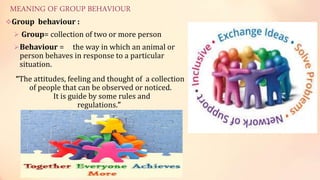
Group behaviour :
 Group= collection of two or more person
Behaviour = the way in which an animal or
person behaves in response to a particular
situation.
“The attitudes, feeling and thought of a collection
of people that can be observed or noticed.
It is guide by some rules and
regulations.”
Benefits of Group Behaviour
• It develops the spirit of cooperation and teamwork as members can learn how to
work together to achieve a goal.
• It develops good leadership and followership qualities in members.
• Group behaviour helps government in acknowledging peoples' feelings about its
policies and in turn, making the right decisions.
• Constructive group behaviours generate peace in the society.
• The healthy competition among members brings out their best qualities and makes
them more useful to the society.
Group behaviour

Group behaviour

  • 1.
  • 2.
    MEANING OF GROUP •Two or more individuals • Interacting and interdependent • come together to achieve organizational goals
  • 3.
    FLOW CHART OFTYPES OF GROUPS TYPES OF GROUPS FORMAL GROUP INFORMAL GROUP COMMAND TASK COMMITTEE INTEREST CLIQUEFRIENDSHIP
  • 4.
    Formal group :Defined by organisation structure Designated with work assignments  Command group: A command group is determined by the organisational chart. It is composed of the subordinates who report directly to a given manager.  Task group: Those working together to finish a job or task is known as task group.  Committee Group: A group of people officially delegated to perform a function, such as investigating, considering, reporting, or acting on a matter.  Informal group :Created by mutual consent Not formally structured Not organizationally determined.  Friendship: members have one or more common characteristics  Interest group: A group of individuals that share a common interest in a specific subject or members.  Cliques: Groups consist of colleagues or those who commonly associate with each other and observe certain social norms and standards.
  • 5.
    The Five-Stage Modelof Group Development 1 • Forming: • Uncertainty about purpose, structure, and leadership 2 • Storming: • Intragroup conflict as members resist constraints 3 • Norming: • Group is cohesive with strong group identity 4 • Performing: • Group fully functional and working toward goals 5 • Adjourning: • For temporary groups: breaking up
  • 6.
    GROUP PROPERTY ROLES :A set of expected behaviour patterns attributed to someone occupying a given position in a social unit. • Role identity – role’s associated attitudes and behaviors • Role perception – our view of how we’re supposed to act in a given situation • Role expectations – how others believe you should act in a given situation • Role conflict – conflict experienced when multiple roles are incompatible NORMS :A set of rules for human behaviour in the organization. It is regard information sharing as usual, correct and socially expected work place behaviour STATUS: The standing or position of an organization in a system based on social honor or esteem. Size: If the goal is fact finding – larger groups more effective.Smaller groups –doing something productive with that input.
  • 8.
    MEANING OF GROUPBEHAVIOUR Group behaviour :  Group= collection of two or more person Behaviour = the way in which an animal or person behaves in response to a particular situation. “The attitudes, feeling and thought of a collection of people that can be observed or noticed. It is guide by some rules and regulations.”
  • 9.
    Benefits of GroupBehaviour • It develops the spirit of cooperation and teamwork as members can learn how to work together to achieve a goal. • It develops good leadership and followership qualities in members. • Group behaviour helps government in acknowledging peoples' feelings about its policies and in turn, making the right decisions. • Constructive group behaviours generate peace in the society. • The healthy competition among members brings out their best qualities and makes them more useful to the society.