ORGANIZATIONAL
STRATEGY
SelmanAy – 21260599
Presentation Agenda
■ Introduction
■ Definition of PESTLEAnalysis
■ Detailing each letter of PESTLE
■ Aim of the analysis
■ Coca Cola – PESTLEAnalysis
■ PESTLEWeb
■ Conclusion
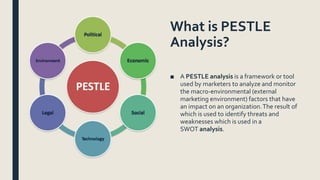
What is PESTLE
Analysis?
■ A PESTLE analysis is a framework or tool
used by marketers to analyze and monitor
the macro-environmental (external
marketing environment) factors that have
an impact on an organization.The result of
which is used to identify threats and
weaknesses which is used in a
SWOT analysis.
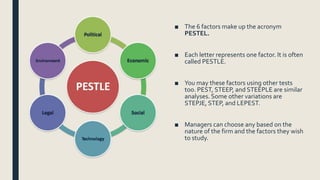
■ The 6 factors make up the acronym
PESTEL.
■ Each letter represents one factor. It is often
called PESTLE.
■ You may these factors using other tests
too. PEST, STEEP, and STEEPLE are similar
analyses. Some other variations are
STEPJE, STEP, and LEPEST.
■ Managers can choose any based on the
nature of the firm and the factors they wish
to study.
Political Factors
■ The political factors account for all the political
activities that go on within a country and if any
external force might tip the scales in a certain
way.
 Trading policies
 Government changes
 Funding
 Foreign pressures
 Conflicts in the political area
 Shareholder and their demands
Economic Factors
■ The economic factors take into view the
economic condition prevalent in the country and
if the global economic scenarios might make it
shift or not.
 Disposable income
 Unemployment level
 Foreign Exchange rates
 Interest rates
 Trade tariffs
 Inflation rate
Social Factors
■ Social factors are your consumers.You need to look
at buying habits, emotional needs, and consumer
behaviour in this section. Because these are the
people who directly influence your sales.
 Ethnic/religious factors
 Major world events
 Demographics
 Consumer opinions and attitudes
 Trends
 Education
 Brand preferences
Technological Factors
■ Technology can be directly involved with company
products, like manufacturing technologies.
 Technological development
 Research and development
 AssociatedTechnologies
 Patents
 Licensing
 Information technology
 Communication
Legal Factors
■ Legal factors have to do with all the legislative and
procedural components in an economy. Also, this
takes into account certain standards that your
business might have to meet in order to start
production/promotion.
 Employment law
 Consumer protection
 Industry-spesific regulations
 Competitive regulations
 Future legislation
 Environmental regulations
Environmental Factors
■ Environmental factors have to do with geographical
locations and other related environmental factors
that may influence upon the nature of the trade
you’re in. For example, agri-businesses hugely
depend on this form of analysis.
 Ecological
 Environmental issues
 Staff attitudes
 Management style
 Environmental regulations
 Consumer values
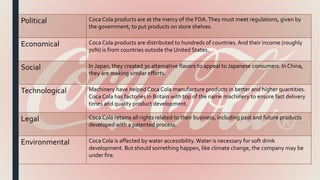
Political Coca Cola products are at the mercy of the FDA.They must meet regulations, given by
the government, to put products on store shelves.
Economical Coca Cola products are distributed to hundreds of countries. And their income (roughly
70%) is from countries outside the United States.
Social In Japan, they created 30 alternative flavors to appeal to Japanese consumers. In China,
they are making similar efforts.
Technological Machinery have helped Coca Cola manufacture products in better and higher quantities.
Coca Cola has factories in Britain with top of the name machinery to ensure fast delivery
times and quality product development.
Legal Coca Cola retains all rights related to their business, including past and future products
developed with a patented process.
Environmental Coca Cola is affected by water accessibility.Water is necessary for soft drink
development. But should something happen, like climate change, the company may be
under fire.
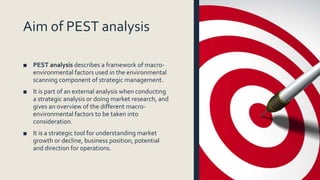
Aim of PEST analysis
■ PEST analysis describes a framework of macro-
environmental factors used in the environmental
scanning component of strategic management.
■ It is part of an external analysis when conducting
a strategic analysis or doing market research, and
gives an overview of the different macro-
environmental factors to be taken into
consideration.
■ It is a strategic tool for understanding market
growth or decline, business position, potential
and direction for operations.
PESTLEWeb
■ The PEST factors, combined with external micro-
environmental factors and internal drivers, can be
classified as opportunities and threats in a SWOT
analysis.
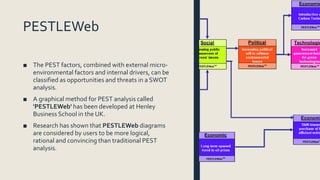
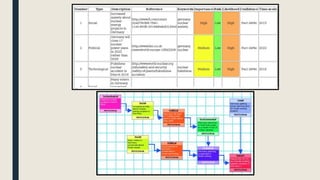
■ A graphical method for PEST analysis called
'PESTLEWeb' has been developed at Henley
Business School in the UK.
■ Research has shown that PESTLEWeb diagrams
are considered by users to be more logical,
rational and convincing than traditional PEST
analysis.
PESTLEWeb
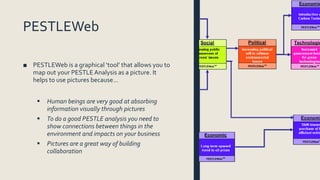
■ PESTLEWeb is a graphical ‘tool’ that allows you to
map out your PESTLEAnalysis as a picture. It
helps to use pictures because…
 Human beings are very good at absorbing
information visually through pictures
 To do a good PESTLE analysis you need to
show connections between things in the
environment and impacts on your business
 Pictures are a great way of building
collaboration
Conclusion
■ In conclusion, PESTLE analysis is an invaluable
business tool that analyzes six different groups of
external factors, all of which can affect businesses.
■ From political ones to environmental ones, each of
these categories presents a wide range of variables
which can impact a business.
■ However, PEST analysis (and its derivatives) is not
an exhaustive technique that considers every type of
factor, especially as some just can’t be categorized
— so don’t be too concerned if you don’t get an even
spread of different factors in your analyses!
Muito Obrigado
■ Selman Ay - 21260599

Pestle analysis

  • 1.
  • 2.
    Presentation Agenda ■ Introduction ■Definition of PESTLEAnalysis ■ Detailing each letter of PESTLE ■ Aim of the analysis ■ Coca Cola – PESTLEAnalysis ■ PESTLEWeb ■ Conclusion
  • 3.
    What is PESTLE Analysis? ■A PESTLE analysis is a framework or tool used by marketers to analyze and monitor the macro-environmental (external marketing environment) factors that have an impact on an organization.The result of which is used to identify threats and weaknesses which is used in a SWOT analysis.
  • 4.
    ■ The 6factors make up the acronym PESTEL. ■ Each letter represents one factor. It is often called PESTLE. ■ You may these factors using other tests too. PEST, STEEP, and STEEPLE are similar analyses. Some other variations are STEPJE, STEP, and LEPEST. ■ Managers can choose any based on the nature of the firm and the factors they wish to study.
  • 5.
    Political Factors ■ Thepolitical factors account for all the political activities that go on within a country and if any external force might tip the scales in a certain way.  Trading policies  Government changes  Funding  Foreign pressures  Conflicts in the political area  Shareholder and their demands
  • 6.
    Economic Factors ■ Theeconomic factors take into view the economic condition prevalent in the country and if the global economic scenarios might make it shift or not.  Disposable income  Unemployment level  Foreign Exchange rates  Interest rates  Trade tariffs  Inflation rate
  • 7.
    Social Factors ■ Socialfactors are your consumers.You need to look at buying habits, emotional needs, and consumer behaviour in this section. Because these are the people who directly influence your sales.  Ethnic/religious factors  Major world events  Demographics  Consumer opinions and attitudes  Trends  Education  Brand preferences
  • 8.
    Technological Factors ■ Technologycan be directly involved with company products, like manufacturing technologies.  Technological development  Research and development  AssociatedTechnologies  Patents  Licensing  Information technology  Communication
  • 9.
    Legal Factors ■ Legalfactors have to do with all the legislative and procedural components in an economy. Also, this takes into account certain standards that your business might have to meet in order to start production/promotion.  Employment law  Consumer protection  Industry-spesific regulations  Competitive regulations  Future legislation  Environmental regulations
  • 10.
    Environmental Factors ■ Environmentalfactors have to do with geographical locations and other related environmental factors that may influence upon the nature of the trade you’re in. For example, agri-businesses hugely depend on this form of analysis.  Ecological  Environmental issues  Staff attitudes  Management style  Environmental regulations  Consumer values
  • 11.
    Political Coca Colaproducts are at the mercy of the FDA.They must meet regulations, given by the government, to put products on store shelves. Economical Coca Cola products are distributed to hundreds of countries. And their income (roughly 70%) is from countries outside the United States. Social In Japan, they created 30 alternative flavors to appeal to Japanese consumers. In China, they are making similar efforts. Technological Machinery have helped Coca Cola manufacture products in better and higher quantities. Coca Cola has factories in Britain with top of the name machinery to ensure fast delivery times and quality product development. Legal Coca Cola retains all rights related to their business, including past and future products developed with a patented process. Environmental Coca Cola is affected by water accessibility.Water is necessary for soft drink development. But should something happen, like climate change, the company may be under fire.
  • 12.
    Aim of PESTanalysis ■ PEST analysis describes a framework of macro- environmental factors used in the environmental scanning component of strategic management. ■ It is part of an external analysis when conducting a strategic analysis or doing market research, and gives an overview of the different macro- environmental factors to be taken into consideration. ■ It is a strategic tool for understanding market growth or decline, business position, potential and direction for operations.
  • 13.
    PESTLEWeb ■ The PESTfactors, combined with external micro- environmental factors and internal drivers, can be classified as opportunities and threats in a SWOT analysis. ■ A graphical method for PEST analysis called 'PESTLEWeb' has been developed at Henley Business School in the UK. ■ Research has shown that PESTLEWeb diagrams are considered by users to be more logical, rational and convincing than traditional PEST analysis.
  • 14.
    PESTLEWeb ■ PESTLEWeb isa graphical ‘tool’ that allows you to map out your PESTLEAnalysis as a picture. It helps to use pictures because…  Human beings are very good at absorbing information visually through pictures  To do a good PESTLE analysis you need to show connections between things in the environment and impacts on your business  Pictures are a great way of building collaboration
  • 16.
    Conclusion ■ In conclusion,PESTLE analysis is an invaluable business tool that analyzes six different groups of external factors, all of which can affect businesses. ■ From political ones to environmental ones, each of these categories presents a wide range of variables which can impact a business. ■ However, PEST analysis (and its derivatives) is not an exhaustive technique that considers every type of factor, especially as some just can’t be categorized — so don’t be too concerned if you don’t get an even spread of different factors in your analyses!
  • 17.

Editor's Notes

  • #4 *The different macro-environmental factors can affect business strategies. So, it is vital to follow the PESTEL framework. The aim is to assess how exactly the factors influence business performance.
  • #5 *You can judge 6 types of environmental influences in the PESTEL framework. They are political, economic, social, technological, environmental and legal. You should not see these factors as independent factors. They are all interdependent. For example, technological advances can affect the economy in different markets. *I have researched some characteristics of these environmental factors so this article will help you find which factors are more important to company’s strategy. Companies will have to dig deeper into the details to take accurate decisions. *It may be so, that the importance of each of the factors may be different to different kinds of industries, but it is imperative to any strategy a company wants to develop that they conduct the PESTLE analysis as it forms a much more comprehensive version of the SWOT analysis. It is very critical for one to understand the complete depth of each of the letters of the PESTLE. It is as below:
  • #6 *The bad politicial relations between US and the other World have bad outcomes for the company.
  • #7 *Additionally, percentages can affect business. The employment or unemployment percentage in a location affects buying patterns. If people are unemployed, they’re buying what they need to survive. Expensive brands may be on their mind but not in their homes. This affects the profits of said brands. *Economic factors directly affect the cashflow of business, so it’s best to really dive into this part when doing your PEST analysis.
  • #8 Their social class, economic background, saving habits, and methods of communication are all factors to include and examine.
  • #9 These factors pertain to innovations in technology that may affect the operations of the industry and the market favorably or unfavorably. 
  • #10 *These factors have both external and internal sides. There are certain laws that affect the business environment in a certain country while there are certain policies that companies maintain for themselves. Legal analysis takes into account both of these angles and then charts out the strategies in light of these legislations. For example, consumer laws, safety standards, labor laws etc.
  • #11 * These factors include all those that influence or are determined by the surrounding environment. This aspect of the PESTLE is crucial for certain industries particularly for example tourism, farming, agriculture etc. Factors of a business environmental analysis include but are not limited to climate, weather, geographical location, global changes in climate, environmental offsets etc.
  • #15  *your team are more likely to look at, and comment on a poster on the wall than study a long report
  • #16  *your team are more likely to look at, and comment on a poster on the wall than study a long report